BIS Certification
 CDSCO
CDSCO
 PESO
PESO
 CPCB
CPCB
 LMPC
LMPC
 WPC Approval
 Global Approvals
 TEC
TEC
 ARAI
ARAI
 BEE
BEE
 ISO Certification
 DGCA Certification
 NOC For Steel
 APEDA Registration























 Business Registration
 FSSAI Mark Certification












 (32).jpg)
 Legal Services
 Trademark Registration
 Copyright Registration
 Patent Registration
 By
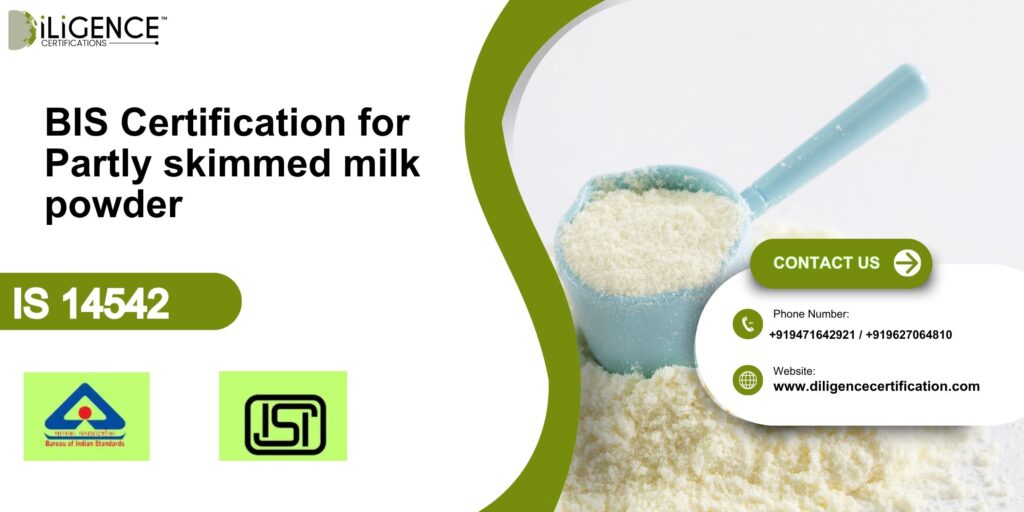
By - BIS Certification for Partly Skimmed Milk Powder under IS 14542 ensures safety and expected quality.
- Consider fat, protein content, moisture and microbiological content.
- The process of obtaining BIS certification involves an application, laboratory testing, and factory inspections.
- The benefits are brand trust, compliance, and increased access to markets.
- Examples of brands with BIS certification include Amul and Mother Dairy.
Introduction
When a mid-sized dairy manufacturer in Gujarat wanted to enter sales of its partly skimmed milk powder into other states, they were surprised to learn they needed to be compliant for regulatory purposes. The manufacturer had a first-rate product; retailers and distributors, however, would not stock it without the BIS Certification for Partly Skimmed Milk Powder under IS 14542 in place.
In India, BIS Certification is not just a legal lets the consumer know that the dairy business is a quality dairy business; it is a mechanism for the manufacturer to sell confidently into a new geography or to grow nationally. Depending on the dairy business and approval, understanding the BIS certification could be the key differentiating factor between local market sales, or selling into the national market.
What is BIS Certification for Partly skimmed milk powder
BIS Certification for Partly skimmed milk powder as per IS 14542 is an actual mark of quality granted by the Bureau of Indian Standards (BIS). It verifies that the product meets applicable standards for safety, hygiene, and nutrition for partly skimmed milk powder, which contains 26-36% fat (reduced fat based on original fat content) from milk.
Key aspects of this certification include:
- Safety: it verifies that the food was free from contaminants, adulterants and harmful bacteria.
- Nutrition: it verifies that the protein, fat and moisture levels for the product were stated in accordance with laboratory testing and IS 14542 standards.
- Labeling claims: it verifies that the product labeling made visible and accurate nutrition information and fat percent to the consumer.
- Market access: will allow for the product to be made available for sale throughout India, and for increased customer confidence with that product.
What is IS 14542 ?

IS 14542 is the Indian Standard for Partly Skimmed Milk Powder that the Bureau of Indian Standards (BIS) has set. It is a detailed standard, describing the product features and the product quality, along with the safety-related aspects that the manufacturers have to comply with in order to make sure that their products are safe, healthy, and fit for consumption. ISI MARK
Key specifications under IS 14542 include:
- Fat Content: The fat content of powder milk that is made from partly skimmed milk should be 26-36%.
- Protein Content: To provide nutrition, the protein content that is the most important should not be less than 34%.
- Moisture Content: The moisture content should be ≤5% in order to prevent the production and survival of microorganisms
- Microbiological Quality: To support good hygiene, the Indian Standard specifies very low limits for the total plate count, coliforms, yeasts, and molds, thus hygienic condition of the product is ensured.
- Packaging & Labeling: Packaging should be made by a method that will keep the product free from contamination and labels should show the correct fat, protein, and expiry details.
Who need BIS Certification for Partly skimmed milk powder
In case any entity is manufacturing, selling, or distributing partly skimmed milk powder in India, it must have a BIS Certification under IS 14542. The following are some of the major examples that cover such a case:
- Dairy Manufacturers: A company that produces partly skimmed milk powder for the distribution of the local area or the whole country.
- Small and Medium Enterprises (SMEs): Local dairy businesses that want to extend their activities to other states or the e-commerce platforms.
- Exporters: The manufacturers who aim at the foreign markets that accept BIS standards as a criterion for food safety and quality.
- Private Label Brands: The companies that sell the packaged milk powder under their brand name through the retail or online channels.
Key features of BIS Certification
- Quality Assurance: The norm states that milk powder should have well-defined nutritional standards for fat, protein, and moisture content.
- Safety Compliance: The standard product safety is ensured that the products are free from any kind other than harmful bacteria, contaminants, and adulterants and thus conforming to microbiological limits.
- Labeling Accuracy: Provide correct nutritional information, fat content, and expiration date as the label of the package that is displayed.
- Market Authorization: It is the legal right to sell partly skimmed milk powder all over India which facilitates trading and distributing at the wholesale and retail level within the state.
- Brand Credibility: The manufacturers are allowed to acquire the loyalty of consumers, thus, by competing effectively with the already established brands in the market.
- Continuous Surveillance: BIS carries out periodic inspections and laboratory tests to check the requirements compliance at all times.

Step by Step process of BIS Certification for Partly skimmed milk powder
Step1: Documentation
- Collect all the necessary documents such as company registration, factory license, and FSSAI license.
- Also, produce the technical details- layout of the plant, process flow diagram, list of machines & QC equipment.
- Prepare a sufficient quality control manual, SOPs, and product specifications conforming to the Indian Standard.
- Confirm that labeling and packaging are not only conceptualized but are also complying with BIS & FSSAI standards.
Step2: Product Testing
- Choose a laboratory that is either BIS recognized or NABL accredited for conducting product testing.
- The product sample is sent to the laboratory for analysis in accordance with the relevant IS (for instance, IS 14542).
- Get a complete and legitimate test report in a company name.
- Make sure that the parameters in the report correspond to the limits set out in the Indian Standard.
Step3: Application Submission
- Register and log in to the BIS Manakonline Portal.
- Enter the information regarding product and factory in an online application.
- Upload the documents and product test report.
- Make the application and inspection fee payment via online mode.
Step4: Scrutiny and Inspection
- BIS officers carry out the verification of all the documents and test reports submitted by the applicant.
- A BIS officer visits the site for inspection of production and quality control systems at the factory.
- BIS staff may take samples from the inspected unit for testing in an independent laboratory.
- If the issues or non-conformities are found, the company is required to take the necessary steps to resolve them.
Step5: Grant of License
- After the inspection and testing, which confirm that the applicant meets the requirements, BIS decides whether or not to grant the license.
- BIS issues the ISI Mark license for the product and the plant after the inspection and testing confirm that all conditions are met.
- The license entitles the manufacturer to use the BIS Standard Mark.
- The license is valid for a certain time (typically 2 years) and the renewal is done before the expiration date.
Importance of BIS Certification
BIS Certification under IS 14542 is quite a significant move for the development of the dairy industry. Dairy manufacturers, in particular, the:
Product Safety is one of the major points that the product goes through various tests and is proven safe and thus free of all kinds of contamination by foreign materials, adulterants, and harmful microbes.
- Supply of Food Quality Standards: Helps in maintaining records of different nutritional parameters, for example, fat, protein, and moisture content.
- Conformity with the Law: Is the foremost requirement for the sale of milk powders in different states and complies with Indian food safety regulations as well.
- Consumer Loyalty: The presence of the ISI mark on the products is the most reliable source of trust and confidence for the buyers, especially in regard to product authenticity and safety.
- Market Growth: It is a necessary condition for the retail chains, distributors, and e-commerce platforms that are looking to source the products.
Benefits of BIS Certification
After achieving BIS certification, the manufacturers, will have real advantages:
- Elevated Credibility: To trust the brand and its services the certificate image is used by the brand and consumers.
- Competitive Advantage: Certified products are more appealing to the consumers and thus they would likely go for the products that have the certification marks and not the others in the competition.
- Uninterrupted Adherence to the Law: They conform to the standards through regular BIS inspections and thus are always compliant.
- Business Development: Products can be promoted and sold in different regions of the country and an opportunity to gain access to the regulated markets is created.
- Risk Minimization: The presence of certification records is one step towards product recall reduction, legal issues and quality disputes alleviation.
Timelines, Costs, Validity & Renewal
| Aspect | Details |
| Timelines | 2-3 months from application to license grant. |
| Costs | Application fee, lab testing, and annual license fee (varies by product). |
| Validity | Usually 2 years from issuance. |
| Renewal | Apply before expiry; updated documents and compliance checks required. |
Why choose Diligence Certification
Diligence Certification is the perfect choice for getting a BIS Certification if you are looking for a compliance process that is simple, reliable, and efficient. Some of the major benefits are:
- Expert Guidance: Personal support from the very beginning until the end of the process of documentation, lab testing, and application submission.
- Compliance Assurance: Makes sure that your products meet all the requirements of IS 14542 standards in terms of quality, safety, and labeling.
- Time-Saving: Avoids situations of process inspections, coordination with BIS, and follow-ups through taking these works to the office staff from whom these tasks will be done.
- Trusted Partner: Helps you to get trust from BIS and continue complying with the standards without breaks.
- Market Readiness: Provides you with the chance to enter the market at a quicker pace with the correct certification, thus giving you the freedom to stay ahead of your competitors.
Conclusion
Obtaining a BIS certification for partially skimmed milk powder according to IS 14542 is the first step to ensuring product safety, quality, and market acceptability. Moreover, it is a necessity that leads to the development of consumer trust and hence, manufacturers are allowed to increase their scope not only in India but also globally. Dairy businesses can efficiently achieve compliance through the correct stages-documentation, lab testing, application, and factory inspection.
It is less bumpy, you are more confident that all requirements are fulfilled, and there is an assurance of continuous compliance, thus resulting in a reliable and market-ready product, if you have a trusted certification partner like Diligence Certification along your way.
Frequently Ask Questions
What is BIS certification for a partly skimmed milk powder?
A partly skimmed milk powder with a BIS certification is one that conforms to the standards set by the Bureau of Indian Standards (IS 14542) and is safe, hygienic, and nutritious.
Who needs to have BIS certification?
B.I.S. certification demands areas' analysis has revealed that manufacturers, distributors, and sellers of partially skimmed milk powders in India, small and medium enterprises, private labels, and exporters are those who require B.I.S. certification the most.
What does the IS 14542 standard refer to?
The standard limits the fat content of the milk powder to 26-36%, the protein content to ≥34%, and the moisture to ≤5%. Besides that, it sets requirements for the microbial quality of the product, packaging, and product naming and labeling.
What are the steps to obtain BIS Certification?
You can submit your application along with the necessary papers and product test report through their online portal.
Is product testing mandatory?
Product testing is a must. The lab carrying out the test should either be a BIS-recognized or a NABL-accredited lab. The lab verifies that the product is as per the requirements of IS 14542.
How long does it take to get a certification?
The certification period is usually between 2 and 3 months and depends on factors such as document availability, laboratory testing, and factory inspection schedules.
How long does a BIS license stay valid?
The license is generally good for 2 years and after this period, it can be renewed.
What are the costs involved?
Getting through this process requires an application fee, a charge for laboratory testing, and an annual license fee. The precise amounts are determined by the size of the factory and the number of products.
What are the advantages of having a BIS Certification?
First of all, it serves as one more step of safety and quality assurance for the final user, then consumer trust in the brand gets higher, the product is allowed to be sold anywhere within the country, thus, the brand's goodwill gets consolidated.
How can Diligence Certification help?
Diligence Certification services an expert who can assist you with document preparation, guide you through the inspection, and assure that everything is in compliance with BIS rules without any difficulties.