BIS Certification
 CDSCO
CDSCO
 PESO
PESO
 CPCB
CPCB
 LMPC
LMPC
 WPC Approval
 Global Approvals
 TEC
TEC
 ARAI
ARAI
 BEE
BEE
 ISO Certification
 DGCA Certification
 NOC For Steel
 APEDA Registration























 Business Registration
 FSSAI Mark Certification












 (32).jpg)
 Legal Services
 Trademark Registration
 Copyright Registration
 Patent Registration
 By
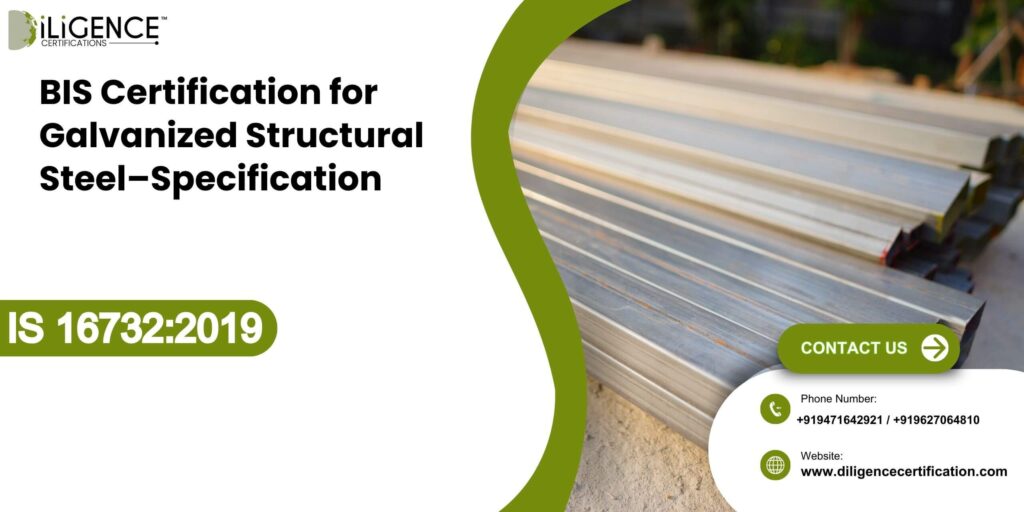
By - BIS Certification according to IS 16732:2019 is a way to assure that the galvanized structural steel coating of the product is of good quality and is consistent.
- The standard specifies the thickness of the coating, its uniformity, the sticking test, and the control of the process.
- After that, manufacturers undergo sample testing, factory inspection and documentation review to get the ISI mark.
- It is necessary to obtain this certification to be able to supply galvanized steel for large scale infrastructure and government projects.
- Proper process discipline, traceability, and QC records are essential for passing BIS surveillance audits.
Introduction
A few months ago, a fabricator supplying galvanized channels to a metro rail contractor called us in a panic. His consignments were being held up because the project consultant insisted on proof of BIS Certification under IS 16732:2019. His coating thickness was consistent, and the plant had been running for more than a decade, yet the absence of formal certification stopped a crore-level order from moving forward. Situations like this have become increasingly common. Buyers no longer view galvanizing as a simple post-processing activity; they expect documented compliance, traceability, and uniformity that only a BIS-certified process can guarantee. That shift is exactly why IS 16732:2019 has become central to India’s structural steel market. Bureau of Indian Standards
What is IS 16732:2019?
The standard lays out the production and testing methods for galvanized steel to ensure that the steel stays durable against corrosion, performs well mechanically and the coating is of consistent thickness. It is used by manufacturers as a standard of quality when they supply products for the infrastructure, industrial and government projects.
Key Points

- Sets minimum coating thickness and coating mass levels for structural steel parts.
- Specifies mandatory tests, including adherence, uniformity, and zinc coating evaluation.
- Covers quality of base steel, surface preparation and galvanizing bath chemistry.
- Includes strict sampling and inspection rules for BIS certification. ISI MARK
- Requires proper product marking and traceability to maintain compliance.
Why is BIS Certification Mandatory
It is necessary for galvanized structural steel to have a BIS Certification since the Government has decided that IS 16732:2019 will be under compulsory quality control. It is a measure that assures safety-tested and traceable products that are compliant with the standard are the only ones that are allowed to enter the Indian infrastructure supply chain. In the absence of certification, manufacturers are not allowed to put a mark or sell galvanized structural steel as per IS specifications in a legal manner, and their materials are turned down in the majority of public and private tenders.
Key Points
- It is the main point that the quality of the standard thickness of the zinc coating and the level of corrosion resistance, which are very important for structures that have to be used for a long time, are ensured.
- Helps to keep the public safe, who use bridges, metros, towers, solar plants, and industrial structures.
- Creates accountability through factory audits, market sampling and traceability.
- Prevents low-grade galvanizing practices that lead to premature failures.
- Aligns manufacturers with national quality control orders (QCOs) issued by the Ministry of Steel and the Bureau of Indian Standards.
Importance and Benefits of BIS Certification
| Importance | Benefits |
| Ensures compliance with IS 16732:2019 | Improves acceptance in government and EPC projects |
| Guarantees coating uniformity and corrosion resistance | Reduces risk of structural failures and rework |
| Protects public safety in critical infrastructure | Enhances brand reputation and credibility |
| Enables traceability and quality control | Increases customer confidence and repeat orders |
| Enforces regulated manufacturing standards | Provides eligibility for ISI marking and wider market access |
Step-by-Step Process of BIS Certification

Step1:Documentation
- Collect required technical documents
- Prepare product specifications
- Gather company registration details
- Ensure documents follow BIS format
Step2:Product Testing
- Send samples to a BIS-approved lab
- Conduct safety and quality tests
- Receive test reports
- Confirm compliance with BIS standards
Step3:Application Submission
- Fill out the BIS application form
- Upload all required documents
- Attach valid test reports
- Pay the necessary BIS fees
Step4:Scrutiny and Inspection
- BIS reviews submitted documents
- Authority verifies test results
- Factory/product inspection may occur
- Clarifications requested if needed
Step5:Grant of License
- BIS approves the application
- License number is issued
- Product can carry BIS mark
- Renewal required before expiry
Documents Required for BIS Certification
| Category | Documents Required |
| Business Documents | Business license/registration, ISO certificate, organizational details |
| Manufacturer Details | Factory layout, process flow chart, machinery list, production details |
| Product Documents | Product specifications, component list, user manual, model details |
| Testing Documents | Test report from BIS-recognized lab, sample details, test request form |
| Legal & Compliance | Authorization letter, brand ownership proof, trademark certificate (if any) |
| Import/Foreign Manufacturer (If applicable) | AIR (Authorized Indian Representative) details, contract agreement, overseas manufacturer documents |
Timelines, Costs, Validity & Renewal
- Timelines: Usually from 20 to 30 days, with only 7-15 days for the testing.
- Costs: The cost of the government and the test varies depending on the product. There can be some additional charges though.
- Validity: The validity period is 2 years in most situations.
- Renewal: The renewal is done before the expiration; there should be updated documents/tests; the renewal
Why Choose Diligence Certifications
- Expert team with strong BIS and regulatory knowledge
- Fast, streamlined processing to reduce approval delays
- Accurate documentation and testing coordination
- Transparent guidance with clear communication
- High success rate and complete end-to-end support
Conclusion
BIS Certification for Galvanized Structural Steel under IS 16732:2019 has become essential for manufacturers aiming to supply major infrastructure and EPC projects. It confirms that your plant follows controlled galvanizing practices, maintains coating uniformity and meets national quality benchmarks. Many facilities struggle mainly with documentation, sampling and audit preparation, which is where Diligence Certifications provides practical support.Our team facilitates the application process, gets the factory ready for inspection and makes sure that the factory keeps up with the standards even after the licence is issued. With proper support, producers are able to obtain the ISI mark without any hitch and be in a position to tap into compliance-driven opportunities of a higher value.
Frequently Ask Questions
What is IS 16732:2019 for galvanized structural steel?
It is an Indian Standard that lays down the requirements for areas such as coating thickness, uniformity, and testing of a galvanized structural steel along with handling the process controls of infrastructure projects.
Is BIS Certification under IS 16732:2019 mandatory?
Yes. The government has been quite clear in this regard as it has put this standard under compulsory quality control meaning that a BIS certification has become a must for a mfg. or sale of structural galvanized steel.
Who needs BIS Certification for galvanized structural steel?
The producers of the beams, channels, angles, plates, or fabricated steel parts who aim to galvanize for areas such as prospective large infrastructure, industrial and government projects need It.
How long does the BIS certification process take?
The time period is about 20-30 days, though it relies on the off-site and on-site inspection, the test schedule, and the documents.
What tests are required under IS 16732:2019?
The key tests consist of thickness of the coating, the weight of the coating, the uniformity (Preece test), the adhesion test, and the quality of the base steel.
Can a manufacturer sell galvanized steel without BIS Certification?
Absolutely not. It is illegal to sell or mark galvanized industrial structural steel without an ISI licence and it results in a tender being rejected as well as legal penalties.
What documents are required for applying?
The applicant must have business registration with a factory layout, a machine list, process flow, product specification, internal QC records, and test reports from a lab that is recognised by BIS.
Does BIS conduct factory inspections?
Yes, they do. BIS officials check in-process controls, bath chemistry, QA systems, calibration records and traceability before issuing the licence.
How long is the BIS licence valid?
A BIS license usually remains valid for two years and after that, it needs to be renewed with updated files and compliance records.
Can Diligence Certifications assist in the BIS process?
Indeed. Diligence Certifications helps manufacturers with paperwork, testing coordination, audit readiness, and complete end-to-end BIS compliance management.