 BIS Certification
 CDSCO
CDSCO
 PESO
PESO
 CPCB
CPCB
 LMPC
LMPC
 WPC Approval
 Global Approvals
 TEC
TEC
 ARAI
ARAI
 BEE
BEE
 ISO Certification
 DGCA Certification
 NOC For Steel
 APEDA Registration























 Business Registration
 FSSAI Mark Certification












 (32).jpg)
 Legal Services
 Trademark Registration
 Copyright Registration
 Patent Registration
 By
By - Compliance with the Mandatory ISI Mark: In India, it is a legal requirement to obtain BIS certification under IS 3930:1994 for the production and sale of flame and induction hardening steels.
- Guaranteeing Quality and Performance: The certification verifies the required chemical composition, surface hardness, case depth, and mechanical strength for the performance of the material to be trustworthy.
- Certificate of Enhanced Wear & Fatigue Resistance: The steels that have been BIS-certified are able to bear wear, stress, and fatigue better than any other non-certified steels in heavy-duty industrial applications.
- Process of Manufacturing Standardization: Hefty Quality assurance, dimensional accuracy and consistency of production through the application of the same process.
- Market Trust And Acceptance Gained Through Certification: Brand reputation, regulatory compliance, and customer trust are all factors that are positively influenced by BIS certification.
Introduction
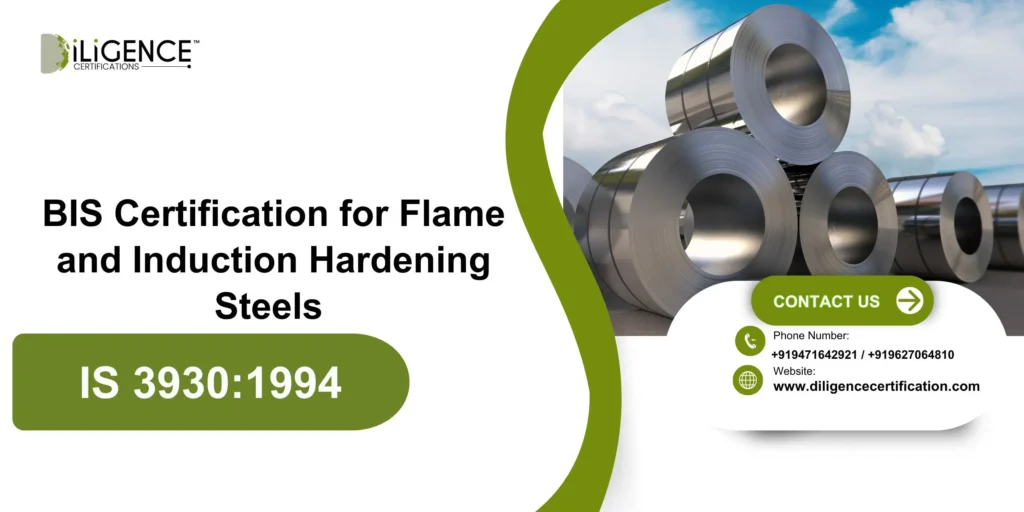
Flame and induction hardened steels are commonly applied in the industry where parts undergo repetitive stress, friction, and wear. Localized heat treatment is applied to these steels to improve the surface hardness while still keeping the core tough, hence they are ideal for gears, shafts, axles, crankshafts, and machine parts.
It is through compliance with IS 3930:1994 that such steels are able to guarantee the hardness, strength, and performance requirements specified by the Bureau of Indian Standards (BIS), thus ensuring safety, reliability, and uniformity.
What Are Flame and Induction Hardening Steels IS 3930:1994?
IS 3930:1994 Indian Standard specifies the requirements for steels intended for flame and induction hardening, & lists parameters such as:
Chemical composition - Aimed at ensuring optimal hardenability and mechanical properties
Mechanical properties - Tensile strength and Impact resistance
Hardness requirements Surface hardness Effective case depth
The effective case depth corresponds to the
Dimensional tolerances - Accuracy in Shape and Size
Surface condition - No cracks, no seams, no detrimental defects
Testing and inspection techniques: Helps maintain quality in the manufactured batches of products
By the adoption of IS 3930:1994, the manufacturers are assured that the hardened Steel parts have subsequent strength, wear, and life resistances.
ISI Mark Certification for Flame and Induction Hardening Steels
- Steels used for flame and induction hardening must also conform to IS 3930:1994 as specified by the ISI Mark Certification Scheme. The BIS certification ensures that:
- Hardness on surface and toughness in core
- Resistant to wear, fatigue, and mechanical stress
- Dimensional accuracy in industrial use cases Isabelle
- Effective quality control for every batch
The ISI mark can be allowed only on the products of certified BIS-license holders who are guarantors of adherence to the standardized norms.
Why Is BIS Certification Mandatory for Flame and Induction Hardening Steels?
The use of non-certified hardening steels leads to serious risks, such as the following:
- The premature wear or surface cracking
- Mechanical failure of the critical components
- Greater maintenance and replacement costs
- Reduced safety and reliability within industrial systems
BIS certification assures the following:
- Conformity to IS 3930 : 1994
- Resistance against mechanical and thermal load
- Increased trust amongst consumers and industries Durable,
- long-term, and with consistent performance.
Importance and Benefits of BIS Certification
| Importance | Benefits |
| Compliance with IS 3930:1994 | Ensures durability and wear resistance |
| Standardized manufacturing | Guarantees uniform quality across batches |
| Mechanical reliability | Reduces failure in heavy-duty applications |
| Regulatory compliance | Prevents legal penalties and market rejection |
| Brand credibility | Builds customer trust and industry reputation |
Step-by-Step BIS Certification Process
Step 1. Documentation
Prepare the company info, production details, and product technical specs as per the BIS standards.
Step 2: Product Testing
The Flame and induction-hardening steel samples are tested for chemical composition, hardness, and mechanical properties by BIS-recognized laboratories.
Step 3: Application Submission
The Uploading test report and other supporting documents on the BIS portal.
Step 4: Scrutiny & Factory Inspection
As The officials from the BIS carry out an on-site visit in order to check the manufacturing procedures.
Step 5: Grant of Licence
Since the A license is given to the manufacturer after successful evaluation. This envisages using ISI marks on certified products.
Documents Required for BIS Certification
- Company Registration Certificate
- Manufacturing unit details
- Technical Requirements of Hardening Steels
- BIS accepted lab test reports
- Brand Authorization (if applicable)
Timeline, Validity, and Renewal
Certification Process Timeline: 20-30 Working Days Licence
Validity: 1-2 years
Renewal: Submission of Up-to-Date Documentation and Confirmation of Compliance on Expiry of Existing Authorization
Conclusion
BIS Certification for Flame and Induction Hardening Steels IS 3930:1994: IS 3930:1994 BIS Certification for Flame and Induction Hardening Steels IS:3930:1994 can be regarded as an evidence of guarantee of quality superiority and safety superiority. The IS Certification provides
IS 3930:1994 compliance makes the process mandatory as it is just imperative to adhere to the mandatory law. This is a good move by the manufacturers as they are guaranteed stability and reliability. This is a good move by the manufacturers as they are guaranteed efficiency and excellence. BIS certified flame and induction hardened steels are the materials that guarantee good output.
Frequently Asked for Questions
What is BIS Certification for IS 3930:1994?
It is an obligatory certification that determines the quality of flame and induction hardening steels in India.
Is BIS certification mandatory for hardened steel?
Indeed, BIS certification under IS 3930:1994 is mandatory in India.
IS 3930:1994 deals with what?
It defines the composition of the material, the degree of hardness, the mechanical properties, and the procedures
Who gives the certification in the case of the BIS in?
The Bureau of Indian Standards (BIS) is responsible for the issuance of the certification.
“What is the ISI mark for hardening steels?”
ISI marks the conformity to the standards of IS 3930:1994.
Which industries employ flame and induction hardened steels?
Automotive, machinery, manufacturing, and heavy engineering sectors.
How long does the BIS certification process take?
BIS Normally 20-30 working days.
What is the validity of a BIS license?
The license is usually valid for a period of 1 to 2 years.
Factory inspection is mandatory in BIS certification.?
Yes, BIS carries out site inspections before approving.
Why is’BIS-certified steel significant?’
This ensures durability, safety, wear resistance, and regulatory standards are met.


