 BIS Certification
 CDSCO
CDSCO
 PESO
PESO
 CPCB
CPCB
 LMPC
LMPC
 WPC Approval
 Global Approvals
 TEC
TEC
 ARAI
ARAI
 BEE
BEE
 ISO Certification
 DGCA Certification
 NOC For Steel
 APEDA Registration























 Business Registration
 FSSAI Mark Certification












 (32).jpg)
 Legal Services
 Trademark Registration
 Copyright Registration
 Patent Registration
 By
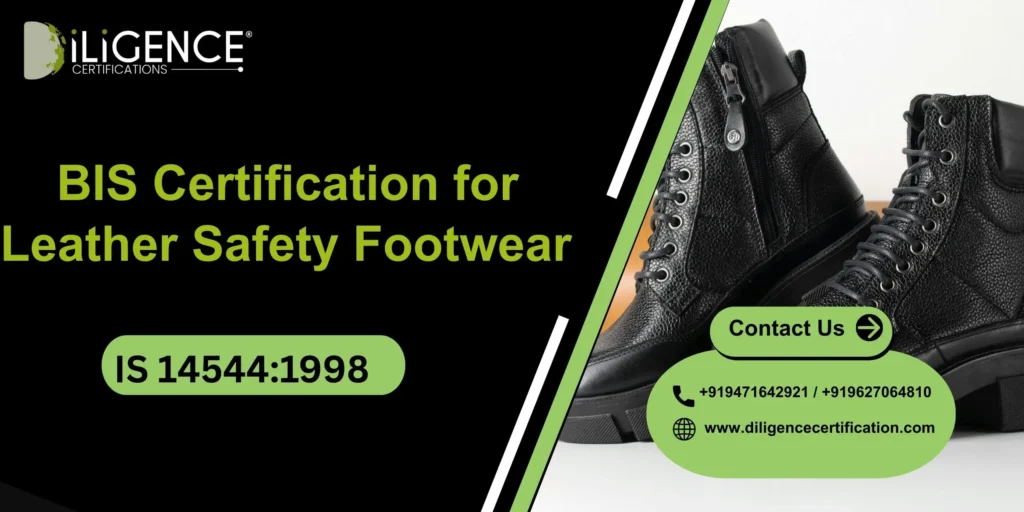
By - Mandatory Safety Compliance BIS for Leather Safety Footwear under IS 14544:1998 is required in the case of leather safety shoes with molded PVC soles to ensure safety to workers in industrial settings.
- Strict Quality & Performance Testing The footwear quality control includes impact resistance, compression resistance, sole to upper adhesion, abrasion resistance, and slip resistance, to conform to Indian safety norms.
- Strengthened Worker Protection Safety shoes with certification provide protection against mechanical damage, chemicals, moisture, and accidental slipping. They are appropriate for industrial settings, construction, and workbenches.
- Legal Market Access in India In some instances, BIS for Leather Safety Footwear footwear meets the criteria and requirements for being legally saleable in India and for being required for government, PSU, and industry tendering.
- Enhanced Brand Trust & Reliability The BIS for Leather Safety Footwear ensures customers of the good quality of the product and prevents the product from being rejected or facing any legal action.
Introduction | BIS for Leather Safety Footwear
Industrial environments, like construction, factories, storage, refineries, and workswell, are some of the places that present various dangers to workers through their feet daily. Falling debris, edged metal, slippery floors, chemical spatters, and heavy machinery pose serious risks to injuries unless safety shoes are worn. To counter such risks and ensure that safety standards in India are uniform, it has been made compulsory by the Bureau of Indian Standards to certify certain types of safety shoes.
BIS for Leather Safety Footwear Certification of Leather Safety Footwear with Moulded PVC Sole as per IS 14544:1998 is an important factor in protecting workers and ensuring the provision of effective and quality products by manufacturers. This Indian standard includes the design, construction, materials, requirements, and test methods specified for leather safety footwear to be used in industrial environments.
What is BIS for Leather Safety Footwear (IS 14544:1998)?
BIS for Leather Safety Footwear under IS 14544:1998 is a process of conformity assessment, where the leather safety shoes with molded PVC soles are tested to check whether they conform to the approved safety and quality standards in the Indian market. Once approved, they are granted the ISI mark, signifying compliance with BIS standards.
This standard applies specifically to:
- Industrial leather safety shoes
- Footwear having moulded PVC sole
- Shoes for protecting mechanical, chemical, and slipping hazards
The process of certification includes testing in factories, testing of products in BIS-accredited laboratories, testing of quality control, and surveillance testing.
Key Features of IS 14544:1998
This standard establishes a number of technical and safety norms which the footwear needs to comply with prior to receiving approval from the BIS for Leather Safety Footwear. Some of the most important of these are:
1. High-quality leather upper The shoes should be made of strong leather which is able to resist attacks from wear, abrasion, and the environment, in addition to providing comfort to the wearer when worn for long periods of time.
2. Moulded PVC sole construction Flexibility, abrasion, slip, and bonding tests are conducted in PVC soles to ensure durability.
3. Impact & Compression Resistance The safety footwear should be able to resist heavy impacts and compression forces to shield the toes and feet from falling objects and machine components.
4. Slip and Abrasion Resistance The outer sole has been tested on various surfaces to avoid the risk of slipping and falling, particularly on oily, wet, and uneven surfaces that can be found in most industries.
5. Water and Chemical Resistance The shoes must be water- and certain chemicals-resistant to qualify for use in factories, construction zones, and processing plants.
Why BIS for Leather Safety Footwear is Required - Key Reasons
1. Worker Safety is a Legal Obligation It is the liability of the employers to provide certified personal protective equipment. BIS-certified safety shoes minimize accidents at workplaces.
2. Compulsory Compliance in India Leather safety footwear is a compulsory certification by BIS for Leather Safety Footwear. Unauthorized products cannot be legally manufactured, sold, and imported in India.
3. Government and PSU Tender Eligibility All the major departments of the government, PSUs, as well as large-scale industries, make BIS certification a primary selection criterion for a tender.
4. Uniform Quality Standards BIS for Leather Safety Footwear ensures that all certified footwear complies with uniform standards for performance and safety and that all unqualified products are eliminated from the market.
5. Legal Protection for Manufacturers IS 14544:1998 ensures a reduction in the possibilities incurred by penalties, recall, and litigation resulting from accidents in the workplace.
Importance vs Benefits of BIS Certification for Leather Safety Footwear (IS 14544:1998)
| Importance of BIS Certification | Benefits of BIS Certification |
| Ensures mandatory worker safety in hazardous industrial environments | Reduces workplace foot injuries, accidents, and compensation costs |
| Guarantees compliance with Indian safety laws and regulations | Avoids legal penalties, product bans, and regulatory action |
| Maintains standardized quality and performance of safety footwear | Improves product durability, comfort, and long-term reliability |
| Mandatory requirement for government and PSU procurement | Enables participation in government, PSU, and large industrial tenders |
| Builds trust among safety officers, buyers, and inspectors | Enhances brand credibility, market reputation, and customer confidence |
BIS Certification Process
Step1:Documentation
- Collect required technical documents
- Prepare product specifications
- Gather company registration details
- Ensure documents follow BIS format
Step2:Product Testing
- Send samples to a BIS-approved lab
- Conduct safety and quality tests
- Receive test reports
- Confirm compliance with BIS standards
Step3:Application Submission
- Fill out the BIS application form
- Upload all required documents
- Attach valid test reports
- Pay the necessary BIS fees
Step4:Scrutiny and Inspection
- BIS reviews submitted documents
- Authority verifies test results
- Factory/product inspection may occur
- Clarifications requested if needed
Step5:Grant of License
- BIS approves the application
- License number is issued
- Product can carry BIS mark
- Renewal required before expiry
Documents Required for BIS Certification
| Category | Documents Required |
| Business Documents | Business license/registration, ISO certificate, organizational details |
| Manufacturer Details | Factory layout, process flow chart, machinery list, production details |
| Product Documents | Product specifications, component list, user manual, model details |
| Testing Documents | Test report from BIS-recognized lab, sample details, test request form |
| Legal & Compliance | Authorization letter, brand ownership proof, trademark certificate (if any) |
| Import/Foreign Manufacturer (If applicable) | AIR (Authorized Indian Representative) details, contract agreement, overseas manufacturer documents |
Timelines, Costs, Validity & Renewal
- Timelines: Usually from 20 to 30 days, with only 7-15 days for the testing.
- Costs: The cost of the government and the test varies depending on the product. There can be some additional charges though.
- Validity: The validity period is 2 years in most situations.
- Renewal: The renewal is done before the expiration; there should be updated documents/tests the renewal
Challenges of BIS Certification Without a Consultant
Even as BIS certification is made mandatory, it has a complicated and lengthy process which an expert prevents. Some common difficulties include:
1. Complex documentation Incomplete and improper documentation leads to rejection and hold-up in their applications.
2. Technical Testing Confusion It can be challenging to grasp test parameters, sample preparation, and lab coordination as a first-time applicant.
3. Preparedness for Factory Inspection A number of manufacturers find it difficult to satisfy BIS requirements when their factories are audited.
4. Frequent Compliance Delays Even small mistakes can lead to a substantial rise in the approval time, which may impact production and sales strategies.
5. Risk of Non-Compliance Pen Lack of awareness regarding BIS rules may give rise to punishment, cancellation of licenses, or banning of products.
Why Choose Diligence Certificates Consultancy?
Diligence Certificates Consultancy is a recognized brand in the provision of certification services of BIS, catering to the needs of manufacturers of leather safety footwear. You can trust us to have a hassle-free certification process.
Our Key Strengths
1. Full Documentation Support We accurately prepare, review, and submit all documents related to BIS.
2. Testing & Lab Coordination Sample selection, testing, and fulfillment of IS 14544:1998 specifications are done by our experts.
3. Support during Factory Audit We help you prepare before inspection so your factory is confident and compliant during the BIS audit.
4. Smoother Approval Procedures Our experience and organized process also enable us to avoid delays in approval.
5. Support Post Process From the surveillance audit to the license renewal process, our firm provides ongoing support in ensuring that you are in compliance
Conclusion
BIS Certification for Leather Safety Footwear with Moulded PVC Sole as per IS 14544:1998 is not merely an administrative requirement, but also an important step for ensuring industry safety, legality, and business expansion. BIS Certification for Leather Safety footwear with Moulded PVC Sole as per IS 14544:1998 ensures protection for people as well as opening up profitable markets.
Without proper guidance, the process of attempting certifications may end up in delays or rejection. Getting into partnership with Diligence Certificates Consultancy will enable the manufacturing company to concentrate on manufacturing and development while we take care of the complexities associated with BIS Certification.
Frequently Asked Questions (FAQs)
What is BIS Certification for Leather Safety Footwear?
It is mandatory approval, ensuring leather safety footwear complies with safety and quality standards specified in IS 14544:1998.
Is BIS Certification compulsory for safety footwear in India?
Well, leather safety boots having molded PVC soles need BIS certification by law.
Which standard applies to Leather Safety Footwear?
The relevant Indian Standard for leather safety footwear is IS 14544:1998.
Who requires BIS Certification for Safety Shoes?
The manufacturing, importing, and marketing of safety shoes in the Indian market require BIS certification.
What species of sole is included within the ambit of IS 14544:1998?
The standard refers to safety footwear with molded PVC soles.
What tests are required for BIS certification?
Impact resistance test, compression strength test, sole adhesion test, abrasion test, slip resistance test are the tests conducted
How long does BIS certification take?
It takes approximately 4-6 weeks of process, depending upon documentation and testing readiness.
Can one sell safety footwear without any certification in India?
No, it is illegal and liable for punishment to sell leather safety footwear that is not certified.
To what extent is BIS certification valid?
Licenses from the BIS are usually valid for 1-2 years and require renewal.
Can a consultant aid in faster approval of the BIS?
Yes, professional consultants minimize errors, increase the processing of approvals, and maximize compliance.


