 BIS Certification
 CDSCO
CDSCO
 PESO
PESO
 CPCB
CPCB
 LMPC
LMPC
 WPC Approval
 Global Approvals
 TEC
TEC
 ARAI
ARAI
 BEE
BEE
 ISO Certification
 DGCA Certification
 NOC For Steel
 APEDA Registration
















 Business Registration
 FSSAI Mark Certification










 (32).jpg)
 Legal Services
 Trademark Registration
 Copyright Registration
 Patent Registration
 By
By - Approval Body/Authority: Certification by Bureau of Indian Standards assures the product meets the country’s standard on matters of safety and quality.
- Applicable Standard: “IS 17263:2019 POLYESTER STAPLE FIBRES Specifies the requirements of the technical specification, characteristics and performance requirements of Polyester Staple Fiber.
- Quality and Performance Requirements: These criteria describe attributes such as quality, fineness, elongation, or tenacity, among others, that are associated with quality or performance.
- For compulsory testing and inspection, the products will be required to undergo testing in laboratories recognized by BIS, besides factory inspection to ensure manufacturing and quality control.
- Market Authorization: It is mandatory in the manufacture, sale, or import of the Polyester Staple Fibers in India, due to which the BIS Certification is eligible for the usage of the ISI mark.
Introduction
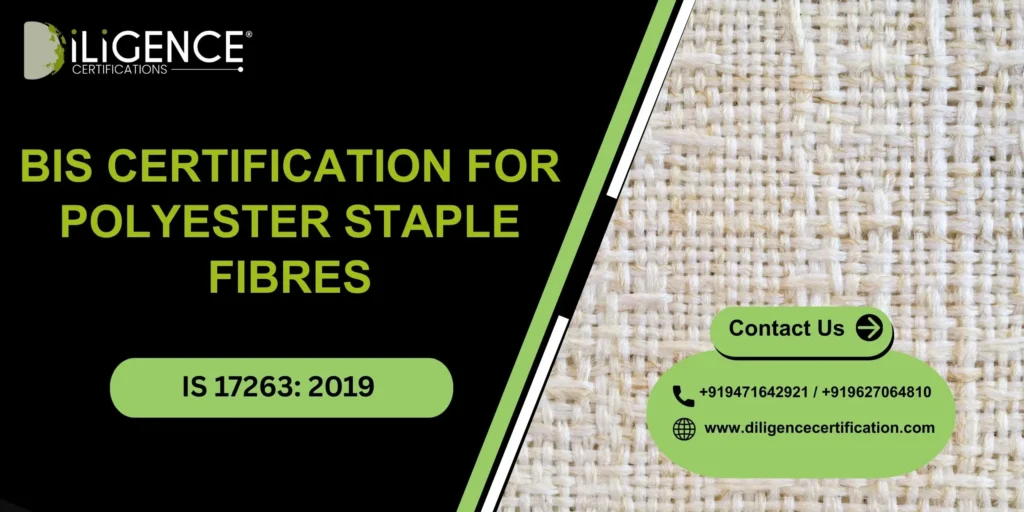
BIS Certification of Polyester Staple Fibres, according to IS 17263:2019, is a necessity from a quality point of view and from the perspective of the government of India. BIS Certification is done by the Bureau of Indian Standards, and such Certification is an assurance that the products that have been certified are of a particular set of standards regarding quality and performance. This standard gives information regarding the specifications, primarily regarding parameters like length, fineness, strength, and uniformity of the staple fibres. This allows for a constant supply to be provided by the suppliers.
What is IS 17263:2019?
IS: 17263:2019 is a specific Indian standard that has been developed by the Bureau of Indian Standards with the intention of specifying the need related to the Quality, Performance, Test Requirement of Polyester Staple Fibers. The need related to the criteria containing staple length, Fineness (Denier), Tenacity, Elongation, Moisture Content, Uniformity has been specified in the standard with the intention of ensuring a certain level of quality is met. Test methods, sampling, and criteria for conformity have been described in the standard. Compliance with the requirements of the Indian standard, IS 17263:2019, is mandatory for the sale of Polyester Staple Fibres in the market and to provide a certain degree of reliability and safety to the buyer.
Key Points:
- Issued Authority:The organization that specifies the IS 17263:2019 for governing ‘Polyester Staple Fibers’ in the country is the Bureau of Indian Standards.
- Product Scoping:The requirement applies to Polyester Staple Fibres used in textile, nonwoven, or industrial applications.
- Quality Parameters:It specifies length, fineness, tenacity, elongation, and uniformity of fibers.
- Testing & Sampling: The requirement states the testing methods and sampling procedures that must be followed in order to be sure that there is compliance.
- Obligatory Compliance: The IS 17263:2019 compliance is compulsory for the manufacture, sale, or import of Polyester Staple Fibres in India.
Why is BIS Certification Mandatory
It is necessary for the products to have a BIS Certification for them to conform to the prescribed standards of quality, safety, and performance. The standards in India for the products that use the ISI mark are governed by the Bureau of Indian Standards. The need for the products to have a BIS hallmark can ensure the quality of the materials through testing, facilitate market access of the products in India, and enable fair trade for the products since only qualified products can bear the ISI hallmark.
Key Reasons:
- Consumer Safety & Quality Assurance: Sectors that ensure their products meet set standards of quality before reaching stores.
- Regulatory Compliance: Required by the Bureau of Indian Standards for the implementation of national standards.
- Prevention of Sub-standard Products: Prevents the entry of low-quality and unsafe products into the Indian market.
- Mandatory Testing & Inspection: This involves testing the products as well as conducting audits on the manufacturing plants in order to confirm the quality of manufacturing.
- Legal Market Access: The BIS certification is mandatory for the manufacture, sale, or import of notified products in India.
Importance and Benefits of BIS Certification
| Importance | Benefits |
| Quality Standardization: It helps product after product to meet Indian quality parameters. | Legal Market Authorization: It enables the marketing of products in India in a legal manner. |
| Consumer Protection: It will protect the end-consumer from dangerous or below-standard goods. | ISI Mark Use: Authorize the use of the ISI mark, which represents guaranteed quality and reliability. |
| “Regulatory Compliance: Mandatory requirement enforced by the Bureau of Indian Standards.” | Competitive Advantage: Certified goods attract greater market preference than non-certified goods. |
| Market Credibility:It increases market credibility and thus the acceptance of the business or brand in the market. | Boosts Brand Reputation: This encourages consumer, distribution, and government trust. |
| Control on Imports: Such control is exercised on imports so as to ensure conformity with Indian specifications. | Removal of Trade Barriers: Helps in easy trading in line with recognized standards. |
Step-by-Step Process of BIS Certification
Step1:Documentation
- Collect required technical documents
- Prepare product specifications
- Gather company registration details
- Ensure documents follow BIS format
Step2:Product Testing
- Send samples to a BIS-approved lab
- Conduct safety and quality tests
- Receive test reports
- Confirm compliance with BIS standards
Step3:Application Submission
- Fill out the BIS application form
- Upload all required documents
- Attach valid test reports
- Pay the necessary BIS fees
Step4:Scrutiny and Inspection
- BIS reviews submitted documents
- Authority verifies test results
- Factory/product inspection may occur
- Clarifications requested if needed
Step5:Grant of License
- BIS approves the application
- License number is issued
- Product can carry BIS mark
- Renewal required before expiry
Documents Required for BIS Certification
| Category | Documents Required |
| Business Documents | Business license/registration, ISO certificate, organizational details |
| Manufacturer Details | Factory layout, process flow chart, machinery list, production details |
| Product Documents | Product specifications, component list, user manual, model details |
| Testing Documents | Test report from BIS-recognized lab, sample details, test request form |
| Legal & Compliance | Authorization letter, brand ownership proof, trademark certificate (if any) |
| Import/Foreign Manufacturer (If applicable) | AIR (Authorized Indian Representative) details, contract agreement, overseas manufacturer documents |
Timelines, Costs, Validity & Renewal
- Timelines: Usually from 20 to 30 days, with only 7-15 days for the testing.
- Costs: The cost of the government and the test varies depending on the product. There can be some additional charges though.
- Validity: The validity period is 2 years in most situations.
- Renewal: The renewal is done before the expiration; there should be updated documents/tests; the renewal
Why Choose Diligence Certifications
Diligence Certifications is a reputed compliance consultancy firm catering to all involved aspects of BIS certification and approvals. Diligence Certifications is well-versed with the norms of India and can ease complex procedures of certification, expedite time consumed for approvals, and even facilitate correct filing of paperwork. Their inputs enable manufacturers/importers to attain compliance with ease, sidestep cost-draining delays, and gain streamlined market entry in India while maintaining the highest levels of excellence in the quality and reliability domains.
Conclusion
BIS certification is a hallmark that significantly impacts the quality, safety, and market compliance of the products being sold within the Indian market. BIS certification, based on the adherence of the products to a set of standards, enables companies to get market access, gain consumer trust, and maintain the quality of the products. Thus, getting a certification through testing, inspection, and conformity is also essential, which will impact the users of the products positively.


