BIS Certification
 CDSCO
CDSCO
 PESO
PESO
 CPCB
CPCB
 LMPC
LMPC
 WPC Approval
 Global Approvals
 TEC
TEC
 ARAI
ARAI
 BEE
BEE
 ISO Certification
 DGCA Certification
 NOC For Steel
 APEDA Registration























 Business Registration
 FSSAI Mark Certification












 (32).jpg)
 Legal Services
 Trademark Registration
 Copyright Registration
 Patent Registration
 By
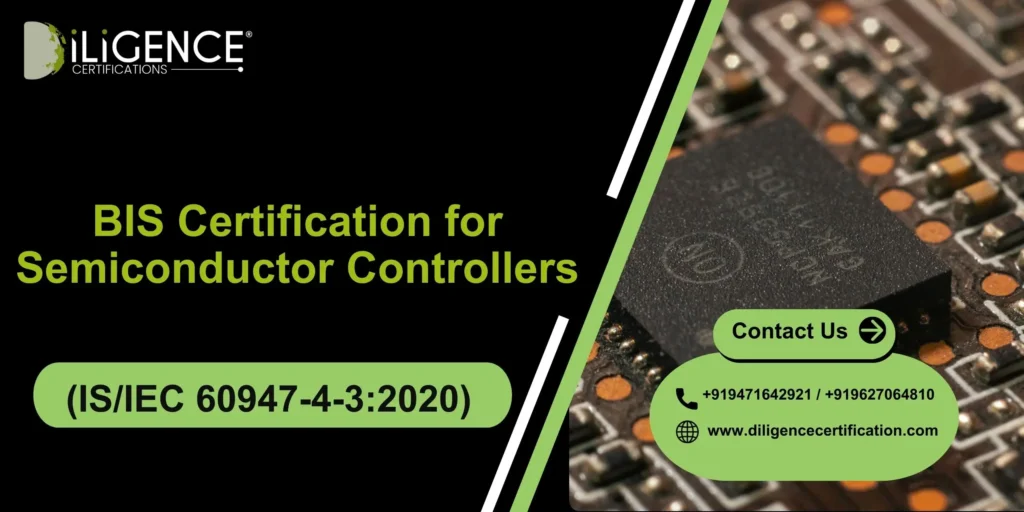
By - Obligatory Compliance - BIS for Semiconductor Controllers regulators for non-motor loads must misbehave with IS/ IEC 60947-4-32020 to be fairly vended in India.
- Safety & Performance Standard - The standard ensures electrical safety, thermal stability, and functional trustability.
- CoversNon-Motor Loads - Specifically designed for semiconductor contactors regulators used in heating, lighting, and resistive loads.
- BIS Licensing needed - Manufacturers must gain BIS instrument before request entry.
- Quality & Trust Marker - BIS instrument boosts buyer confidence and brand credibility.
Introduction | BIS for Semiconductor Controllers
With rapid industrial automation and the growing use of solid-state switching devices, semiconductor controllers and semiconductor contactors have become essential components in low-voltage switchgear systems. These devices are widely used for non-motor loads such as electric heaters, furnaces, lighting systems, and power control applications where precise switching and long operational life are required.
In India, to ensure safety, performance, and consistency, such products fall under the regulatory framework of the Bureau of Indian Standards (BIS). The applicable standard is IS/IEC 60947: Part 4: Section 3:2020 (Third Revision), which aligns Indian requirements with international IEC norms.
What is BIS for Semiconductor Controllers?
BIS for Semiconductor Controllers certification for semiconductor controllers is an official approval granted by BIS confirming that the product complies with IS/IEC 60947-4-3:2020, which governs:
- Semiconductor controllers
- Semiconductor contactors
- Devices used for non-motor electrical loads
What the Standard Covers
- Electrical and mechanical performance
- Dielectric strength and insulation resistance
- Temperature rise limits
- Short-circuit withstand capability
- EMC and operational safety
Importance and Benefits of BIS Certification
| Aspect | Without BIS Certification | With BIS Certification |
| Legal Compliance | Risk of non-compliance | Fully compliant with Indian law |
| Market Entry | Restricted or rejected | Smooth access to Indian market |
| Product Safety | Unverified safety levels | Tested & certified safety |
| Customer Trust | Low confidence | High credibility & reliability |
| Tender Eligibility | Usually ineligible | Eligible for govt & PSU tenders |
| Brand Image | Weak or unknown | Strong, professional brand value |
| Product Recall Risk | High | Minimal |
Step-by-Step Process of BIS Certification
Step1:Documentation
- Collect required technical documents
- Prepare product specifications
- Gather company registration details
- Ensure documents follow BIS format
Step2:Product Testing
- Send samples to a BIS-approved lab
- Conduct safety and quality tests
- Receive test reports
- Confirm compliance with BIS standards
Step3:Application Submission
- Fill out the BIS application form
- Upload all required documents
- Attach valid test reports
- Pay the necessary BIS fees
Step4:Scrutiny and Inspection
- BIS reviews submitted documents
- Authority verifies test results
- Factory/product inspection may occur
- Clarifications requested if needed
Step5:Grant of License
- BIS approves the application
- License number is issued
- Product can carry BIS mark
- Renewal required before expiry
Documents Required for BIS Certification
| Category | Documents Required |
| Business Documents | Business license/registration, ISO certificate, organizational details |
| Manufacturer Details | Factory layout, process flow chart, machinery list, production details |
| Product Documents | Product specifications, component list, user manual, model details |
| Testing Documents | Test report from BIS-recognized lab, sample details, test request form |
| Legal & Compliance | Authorization letter, brand ownership proof, trademark certificate (if any) |
| Import/Foreign Manufacturer (If applicable) | AIR (Authorized Indian Representative) details, contract agreement, overseas manufacturer documents |
Timelines, Costs, Validity & Renewal
- Timelines: Usually from 20 to 30 days, with only 7-15 days for the testing.
- Costs: The cost of the government and the test varies depending on the product. There can be some additional charges though.
- Validity: The validity period is 2 years in most situations.
- Renewal: The renewal is done before the expiration; there should be updated documents/tests; the renewal
Challenges of Getting BIS Certification Without a Consultant
BIS for Semiconductor Controllers instrument under IS/ IEC 60947-4-32020 is technically complex. Manufacturers trying the process alone frequently face serious hurdles
1. Complex Attestation Understanding and preparing specialized documents similar to test reports, circuit plates, QAP, and plant details is time- consuming.
2. Standard Interpretation Issues Misinterpreting clauses of the standard can lead to test failure or operation rejection.
3. Testing Detainments Coordinating with BIS- honored laboratories and icing sample compliance frequently causes detainments.
4. Plant examination Challenges BIS examinations involve strict scrutiny of manufacturing processes, outfit estimation, and quality controls.
5. Rejection &Re-submission Minor miscalculations can affect in operation rejection, leading to loss of time and fresh costs.
Why Choose Diligence Certification for BIS Certification?
Diligence Certification is a trusted compliance partner specializing in BIS certification for electrical and electronic products.
- End-to-End Support - From documentation to license grant
- Technical Expertise - Deep understanding of IS/IEC 60947 standards
- Faster Approval - Reduced timelines through accurate filings
- Lab Coordination - Seamless sample testing with BIS-recognized labs
- Inspection Readiness - Complete support for factory audits
- Cost Efficiency - Avoid re-testing and rejection costs
Conclusion
BIS for Semiconductor Controllers under IS/ IEC 60947-4-32020 is n’t voluntary it is a nonsupervisory necessity for icing electrical safety, product trustability, and legal request access in India. Given the specialized complexity of the standard and strict BIS procedures, trying instruments without expert guidance can result in expensive detainments and rejections.
By partnering with industriousness instrument, manufacturers gain a dependable, effective, and hassle-free pathway to BIS blessing, icing faster request entry and long- term compliance success.
Frequently Asked Questions (FAQs)
Is BIS certification mandatory for semiconductor controllers in India?
Yes, it is mandatory for products covered under IS/IEC 60947-4-3:2020.
Which loads are covered under this standard?
Only non-motor loads such as heaters, lighting, and resistive loads.
Who can apply for BIS certification?
Manufacturers (Indian or foreign with Indian representative).
How long does BIS certification take?
Typically 8-12 weeks, depending on testing and inspection readiness.
Is factory inspection compulsory?
Yes, BIS conducts mandatory factory inspections.
Can imported products get BIS certification?
Yes, through the Foreign Manufacturers Certification Scheme (FMCS).
What happens if products are sold without BIS certification?
Legal penalties, seizure, and sales prohibition.
Is the BIS license permanent?
No, it requires periodic renewal and surveillance.
Are test reports from private labs acceptable?
Only from BIS-recognized laboratories.
Why hire a BIS consultant for this standard?
To avoid rejection, reduce timelines, and ensure 100% compliance.