BIS Certification
 CDSCO
CDSCO
 PESO
PESO
 CPCB
CPCB
 LMPC
LMPC
 WPC Approval
 Global Approvals
 TEC
TEC
 ARAI
ARAI
 BEE
BEE
 ISO Certification
 DGCA Certification
 NOC For Steel
 APEDA Registration























 Business Registration
 FSSAI Mark Certification












 (32).jpg)
 Legal Services
 Trademark Registration
 Copyright Registration
 Patent Registration
 By
By - Mandatory Compliance - Required under BIS regulations for safe sale in the Indian market.
- Safety Standard Coverage - IS 12289:1988 covers safety requirements for handheld electric engraving tools.
- General Safety Requirements - IS 302 (Part 1):2024 covers safety requirements for electrical insulation, temperature rise, mechanical strength, and shock protection.
- Product Testing & Evaluation - The products are tested in BIS recognized laboratories before certification approval.
- Market Access & Consumer Trust - BIS certification ensures legal compliance, product reliability, and enhanced brand credibility.
Introduction | BIS certification for engraving tools
The Bureau of Indian Standards (BIS) for the safety of Household, Commercial, and Similar Electrical Appliances like Handheld Electric Engraving Tools is regulated by IS 12289:1988 and IS 302 (Part 1):2024. These regulations outline the basic safety requirements to protect users from electrical, overheating, mechanical, and insulation hazards. Handheld electric engraving tools are commonly used in industrial workshops, craft purposes, jewelry making, and commercial marking. As these tools are powered by electricity and have high-speed rotating parts, it is essential to ensure that they conform to BIS regulations.
What is IS 12289:1988?
IS 12289:1988 is an Indian Standard that has been specified by the Bureau of Indian Standards (BIS) and defines safety requirements for handheld electric engraving tools, which can be used in household and other areas. This standard was formulated to ensure that these devices function normally without posing any risks to users, such as electric shock, fire, overheating, and mechanical injury.
Key Points:
- Issued by: BIS - Developed by the Bureau of Indian Standards to regulate safety requirements for handheld electric engraving tools.
- Product Specific Standard - This standard is applicable specifically to handheld electric engraving tools used in household as well as commercial applications.
- Electrical Safety Requirements - This part of the standard covers requirements related to protection against electric shock, insulation failure, leakage current, and dielectric strength.
- Mechanical & Thermal Safety - This part of the standard specifies requirements related to construction quality, mechanical strength, and temperature rise limits.
- Mandatory for Certification - This standard is a must-follow in order to get certification from BIS for sale in the Indian market.
Why is BIS Certification Mandatory
BIS Certification for handheld electric engraving tools is a necessity to ensure these products adhere to safety standards in India and are not harmful to those using them. This is because these tools are electric-powered, with parts moving at a high rate of speed, and therefore, if not well-insulated, could cause electric shock or even fires.The certification process for these products, under the guidance of the Bureau of Indian Standards (BIS), involves a series of tests in approved laboratories to ensure these products meet the necessary requirements under IS 12289:1988 and IS 302(Part 1):2024.
Key Reasons:
- Ensures User Safety - Provides safety against electrical shock, overheating, fire risks, and mechanical injuries.
- Regulatory Compliance - Compulsory under Indian regulations for certain electrical appliances.
- Quality Control Order (QCO) Requirement - The products included in the QCO cannot be sold unless they are BIS certified.
- Testing & Verification - The products need to undergo testing in BIS testing centers to check for IS standards.
- Legal Market Access - The certification is necessary for the manufacture, import, and sale of products in India.
Importance and Benefits of BIS Certification
| Importance | Benefits |
| Compliance with Indian Standards - This ensures that the handheld electric engraving tools are safe and efficient within the stipulated parameters. | Improved Consumer Safety - Reduces the risk of electric shock, fire, and mechanical failure. |
| Product Testing Requirement - Mandatory product testing in recognized BIS testing laboratories prior to grant of certification approval. | Legal Authorization to Sell - Mandatory for legal manufacture, import, and sale in India. |
| Factory Inspection - Factory inspection by BIS to ensure proper manufacturing processes are in place. | Improved Brand Credibility - Establishes trust with consumers, distributors, and retailers. |
| Use of Standard Mark - Use of the BIS Standard Mark on the products after obtaining certification. | Market Expansion Opportunities - Helps in easier entry into regulated markets. |
| Ongoing Surveillance - Regular surveillance to ensure quality levels are maintained. | Competitive Advantage - Certified products find greater preference over non-certified competition. |
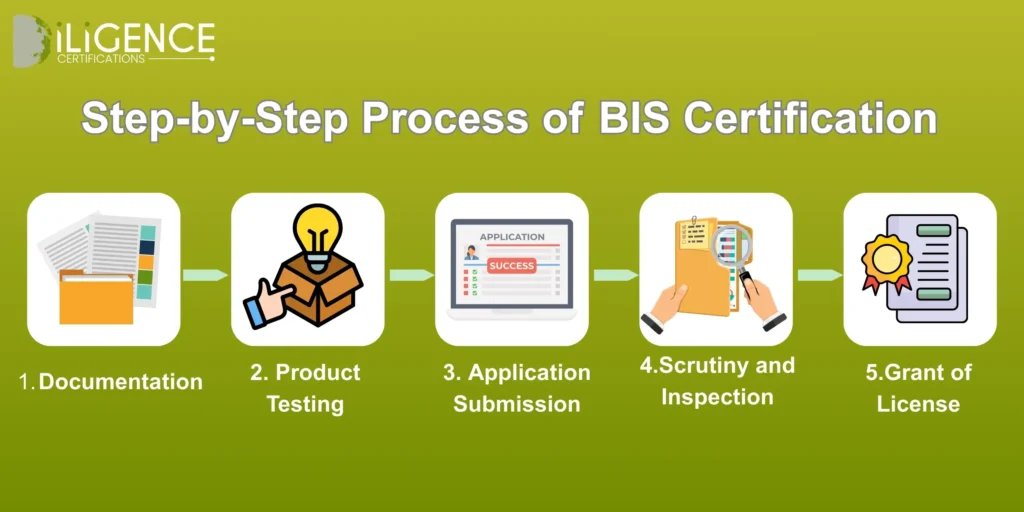
Step-by-Step Process of BIS Certification
Step1:Documentation
- Collect required technical documents
- Prepare product specifications
- Gather company registration details
- Ensure documents follow BIS format
Step2:Product Testing
- Send samples to a BIS-approved lab
- Conduct safety and quality tests
- Receive test reports
- Confirm compliance with BIS standards
Step3:Application Submission
- Fill out the BIS application form
- Upload all required documents
- Attach valid test reports
- Pay the necessary BIS fees
Step4:Scrutiny and Inspection
- BIS reviews submitted documents
- Authority verifies test results
- Factory/product inspection may occur
- Clarifications requested if needed
Step5:Grant of License
- BIS approves the application
- License number is issued
- Product can carry BIS mark
- Renewal required before expiry
Documents Required for BIS Certification
| Category | Documents Required |
| Business Documents | Business license/registration, ISO certificate, organizational details |
| Manufacturer Details | Factory layout, process flow chart, machinery list, production details |
| Product Documents | Product specifications, component list, user manual, model details |
| Testing Documents | Test report from BIS-recognized lab, sample details, test request form |
| Legal & Compliance | Authorization letter, brand ownership proof, trademark certificate (if any) |
| Import/Foreign Manufacturer (If applicable) | AIR (Authorized Indian Representative) details, contract agreement, overseas manufacturer documents |
Timelines, Costs, Validity & Renewal
- Timelines: Usually from 20 to 30 days, with only 7-15 days for the testing.
- Costs: The cost of the government and the test varies depending on the product. There can be some additional charges though.
- Validity: The validity period is 2 years in most situations.
- Renewal: The renewal is done before the expiration; there should be updated documents/tests; the renewal
Why Choose Diligence Certifications
Diligence Certifications is a professional consultancy firm that offers complete solutions for obtaining BIS certification for electrical appliances, including handheld electric engraving tools under IS 12289:1988 and IS 302(Part 1):2024. With a thorough understanding of Indian regulations, Diligence Certifications facilitates a hassle-free certification process for clients. From preparing documentation and arranging product testing to liaising with authorities, Diligence Certifications provides a complete solution for obtaining product certification. Their team of experts helps clients avoid delays and errors in the certification process, ensuring timely product certification.
Conclusion
The BIS certification of Handheld Electric Engraving Tools in accordance with IS 12289:1988 and IS 302(Part 1):2024 is necessary to provide safety to the products, which in turn will provide legal entry to the market. These products must comply with the stringent requirements of the safety guidelines with respect to electrical protection, mechanical strength, and insulation.
Frequently Asked Questions (FAQs)
What is BIS Certification?
It is a compulsory certification given by the Bureau of Indian Standards to ensure product safety and compliance.
What standards are applicable for Handheld Electric Engraving Tools?
IS 12289:1988 and IS 302 (Part 1):2024.
Is BIS Certification Compulsory for Engraving Tools?
Yes, if it is included in the applicable QCO.
Who needs to get BIS Certification?
Manufacturers and importers who wish to market in India.
What tests are carried out?
Electrical safety, insulation, temperature rise, leakage current, and mechanical tests
What is the duration of the certification process?
The duration of the process is usually between 4 to 8 weeks, depending on the documentation and the test processes involved.
Is it necessary to undergo a factory audit?
Yes, the BIS has the authority to audit the factories before the products are certified.
Can foreign manufacturers also apply?
Yes, the Foreign Manufacturers Certification Scheme (FMCS) allows foreign manufacturers to apply for the certification.
What are the consequences of selling products without BIS certification?
The products will face legal consequences, such as penalties and the seizing of the products.
Is the BIS certification renewable?
Yes, the certification has to be renewed as per the guidelines of the BIS.