BIS Certification
 CDSCO
CDSCO
 PESO
PESO
 CPCB
CPCB
 LMPC
LMPC
 WPC Approval
 Global Approvals
 TEC
TEC
 ARAI
ARAI
 BEE
BEE
 ISO Certification
 DGCA Certification
 NOC For Steel
 APEDA Registration























 Business Registration
 FSSAI Mark Certification












 (32).jpg)
 Legal Services
 Trademark Registration
 Copyright Registration
 Patent Registration
 By
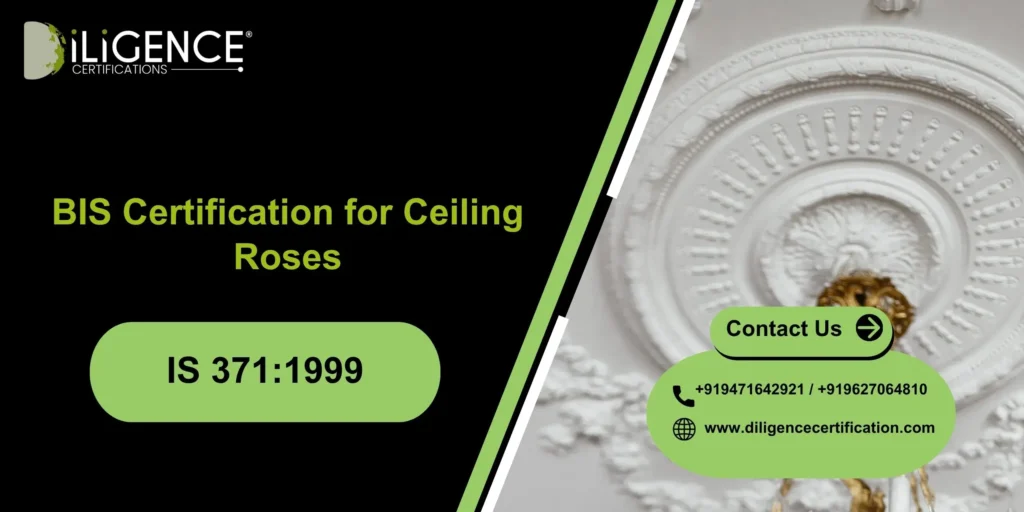
By - Mandatory Standard Compliance -BIS Certification for Ceiling Roses IS 371:1999 guarantees the safety and quality requirements for electrical installations.
- Product Safety Assurance - The certification guarantees safety from electrical hazards such as short circuits and overheating.
- Quality of Materials - This BIS Certification for Ceiling Roses ensures the use of long-lasting insulating materials with sufficient mechanical strength.
- ISI Mark Requirement - Manufacturers need to secure the BIS certification and use the ISI mark before selling the products.
- Market Trust & Legal Compliance - The BIS Certification for Ceiling Roses enhances consumer trust and legal compliance with the regulations in India.
Introduction | BIS Certification for Ceiling Roses
BIS Certification for Ceiling Roses are important electrical components used for connecting lighting fixtures with the main electrical supply source in buildings, whether residential or commercial in nature. In order for these components to be safe, durable, and efficient, they must conform to the standards set by the Indian Standard, i.e., IS 371: 1999. BIS certification for ceiling roses ensures that these components adhere to certain standards of quality and safety, thereby avoiding electrical hazards such as short circuits, overheating, and insulation failures, among others. BIS certification, along with the ISI mark, is important for manufacturers so that they can market their products in the country legally, gaining the trust of customers as well.
What is IS 371:1999?
The standard, i.e., IS 371:1999, is an Indian Standard for Electrical Ceiling Roses. It is prepared by the Bureau of Indian Standards (BIS) and provides guidelines for electrical ceiling roses. The standard is primarily concerned with the quality of insulation, resistance to heat, and strength of electrical ceiling roses, thus ensuring their safety.
Key Points:
- It outlines the technical requirements for ceiling roses for wiring systems.
- It ensures the safety of the electrical system from shocks and short circuits.
- It outlines the quality requirements for the material used, especially for insulation and heat resistance.
- It outlines the requirements for testing the durability of the products.
- It aids the manufacturer in getting the products certified by the BIS and marked with the ISI mark for legal trade.
Products Covered Under IS 371 : 1999
Electrical wiring systems for connecting light fittings, fans, and flexible cords, which are usually fixed on the ceiling or on the walls, are included in IS 371:1999, which covers ceiling roses. This standard is necessary to ensure that all types of ceiling roses, which provide a safe point for electrical connections, comply with safety, insulation, and performance criteria for domestic and commercial use.
Key Reasons:
- Covers two-plate ceiling roses for simple electrical connections.
- Includes three-plate ceiling roses for multiple wiring connections.
- Suitable for use on insulating materials, including plastics.
- Used to connect light fixtures, fans, and pendant lighting.
- Safe for joining flexible cords with fixed wiring systems.
Importance and Benefits of BIS Certification
| Importance | Benefits |
| Ensures compliance with safety standards as per IS 371:1999. | Increases safety for consumers by reducing electrical risks. |
| It is mandatory for manufacturers to obtain BIS certification, also known as the ISI mark. | Fosters trust and credibility in the market. |
| It deals with aspects of insulation, heat, and durability. | Guarantees consistent quality and performance. |
| The product needs to be tested in laboratories approved by BIS. | Facilitates compliance with Indian laws. |
| It is applicable for domestic and commercial use. | Creates a competitive advantage for certified manufacturers. |
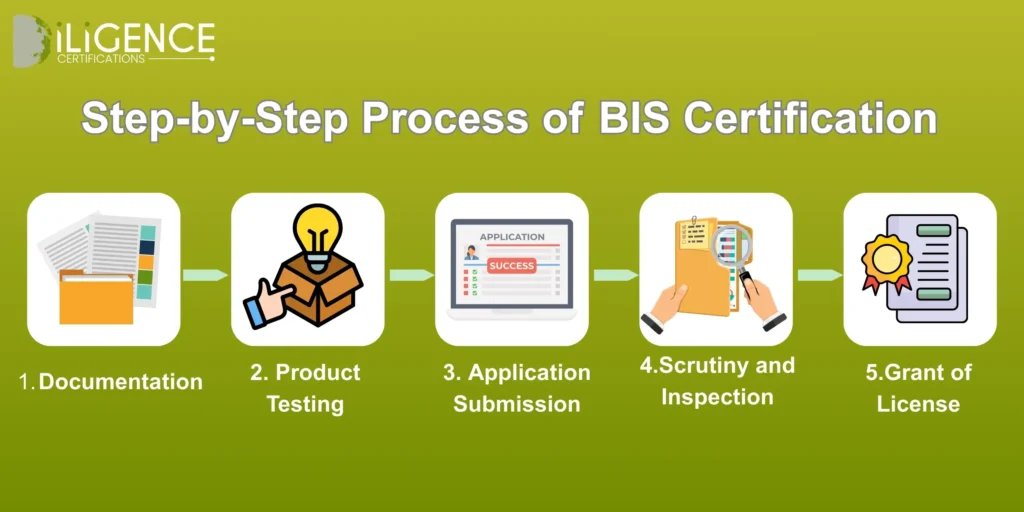
Step-by-Step Process of BIS Certification
Step1:Documentation
- Collect required technical documents
- Prepare product specifications
- Gather company registration details
- Ensure documents follow BIS format
Step2:Product Testing
- Send samples to a BIS-approved lab
- Conduct safety and quality tests
- Receive test reports
- Confirm compliance with BIS standards
Step3:Application Submission
- Fill out the BIS application form
- Upload all required documents
- Attach valid test reports
- Pay the necessary BIS fees
Step4:Scrutiny and Inspection
- BIS reviews submitted documents
- Authority verifies test results
- Factory/product inspection may occur
- Clarifications requested if needed
Step5:Grant of License
- BIS approves the application
- License number is issued
- Product can carry BIS mark
- Renewal required before expiry
Documents Required for BIS Certification
| Category | Documents Required |
| Business Documents | Business license/registration, ISO certificate, organizational details |
| Manufacturer Details | Factory layout, process flow chart, machinery list, production details |
| Product Documents | Product specifications, component list, user manual, model details |
| Testing Documents | Test report from BIS-recognized lab, sample details, test request form |
| Legal & Compliance | Authorization letter, brand ownership proof, trademark certificate (if any) |
| Import/Foreign Manufacturer (If applicable) | AIR (Authorized Indian Representative) details, contract agreement, overseas manufacturer documents |
Timelines, Costs, Validity & Renewal
- Timelines: Usually from 20 to 30 days, with only 7-15 days for the testing.
- Costs: The cost of the government and the test varies depending on the product. There can be some additional charges though.
- Validity: The validity period is 2 years in most situations.
- Renewal: The renewal is done before the expiration; there should be updated documents/tests; the renewal
Why Choose Diligence Certifications
Diligence Certifications is a consultancy firm that provides professional assistance to manufacturers for obtaining certification under the BIS certification scheme in a smooth and efficient manner. With their thorough understanding of Indian standards such as IS 371:1999, Diligence Certifications provides end-to-end solutions for obtaining certification under the BIS scheme. With their team of experts, organizations are ensured that all requirements are met in a smooth and efficient manner, thereby saving time and avoiding complications that may arise during the process.
Conclusion
BIS Certification for Ceiling Roses as per IS 371:1999 is very important for ensuring the safety, quality, and reliability of electrical products. It is very useful for manufacturers in abiding by Indian regulations, and for users, it provides safety against electrical risks. It not only helps the product comply with the standards, but also increases its market credibility. It is very important for business growth and for enhancing the overall performance of the product.
Frequently Asked Questions (FAQs)
What is IS 371:1999?
It is an Indian standard for ceiling roses used in electrical wiring systems.
Is BIS certification compulsory?
Yes, BIS certification is compulsory for sale in India.
What is a ceiling rose?
It is a connector used for connecting light fixtures or fans.
Who provides BIS certification?
Bureau of Indian Standards (BIS).
What is the ISI mark?
It is a mark that indicates that a product meets BIS standards.
What are the materials used?
Insulation materials like plastic or Bakelite.
Why is certification necessary?
Safety and electrical hazards are avoided.
Where are ceiling roses commonly used?
In homes, offices, and commercial buildings.
What tests need to be done?
Safety, insulation, and durability tests.
Can un-certified products be sold?
No, selling without certification from the BIS is not allowed.