BIS Certification
 CDSCO
CDSCO
 PESO
PESO
 CPCB
CPCB
 LMPC
LMPC
 WPC Approval
 Global Approvals
 TEC
TEC
 ARAI
ARAI
 BEE
BEE
 ISO Certification
 DGCA Certification
 NOC For Steel
 APEDA Registration























 Business Registration
 FSSAI Mark Certification












 (32).jpg)
 Legal Services
 Trademark Registration
 Copyright Registration
 Patent Registration
 By
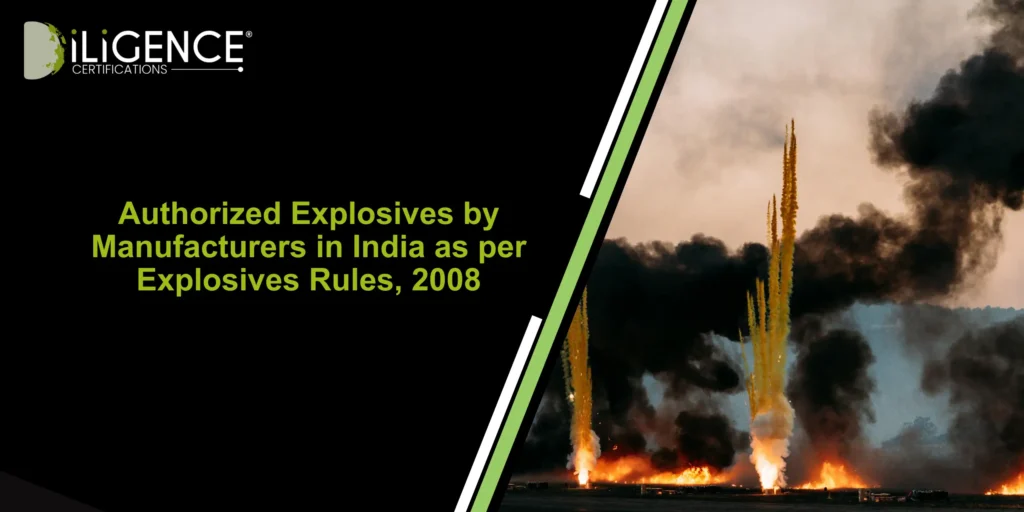
By - Explosives Manufacturer Approval Petroleum and Explosives Safety Organization (PESO) regulates manufacturing, approval, storage, and sale of explosives in India.
- Only explosives approved under the Explosives Rules, 2008 can be legally manufactured and sold.
- Authorization is granted manufacturer-wise, meaning each company must get approval for each product type.
- Testing, safety compliance, and documentation are mandatory before approval.
- Unauthorized manufacturing or sale can lead to strict legal penalties, including cancellation of licenses.
Introduction | Explosives Manufacturer Approval
The Explosives Manufacturer Approval in India operates under strict regulatory oversight due to the inherent risks associated with manufacturing, handling, and distribution. The Explosives Rules, 2008 provide a comprehensive legal framework governing the approval and use of explosives across industries such as mining, construction, defense, and infrastructure development.
One of the most critical aspects of this regulation is the authorization of explosives on a manufacturer-wise basis. This means that each manufacturer must obtain specific approvals for every explosive product they intend to produce or sell. This ensures traceability, safety compliance, and quality control.
For businesses operating in this sector, understanding how authorized explosives are categorized and approved is essential for legal compliance and operational continuity.
What is “Authorized Explosives by Manufacturers”?
Explosives Manufacturer Approval refer to explosive products that have been tested, evaluated, and officially approved by regulatory authorities for manufacturing and use in India. These approvals are granted to specific manufacturers based on their production capability, safety standards, and compliance with legal requirements.
Key Points of Explosives Manufacturer Approval
- Approval is product-specific and manufacturer-specific
- Each explosive must meet safety and performance standards
- Authorization includes classification, packaging, and usage guidelines
- Testing is conducted in approved laboratories
- Approval is documented and published by regulatory authorities
Why Explosives Manufacturer Approval is Required
The Explosives Manufacturer Approval poses high safety risks, making strict regulation necessary. Authorization ensures that only safe and compliant products enter the market.
Key Points
- Prevents accidents and hazardous incidents
- Ensures product quality and consistency
- Enables traceability of explosives
- Maintains national security standards
- Protects workers and the environment
Without proper authorization, explosives can lead to severe industrial accidents, legal consequences, and loss of business credibility.
Important Features and Benefits of Explosives Manufacturer Approval
| Aspect | Details |
| Legal Compliance | Ensures adherence to Explosives Rules, 2008 |
| Safety Assurance | Reduces risks during manufacturing and usage |
| Market Access | Only authorized explosives can be sold commercially |
| Credibility | Builds trust with clients and regulators |
| Traceability | Enables tracking of explosives to specific manufacturers |
| Standardization | Maintains uniform quality across products |
| Risk Reduction | Minimizes chances of accidents and penalties |
Types of Authorized Explosives (Manufacturer-Wise)
Authorization varies depending on the type of explosive and its intended application.
Common Categories
- Industrial explosives (used in mining and construction)
- Detonators and initiators
- Gunpowder and pyrotechnics
- Slurry and emulsion explosives
- Safety fuses and detonating cords
Each manufacturer must obtain separate approvals for each category and variant.
Approval Process for Explosives Manufacturer Approval
The process is structured and requires strict compliance at every stage.
Step-by-Step Process
- Application Submission
Manufacturer submits detailed application with product specifications. - Documentation Review
Authorities verify technical data, safety measures, and compliance. - Sample Testing
Product samples are tested in approved laboratories. - Factory Inspection
Manufacturing facility is inspected for safety and capability. - Compliance Verification
Ensures adherence to Explosives Rules, 2008. - Approval Grant
Authorization is issued for specific explosives. - Listing and Certification
Product is officially listed as authorized.
Challenges of Getting This Certification Without a Consultant
Many businesses underestimate the complexity of the approval process. Doing it alone often leads to delays or rejection.
Key Challenges
- Incorrect documentation submission
- Lack of technical understanding of compliance
- Failure in product testing
- Delays due to regulatory communication gaps
- Incomplete safety infrastructure
- Misinterpretation of legal requirements
Reality Check
Trying to handle this internally without expertise usually results in:
- 3-6 months additional delays
- Multiple rejections
- Increased compliance costs
Why You Should Choose Diligence Certification
For manufacturers, speed and accuracy in approvals directly impact business operations. This is where Diligence Certification becomes relevant.
What to Do
- Use expert support for documentation
- Align product specifications with regulatory expectations
- Prepare for inspections in advance
What NOT to Do
- Submit incomplete applications
- Ignore testing requirements
- Assume all explosives fall under one approval
Key Advantages
- End-to-end compliance handling
- Faster approval timelines
- Reduced rejection rates
- Expert guidance on regulatory changes
- Strong understanding of Indian compliance frameworks
Manufacturer-Wise Authorization Structure
Authorization is not generic. It is structured around:
- Manufacturer identity
- Product type
- Chemical composition
- Intended usage
- Safety classification
This ensures that even similar products from different manufacturers are evaluated independently.
Compliance Requirements You Cannot Ignore
Mandatory Requirements
- Valid manufacturing license
- Safety management systems
- Qualified technical personnel
- Approved storage facilities
- Regular audits and inspections
Ignoring any of these can result in suspension or cancellation of authorization.
Common Mistakes That Kill Approval Chances
What NOT to Do
- Copying documentation from competitors
- Submitting outdated test reports
- Ignoring safety compliance
- Underestimating inspection readiness
- Using unapproved raw materials
What to Do Instead
- Create original, accurate documentation
- Conduct pre-compliance audits
- Work with certified testing labs
- Maintain proper records
Conclusion
Explosives Manufacturer Approval under the Explosives Rules, 2008 is not just a regulatory requirement-it is a critical process that ensures safety, quality, and accountability in a high-risk industry.
Manufacturer-wise approval adds another layer of control, ensuring that each product is thoroughly evaluated before entering the market. While the process can be complex and time-consuming, proper planning and expert guidance can significantly reduce delays and risks.
For businesses looking to operate in this sector, compliance is not optional-it is the foundation of sustainable operations.
Frequently Asked Questions (FAQs)
What are authorized explosives?
Authorized explosives are products approved by regulatory authorities for manufacturing and use in India.
Who grants approval for explosives in India?
Approval is granted by the Petroleum and Explosives Safety Organization.
Is approval required for each explosive product?
Yes, each product must be approved separately.
Can one approval cover multiple manufacturers?
No, approvals are manufacturer-specific.
How long does the approval process take?
Typically 3-6 months, depending on compliance and documentation.
What happens if unauthorized explosives are used?
It can lead to legal penalties, license cancellation, and criminal action.
Is testing mandatory?
Yes, all explosives must pass approved laboratory testing.
Can approvals be revoked?
Yes, if compliance is not maintained.
Do small manufacturers also need approval?
Yes, regardless of size, all manufacturers must comply.
Why should I hire a consultant?
A consultant reduces errors, speeds up approval, and ensures compliance with regulations.