 BIS Certification
 CDSCO
CDSCO
 PESO
PESO
 CPCB
CPCB
 LMPC
LMPC
 WPC Approval
 Global Approvals
 TEC
TEC
 ARAI
ARAI
 BEE
BEE
 ISO Certification
 DGCA Certification
 NOC For Steel
 APEDA Registration












 Business Registration
 FSSAI Mark Certification


 (32).jpg)
 Legal Services
 Trademark Registration
 Copyright Registration
 Patent Registration
 By
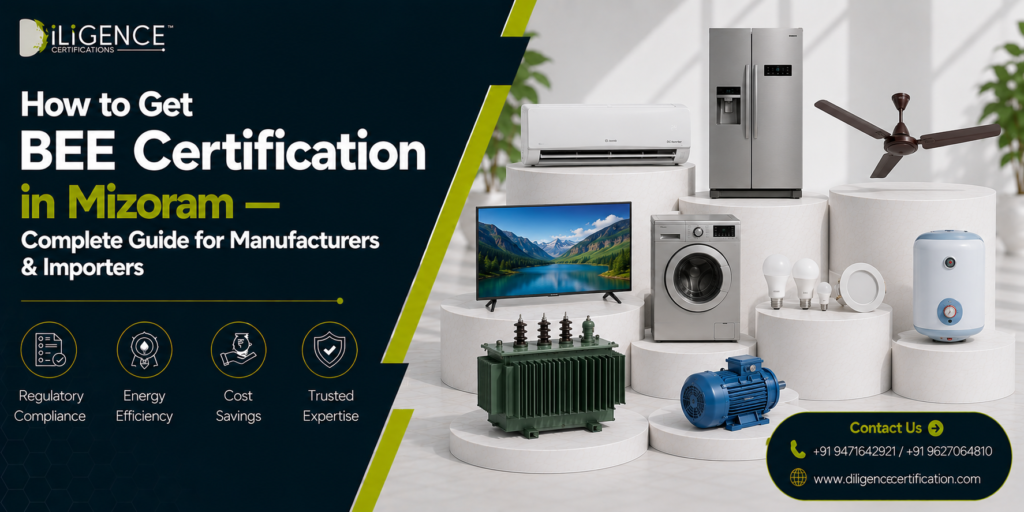
By BEE Certification in Mizoram is important for manufacturers, importers, and brand owners selling energy-consuming products in India.
It allows eligible products to carry the official BEE Star Label after proper testing and registration.
For businesses targeting Mizoram’s consumer and commercial market, BEE compliance improves trust, reduces regulatory risk, and supports product acceptance.
Introduction
A manufacturer of electrical appliances once contacted our team after receiving interest from dealers in Aizawl. The product was ready, packaging was complete, and the sales team had already started planning distribution. During the final compliance review, one issue came up: the product required BEE registration before it could be sold with a valid energy label.
The company assumed that product quality testing and GST documentation were enough. In reality, for many energy-consuming products, BEE Certification in Mizoram becomes a practical requirement before market entry because the product must follow India’s energy efficiency labelling rules.
This is a common situation. Manufacturers, importers, and brand owners often focus on pricing, logistics, packaging, and dealer networks. Compliance is checked only when the product reaches the selling stage. That delay can affect launch timelines, distributor confidence, and brand credibility.
Pre-planning the BEE process is always better than correcting mistakes after stock is ready.
What is BEE Certification in Mizoram?
BEE Certification in Mizoram refers to the registration and approval process required for certain electrical and electronic products under the Bureau of Energy Efficiency’s Standards and Labelling Programme. The Bureau of Energy Efficiency runs the Standards and Labelling programme for covered equipment and appliances, including mandatory and voluntary categories.
After approval, eligible products can display the BEE Star Label. This label helps customers compare energy performance and choose products that consume less electricity.
In simple terms, BEE certification is not just a sticker. It is a compliance approval based on product testing, technical evaluation, label approval, and registration.
For Mizoram, the process is not separate from national BEE rules. The same central BEE registration framework applies across India. However, businesses selling in Mizoram still need to ensure that their products are properly registered before distribution.
Why BEE Certification Matters for Mizoram Businesses
Mizoram’s market is growing steadily in electrical appliances, cooling products, lighting products, commercial equipment, and household electronics. Buyers are more aware of electricity consumption than before. Dealers also prefer products that are legally compliant and easier to sell.
For products covered under BEE rules, selling without proper registration can create avoidable problems. A distributor may reject the product. A marketplace may ask for compliance proof. A government buyer may require valid registration before procurement.
BEE Certification in Mizoram helps businesses show that their products meet energy efficiency standards and are suitable for regulated sale in India.
The BEE Star Label also works as a trust signal. Customers may not read technical test reports, but they understand star ratings. A higher star rating often gives the product a stronger sales advantage.
Products Commonly Covered Under BEE Registration
BEE registration applies to several product categories under mandatory or voluntary labelling. The official BEE programme covers equipment and appliances under its Standards and Labelling scheme, and BEE also conducts check testing to verify compliance.
Common product categories include:
- Room air conditioners
- Refrigerators
- Ceiling fans
- LED lamps
- Washing machines
- Television sets
- Distribution transformers
- Electric motors
- Water heaters
- Commercial beverage coolers
- Deep freezers
- Chillers
- Induction hobs
- Computers
- Ballasts
- Agricultural pumps
The exact requirement depends on the product category, applicable notification, model details, and current BEE schedule. Before applying for BEE Certification in Mizoram, a company should first confirm whether the product falls under mandatory or voluntary registration.
Who Needs BEE Certification in Mizoram?
The following businesses usually need BEE registration:
Manufacturers
Indian manufacturers producing notified energy-consuming products must obtain BEE registration before selling those products in the market.
Importers
Importers bringing covered products into India must ensure proper BEE registration before commercial sale. Imported products need technical documents, test reports, and brand details.
Brand Owners
Numerous brands are manufactured outside their country but use brand name labels to sell these products. In that case, the brand owner must ensure proper registration and compliance with applicable regulations.
Foreign producers usually need an authorised representative who can act as their point of contact in India to make sure they meet the requirements for compliance, documentation and communications with appropriate authorities.
BEE Certification Process in Mizoram
The process for BEE Certification in Mizoram usually includes product evaluation, document preparation, testing, online application, label approval, and final registration.
Step 1: Product Category Identification
Identifying if the product falls under Bureau of Energy Efficiency (BEE) will be the first step by checking if it falls within the same category as other products, has technical standards, and if it falls within either Mandatory or Voluntary labelling. Most companies make the same common mistake at this point in their process by thinking that their product’s category is similar enough that it has all the same rules. Technical reviews are always better at this point than commercial comparison..
Step 2: Document Collection
The applicant must prepare company documents, product specifications, brand details, manufacturing information, authorization letters, and technical documents.
For imported products, additional documents may be required, such as foreign manufacturer details, import documents, nomination letters, and authorised representative details.
Step 3: Product Testing
Testing is one of the most important parts of the BEE process. The product must be tested as per applicable energy performance standards. The test report helps determine whether the product qualifies for a specific star rating.
Testing delays are common when product samples are not prepared properly or documents do not match the model details.
Step 4: Online Application
After testing and documentation, the application is submitted through the BEE registration system. The details must match the test report and supporting documents.
Any mismatch in model number, brand name, technical rating, or label information may lead to clarification or delay.
Step 5: Review and Approval
BEE reviews the application, documents, and test reports. If the application is complete, approval is granted. If clarification is required, the applicant must respond properly.
Step 6: Star Label Approval
Once approved, the product can use the BEE Star Label as per approved design, rating, and validity. The label must not be modified casually because wrong label usage can create compliance issues.
Documents Required for BEE Certification in Mizoram
The document list may vary depending on the product and applicant type, but generally includes:
- Company registration certificate
- GST certificate
- Brand authorization letter
- Trademark certificate or brand ownership proof
- Manufacturing unit details
- Product technical specification sheet
- Model declaration
- Test report from approved laboratory
- Label design details
- Authorised signatory proof
- Importer Exporter Code, if applicable
- Authorisation letter for Indian representative, if applicable
- Undertaking and declarations as required
For BEE Certification in Mizoram, document accuracy matters more than document volume. A small mismatch in product model number or brand name can hold the application.
Benefits of BEE Certification in Mizoram
1. Legal Market Access
For mandatory products, BEE registration supports lawful sale in India. It helps avoid unnecessary compliance objections from dealers, online platforms, and institutional buyers.
2. Better Consumer Trust
Consumers prefer products that clearly show energy efficiency performance. A valid BEE Star Label gives them confidence while purchasing.
3. Improved Dealer Confidence
Dealers and distributors in Mizoram may hesitate to stock products without clear compliance. BEE-approved products are easier to position in the market.
4. Competitive Advantage
Having a higher star rating can help to sell your appliance products. Customers often consider Energy Efficiency ratios (EERs) when buying appliances.
5 .Reduced Regulatory Risk
The correct registration also lowers the chances of rejection, withdrawing products, and issues with labeling.
Difference Between BIS and BEE Certification
Many clients confuse BIS and BEE because both are related to product compliance. However, they are different.
BIS certification focuses mainly on safety, quality, and Indian Standards compliance. BEE certification focuses on energy efficiency and star labelling.
For some products, both BIS and BEE may be required. For example, a product may need BIS approval for safety compliance and BEE registration for energy performance labelling.
That is why a compliance review is important before launching any product in Mizoram or other Indian states.
BEE Certification in Mizoram for Importers
Importers need to be extra careful because imported products usually involve multiple parties: foreign manufacturer, Indian importer, brand owner, and authorised representative.
Before importing large stock, the importer should verify:
- Whether the product requires BEE registration
- Whether the foreign test report is acceptable or fresh testing is needed
- Whether the model number and product rating are final
- Whether the brand ownership documents are available
- Whether the Indian representative has proper authority
A common mistake is importing goods first and checking BEE compliance later. This can block sales and increase storage costs.
BEE Certification in Mizoram for Manufacturers
Indian manufacturers should integrate BEE compliance into product development. If energy performance is checked only after production, the product may fail to meet the expected star rating.
Manufacturers should review:
- Energy consumption values
- Product design specifications
- Testing requirements
- Star rating target
- Label content
- Packaging compliance
- Renewal and validity planning
For manufacturers, BEE Certification in Mizoram is not only a legal formality. It also affects product positioning, pricing, and market reputation.
How Diligence Certifications Supports BEE Registration
Diligence Certifications assists businesses with end-to-end BEE compliance support. Our team helps with product category checking, documentation, testing coordination, application filing, clarification handling, and label approval guidance.
Our support generally includes:
- Product applicability check
- Required document checklist
- Test report coordination
- Application preparation
- Model registration support
- BEE label guidance
- Compliance follow-up
- Renewal and modification support
Cost of BEE Certification in Mizoram
The cost of BEE certification depends on product category, testing requirements, number of models, documentation status, and whether the product is manufactured in India or imported.
A single fixed cost is not suitable for every business because requirements differ from product to product. Testing charges, government fees, professional support, and label-related requirements may vary.
For an accurate estimate, contact Diligence Certifications with your product details, model list, brand name, and manufacturing or import status.
Conclusion
Obtaining BEE Certification in the state of Mizoram is required by all manufacturers, importers and brand owners that sell designated types of energy consuming products. BEE Certification allows businesses to legally offer products in the market while building trust with consumers by assisting businesses to correctly represent their product’s energy efficiency.
Businesses that intend to offer appliances, electronics or commercial energy products for sale in the state of Mizoram should not wait until the last minute to get BEE registered. By developing a plan early on, businesses will avoid delays in product testing and errors in documentation and will be able to overcome objections from distributors.
Diligence Certifications can provide you with the expertise needed for BEE Certification in the state of Mizoram, including assisting you with document preparation, coordinating testing, filing applications, and overall guidance on how to remain compliant.
Frequently Asked Questions
What is BEE Certification in Mizoram?
BEE Certification in Mizoram is the approval process for energy-consuming products covered under the Bureau of Energy Efficiency’s Standards and Labelling Programme. It allows eligible products to use the BEE Star Label after testing and registration.
Is BEE Certification mandatory in Mizoram?
Yes, it is mandatory for products notified under mandatory BEE labelling rules. The same central BEE requirements apply to Mizoram and other Indian states.
Who can apply for BEE Certification in Mizoram?
Manufacturers, importers, brand owners, and authorised Indian representatives can apply, depending on the product and business structure.
Which products require BEE registration?
Products such as air conditioners, refrigerators, ceiling fans, LED lamps, televisions, water heaters, chillers, deep freezers, and other notified categories may require BEE registration.
How much time does BEE registration take?
The timeline depends on product testing, document readiness, application review, and clarification handling.
Is BEE certification required for imported products?
Yes, imported products covered under BEE rules must be registered before sale in India.
Can one BEE registration cover multiple models?
Multiple models may require separate model registration or grouped handling depending on the product category and BEE rules.
What happens if a product is sold without BEE approval?
Selling a covered product without required BEE registration can lead to compliance objections, market restrictions, and regulatory risk.