BIS Certification
 CDSCO
CDSCO
 PESO
PESO
 CPCB
CPCB
 LMPC
LMPC
 WPC Approval
 Global Approvals
 TEC
TEC
 ARAI
ARAI
 BEE
BEE
 ISO Certification
 DGCA Certification
 NOC For Steel
 APEDA Registration























 Business Registration
 FSSAI Mark Certification












 (32).jpg)
 Legal Services
 Trademark Registration
 Copyright Registration
 Patent Registration
 By
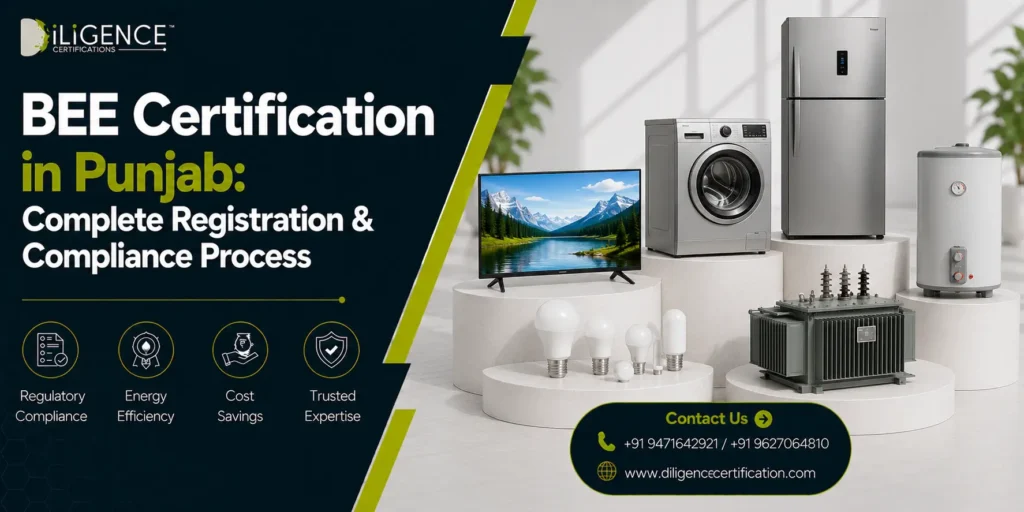
By - Punjab BEE certification is a mandatory process for the release of electrical equipment that use energy in Punjab.
- This involves testing, brand registration, model registration, and labeling.
- Diligence Certifications helps business organizations in ensuring compliance with BEE through proper documentation and testing services.
Introduction
This situation is typical of all businesses selling such items as ceiling fans, refrigerators, air conditioners, LED lights, geysers, washing machines, motors, pumps, commercial coolers, chillers, and other electrical gadgets where their sale falls under the mandatory registration of BEE.
Punjab State has quite an impressive presence of industries in the cities of Ludhiana, Jalandhar, Amritsar, Mohali, Patiala, Bathinda, Mandi Gobindgarh, Rajpura, Derabassi, and many other neighboring industrial zones in and around Chandigarh. There are quite a number of industries in these industrial clusters that deal in manufacturing or trading of electrical gadgets, engineering items, packed goods, and many other consumer goods.
For such businesses, BEE certification is unavoidable if they sell items under mandatory BEE registration. Otherwise, these businesses are likely to face numerous problems such as rejection by dealers, warnings from authorities, delayed product launch, and loss of consumer trust.
What is BEE Certification in Punjab?
BEE Certification in Punjab refers to the certification process administered by the Bureau of Energy Efficiency (BEE) that allows eligible manufacturers, importers, and brand owners to obtain approval for energy-consuming products and use the BEE Star Label on certified models.
The BEE Star Label indicates the energy efficiency performance of a product. Star ratings generally range from 1 Star to 5 Star, where a higher rating signifies better energy efficiency and lower electricity consumption compared to similar products.
For consumers, the BEE label helps compare products based on energy performance before purchase. For businesses, it improves market credibility, supports regulatory compliance, and enhances product acceptance across India.
The BEE certification process generally includes:
- Brand Registration
- Product Testing
- Model Registration
- Technical Documentation
- Application Submission
- BEE Review
- Label Approval
Once the product is approved, the manufacturer or importer is authorized to use the BEE Star Label in accordance with the applicable Bureau of Energy Efficiency guidelines.
Importance and Benefits of BEE Certification in Punjab
| Importance of BEE Certification | Business Benefits |
| Required for regulated energy-consuming products | Allows legal sale of applicable products in India |
| Helps businesses follow BEE compliance rules | Reduces risk of penalties and market restrictions |
| Supports product sale from Punjab to other states | Enables smooth distribution across India |
| Adds BEE star labelling to eligible products | Builds customer trust and buying confidence |
| Proves energy-efficiency performance | Improves brand credibility in competitive markets |
| Makes products more acceptable to dealers | Strengthens dealer and distributor confidence |
| Supports sustainable business practices | Improves long-term brand value |
| Helps with marketplace and tender requirements | Makes product documentation stronger |
On a practical note, a dealer is much at ease when they can stock up products that have been compliant. The large purchasers, e-commerce stores, and other organizational clients usually verify whether the product carries valid certification.
Any Punjab-based manufacturer who plans to manufacture air coolers, fans, motors, or refrigeration equipment cannot take BEE certification to be the final stage. They need to plan their steps even before the manufacturing and packing process begins.
Products Covered Under BEE Certification
BEE certification applies to several electrical appliances and energy-consuming products. The exact requirement depends on whether the product category is mandatory or voluntary under the BEE Standards and Labelling programme.
Common product categories include:
- Ceiling fans
- Room air conditioners
- Refrigerators
- LED lamps
- Distribution transformers
- Washing machines
- Electric geysers
- Deep freezers
- Commercial beverage coolers
- Induction hobs
- LPG stoves
- Chillers
- Motors
- Pumps
- Solar photovoltaic products
- Side-by-side refrigerators
- Table fans
- Wall fans
- Air compressors
- Ultra-high-definition televisions
Businesses should always confirm the latest product coverage before production, import, packaging, or sales planning. BEE product categories and labelling conditions may be updated from time to time.
Mandatory and Voluntary BEE Registration
BEE registration is generally divided into two types: mandatory registration and voluntary registration.
Mandatory BEE Registration
Mandatory BEE registration applies when a product category has been notified under compulsory labelling requirements. In such cases, the manufacturer, importer, or brand owner must obtain BEE approval before selling the product in India.
For mandatory products, selling without valid BEE certification may create legal and commercial problems. Dealers may refuse the stock, e-commerce platforms may ask for compliance documents, and institutional buyers may reject the product during vendor evaluation.
Voluntary BEE Registration
When BEE certification is not mandatory for that particular product line but companies still decide to opt for certification, that falls under Voluntary BEE Registration. There are a lot of companies that register themselves with BEE, as the star rating assists them in proving their energy efficiency.
In a competitive environment like Punjab, a company’s voluntary BEE label will work in its favor as consumers compare energy-efficient products.
Step-by-Step BEE Certification Process in Punjab
The BEE certification process requires technical accuracy. Even a small mismatch between the test report, model number, label design, or application details can delay approval.
Step 1: Product Category Check
The first step is to identify whether the product falls under mandatory or voluntary BEE registration. The applicable schedule, test standard, star rating table, and label requirements must be checked carefully.
This step is important because wrong product category selection can affect the entire application. For example, a refrigerator, ceiling fan, or commercial cooler may have different testing and labelling requirements.
Step 2: Brand Registration
Brand registration is an important part of the BEE certification process. The applicant must submit business details, trademark documents, authorization letters, and other supporting documents.
If the brand is owned by another entity, proper authorization is required. For importers, foreign manufacturer authorization may also be needed. Any gap in brand ownership or authorization documents can lead to queries.
Step 3: Product Testing
The product model must be tested from a recognised laboratory as per applicable energy performance standards. The test report must contain accurate model details, technical values, rating capacity, and product specifications.
This stage often takes time because laboratory availability, sample preparation, and testing requirements differ by product. Businesses should not wait until the final launch date to start testing.
Step 4: Model Registration
After product testing, model registration is filed with BEE. This includes details such as model number, energy consumption, rating capacity, label period, star rating value, and technical specifications.
The information in the model registration must match the test report and product documents. Any difference in spelling, model number, capacity, or technical values can result in delay.
Step 5: Document Review
BEE reviews the submitted application and documents. If there is any issue, the applicant may receive a query. The response must be accurate and supported by proper documents.
Many businesses face delays because they submit incomplete documents or reply to queries without checking the technical file properly.
Step 6: Label Approval
After approval, the product gets authorization to use the BEE star label. The label must be used according to BEE guidelines.
The approved label details should match the packaging, product plate, brochure, and online listing. Incorrect label usage may create compliance issues later.
Documents Required for BEE Certification in Punjab
The exact documents depend on the product category, applicant type, and business structure. However, commonly required documents include:
- Company registration certificate
- GST certificate
- Factory license or manufacturing proof
- Trademark certificate or brand authorization
- ISO certificate, if applicable
- Product technical specification sheet
- Test report from approved laboratory
- Sample label design
- Authorization letter
- Importer Exporter Code, if applicable
- MSME certificate, if available
- Undertaking and declarations
- Product photographs
- Model details and rating plate information
- User manual or product catalogue, if required
Importers may need additional documents such as foreign manufacturer authorization, import documents, brand ownership proof, and technical details from the overseas manufacturer.
A simple mistake can delay approval. For example, if the model number on the test report is different from the model number mentioned in the application, BEE may raise a query.
Common Challenges in BEE Certification
Many businesses assume that BEE registration is only an online submission. In reality, the approval depends on correct product testing, technical documents, label details, and application accuracy.
Common challenges include:
- Wrong product category selection
- Test report and application mismatch
- Incorrect model number
- Incomplete trademark documents
- Delay in laboratory testing
- Incorrect label period selection
- Missing authorization letter
- Poor technical file preparation
- Wrong star rating calculation
- Incorrect product photographs
- Query response errors
- Delay in fee payment or document submission
For a Punjab-based business, even a few weeks of delay can affect dealer commitments and market supply. This is why BEE certification should be handled before final packaging, mass dispatch, and product launch.
BEE Certification Cost, Timeline, and Validity in Punjab
| BEE Certification Cost in Punjab | BEE Certification Timeline | BEE Certification Validity |
| Depends on product category and BEE requirements | Depends on testing, documentation, and application review | Depends on applicable BEE rules and product category |
| Influenced by laboratory testing and government fees | Complete documents can reduce approval time | Valid as per approved registration period |
| Varies according to number of models | Delays may occur due to incorrect submissions | Renewal or re-registration may be required |
| Documentation and compliance needs affect cost | BEE technical queries may extend the timeline | Continued compliance is necessary |
| Consultancy support may affect total expense | Early application helps avoid launch delays | Businesses should monitor BEE updates |
Businesses should avoid assuming one fixed cost or one fixed timeline for all products. A ceiling fan, chiller, refrigerator, motor, and LED lamp may have different testing requirements, document requirements, and approval timelines.
Why BEE Certification Matters for Punjab Businesses
The state of Punjab has a well-developed network of manufacturers, dealers, importers, and distributors. The firms from Ludhiana, Jalandhar, Mohali, Amritsar, Patiala, and the surrounding industrial areas often sell their products throughout North India.
For such firms, BEE certification in Punjab would serve three practical purposes.
First, the BEE certification process is critical for ensuring compliance. In case the product comes under the ambit of mandatory BEE registration, certification becomes a pre-requisite to selling the product.
Second, it enhances market acceptance. Buyers, whether dealers, distributors, or institutions, have greater confidence in certified products.
Finally, it is also useful for the brand’s communication. The customers in today’s markets tend to compare electric bills, and performance, and BEE star rating helps make that decision clear.
Why Choose Diligence Certifications?
Diligence Certifications supports manufacturers, importers, and brand owners with BEE Certification in Punjab and across India.
Our team assists with:
- Product category identification
- BEE registration guidance
- Documentation preparation
- Testing coordination
- Model registration support
- Query handling
- Label approval assistance
- Renewal and compliance support
We help businesses reduce avoidable mistakes and manage the process in a more structured way.
A good consultant does not only submit forms. The real work is checking whether the product category, test report, model details, label design, and supporting documents match before submission. That is where professional support saves time.
Conclusion
BEE Certification is crucial for manufacturers, importers, and brand holders selling energy-consumption-controlled products in the Punjab state of India. BEE Certification helps in meeting the required standards and enhances the level of customer confidence while ensuring easy product availability in the Indian market.
Companies located in Ludhiana, Jalandhar, Amritsar, Mohali, Patiala, Bathinda, Rajpura, Derabassi, and other nearby industrial regions must consider obtaining BEE Certification before launching their product.
If your product needs BEE Certification, Diligence Certifications will help you through the documentation process, product testing arrangements, registration, query resolution, and labeling approval.
Diligence Certifications offers expert assistance for BEE Certification in Punjab.
Frequently Asked Questions
What is BEE Certification?
BEE certification is the process where the Bureau of Energy Efficiency certifies that the particular energy-using product complies with the specified energy performance standards, hence allowing the product to bear the BEE Star rating label.
Is BEE Certification required in Punjab?
Yes, for those products that come under the mandatory BEE Standards & Labeling Program, it is compulsory to have the BEE certificate to sell the products in Punjab.
Who needs BEE Certification in Punjab?
For manufacturers, importers, traders, and brand owners who are selling any regulated electrical appliances or energy products, BEE certification is necessary before offering the products for sale.
What products require BEE Certification?
Ceiling fans, refrigerators, air conditioners, LED bulbs, geysers, washing machines, motors, pumps, chillers, commercial coolers, etc., will need BEE certification.
What is the process for BEE Certification in Punjab?
BEE Certification process involves product category confirmation, brand registration, testing of the product, product model registration, documentation check, clarification of doubts, and label verification.
Which documents are needed for BEE Certification?
Standard documents include company registration, GST Certificate, trademark certificate, product testing certificate, technical specification, authorization letter, model details, label design, and product photo.
How long does it take to get BEE Certification?
It depends upon testing of product, document preparation, filing of application, BEE examination process, and clarification of any query. Well-prepared documents would definitely cut down your processing time.
What is the cost for BEE Certification in Punjab?
The cost varies based on the type of product, models under consideration, testing charges, government fee, document requirement, and consultancy fee.
Do importers need to apply for BEE Certification?
Certainly, importers can apply for BEE certification. For this purpose, the authorization letter from foreign manufacturer, importing documents, and technical detail of the product are essential.
What will happen if a product is sold without BEE approval?
It would certainly give you a lot of problem because of non-compliance, restricted sales opportunities, dealers refusal, penalties, and ultimately business loss.