 BIS Certification
 CDSCO
CDSCO
 PESO
PESO
 CPCB
CPCB
 LMPC
LMPC
 WPC Approval
 Global Approvals
 TEC
TEC
 ARAI
ARAI
 BEE
BEE
 ISO Certification
 DGCA Certification
 NOC For Steel
 APEDA Registration








 Business Registration
 FSSAI Mark Certification
 (32).jpg)
 Legal Services
 Trademark Registration
 Copyright Registration
 Patent Registration
 By
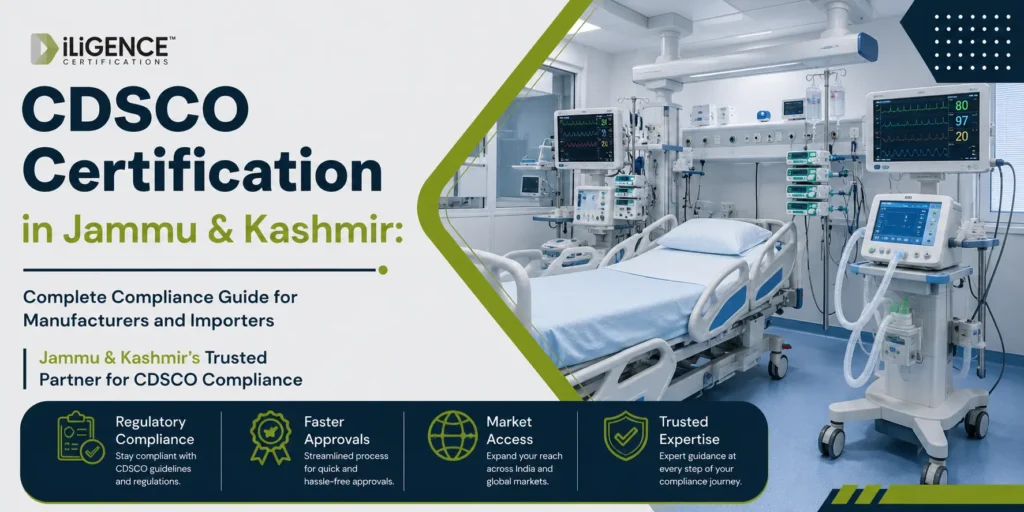
By - CDSCO Certification in Jammu & Kashmir is required For regulated products (pharmaceuticals, medical devices, diagnostics, cosmetics) used in India, including those supplied in Jammu & Kashmir, a certificate from CDSCO (Central Drugs Standard Control Organization) is essential before market entry.
- CDSCO ensures that all products adhere to stringent safety and quality standards as laid out in the Drugs and Cosmetics Act, 1940.This includes submission and review via their official portal, SUGAM.
- By diligently following the correct classification, documentation, and application processes through SUGAM, manufacturers and importers can significantly reduce rejection rates and accelerate approvals, thereby unlocking market access in regions like Jammu & Kashmir smoothly and efficiently.
Introduction
Imagine this scenario: A medical device importer based in Srinagar sources a shipment of diagnostic kits that are internationally recognized, complete with robust manufacturing documentation and even CE markings. They aim to distribute these kits to major hospitals in Jammu & Kashmir, confident in the product’s quality. To their surprise and frustration, the shipment remains stalled at their distribution hub. Why? Because they lacked CDSCO certification for India.
This isn’t an isolated incident; it’s a reflection of the evolving healthcare landscape in Jammu & Kashmir. With advancing infrastructure in hospitals, a proliferation of private diagnostic centres, and growing patient demand, the need for quality healthcare products is on the rise. However, the regulatory environment often lags behind market growth. CDSCO certification is far more than a bureaucratic hurdle, it’s the indispensable key that grants legal passage for any pharmaceutical drug, medical device, diagnostic tool, or regulated cosmetic to reach and be marketed in India, including within Jammu & Kashmir. No approved, high-quality product can legally make its way to the market without this critical sign-off.
What exactly is CDSCO Certification?
CDSCO stands for the Central Drugs Standard Control Organization, an umbrella regulatory authority in India that oversees all drug and medical device related matters. CDSCO certification, in essence, is an official authorization confirming a product’s alignment with the essential standards of safety, quality, and clinical performance stipulated by Indian authorities prior to its market introduction.
The scope of CDSCO certification encompasses a wide range of products, namely:
Pharmaceutical preparations and formulations
Medical devices of all kinds (surgical, diagnostic, monitoring)
In-vitro diagnostic devices (IVDs)
Specific cosmetic items making health claims
Imported healthcare products of the above categories
The primary function of CDSCO is to safeguard the public by ensuring only clinically effective and safe products reach consumers and patients.
The Regulatory Ecosystem Backing CDSCO India
CDSCO operates under the overarching legal framework provided by the Drugs and Cosmetics Act, 1940, functioning under the purview of the Ministry of Health and Family Welfare.
Its regulatory structure is layered and complex, involving multiple entities:
- The Central Authority - The Drug Controller General of India (DCGI) leads the final approval process for significant drugs and medical devices.
- Zonal and Sub-Zonal Offices - Responsible for on-ground inspections, audits, and compliance checks.
- State Licensing Authorities - Coordinate directly with local manufacturers and ensure adherence to regional compliance rules.
- SUGAM Portal - A centralized online system dedicated to processing applications, tracking progress, and facilitating communication between manufacturers, importers, and CDSCO officials.
The entire submission and tracking procedure for those in Jammu & Kashmir is now fully digital, emphasizing the accuracy and completeness of documentation over sheer volume of paperwork.
The Significance of CDSCO Certification in Jammu & Kashmir
Jammu and Kashmir has witnessed tremendous growth in its healthcare infrastructure, marked by the emergence of numerous new hospitals, expanding diagnostic chains, and thriving private healthcare facilities. With this development, there’s an inevitable rise in the demand for sophisticated, regulated medical products. Simultaneously, this growth is attracting greater regulatory attention.
CDSCO certification is fundamental in this context because it provides
Legal authorization to market and sell any regulated product within India, including Jammu & Kashmir.
Reassurance of patient safety and efficacy for end-users.
The prerequisite for tender bids and procurement contracts from government and private hospitals.
A framework for seamless interstate distribution across India.
Assurance of compliance with national healthcare standards and benchmarks.
Put simply, without this official clearance, a product simply doesn’t exist legally in the Indian market.
Who Needs CDSCO Certification in Jammu & Kashmir?
CDSCO certification is essential for several different business categories operating within Jammu & Kashmir or serving its market:
1. Manufacturers Local production units located in Jammu or adjacent industrial regions must secure CDSCO certification for their products prior to distribution.
2. Importers For international manufacturers looking to introduce their products into the Indian market, CDSCO certification is obtainable through a registered Indian Authorized Agent.
3. Diagnostic Laboratories Any diagnostic lab employing regulated in-vitro diagnostic (IVD) kits must ensure these kits have received appropriate CDSCO approval.
4. Healthcare Distributors If a distribution company handles a range of regulated medical devices, drugs, or cosmetics in Jammu and Kashmir, they must verify the upstream CDSCO compliance of all products.
Each of these groups faces specific documentation and regulatory requirements based on their role in the supply chain.
Classification of Medical Devices for CDSCO
CDSCO categorizes medical devices based on their perceived risk:
| Class | Risk Level | Devices Included | Examples | Regulatory Requirement |
| Class A | Low Risk | Basic medical and safety devices | Thermometers, bandages, simple surgical instruments, standard disposables | Minimal documentation and low regulatory scrutiny |
| Class B | Low to Moderate Risk | Routine diagnostic and basic therapeutic devices | Diagnostic reagents, suction apparatus, physiotherapy equipment, patient monitoring instruments | Moderate documentation and testing requirements |
| Class C | Moderate to High Risk | Advanced diagnostic and therapeutic devices | Infusion pumps, imaging equipment (X-ray, ultrasound), complex surgical instruments, diagnostic tools | Rigorous testing, validation, and regulatory review |
| Class D | High Risk | Life-supporting and implantable devices | Stents, artificial joints, ventilators, cardiac pacemakers, critical care systems | Highest level of scrutiny, detailed clinical and safety evaluation |
These are the most heavily scrutinized devices and undergo extensive clinical evaluation.
Incorrect classification is a frequent pitfall that can lead to immediate rejection or lengthy delays.
The CDSCO Certification Journey: Step by Step
The process of obtaining CDSCO certification, although well-defined, can be intricate. Here’s a typical workflow:
Step 1:
Product Assessment and Classification The very first step involves evaluating the product’s function and potential risk to determine its precise regulatory classification.
Step 2:
Compilation of Technical Dossier A comprehensive file is assembled, detailing the product’s design, functionality, safety specifications, performance data, and quality management systems.
Step 3:
Application Submission via SUGAM Portal All compiled documents are uploaded digitally to the SUGAM portal for the regulatory authorities’ review.
Step 4:
Scrutiny of the Application The authorities meticulously examine the submitted documents for completeness, technical accuracy, and compliance.
Step 5:
Clarification Requests If any discrepancies or missing information are found, CDSCO issues queries to the applicant, requiring detailed responses.
Step 6:
Final Evaluation and Approval Once all queries are satisfactorily addressed and the technical dossier is deemed compliant, CDSCO issues either a manufacturing license or a product approval certificate.
Key Documents Needed for CDSCO Certification
A successful CDSCO application hinges on the submission of a complete set of accurate documents, including:
| S. No. | Document Type | Description / Purpose |
| 1 | Manufacturing License | Required for domestically produced goods to confirm legal manufacturing approval. |
| 2 | Device Master File (DMF) | Detailed technical document containing product design, composition, and manufacturing information. |
| 3 | Factory / Plant Layout & Process Flow | Shows manufacturing setup, infrastructure, and step-by-step production process. |
| 4 | Quality Management System (ISO 13485) | Certification ensuring compliance with international quality standards for medical devices. |
| 5 | NABL Test Reports | Laboratory testing reports from accredited labs confirming product safety and performance. |
| 6 | Clinical Evaluation Reports (CER) | Evidence of clinical safety, efficacy, and performance of the product (if applicable). |
| 7 | Label & Packaging Artwork | Demonstrates compliance with Indian labeling and packaging regulations. |
| 8 | Indian Authorized Agent Agreement | Defines responsibilities of the Indian representative for foreign manufacturers. |
| 9 | Company Legal Documents | Includes incorporation certificate and legal registration proof of the company. |
| 10 | Technical Specifications & User Manual | Detailed product specifications, instructions for use, and operational guidelines. |
In Jammu and Kashmir, as elsewhere, incompleteness in documentation is by far the most common reason for delays.
Common Reasons for CDSCO Rejection
Even well-designed and high-quality products can be denied CDSCO certification.
Frequently encountered rejection reasons include:
| S. No. | Reason for Rejection | Explanation |
| 1 | Incorrect Product Classification | Applicant assigns wrong risk class or device category, leading to regulatory mismatch. |
| 2 | Incomplete Technical Dossier | Missing or insufficient technical documentation such as product details, design data, or safety information. |
| 3 | Non-Compliant Labeling Claims | Misleading, unverified, or non-standard claims on packaging and labels that violate CDSCO norms. |
| 4 | Missing Indian Authorized Agent | Foreign manufacturers fail to appoint a valid Indian Authorized Agent for regulatory representation. |
| 5 | SUGAM Portal Errors | Technical mistakes during online submission such as incorrect forms, missing fields, or upload issues. |
| 6 | Invalid Test Reports | Use of outdated reports or reports from non-NABL accredited laboratories. |
| 7 | Procedural Non-Compliance | Most rejections occur due to documentation and process errors rather than actual product safety issues. |
What Influences the Duration of CDSCO Approval?
The timeline for CDSCO approval varies considerably, as there’s no fixed duration.
Factors influencing the pace of approval include:
- The product’s risk classification (lower risks typically progress faster).
The quality and comprehensiveness of the submitted documentation.
The lead time required for product testing.
The applicant’s response time to queries from CDSCO.
The current workload and review backlog within CDSCO offices.
A well-prepared application package can significantly shave months off the overall processing time.
The Central Role of the SUGAM Portal in CDSCO Compliance
The Imperative of Documentation Accuracy
CDSCO compliance transcends merely completing a form; it demands rigorous technical and regulatory discipline. Common oversights include:
Incorrectly categorizing the product.
Non-standard formats used in the technical file.
Inconsistencies in manufacturer details between documents.
Gaps in validation and testing data.
Even small inaccuracies can result in delays spanning weeks or months.
The Commercial Repercussions of CDSCO Certification for Businesses in Jammu & Kashmir
Obtaining a CDSCO certification has a direct and tangible impact on a business’s viability:
- It allows access to government and private hospital procurement.
It instills confidence in distributors and healthcare providers.
It opens doors for wider interstate sales across India.
It bolsters the credibility and reputation of the brand.
It minimizes legal risks and penalties.
Without official certification, a quality product remains effectively off the market, unable to generate revenue or establish a market presence in Jammu and Kashmir and across India.
How CDSCO Expertise Matters
You may find it challenging to recognize how complex the CDSCO certification process may appear for the first time. These areas may require help:
- Regulatory analysis of different documents and records
- Defining product features to assign appropriate risks
- Appropriate method of writing a technical documentation
- Coordination with the lab for necessary testing
- The correct process for filing your application in the CDSCO online portal, ensuring the submission’s accuracy
There’s only so much the process involves, and the compliance strategies implemented to secure certifications shorten approval times and lessen the probability of any application getting rejected.
How Diligence Certifications Aids in CDSCO Compliance in Jammu & Kashmir
We, at Diligence Certifications, assist your journey in achieving end-to-end compliance under the CDSCO, with our services:
- assistance in product classification for you
- Product Technical File preparation in accordance with the CDSCO guidelines
- Provision of SUGAM Portal Filing Support
- Professional assistance to manage and respond to CDSCO Queries
- Comprehensive regulatory advice for drug products and medical devices
Conclusion
CDSCO certification in Jammu & Kashmir is a non-negotiable requirement that facilitates the market entry of pharmaceutical, diagnostic, or medical devices business in Jammu and Kashmir. By securing proper approvals, you can ensure product quality, safety, and meet nationwide standards, allowing you to commence your operations in the Indian market seamlessly.
Therefore, it’s crucial to approach CDSCO certification as a regulatory process.
With well-defined steps in the direction of proper classification, documented process, and mindful execution, you minimize any potential risks or delays caused by inaccurate filings and thereby can quickly gain market access. The best approach towards a swift and streamlinedCDSCO certification journey lies in professional expertise that handles the process with efficiency and precision.
Frequently Asked Questions
Is CDSCO needed in Jammu and Kashmir?
Ans: Yes.
The central regulatory authority mandates approval in all Indian states and union territories, including J&K.
What is CDSCO certification?
Ans: CDSCO certification refers to a mandatory process of approving medical products and medicines before entering the Indian market.
Who provides the authority for CDSCO approvals?
The Central Drugs Standard Control Organization, under the Ministry of Health, issues the final authorization.
What is the SUGAM portal?
The online portal managed by the Central Drugs Standard Control Organization where applications can be filed and tracked.
What kind of products must undergo CDSCO authorization?
Primarily drugs, medical devices, diagnostics products, and selected cosmetic products must have CDSCO approval.
Is testing mandatory for CDSCO?
Yes ,The product requires testing in an NABL accredited lab.
Can a foreign company obtain a CDSCO certification?
Yes.
A foreign company can get CDSCO approved by working with an Indian Authorized Agent. Q8: What reasons lead to the rejection of a CDSCO application?
Ans: Main culprits for CDSCO application rejection are incorrect classification of a product and incomplete or improper documentation.
What is the estimated time for CDSCO approval?
The total timeframe varies based on product complexity and accuracy.
Is the CDSCO approval valid across all of India?
Once approved, your medical or drug product receives nation-wide recognition by the CDSCO.
How can businesses obtain CDSCO Certification in Jammu & Kashmir?
Businesses can obtain CDSCO Certification in Jammu & Kashmir by identifying the correct product classification, preparing the required technical documents, completing registration through the SUGAM portal, and complying with CDSCO regulations. Manufacturers and importers must ensure that all documentation, testing reports, and quality certifications meet the requirements prescribed by the Central Drugs Standard Control Organization before approval is granted.