BIS Certification
 CDSCO
CDSCO
 PESO
PESO
 CPCB
CPCB
 LMPC
LMPC
 WPC Approval
 Global Approvals
 TEC
TEC
 ARAI
ARAI
 BEE
BEE
 ISO Certification
 DGCA Certification
 NOC For Steel
 APEDA Registration























 Business Registration
 FSSAI Mark Certification












 (32).jpg)
 Legal Services
 Trademark Registration
 Copyright Registration
 Patent Registration
 By
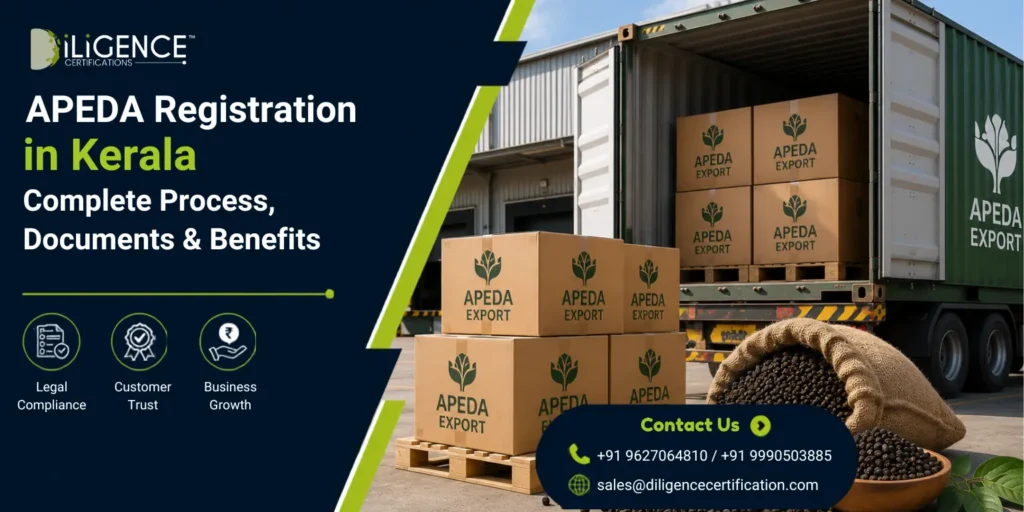
By - APEDA registration in Kerala is mandatory for businesses involved in exporting scheduled agriculture and processed food products from India.
- The exporters are issued an APEDA Registration and Membership Certificate (RCMC) that provides them with access to various government export promotion schemes and international markets.
- This guide will cover how you can register, including requirements, cost, benefit etc
Introduction
In the last year, a manufacturer of spices from the city of Kochi contacted us after being approached by a buyer in Germany through an enquiry. The exporter had good products, proper packing, and even an IEC issued by DGFT. Nevertheless, the export order could not move ahead as the buyer demanded an APEDA Registration Cum Membership Certificate (RCMC).
The exporter thought that an Import Export Code (IEC) would be sufficient to start international business. Similar to other exporters, he did not know that exporting of scheduled agricultural and processed food products required APEDA registration in Kerala in accordance with the Indian Export Regulations.
Such situations are more frequent than people tend to realize.
Kerala has acquired a solid reputation in international agricultural exports. From premium spices and tea to coffee, coconut products, processed fruits, vegetables, and other value added food products, products from Kerala have been exported to buyers from Europe, Middle East, North America, and Southeast Asia. With the increasing demands of the international market, regulatory compliance became as essential as the product itself.
APEDA Registration becomes necessary for business firms willing to export scheduled products.
If you are an exporter, manufacturer, start-up, farmer producer organization (FPO), or food processing unit, knowing the registration procedure will help you avoid unnecessary delays.
In this article, we have covered all the details related to APEDA Registration in Kerala such as eligibility, necessary documents, procedure, fee, validity, and much more.
Why is Kerala an Important Export State?
Kerala is a big contributor to agricultural and processed food exports from India. Its pleasant climate, presence of processing industries and well-connected ports make it one of the biggest exporters from India.
Some of the major items exported by Kerala include:
- Black Pepper
- Cardamom
- Nutmeg
- Cinnamon
- Cloves
- Coffee
- Tea
- Coconut Oil
- Virgin Coconut Oil
- Desiccated Coconut
- Banana Products
- Jackfruit Products
- Processed Fruits
- Vegetable Products
- Cashew Products
- Value-added Food Products
With the help of ports like Kochi to cater to the needs of the international market, exporters from Kerala continuously export their products to over 100 countries.
But prior to exporting these products, companies have to go through the process of APEDA Registration and get RCMC from APEDA.
What is APEDA?
The APEDA (Agricultural and Processed Food Products Export Development Authority) is a statutory body formed by the Government of India as per the APEDA Act, 1985.
The main aim of APEDA is to facilitate the exports of scheduled agricultural and processed food products through registration, quality development, export promotion, financial assistance, infrastructure, marketing and brand development.
After the registration process is done, the exporter is given the RCMC (Registration Cum Membership Certificate).
In addition to registration, APEDA also assists the exporter in:
- Promoting Indian food products in global markets
- Assisting exporters in quality improvement
- Encouraging traceability systems
- Supporting packaging development
- Facilitating participation in international trade fairs
- Promoting organic exports
- Developing export infrastructure
For exporters aiming to establish long-term international business, APEDA plays a crucial role in improving global competitiveness.
Who Needs APEDA Registration in Kerala?
Not every exporter requires APEDA Registration. It is specifically applicable to businesses dealing with products listed under APEDA’s scheduled products.
Businesses commonly requiring APEDA Registration include:
- Spice exporters
- Coconut product exporters
- Fruit exporters
- Vegetable exporters
- Processed food manufacturers
- Pickle manufacturers
- Honey exporters
- Bakery product exporters
- Herbal product exporters
- Organic food exporters
- Rice exporters
- Millet exporters
- Floriculture businesses
- Food processing companies
- Merchant exporters
Even businesses exporting through online B2B marketplaces should verify whether their products fall under APEDA’s scheduled list before initiating exports.
Who is Eligible for APEDA Registration in Kerala?
One of the most common misconceptions among first-time exporters is that APEDA Registration is only meant for large companies. In reality, businesses of different sizes can apply, provided they deal with products covered under the APEDA Act.
You may be eligible if you are:
- Manufacturer exporter
- Merchant exporter
- Partnership firm
- Private Limited Company
- LLP
- Proprietorship
- Farmer Producer Organisation (FPO)
- Cooperative Society
- Food processing company
- Export house
- MSME engaged in scheduled agricultural or processed food products
The primary requirement is that your business exports or intends to export products notified under APEDA’s scheduled product list.
For businesses in Kerala, this often includes exporters dealing in:
- Spices
- Coconut products
- Tea
- Coffee
- Honey
- Fruits
- Vegetables
- Processed foods
- Pickles
- Bakery products
- Organic food products
- Floriculture products
If your export portfolio contains scheduled products, obtaining APEDA Registration in Kerala should be one of the first compliance steps after securing your Import Export Code (IEC).
Prerequisites Before Applying
Before starting your application, ensure these registrations are already in place:
Import Export Code (IEC)
An IEC issued by DGFT is mandatory. In July 2023, APEDA issued the Registration Cum Membership Certificate (RCMC) through the DGFT e-RCMC system, making a valid IEC a prerequisite.
PAN
The business must have a valid Permanent Account Number linked with its legal entity.
Bank Account
The bank account should be in the name of the business applying for registration.
Business Constitution
The constitution of the business-such as Proprietorship, LLP, Partnership, or Company-should be clearly established through relevant incorporation documents.
Documents Required for APEDA Registration in Kerala
Preparing documents in advance significantly reduces the chances of delays.
Typically, the following documents are required:
Mandatory Documents
- Import Export Code (IEC)
- PAN Card
- GST Registration (where applicable)
- Cancelled cheque or bank certificate
- Business address proof
- Email ID
- Mobile number
- Digital copies of authorised signatory details
Additional Documents (where applicable)
Depending on the products exported, APEDA may require proof of registration with the relevant authority-for example, FSSAI for processed foods and dairy, or other competent agencies for specific product categories. These requirements are outlined in the APEDA registration procedure.
Step-by-Step APEDA Registration Process in Kerala
The registration process has become considerably more streamlined with online filing.
Step 1 - Obtain an IEC
If your business does not already have an Import Export Code, apply for it through DGFT. Without an IEC, you cannot proceed with APEDA registration.
Step 2 - Access the e-RCMC Portal
Submit the application for an APEDA Registration Cum Membership Certificate (RCMC) through the DGFT e-RCMC portal, as prescribed by APEDA.
Step 3 - Complete Business Details
Provide accurate information such as:
- Business name
- Constitution
- Registered office address
- Factory address (if applicable)
- Bank details
- IEC details
- Contact information
Even minor errors in the application can result in queries from the authority.
Step 4 - Submit Required Documents
Submit the required documents as per the specified guidelines.
Make sure that:
- Documents are clear
- Document scans are readable
- File size is as per the portal guidelines
- Names in the document are consistent
Step 5 - Payment of Registration Fee
After the verification of the documents, you need to pay the required APEDA registration fee. Usually, APEDA has prescribed the APEDA registration fee at ₹5,000 plus GST, but one should check the same from the portal itself.
Step 6 - Processing of the Application
The APEDA processes the submitted application.
If the APEDA needs more information from you, then you will get a request from the APEDA.
Step 7 - Issue of the RCMC
If your application gets approved, then you will get the RCMC certificate from APEDA.
How Much Time Does It Take To Get APEDA Registration?
Time taken depends on:
- Accuracy of documentation
- Workload at the portal
- Completion of application
- Response to the clarifications
Applications that have complete and accurate documentation are processed very quickly compared to applications that require revisions.
APEDA Registration Fees
Applicants should budget for:
- APEDA registration fee
- Applicable GST
- Professional consultancy charges (if engaging a consultant)
The official fee structure should always be confirmed on the APEDA portal before making payment.
Validity of APEDA Registration
The validity of the APEDA Registration-cum-Membership Certificate (RCMC) is determined according to the latest guidelines issued by APEDA and the Directorate General of Foreign Trade (DGFT). Once granted, the registration remains valid unless it is cancelled, suspended, or voluntarily surrendered by the exporter. Businesses must comply with all applicable APEDA regulations and export requirements during the validity period. Exporters should regularly monitor official APEDA and DGFT notifications for any updates regarding renewal, compliance requirements, or changes in validity rules to ensure uninterrupted export operations.
Common Reasons for Application Delays
From a consultancy perspective, most delays arise from avoidable issues rather than complex legal problems.
The most frequent reasons include:
- Incorrect IEC details
- Mismatch in business names
- Invalid bank certificate
- Unclear document uploads
- Wrong product category selection
- Incomplete address details
- Expired supporting documents
- Incorrect email or mobile number
A careful document review before submission can prevent most of these issues and reduce processing time.
Benefits of APEDA Registration in Kerala
Many exporters view APEDA Registration as a regulatory requirement. It is also a tool which helps businesses in enabling their operations. The APEDA Registration Kerala helps in improving the credibility with foreign purchasers and gaining access to export promotional schemes backed by the government.
APEDA registration helps businesses in Kerala involved in the exports of spices, coconuts, tea, coffee, food products, fruit, and vegetables, in growing their exports in the long run.
1. Gains the Confidence of International Buyers
While selecting a supplier for the first time, compliance comes into the picture prior to pricing. Possessing an APEDA Registration Cum Membership Certificate (RCMC) reflects that you are a recognized entity in the agricultural exports of India.
2. Access to Export Promotion Schemes
APEDA periodically implements export promotion programmes to enhance the competitiveness of Indian agricultural products in global markets.
Registered exporters may become eligible for support related to:
- Export infrastructure development
- Quality improvement
- Packaging enhancement
- Branding initiatives
- International trade fairs
- Market development programmes
The availability and eligibility of specific schemes depend on APEDA’s prevailing guidelines and notifications.
3. Better Market Acceptance
There is an increasing trend among international buyers for suppliers who adhere to regulations and standards.
From cardamom exports to Saudi Arabia to processed coconut exports to Germany, there will always be a demand for documents showing adherence to regulations.
An APEDA registration could facilitate negotiations with potential suppliers.
4. Participation in International Trade Exhibitions
APEDA regularly supports Indian exporters by organising or facilitating participation in:
- International food exhibitions
- Buyer-seller meets
- Export promotion events
- Trade delegations
- Product showcases
These platforms help businesses establish new overseas partnerships and explore emerging export markets.
5. Improved Export Documentation
Registered exporters generally become more structured in maintaining export records.
This includes:
- Product documentation
- Shipment records
- Traceability
- Quality certifications
- Export invoices
- Packing details
A disciplined documentation process reduces compliance risks and supports smoother customs clearance.
Why Kerala Exporters Benefit the Most
Kerala is one of the largest producers of coconut products in India.
Some of the items that are regularly exported are:
- Virgin Coconut Oil
- Coconut Oil
- Desiccated Coconut
- Coconut Milk Powder
- Coconut Water
- Coconut Chips
- Coconut Flour
- Tea and Coffee
Kerala is one of the leading states in the production of tea and coffee in India.
Roasted coffee, gourmet coffee, and tea are a few of the value-added products that have continued to find favor with foreign buyers.
Fruits and Vegetables
The exportable items are:
- Banana
- Jackfruit
- Pineapple
- Mango
- Vegetables (fresh)
- Vegetables (frozen)
- Fruit pulp (processed)
Processed Food Products
Kerala has a fast-growing industry in the processing of food products.
The items that are usually exported are:
- Pickles
- Ready-to-eat food
- Bakery products
- Fruit juices
- Frozen foods
- Spices
- Kerala snacks
The above industries gain from the emphasis on quality and branding by APEDA.
Common Mistakes Exporters Should Avoid
From helping exporters in various sectors, it becomes clear that many registration delays occur due to avoidable errors rather than legal complications.
Filing Without an IEC
It is essential to have an Import Export Code before applying for APEDA Registration.
There are instances where novice exporters file for the APEDA process without an IEC.
Incorrect Product Category Selection
Companies tend to register for the wrong categories of products.
Such registrations will lead to delays and changes in registration later.
Submission of Low-Quality Documents
Sometimes documents such as blurry scans, incomplete bank documents, or illegible certificates make you go through the clarification process.
Please submit all the documents in high quality.
Not Taking Note of Consistency in Documents
Business Name needs to be consistent among:
- PAN
- IEC
- Bank Account
- GST registration, if any
- Incorporation document
Even the small difference in punctuations can cause avoidable delays.
Awaiting Export Order Before Applying for Registration
There are companies who register only after the procurement order comes.
This method causes delays in the shipment schedule.
APEDA Registration beforehand will help you be ready for exporting.
Why Choose Diligence Certifications for APEDA Registration?
Applying through the portal is only one part of the process. Ensuring that your documentation is complete and accurate can significantly reduce the chances of delays or repeated queries.
At Diligence Certifications, we assist exporters with end-to-end APEDA registration support, including:
- Eligibility assessment
- Document verification
- Application preparation
- Online filing assistance
- Query resolution
- Guidance on export compliance
- Support for first-time exporters and established businesses
Our objective is to simplify the registration process so businesses can focus on expanding into international markets.
Conclusion
Kerala has distinguished itself as one of the major export destinations in India for top quality spices, coconuts, tea, coffee, processed food, fruits, and vegetables. With growing global business activity, there is an absolute necessity of regulatory compliance to succeed in an export business.
Getting an APEDA Registration in Kerala is not just a process of meeting certain criteria; it builds the business credibility, ensures buyer confidence, and makes the company eligible for various export promotion programs. Whatever type of company - a startup or experienced exporter, getting an APEDA Registration at the right time will ensure the successful development.
Diligence Certifications experts can provide professional guidance on getting an APEDA Registration in Kerala from start to finish - from verifying documents, filling out applications to answering queries.
Frequently Asked Questions
What is APEDA Registration in Kerala?
APEDA Registration in Kerala is the Registration-Cum-Membership Certificate (RCMC) required for exporting scheduled agricultural and processed food products.
Who needs APEDA Registration in Kerala?
Manufacturers, merchant exporters, food processors, FPOs, and businesses exporting APEDA-scheduled products generally require this registration.
Is APEDA Registration mandatory in Kerala?
Yes, it is mandatory for businesses exporting products covered under the APEDA Schedule.
What documents are required for APEDA Registration?
You generally need an IEC, PAN, GST (if applicable), business registration proof, bank details, and address proof.
How can I apply for APEDA Registration in Kerala?
You can apply online through the APEDA e-RCMC portal by submitting the required documents and paying the prescribed fee.
How much is the APEDA Registration fee?
The government registration fee is generally ₹5,000 plus applicable GST, subject to any updates by APEDA
How long does APEDA Registration take?
The processing time depends on the accuracy of the application and successful document verification.
What are the benefits of APEDA Registration in Kerala?
It improves export credibility, supports regulatory compliance, and provides access to APEDA's export promotion initiatives, where applicable.
Which products require APEDA Registration?
Products such as spices, tea, coffee, coconut products, fruits, vegetables, processed foods, honey, dairy products, and other scheduled products require APEDA Registration.
Can Diligence Certifications help with APEDA Registration?
Yes, Diligence Certifications provides end-to-end assistance with documentation, application filing, compliance guidance, and query resolution.