BIS Certification
 CDSCO
CDSCO
 PESO
PESO
 CPCB
CPCB
 LMPC
LMPC
 WPC Approval
 Global Approvals
 TEC
TEC
 ARAI
ARAI
 BEE
BEE
 ISO Certification
 DGCA Certification
 NOC For Steel
 APEDA Registration























 Business Registration
 FSSAI Mark Certification












 (32).jpg)
 Legal Services
 Trademark Registration
 Copyright Registration
 Patent Registration
 By
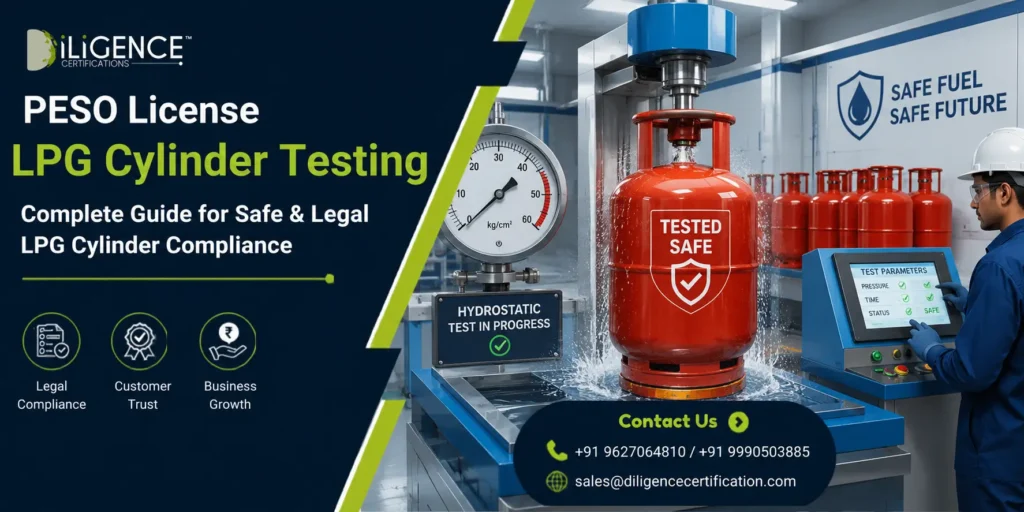
By - LPG Cylinder Testing and Certification guarantees that all safety standards related to LPG cylinder inspection, testing, and certification are met.
- LPG Cylinder Testing and Certification assists companies in ensuring the safe, reliable, and compliant use of LPG cylinders.
- Seek professional help in LPG Cylinder Testing and Certification with full support for documentation and inspection.
Introduction
LPG cylinders have a broad range of application in domestic, commercial, and industrial spheres for storing and delivering liquefied petroleum gas. Given the high flammability of this fuel type, all LPG cylinders require constant inspection and testing in order to be deemed safe for further usage. Testing allows discovering defects, preventing accidents and making sure that all necessary safety requirements are met.
LPG Cylinder Testing and Certification is an obligatory compliance requirement for those facilities which deal with inspection, testing, repair, and certification of LPG cylinders. This certificate proves that LPG cylinders comply with technical and safety standards before they can be put into circulation again.
Getting LPG Cylinder Testing and Certification is beneficial both from the point of view of legal compliance and operational safety.
What is LPG Cylinder Testing and Certification?
LPG Cylinder Testing and Certification refers to the Petroleum and Explosives Safety Organization authorization issued to the duly designated testing stations to test and certify LPG cylinders as per the relevant safety standards for petroleum.
Before issuing the certificate, the competent authority looks at various issues related to the testing stations, such as testing equipment, inspection processes, qualified personnel, safety measures, calibration process, quality control, among others.
The certificate proves that the testing station is able to conduct inspections and tests of LPG cylinders as required by the regulations. It is a very important process as it ensures that LPG cylinders that are safe for use are employed in the storage and transportation of gases.
Who Needs LPG Cylinder Testing and Certification?
Testing, requalification, inspection, maintenance, or certification of LPG cylinders normally requires the organization to acquire LPG Cylinder Testing and Certification prior to engaging in business operations. This depends on certain things like the type of testing done, the facilities available, testing equipment, and other regulatory guidelines.
Some of the commonly known organizations that require LPG Cylinder Testing and Certification include:
- LPG Cylinder Testing Stations
- LPG Cylinder Requalification Stations
- LPG Cylinder Inspection Stations
- LPG Cylinder Repair and Testing Stations
- LPG Cylinder Refurbishment Stations
- LPG Cylinder Manufacturing Firms
- LPG Bottling Plants
- LPG Distribution Firms
- Industrial Gas Cylinder Testing Stations
- Approved LPG Cylinder Maintenance Stations
- Oil Marketing Firms
- LPG Cylinder Services
- Government Approved Cylinder Testing Stations
- Expansion or modification of existing LPG Cylinder Testing Stations
Whether setting up a new station or enhancing an existing one, it is always important to acquire LPG Cylinder Testing and Certification.
Types of LPG Cylinder Testing and Certification
Requirements for certification vary depending on the testing facility, operations conducted at it, and services provided to LPG cylinders. Choosing the right kind of certification would make sure the petroleum safety laws are complied with and safe cylinder testing is conducted efficiently.
This certification must be obtained by those testing facilities that inspect and test LPG cylinders prior to their approval for future use.
Applicable for:
- LPG Cylinder Testing Facility
- LPG Cylinder Inspection Center
- LPG Cylinder Testing Facility
- LPG Cylinder Requalification Unit
- LPG Cylinder Testing Centers
LPG Cylinder Testing and Repair Facility Certification
The LPG cylinder repair center certification is required for organizations that carry out cylinder inspection, together with cylinder repair, maintenance, and requalification before certifying the LPG cylinders for use.
Applicable To:
- LPG Cylinder Repair Centers
- Cylinder Refurbishment Centers
- LPG Cylinder Maintenance Centers
- LPG Cylinder Service Centers
- Authorized Cylinder Repair Centers
LPG Cylinder Testing Facility with Associated Equipment Certification
It applies to facilities fitted with hydrostatic testing equipment, valve test equipment, leakage detection system, drying equipment, calibration equipment, and others. It ensures that all the testing equipment is in compliance with the technical and safety standards.
Applicable To:
- LPG Cylinder Test Facilities
- Hydrostatic Testing Facilities
- Cylinder Valve Test Facilities
- LPG Cylinder Inspection Facilities
- Large-Scale LPG Cylinder Test and Certification Facilitie
Importance & Benefits of LPG Cylinder Testing and Certification
| Importance | Benefits |
| Ensures compliance with applicable safety regulations for the inspection, testing, and certification of LPG cylinders. | Helps build trust among regulatory authorities, LPG distributors, commercial users, and business partners through regulatory compliance. |
| Provides legal authorization to inspect, test, and certify LPG cylinders in accordance with prescribed technical and safety standards. | Enhances the credibility and professional reputation of the organization in the LPG and petroleum industry. |
| Promotes safe handling, inspection, maintenance, and certification of LPG cylinders to minimize operational risks. | Supports uninterrupted business operations by reducing compliance-related issues and regulatory interruptions. |
| Helps maintain proper testing equipment, calibrated instruments, safety procedures, and quality control systems. | Reduces the risk of penalties, legal complications, or operational restrictions arising from non-compliance. |
| Protects workers, customers, LPG cylinders, storage facilities, and surrounding property from potential hazards. | Simplifies future approvals, renewals, facility upgrades, and expansion of testing operations. |
| Ensures that testing equipment, inspection procedures, hydrostatic testing systems, and associated facilities comply with approved technical standards. | Demonstrates the organization’s commitment to safety, quality assurance, and responsible LPG cylinder testing practices. |
Documents Required for LPG Cylinder Testing and Certification
The documents required for LPG Cylinder Testing and Certification would depend upon the type of testing facility, activities undertaken, regulations applicable, and certifications required. The following are generally required in the process of certification:
Identity proof of the applicant (Aadhaar Card, PAN Card, Passport or any other valid identity proof)
- Photograph of the applicant in passport size
- Proof of address of the applicant and his business place
- Documents related to business registration (Proprietorship, Partnership, LLP or Company)
- Certificate of Incorporation, if any
- Proof of ownership, lease or rent of testing facility
- Site plan and drawings of the testing facility approved
- Details of the testing machines, hydrostatic testing machine, and calibration equipment
- Calibration certificates of the equipment
- Details of qualified and trained personnel conducting the test
- Fire safety approval and fire fighting equipment details
- Electrical safety approval and installation report
- Standard Operating Procedure for conducting cylinder testing
- Quality control procedures and inspection records
- Emergency plan and safety management plan
- Environment clearance/NOC, if any
- Declaration regarding compliance with petroleum safety regulations, if any
Depending upon the nature of testing facility, more documentation may be asked by the relevant authority at the time of verification.
LPG Cylinder Testing and Certification Step-by-Step Process
Acquisition of LPG Cylinder Testing and Certification can be made very easy if the necessary documents, technical infrastructure, and safety precautions are in place. It is necessary to follow an organized approach to get LPG Cylinder Testing and Certification done in a smooth way.
Step 1 : Identification of Certification Requirement
This step involves identification of certification requirement in accordance with the nature of testing facilities, kind of services offered, equipment used, and petroleum safety requirements.
Step 2: Preparation of Necessary Documents
Prepare all the necessary business documents, technical specifications, safety precautions, and other documents prior to making an application.
Step 3: Application of Certificate
Make an application for LPG Cylinder Testing and Certification.
Step 4: Document Verification
The concerned authority reviews the submitted application and supporting documents. If any clarification or additional information is required, the applicant must provide it within the prescribed timeframe.
Step 5: Technical Inspection of Testing Facility
Technical inspection can be carried out in the testing facility to authenticate the testing instruments, calibration, hydrostatic testing equipment, testing process, safety provisions, quality control, and other technical aspects.
Step 6: Certification Approval
Following the successful verification of documents and technical inspection of the facility, the relevant authority approves the testing and certification of LPG cylinders.
Step :7 Certification
Following certification, the testing facility is authorized to perform testing and certification of LPG cylinders in accordance with the specified regulations and guidelines.
Timeline, Cost & Validity of LPG Cylinder Testing and Certification
The timeline, cost, and validity of LPG Cylinder Testing and Certification depend on several factors, including the type of testing facility, scope of operations, technical evaluation, document verification, inspection requirements, and compliance with applicable petroleum safety regulations.
| Timeline | Cost | Validity |
| The certification timeline depends on document verification and technical evaluation. | The cost depends on the type of LPG Cylinder Testing and Certification required for the facility. | The validity depends on the applicable petroleum rules and certification conditions. |
| Facility inspection and technical compliance assessment may influence the overall processing period. | Government application fees and professional consultancy charges may apply. | Renewal is required within the prescribed period to continue legal operations. |
| Complete and accurate documentation helps avoid unnecessary delays during the certification process. | Additional expenses may vary depending on technical requirements, inspections, and compliance obligations. | The testing facility must continue complying with prescribed safety and technical standards throughout the validity period. |
| Processing time may vary depending on the complexity and operational scale of the testing facility. | Proper planning and documentation help manage the overall certification cost efficiently. | Maintaining updated records and continuous compliance supports a smooth renewal process |
Why is LPG Cylinder Testing and Certification Important?
The Importance of LPG Cylinder Testing and Certification is vital as LPG cylinders are the means for storing hazardous liquefied petroleum gas, which needs to be handled safely at all times. Due to wear and tear with the passage of time, LPG cylinders may get affected by corrosion, dents, cracks, faulty valves, and similar issues that make them unsafe to use.
An authorized testing facility carries out tests following an approved procedure and using equipment that is well-calibrated. The chances of any accidents occurring are greatly reduced by such a process.
Why LPG Cylinder Testing and Certification is highly necessary:
- Ensures safety during inspections and testing of LPG cylinders.
- Ensures that businesses abide by petroleum safety guidelines and standards.
- Decreases the probability of gas leakage, fire, failure of LPG cylinders, and accidents.
- Improves the trust of the regulatory authority, LPG cylinder providers, and consumers.
- Promotes the safe and smooth delivery of LPG cylinders.
Consequences of Operating an LPG Cylinder Testing Facility Without Certification
A business enterprise conducting LPG cylinder testing without being certified poses various dangers. Because LPG is a very flammable product, failure to adhere to safety regulations may pose great danger to the workers, customers, the business itself, and neighboring properties.
Among the problems that may arise include:
- Action by the concerned authority.
- Restriction of testing and certification activities.
- Failure to comply with the appropriate petroleum safety regulations.
- Risk of gas leakages, cylinder failures, and accidents.
- Difficulties in getting future approvals and renewals.
- Damage to the business reputation and client trust.
- Getting LPG Cylinder Testing and Certification ensures that these dangers are avoided.
Renewal of LPG Cylinder Testing and Certification
LPG Cylinder Testing and Certification needs to be renewed within the validity period of the certificate in order to maintain the legal operation and safety of the testing station.
On the occasion of renewing the LPG Cylinder Testing and Certification, the competent authority may consider various factors related to the testing station such as:
- Information about the current certification.
- Adherence to petroleum safety standards.
- Condition and calibration of testing machinery.
- Records of maintenance for hydrostatic testing equipment and other machines used in the process.
- Fire protection measures.
- Quality control.
Modifications and improvements in the testing facility.
How Professional Assistance Helps in Obtaining LPG Cylinder Testing and Certification?
Requirements for obtaining LPG Cylinder Testing and Certification include proper documentation, technical compliance, equipment verification, regulation coordination, and finally, the successful inspection of the testing facility. Professional help makes the whole procedure easy since everything will be done in accordance with all the required standards.
Professional help will include:
- Knowledge about the appropriate certification requirements of the testing facility.
- Preparation, review, and organization of all required documentation.
- Verification of technical drawings and equipment and technical compliance.
- Help in filing the correct application for certification.
- Cooperation during document verification and technical inspection.
- Future renewals and amendments.
Professional help will ensure that companies receive LPG Cylinder Testing and Certification in the most convenient way possible.
Why Choose Diligence Certifications for LPG Cylinder Testing and Certification?
LPG Cylinder Testing and Certification demands knowledge about petroleum safety standards, technical specifications, inspection procedures, quality controls, and documentation. Diligence Certification facilitate certification of enterprises with proper compliance with all the regulations.
Advantages of professional consultancy are some of them which are:
- Less likelihood of document errors and application delay.
- Complete support in document preparation and submission for certification.
- Improved compliance with petroleum safety standards and technical specifications.
- Professional coordination with the respective authority for the entire process.
- Certification renewal and other future compliance issues.
Professional consultancy enables the enterprises to concentrate on their core business while the experts take care of the certification process.
Conclusion
LPG Cylinder Testing and Certification is a necessary condition for companies engaged in the inspection, testing, maintenance, and certification of LPG cylinders because this type of fuel is quite flammable, so each of them must be properly tested in authorized establishments to guarantee its safety in storage, transportation, and further use.
Obtaining LPG Cylinder Testing and Certification proves compliance with the relevant regulations and standards regarding petroleum safety, technical compliance, and inspection. Moreover, it contributes to the improvement of workplace safety, risk reduction, customer satisfaction, and the distribution of LPG cylinders.
This process includes correct documentation, technical analysis, inspection of the facility, and continuous compliance with the requirements. Periodic renewal and maintenance of the testing equipment guarantee legal and effective operation of the facility.
Professional help can make this whole process much easier by handling all issues related to documentation, regulation, compliance, and inspection. Thanks to professional assistance, companies can easily receive LPG Cylinder Testing and Certification.
Frequently Asked Questions
What is LPG Cylinder Testing & Certification?
LPG Cylinder Testing & Certification is the certification procedure through which the relevant authorities grant certification to eligible organizations for the inspection and testing of LPG cylinders as per the relevant petroleum safety norms and standards.
Is LPG Cylinder Testing & Certification Mandatory?
Yes. Organizations conducting inspection and testing of LPG cylinders need to have the relevant certifications as per the relevant regulatory requirements.
Who conducts LPG Cylinder Testing & Certification?
The certification is issued by the relevant regulatory authority as per the relevant petroleum safety norms and standards.
What documents are required for LPG Cylinder Testing & Certification?
Some common documents are Identity Proof, Business Registration Documents, Site Plan, Details of Inspection Equipment, Fire Safety Documents, Calibration Certificates, Technical Documents, and other relevant documents.
Validity of LPG Cylinder Testing and Certification?
It will depend upon the prevailing regulations and certification criteria. The renewal has to be done within the specified time to maintain continuity in operations.
Is there a possibility for an LPG cylinder testing facility to function without certification?
No, not at all. If one is operating without the needed certification, then it might lead to trouble.
Why is it necessary to conduct periodic LPG cylinder tests?
It is essential for defect detection, safety assurance, risk reduction, and confirmation of the suitability of LPG cylinders for further use.
What aspects related to safety are checked during the certification process?
Usually, testing equipment, hydrostatic test plant, calibration documents, safety protocols, trained personnel, quality assurance, and compliance with regulations are the key areas.
Is there any possibility to upgrade or modify the testing facility?
Yes, but modifications and expansions may need approval from the concerned authority.
Q. Who needs LPG Cylinder Testing and Certification?
Authorized LPG cylinder testing, inspection, repair, and certification facilities need LPG Cylinder Testing and Certification to operate legally