BIS Certification
 CDSCO
CDSCO
 PESO
PESO
 CPCB
CPCB
 LMPC
LMPC
 WPC Approval
 Global Approvals
 TEC
TEC
 ARAI
ARAI
 BEE
BEE
 ISO Certification
 DGCA Certification
 NOC For Steel
 APEDA Registration























 Business Registration
 FSSAI Mark Certification












 (32).jpg)
 Legal Services
 Trademark Registration
 Copyright Registration
 Patent Registration
 By
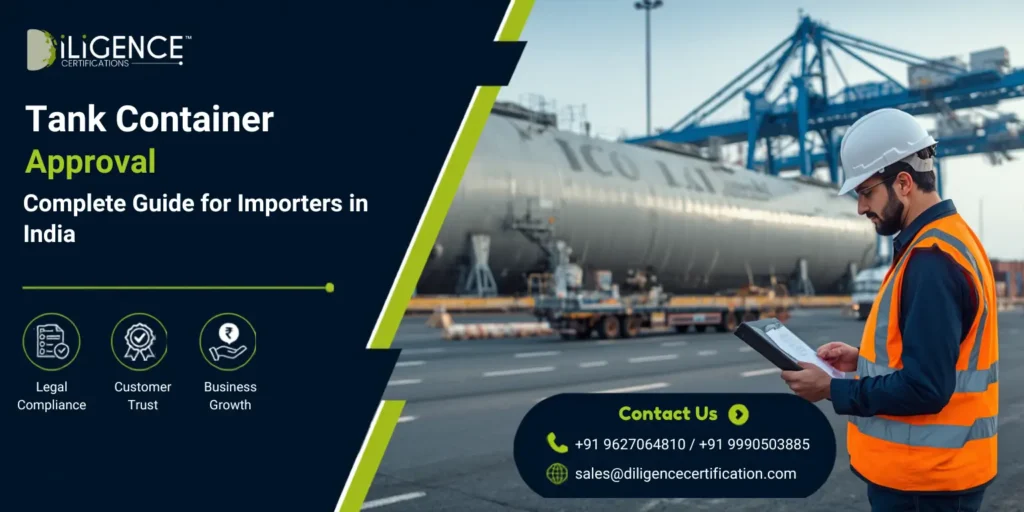
By - Tank Containers Approval is mandatory to make sure that the tank containers used for carrying dangerous and non-dangerous liquids meet the safety criteria prescribed by India and the international community.
- Before using tank containers in India, importers have to conduct technical inspections, testing, and statutory approvals.
- Diligence Certifications helps importers through technical inspections and statutory approvals.
Introduction
An importer had already finalized the purchase of several ISO tank containers from an overseas manufacturer. The consignment arrived at the Indian port on time, the customs process was well underway, and the deliveries were committed to the clients. The situation seemed to be under control until the government officials insisted upon technical documentation, test certificates, and proof that the tank containers satisfied the Indian safety regulations.
The delays in getting the required approval led to increased costs for inspection as well as documentation. It also caused disruptions in delivery schedules and other commercial losses that could have been avoided otherwise.
This is a frequent problem encountered by importers. Even though the tank container is manufactured according to international standards, there are times when it cannot be used in India without adhering to the necessary guidelines. Knowing about Tank Container Approval prior to import will save from unnecessary costs as well as ensure legal and safe transport of hazardous or non-hazardous material.
We at Diligence Certifications will help you with complete Tank Container Approval services from documentation to approval.
What is Tank Container Approval?
Tank Container Approval is the process where verification is made regarding the compliance of a tank container with all safety, engineering and regulatory standards for carrying liquids, gases and hazardous materials. Tank container approval means that the tank container will have been engineered, constructed, inspected and tested against applicable national or international standards before being commissioned for use.
In India, the use of tank containers for transporting petroleum products, liquefied gases and hazardous materials might also be covered under regulations by the Petroleum and Explosives Safety Organisation (PESO). This will ensure that the transport is done safely and legally.
Whether the tank container is meant to carry chemicals, food grade liquids, industrial gases or petroleum products, it makes sense for importers to have the tank container approved before its use..
Why is Tank Container Approval Important?
For importers, obtaining approval is not simply another regulatory formality.
It demonstrates that the equipment has been designed, manufactured, inspected, and tested according to recognised safety requirements.
Proper approval helps organisations:
- Improve transportation safety
- Reduce accident risks
- Protect employees and the environment
- Meet statutory compliance requirements
- Prevent customs and operational delays
- Build customer confidence
- Reduce insurance-related concerns
- Ensure long-term operational reliability
In industries dealing with hazardous chemicals, petroleum products, industrial gases, food-grade liquids, or pharmaceuticals, compliance failures can have serious commercial and legal consequences.
Is Tank Container Approval Necessary in India?
Yes, Tank Container Approval is mandatory in cases where tank containers are utilized to carry any kind of cargo which is regulated, whether hazardous or chemical, petrochemicals, LPG and more. Your tank container should adhere to all the Indian laws relating to safety regulations and testing prior to utilization.
Before importing and operating your tank container, you have to make sure that it adheres to all the technical and inspection requirements. Failure to comply might create several issues for you, ranging from delays at the customs to sanctions and restrictions on its operations. With the help of Diligence Certifications, you will easily get your Tank Container Approval.
Which Industries Need Tank Container Approval?
Tank containers find wide application in various industrial fields.
Among the major industries are:
Chemical Industry
Chemical companies transport acids, solvents, alkalis, resins, specialty chemicals, and industrial liquids via certified tank containers.
Oil Industry
Oil industry companies employ tank containers certified to transport fuel additives, lubricants, petroleum chemicals, and special liquid products.
Pharmaceutical Industry
There are certain pharmaceutical liquids that have to be transported in contamination-free conditions; thus, special stainless steel tank containers are used.
Food Industry
Food tank containers transport:
- Edible oils
- Fruit concentrates
- Milk products
- Liquid sugar
- Beverages
- Food additives
- Special attention should be paid to both hygienic and structural safety of such containers.
Industrial Gas Companies
The cryogenic and special gas transport requires specially designed tank containers to keep up with temperature and pressure.
Logistics and Freight Companies
International logistics companies use ISO tank containers to ship cargos by:
- Road
- Rail
- Sea
- Different modes of transportation raise different safety issues and thus call for regulation.
Who Should Apply for Tank Container Approval?
The approval may be required by:
- Importers
- Tank container owners
- Logistics companies
- Chemical manufacturers
- Petroleum companies
- EPC contractors
- Leasing companies
- Fleet operators
- Industrial gas suppliers
- Export-import businesses
Every organisation responsible for operating or importing tank containers should verify applicable approval requirements before commercial use.
Understanding the Tank Container Approval Process
One of the most prevalent misconceptions among beginners is the idea that approval begins when the container arrives at its destination, which is India.
The truth of the matter is that an effective procedure must begin way before that.
Seasoned importers examine the technical drawings, manufacturing standards, inspection certificates, material descriptions, and applicable rules prior to placing their purchase orders.
A proper Tank Container Approval process involves multiple technical steps rather than just one inspection.
Step 1: Technical Evaluation
Experts assess the tank design, capacity, material grade, pressure rating, safety devices, and intended application to ensure compliance.
Step 2: Documentation Verification
Technical documents and certificates are reviewed to confirm compliance with applicable standards. Complete documentation helps prevent delays.
Step 3: Physical Inspection
The tank container is inspected for structural condition, weld quality, valves, safety fittings, and identification markings.
Step 4: Testing
Required tests, such as pressure and leak tests, verify the container’s safety, strength, and operational reliability.
Step 5: Final Approval
After successful inspection, testing, and document verification, the competent authority grants approval for the tank container’s intended use.
Common Types of Tank Containers Requiring Approval
Although many people use the term “tank container” as a single category, different industries use specialised designs depending on the material being transported.
Some common examples include:
- ISO Tank Containers
- Chemical Tank Containers
- Petroleum Tank Containers
- Food Grade Tank Containers
- Cryogenic Tank Containers
- Gas Tank Containers
- Stainless Steel Tank Containers
- Pressure Tank Containers
- Dangerous Goods Tank Containers
- Multi-Compartment Tank Containers
Each category has different engineering and compliance requirements, making it essential to understand the applicable approval pathway before import.
Documents Required for Tank Container Approval
One of the primary reasons applications are delayed is incomplete or inconsistent documentation. Regulatory authorities rely on technical records to verify that a tank container has been designed, manufactured, and tested in accordance with applicable standards.
Although document requirements may vary depending on the product being transported and the approving authority, importers should generally prepare the following:
- Technical Specifications of the Manufacturer
- General Arrangement (GA) Drawing
- Drawing for fabrication
- Material Test Certificate (MTC)
- Welding Procedure Specification (WPS)
- Procedure Qualification Report (PQR)
- Welder Qualification Certificate
- Report of Hydrostatic Test
- Report of Pneumatic Test (Where Applicable)
- Non-destructive Testing Report
- Calibration Certificate of Pressure Relief Valve
- Nameplate Data
- Manufacturer’s Quality Certificate
- Factory Inspection Report
- Inspection Report (for Used Containers)
- Import Documents
- Invoice and Packing List
- Bill of Lading
- Product Catalog
- Manual
At Diligence Certifications, every document is reviewed before submission so that discrepancies can be corrected in advance, reducing regulatory queries and approval delays.
Applicable Standards for Tank Container Approval
Approval authorities assess tank containers against recognised engineering and safety standards. The applicable code depends on the design, intended service, operating pressure, and the nature of the cargo.
Some commonly referenced standards include:
- ISO standards for tank containers
- IMDG Code for dangerous goods
- ADR requirements where applicable
- CSC (Container Safety Convention)
- UN Recommendations on the Transport of Dangerous Goods
- ASME pressure vessel requirements (where applicable)
- Indian regulatory requirements prescribed by the competent authority
Meeting international manufacturing standards alone may not be sufficient. Imported equipment must also satisfy Indian regulatory expectations before it can be placed into service.
Inspection Requirements for Tank Container Approval
Requirements for the Tank Container Inspection Before Approval
Before the approval of a tank container, it is subjected to a comprehensive inspection to ascertain that all required safety, design, and quality criteria have been met. The inspection serves to confirm that the tank is fit for the transport of its intended cargo.
1. Design Inspection
Designers will inspect the tank for the design, size of the shell, pressure rating, frame strength and safety accessories to ascertain that it conforms to the approved engineering specifications.
2. Material Inspection
Materials will be tested for the grade of material used, corrosion resistance and traceability.
3. Welding Inspection
This process entails inspection for weld quality, welding processes, welders’ qualifications and Non-Destructive Test (NDT) reports.
4. Dimension Inspection
Important dimensions such as the diameter of the tank, thickness of the shell, frame sizes, and locations of the valves will be measured.
5. Final Inspection
The complete tank will be inspected for identification markings, pressure relief valves, manhole assembly, discharge valves, safety fittings, and workmanship.
Testing Requirements for Tank Container Approval
Prior to granting its approval, the tank container needs to be subjected to different kinds of tests to make sure it passes the criteria of structural integrity, resistance to pressure, and safe functioning.
1. Hydrostatic Pressure Test
Filling the tank with water and putting it under pressure greater than the tank’s usual operating pressure helps determine its strength and detect structural weak points and leaks.
2. Leak Test
Welds, valves, flanges, nozzles, and joints of the tank are thoroughly examined to find out if there are any leaks and the tank is absolutely leak-proof.
3. Non-destructive Testing (NDT)
The techniques of non-destructive testing (Radiographic Testing RT; Ultrasonic Testing UT; Magnetic Particle Testing MT; Dye Penetrant Testing PT) are used to find out any defects in the tank without damaging it.
4. Pressure Relief Valve Test
Checking the pressure relief valve is aimed at making sure that the valve will open and close at a certain pressure to prevent the tank from over-pressure while transporting the cargo.
5. Vacuum Test (if needed)
For vacuum service tanks containers, vacuum test is conducted to check whether the tank will stand vacuum pressure without deformations and failures.
Validity and Renewal of Tank Container Approval
The validity of a Tank Container Approval depends on several factors, including the applicable regulations, type of container, intended service, inspection schedule, and the requirements of the competent authority.
Importers should not assume that approval remains valid indefinitely. Most tank containers are subject to periodic inspections, maintenance checks, and renewal requirements to confirm continued compliance and safe operation.
Renewal generally involves:
- Reviewing maintenance records
- Conducting periodic inspections
- Performing prescribed tests
- Verifying safety devices
- Updating inspection certificates where required
Maintaining a proactive renewal schedule helps avoid operational interruptions and regulatory non-compliance.
Common Reasons Tank Container Approval Gets Rejected
Many importers assume that purchasing a high-quality container automatically guarantees approval. In practice, most delays arise from documentation or compliance issues rather than manufacturing defects.
Some common reasons for rejection include:
- Missing technical documents
- Incorrect material certificates
- Damaged containers during transport
- Non-compliant pressure relief devices
- Incomplete inspection records
- Welding deficiencies
- Unauthorised design modifications
- Corroded components
- Missing identification markings
- Failed pressure testing
- Incorrect safety labelling
- Poor maintenance history for used containers
Early technical review can prevent many of these issues before the application reaches the approval stage.
Best Practices for Importers
Import experts build compliance planning into their procurement process as opposed to compliance being treated as something that happens after the shipment.
Some of these recommendations include:
Checking the Manufacturer
- Opt for a manufacturer who has the expertise to produce internationally compliant tank containers.
- References, certification, and inspection history can be asked for prior to ordering.
Technical Drawing Assessment Before Purchase
- The engineering drawing should be assessed to confirm whether the tank container will fit Indian needs and regulation requirements.
- This will avoid costly modifications after import.
Inspection Before Ship out
- Pre-shipment inspection gives one the chance to detect any defects before shipping.
- Defects should be sorted overseas since it is easier and cheaper than sorting them after they have been imported.
Document Everything
- Keep a dossier containing all certification, inspections, drawings, and testing reports.
- Good organization makes regulatory approval process faster and facilitates future inspections.
Periodic Inspection
- Approval is just the beginning of compliance process.
- Regular inspections help detect any wear, corrosion or deterioration of components.
Why Choose Diligence Certifications?
Obtaining Tank Container Approval requires technical expertise, regulatory knowledge, and careful coordination with inspection authorities. Even minor documentation errors can delay approvals and increase operational costs.
Diligence Certifications provides end-to-end assistance, including:
- Eligibility assessment
- Technical documentation review
- Regulatory application support
- Coordination with inspection agencies
- Compliance guidance
- Approval tracking
- Renewal assistance
- Ongoing regulatory support
Our experienced consultants help importers navigate complex approval requirements while reducing compliance risks and avoiding unnecessary delays.
Conclusion
Regardless of whether you are importing a single ISO tank container or even running a fleet of tank containers for the transportation of chemicals, petroleum products, pharmaceuticals, and foodstuffs, Tank Container Approval should be considered a mandatory compliance requirement rather than a mere administrative procedure.
Thorough planning, documentation, inspection, and following proper standards will help ensure that your business is conducted safely and without interruption. Importers who handle their compliance prior to shipping are usually able to avoid potential customs problems, additional expenses, and operational inconveniences.
If you need help with Tank Container Approval, the specialists from Diligence Certifications will be glad to assist you at any stage of this process.
Frequently Asked Questions
What is Tank Container Approval?
Tank Container Approval verifies that a tank container complies with applicable safety, engineering, and regulatory requirements before it is used for transporting liquids or hazardous materials.
Who needs Tank Container Approval?
Importers, logistics companies, chemical manufacturers, petroleum businesses, EPC contractors, and tank container owners may require Tank Container Approval.
Is Tank Container Approval mandatory in India?
Yes, approval is generally required when tank containers are used for regulated or hazardous substances and must comply with applicable Indian regulations.
Which authority regulates Tank Container Approval in India?
Depending on the application and cargo, the approval may involve the relevant competent authority and compliance with applicable Indian safety regulations.
What documents are required for Tank Container Approval?
Common documents include technical drawings, material certificates, inspection reports, pressure test certificates, and import-related documents.
How long does the Tank Container Approval process take?
The processing time depends on documentation quality, inspection schedules, testing requirements, and regulatory review.
Can a used tank container obtain approval?
Yes, provided it passes the required inspections, testing, and document verification and meets the prescribed safety standards.
Why is my Tank Container Approval application delayed?
Delays usually occur due to incomplete documentation, failed inspections, missing test reports, or technical non-compliance.
How often should a tank container be inspected?
Tank containers should undergo periodic inspections and testing as required by the applicable regulations and the competent authority.
How can Diligence Certifications help with Tank Container Approval?
Diligence Certifications assists with document preparation, technical review, regulatory coordination, inspection support, and end-to-end approval services for importers.