 BIS Certification
 CDSCO
CDSCO
 PESO
PESO
 CPCB
CPCB
 LMPC
LMPC
 WPC Approval
 Global Approvals
 TEC
TEC
 ARAI
ARAI
 BEE
BEE
 ISO Certification
 DGCA Certification
 NOC For Steel
 APEDA Registration
















 Business Registration
 FSSAI Mark Certification












 (32).jpg)
 Legal Services
 Trademark Registration
 Copyright Registration
 Patent Registration
 By
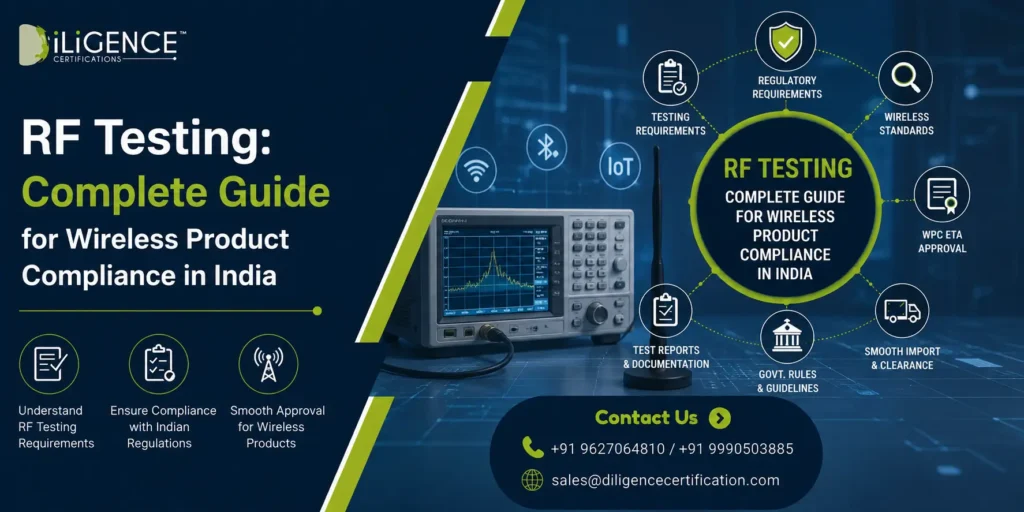
By - RF Testing checks how wireless devices work, what frequency range they use, how strong their signals are and how they behave with electricity before they are sold.
- This is important because manufacturers and people who bring devices into the country need to do RF Testing to make sure their products meet the rules that the government has set like getting approvals from WPC ETA and following wireless standards.
- Diligence Certifications assists companies in understanding what they need to do to comply with RF rules, what papers they need to fill out and how to get approval for products, in India.
Introduction
A month ago a company that imports electronic goods came to Diligence Certifications with a problem. This company had brought in devices that use Bluetooth and wanted to sell them in India.. When they checked if these devices met all the rules they found out that they did not have the right test reports for the radio frequencies used by these devices.
The devices worked fine. That was not enough. Devices that use technology send and receive information through radio frequencies. If these frequencies are not controlled they can interfere with systems that use radio frequencies to communicate. If the devices are not tested properly the companies that make them might have to wait a time to get approval or they might even have problems with customs or their devices could be rejected when they are checked to see if they meet the rules.
This is where testing for radio frequencies or RF Testing becomes very important.
RF Testing is a way to check devices to see how well they use radio frequencies, how they send information, how much power they use and if they meet the rules that apply to them. It makes sure that devices like Bluetooth devices, Wi-Fi equipment devices that connect to the internet, smart sensors and systems that use wireless communication work safely and do not use more frequencies than they are allowed to.
In India devices that use technology usually need to be approved by the Wireless Planning & Coordination Wing which is part of the Department of Telecommunications. Reports from RF testing are very important to get approvals like the WPC ETA certification.
At Diligence Certifications we often work with companies that make devices, import devices and technology companies that’re confused about what tests they need to do. A lot of businesses focus on designing and making products. They do not think about testing, for rules and regulations until it is time to get approval. If companies plan ahead for RF rules they can avoid waiting a time and spending extra money.
What is RF Testing?
RF Testing is a way to check how well wireless devices work with radio frequencies. This process helps make sure that these devices are working correctly and are not using much power.
Wireless devices talk to each other using different kinds of waves. These waves have their frequencies and each country has its own rules about how these frequencies can be used.
During RF Testing laboratories look at lots of things like:
- Frequency range
- Output power
- Bandwidth
- Signal strength
- Spurious emissions
- Harmonic emissions
- Receiver performance
- Transmission stability
The main goal is to make sure that wireless equipment does not get in the way of communication networks and that it works well.For example things like a Bluetooth speaker or a Wi-Fi router or a smartwatch or a smart home device seem easy to use.
Inside these devices there are wireless parts that send out signals on certain frequencies.We do something called RF Testing to make sure these signals from the equipment stay within the rules.RF Testing is important for the wireless equipment to work properly and not interfere with communication networks.
Why is RF testing needed for devices?
Wireless technology is used in every kind of work. We see it in tools and machines that control factories. We also see it in things we use every day like phones and smart devices. Radio signals make all these things work together.
However, uncontrolled RF emissions can create serious problems, including:
- Interference with other wireless networks
- Poor device performance
- Communication failures
- Regulatory violations
- Product approval delays
Therefore, regulatory authorities require manufacturers and importers to demonstrate that their products comply with RF emission and frequency requirements.
Key Reasons Businesses Need RF Testing
1. Regulatory Compliance
The primary purpose of RF Testing is meeting regulatory requirements. In India, wireless products operating in license-free frequency bands require approval from WPC before commercial sale.
A proper RF test report provides technical evidence that the product follows approved frequency and emission standards.
For companies importing wireless products, incomplete RF documentation is one of the common reasons for approval delays.
2. Smooth WPC ETA Approval Process
Many wireless devices require WPC ETA approval before entering the Indian market.
Products commonly requiring RF evaluation include:
- Bluetooth devices
- Wi-Fi equipment
- Wireless microphones
- Smart watches
- IoT devices
- Wireless sensors
- RFID-based products
The RF test report helps authorities verify that the device operates within permitted frequency ranges.
Diligence Certifications assists businesses by reviewing technical documents, coordinating compliance requirements, and helping prepare applications correctly before submission.
3. Product Quality Assurance
RF Testing is not only about regulatory approval. It also improves product reliability.
A poorly designed wireless device may experience:
- Weak signal coverage
- Frequent connection drops
- Interference problems
- Reduced battery performance
Testing identifies these issues before large-scale production.
For manufacturers, finding RF problems during development is significantly easier and less expensive than correcting them after market launch.
How Does RF Testing Work?
The RF Testing process involves multiple technical evaluations performed in specialized laboratories equipped with advanced measurement instruments.
A typical RF Testing procedure includes the following stages:
Step 1: Product and Technical Document Review
Before testing begins, engineers review product specifications, wireless modules, operating frequencies, and intended usage.
Important details include:
- Product model number
- Wireless technology used
- Frequency band
- Manufacturer information
- Technical datasheets
- User manuals
This stage helps determine the applicable testing requirements.
Step 2: Selection of Applicable RF Parameters
Different wireless products require different testing parameters.
For example:
A Bluetooth device may require testing for:
- Bluetooth frequency operation
- Maximum transmitter power
- Channel performance
- Unwanted emissions
A Wi-Fi router may require evaluation of:
- Frequency channels
- Bandwidth
- Transmission power
- Spectrum performance
The testing approach depends on the wireless technology and regulatory requirements.
Step 3: Laboratory Testing
The device is tested using specialised RF measurement equipment such as:
- Spectrum analysers
- Signal generators
- Antenna measurement systems
- RF chambers
Testing engineers measure how the device transmits and receives signals.
The objective is to confirm that emissions remain within acceptable limits.
Step 4: Test Report Preparation
After successful evaluation, the laboratory prepares an RF test report containing technical results.
The report generally includes:
- Device information
- Testing methodology
- Frequency measurements
- Power output details
- Emission results
- Laboratory details
- Compliance conclusion
This report becomes an important document for regulatory submissions.
Step 5: Regulatory Approval Support
Once RF testing is completed, businesses can proceed with required approvals such as WPC ETA certification.
Diligence Certifications supports companies throughout the compliance journey, from documentation review to application assistance.
What Products Require RF Testing?
With increasing adoption of wireless technology, RF Testing applies to a wide range of products.
- Consumer Electronics
Examples include:
- Bluetooth speakers
- Wireless headphones
- Smart watches
- Gaming accessories
- Smart televisions
- Wireless keyboards and mice
These products use radio communication and require technical evaluation before commercial distribution.
- IoT Devices
The Internet of Things industry depends heavily on wireless connectivity.
Common examples:
- Smart sensors
- Smart meters
- Home automation devices
- Industrial monitoring systems
- Connected security devices
RF Testing ensures these products communicate efficiently without creating interference.
- Networking Equipment
Wireless networking products require detailed RF evaluation, including:
- Wi-Fi routers
- Access points
- Wireless bridges
- Communication gateways
These products continuously transmit signals, making compliance testing essential.
- Industrial and Medical Wireless Equipment
Industrial automation and healthcare sectors increasingly use wireless technology.
Examples:
- Wireless monitoring systems
- Automated control equipment
- Medical communication devices
For these applications good RF performance is really important because if something goes wrong with communication it can affect how things work.
RF Testing Parameters
Some people think that RF Testing just checks if a wireless device can send signals.. That is not true. Testing actually involves technical checks to see if the device works safely efficiently and meets all the rules.
The exact things that are checked depend on what kind of product it is, what kind of wireless technology it uses and what rules apply.
1. Frequency Range Testing
This test checks if a wireless device works within the right frequency band.Every wireless technology uses its set of frequencies. For example Bluetooth and Wi-Fi devices usually work in the 2.4 GHz band while other communication technologies use frequencies.
This test makes sure the device does not send signals outside the allowed range.If the frequency is not right it can cause:
- problems
- Signal interference
- Approval issues
- Poor communication
2. Transmitter Power Testing
The power of the transmitter determines how strong the wireless signal is.During RF Testing engineers check if the power level is within the allowed limit.If the power is too high it can interfere with devices and if it is too low it can reduce how far the signal goes.
- The right power level helps with:
- connection
- Better performance
3. Bandwidth Measurement
This test checks how much of the frequency range is used by the wireless signal.If a device uses much of the frequency range it can interfere with other communication channels.This test makes sure the wireless signal is controlled and efficient.
4. Spurious Emission Testing
Spurious emissions are signals that are sent outside the intended frequency range.These unwanted signals can affect communication systems.RF Testing finds these emissions. Make sure they are within the allowed limits.This is especially important for products that work in frequency environments, such as RF devices that are used in cities.
- Smart home devices
- Wireless routers
- IoT equipment
5. Harmonic Emission Testing
Electronic circuits can sometimes generate additional frequency signals called harmonics.Harmonic emission testing checks whether these additional signals remain within acceptable limits.
Reducing unwanted harmonics improves:
- Wireless reliability
- Device safety
- Regulatory acceptance
RF Testing Standards and Regulatory Requirements in India
India has rules to control devices that use radio waves and to stop them from interfering with each other.The Wireless Planning & Coordination Wing, which is part of the Department of Telecommunications, is in charge of giving approvals for using the radio spectrum in India.
For many wireless products, businesses need WPC ETA approval before importing or selling products commercially.
According to WPC requirements, manufacturers and importers may need technical documents such as:
- RF test reports
- Product specifications
- User manuals
- Wireless module details
- Manufacturer authorization documents
Businesses should verify applicable requirements before importing or manufacturing wireless devices.
The official regulatory information can be accessed through the Department of Telecommunications website:
https://dot.gov.in/wpc
Documents Required for RF Testing
Before submitting a product for RF evaluation, businesses should prepare complete technical documentation.
Commonly required documents include:
- Product Technical Documents
- Product specification sheet
- Product datasheet
- Circuit details
- Wireless module information
- Operating frequency details
- Manufacturer Documents
- Company details
- Manufacturer authorization
- Product model information
- Declaration documents
- Testing Documents
- Previous test reports (if available)
- User manual
- Technical drawings
- Label information
Incomplete documentation can increase testing time and create unnecessary communication between laboratories and applicants.At Diligence Certifications, we help businesses organize compliance documentation before starting the approval process.
RF Testing Process for WPC ETA Approval in India
For businesses importing wireless devices, RF Testing is closely connected with WPC ETA certification.
The general process includes:
- Product Evaluation
The first step is identifying whether the product uses wireless technology and whether WPC approval applies.
- RF Testing
The product undergoes testing through an appropriate laboratory to generate required technical reports.
- Document Preparation
All supporting documents, including RF reports and product details, are prepared.
- Application Submission
The WPC ETA application is submitted with relevant technical information.
- Approval Review
The authority reviews submitted documents before issuing approval.
Factors Affecting RF Testing Cost in India
- Product Technology
A simple Bluetooth product may require fewer tests compared with a complex multi-band wireless device.
- Number of Wireless Modules
Products containing multiple wireless technologies may require additional evaluation.
For example:
- Bluetooth + Wi-Fi
- Wi-Fi + Cellular
- Multiple frequency bands
may involve additional testing requirements.
- Testing Laboratory Requirements
Different laboratories may charge based on:
- Equipment requirements
- Testing complexity
- Documentation support
- Report preparation
- Product Category
Industrial equipment, consumer electronics, and IoT products may have different testing requirements.Businesses should consider RF Testing as a compliance investment rather than only an expense. Proper testing reduces the risk of product rejection and market delays.
Common Challenges Businesses Face During RF Testing
- Incorrect Technical Information
One of the most frequent issues is incorrect product information submitted during compliance evaluation.Examples include:
- Wrong frequency details
- Incorrect module specifications
- Missing technical documents
- Accurate information helps avoid unnecessary revisions.
- Choosing an Unsuitable Testing Approach
Some businesses begin testing without understanding applicable requirements.This can lead to:
- Additional testing
- Increased expenses
- Delayed approvals
- A compliance review before testing helps identify the correct approach.
- Lack of Regulatory Knowledge
Wireless regulations can be complex, especially for companies entering the Indian market for the first time.Importers often understand product manufacturing but are unfamiliar with approval procedures.Professional guidance helps bridge this gap.
Benefits of Professional RF Testing Support
Working with an experienced compliance consultant provides several advantages:
- Faster Approval Preparation
Experts help identify required documents and testing requirements before submission.
- Reduced Compliance Risks
Proper review reduces chances of rejection due to technical mistakes.
- Better Coordination
Consultants coordinate between manufacturers, laboratories, and regulatory authorities.
- Smooth Product Launch
Correct RF compliance planning helps businesses introduce products without unnecessary delays.Diligence Certifications supports companies with wireless product compliance, including RF Testing guidance and WPC ETA approval assistance.
Why Choose Diligence Certifications for RF Testing Assistance?
Diligence Certifications works with manufacturers, importers, and technology companies requiring regulatory compliance support in India.
Our approach focuses on:
- Understanding product requirements
- Reviewing technical documents
- Supporting RF Testing coordination
- Assisting with WPC ETA compliance
- Helping businesses avoid documentation errors
Many companies approach compliance only after facing approval problems. Our recommendation is to evaluate requirements during the product planning stage itself.
Early compliance planning saves time and prevents unexpected challenges during market entry.
Conclusion
RF Testing is really important to make sure that wireless products work safely and meet the rules. This helps them get into the market without any delays.RF Testing is necessary for all kinds of products, like Bluetooth accessories and IoT devices. It even helps with wireless communication equipment.
When manufacturers do RF Testing correctly they can be sure that their products are good and meet the rules.If businesses plan their testing early they can avoid problems. Launch their products with confidence.
Diligence Certifications helps people who make things and people who import things with RF Testing. They give guidance and help with papers and wireless compliance solutions.You should contact Diligence Certifications today to know what RF Testing you need and to get your products approved faster.
Frequently Asked Questions
1. What is RF Testing?
RF Testing is the process of evaluating wireless devices to measure frequency operation, signal strength, power output, and unwanted emissions. It confirms that wireless products meet technical and regulatory requirements.
Is RF Testing mandatory for WPC ETA approval?
Yes, many wireless products require RF test reports as part of the WPC ETA approval process. The requirement depends on the product type, wireless technology, and applicable regulations.
Which products require RF Testing?
Products such as Bluetooth devices, Wi-Fi equipment, IoT devices, wireless sensors, smart devices, and communication equipment commonly require RF evaluation.
How long does RF Testing take?
The testing duration depends on product complexity, required parameters, laboratory availability, and documentation completeness.
Can RF Testing be completed in India?
Yes, businesses can complete RF Testing through suitable testing laboratories in India that provide technical evaluation reports according to applicable requirements.