BIS Certification
 CDSCO
CDSCO
 PESO
PESO
 CPCB
CPCB
 LMPC
LMPC
 WPC Approval
 Global Approvals
 TEC
TEC
 ARAI
ARAI
 BEE
BEE
 ISO Certification
 DGCA Certification
 NOC For Steel
 APEDA Registration























 Business Registration
 FSSAI Mark Certification












 (32).jpg)
 Legal Services
 Trademark Registration
 Copyright Registration
 Patent Registration
 By
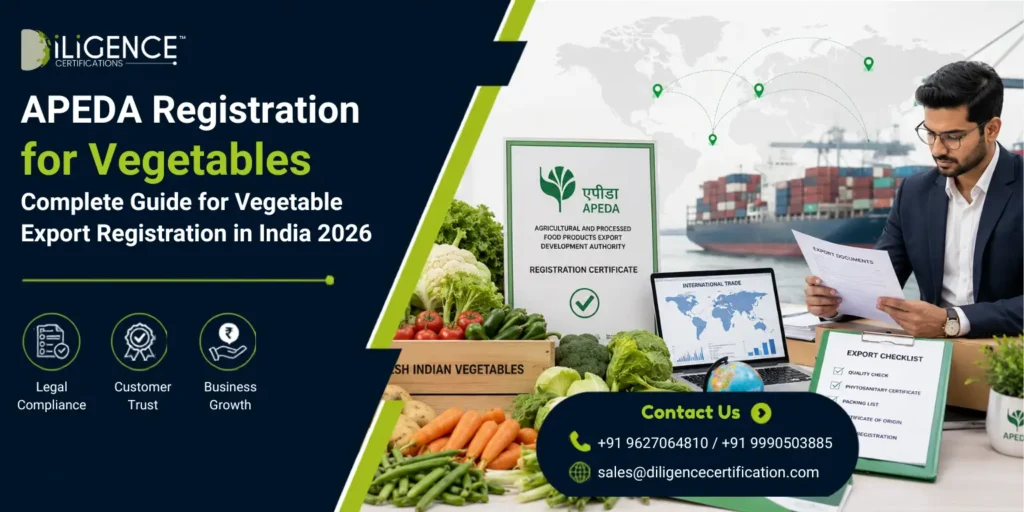
By - APEDA Registration for Vegetables with fresh Indian vegetables, export papers, and international business aspects.
- Highlights the vegetable export requirements, quality standards, certificate procedure, and global market prospects.
- Designs a professional-looking business-related image for the APEDA vegetable export guide blog banner.
Introduction
India is among the top producers of vegetables and provides various vegetable products such as onion, potato, tomato, okra, green pea, garlic, ginger, carrot, leafy vegetables and others which are very popular and much in demand in international markets. Indian vegetables have become very popular in international markets due to favorable climate, diverse agricultural systems and farming systems in India.
Firms or businesses exporting any vegetable product eligible for export need to get APEDA Registration if the products come under the purview of the Agricultural & Processed Food Products Export Development Authority (APEDA).
For any exporter of fresh vegetables, processed vegetables, organic vegetables, vegetable products and other agricultural exports, the APEDA registration for vegetables will ensure compliance with international export standards and help in building business credibility internationally.
If you are a manufacturer exporter, merchant exporter, vegetable processing firm, fresh vegetable exporter, start-up, MSME or export house, the APEDA registration for vegetables will help you increase your export business.
What is APEDA Registration for Vegetables?
APEDA Registration for Vegetables means the registration obtained by exporters of agricultural and processed food products under the Agricultural and Processed Food Products Export Development Authority (APEDA) Act. APEDA Registration allows eligible exporters to participate in export promotion activities and access various benefits and facilities available to agricultural exporters.
For exporters of eligible vegetables, APEDA Registration helps ensure compliance with export standards, maintain product quality, and build credibility among international buyers.
The following services are included in APEDA Registration for Vegetables:
- Export Registration
- Product Quality Development
- Export Promotion
- Market Development
- Brand Promotion
- Packaging Development
- Export Documentation
- Compliance of International Standards
The APEDA Registration for Vegetables will help exporters establish themselves better in international markets and improve their export management process.
Applications of APEDA Registration for Vegetables
APEDA Registration for Vegetables is relevant for companies that export fresh vegetables, vegetable products, and value-added vegetable products abroad. The registration gives due recognition to exporters and helps in exploring export opportunities.
Companies that commonly go for APEDA Registration for Vegetables are as follows:
- Fresh Vegetable Exporters
- Vegetable Processing Plants
- Manufacturer Exporters
- Merchant Exporters
- Organic Vegetable Exporters
- Frozen Vegetable Producers
- Food Processing Plants
- Vegetable Packaging Plants
- MSMEs
- Startups
- Export Houses
- Farmer Producer Organizations (FPOs)
APEDA Registration for Vegetables enables exporters to explore the foreign market using export promotion policies.
Who Needs APEDA Registration for Vegetables?
APEDA Registration for Vegetables is mandatory for organizations involved in the business of exporting vegetable products included in the APEDA Schedule. This registration will be useful for the exporters who want official recognition along with market benefits and smoothness in the export process.
Some of the entities which need APEDA Registration for Vegetables are as follows:
- Vegetable Export Firms
- Manufacturer Exporters
- Merchant Exporters
- Vegetable Processing Firms
- Organic Vegetable Exporters
- Food Processing Firms
- Vegetable Packaging Firms
- Export Houses
- MSMEs
- Start-ups
- Farmer Producer Organizations (FPOs)
- Agricultural Export Firms
By getting APEDA Registration, the exporters of vegetables can get themselves involved in international trade fairs, exhibitions, buyers sellers meet, export promotions, and quality improvement programs conducted for agricultural exports from India.
Types of Compliance Under APEDA Registration for Vegetables
The compliances needed for APEDA Vegetable Exporter Registration would depend on various considerations such as the type of vegetable products being exported, nature of business, destination of export and export compliances. Proper adherence to compliances enables smooth transaction of international business by exporters.
Export Registration Compliances
Companies engaged in export of suitable vegetable products need to get APEDA Vegetable Exporter Registration.
The registration generally includes:
- Business Registration
- Import Export Code (IEC)
- PAN Details
- GST Registration
- Bank Details
- Product Information
Useful for:
- Manufacturer Exporters
- Merchant Exporters
- Vegetable Processing Units
- Food Processing Companies
- MSMEs
- Startups
Maintaining proper registration details allows exporters to legally export eligible vegetable products while accessing APEDA export promotion facilities and government support programs.
Product Quality Compliance
Vegetable exporters need to maintain consistent product quality by following applicable food safety standards, packaging requirements, labeling guidelines, and quality expectations of international buyers.
Product quality compliance generally includes:
- Quality Control
- Product Testing
- Traceability
- Proper Packaging
- Labeling Requirements
- Food Safety Standards
Useful for:
- Vegetable Exporters
- Organic Vegetable Exporters
- Vegetable Processing Units
- Food Processing Companies
- Manufacturer Exporters
Maintaining quality standards helps exporters improve buyer confidence, increase product acceptance, and create long-term relationships in international markets.
Export Documentation Compliance
Maintaining complete and accurate export documentation is important for ensuring smooth shipment procedures and compliance with international trade requirements.
Export documentation generally includes:
- Registration Records
- Export Invoices
- Shipping Documents
- Product Details
- Quality Certificates
- Export Records
Proper documentation helps vegetable exporters complete international trade procedures efficiently while reducing export-related complications.
Documents Required for APEDA Registration for Vegetables
The documents required for APEDA Registration for Vegetables may vary depending on the type of business activity, export operations, and the vegetable products being exported. Proper documentation helps exporters complete the registration process smoothly and avoid unnecessary delays.
Generally, the required documents include:
- Import Export Code (IEC)
- PAN Card of the Business
- GST Registration Certificate (if applicable)
- Business Registration Certificate
- Address Proof of Business
- Bank Certificate or Cancelled Cheque
- Digital Signature (if applicable)
- Email ID & Mobile Number
- Details of Vegetable Products
- Authorized Signatory Details
- Other documents required by APEDA
Keeping business and export-related documents updated helps exporters complete the APEDA Registration process efficiently while ensuring compliance with APEDA requirements.
Step-by-Step Registration Process for APEDA Registration for Vegetables
Having all the necessary documentation will make the process of getting the APEDA Registration for Vegetables easy.
Exporters will be able to avoid problems through the right process of filling in the documents.
Step 1: Eligibility Checking
For those applying for APEDA Registration, it is important that one checks to see if their vegetable products fall in the regulated category of APEDA.
One should have a valid Import Export Code (IEC) before applying for APEDA Registration.
Checking of eligibility is important to know if your products qualify for APEDA Registration.
Step 2: Preparing all Necessary Documents
After completing the eligibility criteria, the exporter needs to prepare all the necessary documents prior to filling out the online application form.
These documents usually include:
- Import Export Code (IEC) Certificate
- PAN Card
- GST Certificate (If any)
- Bank Details
- Registration Details of Business
- Details of Vegetables Products
Preparation of documents can help to avoid any kind of mistakes during the application process.
Step 3: Completing Online Application Form
The candidate must fill up the online form for registration under APEDA Registration.
Exporters should check all the details that have been entered in the online application form before submitting it.
The details asked in the online form include:
- Business Details
- Export Details
- Category of Products
- Contact Details
- Registration Details
Entering correct details ensures that the application is processed quickly and prevents the application from getting rejected.
Step 4: Application Verification Process
Verification of the Application Form
APEDA verifies the details and documentation provided by the exporter along with the application form.
During the verification process, the details verified by APEDA include:
- Business Details
- IEC Number
- Product Category
- Documents
- Payment Details
In case of any query, APEDA may ask the applicant to provide additional details about the provided details.
Step 5: APEDA Registration
After the successful verification of the application, APEDA provides the Registration Cum Membership Certificate (RCMC) to the exporter.
The RCMC proves that the exporter is registered under APEDA and is allowed access to several export promotion services, development programs, and facilities offered by APEDA.
The APEDA Registration for Vegetables acts as an official certificate for those exporters who trade in eligible vegetable products.
Step 6: Compliance
After getting APEDA Registration for Vegetables, it is essential for the exporters to adhere to APEDA regulations and remain compliant with all the export requirements.
Compliance with the regulations will help the companies to carry on their export activities smoothly and benefit from export promotion services.
Updation of business and product details will ensure continuous compliance.
Timeline, Cost & Validity of APEDA Registration for Vegetables
The timeline, cost, and validity of APEDA Registration for Vegetables depend on factors such as document availability, application verification process, and applicable registration requirements.
| Timeline | Cost | Validity |
| The registration timeline depends on document verification and application processing. | The cost depends on the applicable government fee and professional service charges, if any. | APEDA Registration generally remains valid as per the prevailing APEDA registration guidelines. |
| Proper documentation helps reduce processing delays. | Additional charges may vary depending on business requirements. | Exporters should comply with applicable renewal or update requirements whenever necessary. |
| Processing time may vary based on the completeness of the application. | Proper planning helps manage the registration cost efficiently. | Maintaining updated business information helps ensure continued compliance. |
Importance & Benefits of APEDA Registration for Vegetables
| Importance | Benefits |
| Helps exporters obtain official recognition for exporting eligible vegetable products from India. | Enhances business credibility and builds trust among international buyers. |
| Supports businesses in complying with APEDA export regulations and applicable industry standards. | Enables access to APEDA export promotion schemes and government support. |
| Encourages quality improvement, proper packaging, and branding of exported vegetable products. | Improves product acceptance and competitiveness in international markets. |
| Helps exporters expand their presence in global markets through export development initiatives. | Creates better export opportunities and supports long-term business growth. |
| Enables participation in international trade fairs, exhibitions, and buyer-seller meets. | Strengthens global visibility and enhances brand recognition in overseas markets. |
Why is APEDA Registration for Vegetables Important?
APEDA Registration is essential for those exporters who are involved in exporting eligible vegetables from India as APEDA Registration assists in making sure that they comply with the rules and regulations related to exports, and remain competitive in the global market. This APEDA Registration helps in providing an official stamp of approval to the exporter and also assists him in taking advantage of the export promotion schemes offered by the government.
APEDA Registration for Vegetables is important because of the following reasons:
- Export Recognition
- International Market Entry
- Government Export Promotion Schemes
- Quality Improvement
- Brand Building
APEDA Registration acts as a base for constructing a successful vegetable export business.
Consequences of Non-Compliance with APEDA Registration Requirements
Exporters of eligible vegetable produce without satisfying APEDA compliance requirements might experience various obstacles which could have an impact on their export operations and business development.
These obstacles might be:
- Limited access to export promotion services provided by APEDA
- Difficulties in benefiting from government export support services
- Poor credibility of the business in international markets
- Limited growth opportunities in international markets
- Inability to attend international exhibitions and buyer-seller meets
- Delays in export processes
- Loss of valuable business opportunities
- Less trust from foreign buyers
Competitive disadvantage in international vegetable exports
APEDA compliance requirements help exporters run their international business processes successfully and ensure good standing in the international markets.
Renewal of APEDA Registration for Vegetables
The process of continuous enjoyment of the advantages of APEDA Registration for Vegetables requires exporters to keep their registration information up-to-date as per APEDA’s guidelines. Any modification that takes place in regard to the business information, contact information, bank information, or exported vegetables needs to be made on the APEDA website.
It will help exporters make use of the APEDA services without any disruption in their export business.
The following activities are generally required for updating or maintaining registration information:
- Updating Business Information
- Verification of Registration Information
- Updating Export Product Information
- Document Submission (where necessary)
- Compliance with APEDA Guidelines
Regular maintenance of APEDA Registration helps vegetable exporters continue their export activities while following applicable compliance requirements.
How Professional Assistance Helps in APEDA Registration for Vegetables?
APEDA Registration for Vegetables requires documentation and proper filling of applications. There may be problems while verifying the application due to lack of proper documentation or improper filing of information.
Proper professional help facilitates the entire registration process since it helps exporters to file their application and documents in an easy way.
Professional services generally help businesses with the following:
- Understanding APEDA Registration requirements
- Document preparation and review
- Online application filing
- Resolving documentation issues
- Guidance related to APEDA compliance
- Application tracking
- Handling queries during the registration process
Professional services include:
- Eligibility check
- Documentation support
- Online application assistance
- Compliance guidance
- Application status tracking
- Query resolution
- Registration support
- Post-registration assistance
With professional support, exporters can complete APEDA Registration for Vegetables efficiently while avoiding common mistakes during the registration process.
Why Choose Diligence Certifications for APEDA Registration for Vegetables?
The APEDA Registration for Vegetables involves accurate documentation, proper submission of the application, and adherence to the exporting guidelines. Professional assistance makes it easier for exporters to get the APEDA registration process done without any issues.
Diligence Certifications assists exporters in getting the entire process of APEDA Registration done and helps them concentrate on their vegetable exporting business.
Here are some of the advantages of choosing Diligence Certifications for APEDA Registration:
- Comprehensive assistance in APEDA documentation
- Help with filling the online application form
- Assistance with APEDA compliance guidelines
- Immediate response to the queries of the exporters
- Comprehensive assistance right from the stage of application to registration
- Help with APEDA post-registration compliance
Getting APEDA Registration for Vegetables done through Diligence Certifications is easy and convenient for exporters in India.
Conclusion
Registration of Vegetables under APEDA is very necessary for firms that want to export vegetables from India and gain a stronghold in the international markets. This will help the exporters gain official recognition, ensure export compliance, enhance the quality of the products and avail many different schemes provided by the government for the promotion of agricultural exports.
If you are a manufacturer exporter, merchant exporter, vegetable processing plant, MSME, start-up or an export house then registering your firm under APEDA for Vegetables will be helpful for improving your business reputation and gaining more market opportunities.
Frequently Asked Questions
What is APEDA Registration for Vegetables?
APEDA Registration for Vegetables is the registration that is acquired by exporters for eligible vegetable products listed under APEDA. This will help exporters comply with export regulations and make use of facilities provided by APEDA for exports.
Who is Eligible for APEDA Registration for Vegetables?
Exporter of fresh vegetables, manufacturer exporter, merchant exporter, vegetable processing units, organic vegetable exporter, food processors, MSMEs, start-ups, export houses, and other organizations engaged in exporting eligible vegetable products can acquire APEDA Registration.
Is APEDA Registration Compulsory for Vegetable Exporters?
Exporter of eligible vegetable products needs to acquire APEDA Registration.
What Documents are needed for APEDA Registration?
The documents needed for APEDA Registration are IEC, PAN Card, GST Registration certificate if available, documents of business registration, bank details, proof of address, and details of vegetable products.
What is the Time Frame for APEDA Registration?
Time taken to complete APEDA Registration is dependent upon the preparation of documents, accuracy of details of the application, and the verification process carried out by APEDA.
What is the Validity Period of APEDA Registration?
Validity period of APEDA Registration is dependent upon the existing APEDA registration guidelines.
Are MSMEs and Startups Eligible for APEDA Registration for Vegetables?
Yes, MSMEs, startups, manufacturer exporters, merchant exporters, and other such entities engaged in exporting vegetables can apply for APEDA Registration.
Why do You Need APEDA Registration for Vegetables?
With APEDA Registration, vegetable exporters can enhance credibility, participate in export promotion events, maintain quality standards, and explore international business prospects.
Is APEDA Registration Helpful for International Business Growth?
Yes, APEDA Registration aids international business growth in terms of buyer credibility, export awareness, and market access.
How Can Professional Consultants Aid with APEDA Registration?
Professional consultants help businesses with eligibility criteria, document preparation, online submission, compliance requirements, application tracking, and answering all registration-related concerns.