BIS Certification
 CDSCO
CDSCO
 PESO
PESO
 CPCB
CPCB
 LMPC
LMPC
 WPC Approval
 Global Approvals
 TEC
TEC
 ARAI
ARAI
 BEE
BEE
 ISO Certification
 DGCA Certification
 NOC For Steel
 APEDA Registration























 Business Registration
 FSSAI Mark Certification












 (32).jpg)
 Legal Services
 Trademark Registration
 Copyright Registration
 Patent Registration
 By
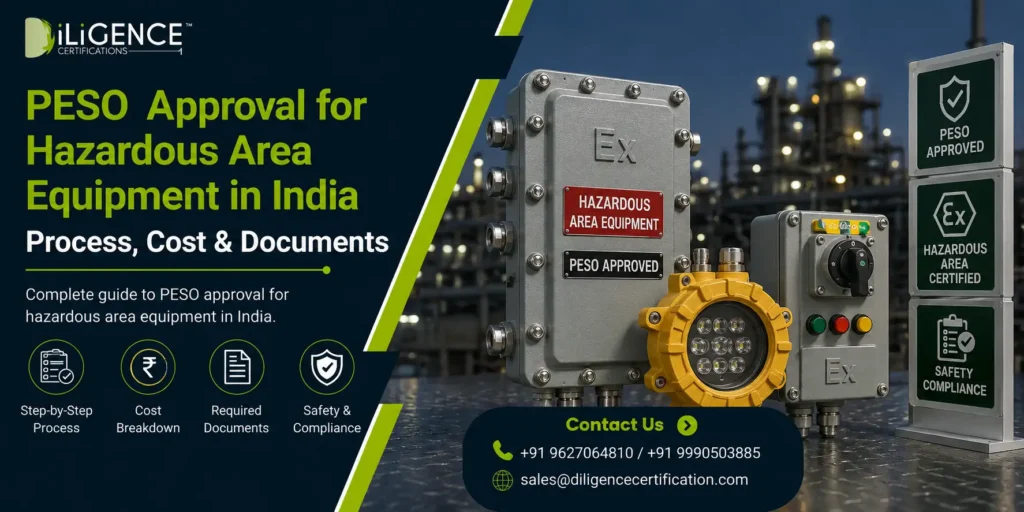
By - The PESO approval of Hazardous Area Equipment will be needed for equipment that falls within the category of equipment used in hazardous areas in India.
- The process involves considering the protection principle of the equipment, its technical construction, standards relevant to it, test certificates, and manufacturer/authorized representatives.
- Equipment manufacturers and importers must determine the right PESO application criteria before installing equipment in hazardous areas.
Introduction
A month ago an industrial equipment supplier asked a compliance team a question that seemed simple: “Our equipment already has an IECEx certificate. Why is another approval needed in India?”
The product was built well. It had test documents, a known manufacturer overseas and a clear Ex marking. The issue was not with the engineering. The issue was with the rules in India.
The equipment was meant for a petroleum site where flammable vapours could be present. That changed everything. According to the Petroleum Rules electrical equipment used in areas must get approval from the Chief Controller of Explosives. PESOs official FAQ also says that foreign-made electrical equipment for areas must be approved before it can be used.
This is where PESO Approval for Hazardous Area Equipment is more than a paper certificate. It links the product’s design with India’s rules.
For a manufacturer the main question is not just “Is my equipment explosion-proof?”
The better question is:
“Is this exact equipment, in this protection method and setup approved for the dangerous use it is being sent for in India?”
That difference avoids problems that could have been avoided.
What is PESO approval for equipment that goes into areas?
PESO approval for equipment in areas is a necessary approval for equipment that will be used in hazardous environments. This approval comes under the rules of PESO.
PESO is the Petroleum and Explosives Safety Organisation. It works under the Department for Promotion of Industry and Internal Trade Ministry of Commerce and Industry. PESO makes sure that petroleum, explosives and compressed gases are handled safely. PESO also looks at safety equipment that is used in areas where there are gases.
This approval is very important because equipment can sometimes cause fires in areas where there are gases.
When PESO checks equipment they look at things like how the equipment’s made and how it works with electricity. They also look at how the equipment’s protected and what kind of hazardous area it will be used in.
They consider things like:
- How the equipment is constructed
- How it works with electricity
- How it is protected
- What kind of area it will be used in
- What type of gas it will be around
- How hot it can get
- How well it is protected
- Test results
- drawings
- Different versions of the equipment
- How it is made
- Quality control
- If it meets international standards
- What parts are used to make it
PESO has a list of guidelines for equipment that can be used in areas. This list includes standards from the IEC 60079 series. These standards cover things, like equipment that does not spark and equipment that is protected from explosions.
Why Is Hazardous Area Equipment Regulated?
A dangerous place is not dangerous just because there are machines. The problem is the chance of a mix that can explode.
Think about a place where oil is handled and a machine moves a liquid that can catch fire. When everything works right you might not see any air that can burn.. A tiny leak, work being done or moving the liquid can create a mix that can catch fire.
A normal light switch can make a spark when you use it.
In an office that spark doesn’t matter.
In a place where something that can burn is around the same spark can cause big problems.
So engineers work to make sure that electrical things don’t start a fire or to stop the damage if a fire does start using the way to protect against explosions.
The official paper from PESO says that dangerous places are split into Zone 0 Zone 1 and Zone 2 based on how flammable gas or vapor is around.
Zone 0
A Zone 0 place is where a mix that can explode is around all the time or for a time.An example is the inside of a tank where oil is stored.
Zone 1
Zone 1 is where a mix that can explode might be around when things are working normally.Areas near some parts where oil is filled are taken out. Let out can be in this group depending on the rules.
Zone 2
Zone 2 is where a mix that can explode is not usually around when things are working normally but might be there for a while because of problems, like a leak or something breaking.The exact way a place is classified as dangerous should come from the way the place was built and the rules that apply not from what a product list says.
What kind of equipment needs approval from PESO
There is no list that says every piece of equipment that is sold to a factory needs the PESO approval.It really depends on the equipment, what it does, where it is installed and the rules that apply.Equipment that is used in places where there are hazards often needs PESO approval like
- Flameproof junction boxes
- Flameproof control stations
- Flameproof motors
- Special enclosures for electrical equipment
- Lighting equipment that is safe from flames
- Switches that are certified as
- Stations with push buttons
- Control panels
- indicators
- Temperature sensor
- Pressure switches
- Level switches
- Equipment that detects gas
- Equipment that is safe from explosions
- Instruments that are protected from explosions
- Cable glands and other parts that are used with them
- Assemblies that are safe from explosions
- Equipment that heats with electricity
- Equipment that shuts off in an emergency
- Equipment for handling petroleum
- Equipment for dispensing fuel and the systems that go with it
- Other electrical equipment that is used in places with hazards.
PESO has guidelines for equipment that’s safe, from explosions, which includes a lot of different ways to protect equipment like making it flameproof, filling it with powder or immersing it in liquid.
The main thing to remember is that each piece of equipment needs to be checked to see if it needs PESO approval.
Does IECEx or ATEX certification replace PESO approval?
No it does not. An international certification is not a substitute for regulatory approval.
This is really important for people who import things into India.The Petroleum Rules of 2002 say that equipment from countries that will be used in hazardous areas needs to be approved before it can be used.
PESO has a list of asked questions and it says the same thing: foreign-made electrical equipment needs approval before it can be used.
Having certification is still useful though.For example IECEx documents can show that the equipment is designed and tested to prevent explosions.PESO also says that certification from test houses is necessary for imported electrical equipment.
So what does this mean?
IECEx certification and other international certifications can help support the case for the equipment.It does not mean that the equipment does not need PESO approval.People who import equipment to India should check this before they ship anything.It is always better to be safe than sorry.The main thing to remember is that IECEx or ATEX certification does not replace PESO approval.PESO approval is still required for equipment that will be used in areas in India.
What documents do you need to get PESO approval for equipment that can be used in areas?
Sometimes people have good equipment but they still have trouble because of the paperwork.
The PESO website has a list of questions and answers that says you need to give them information about the factory where the equipment is made, the engineers who designed it and the technical details of the equipment. You also need to give them drawings and test results.
For equipment that is made to be safe around flames you need to have a licence from the Bureau of Indian Standards. This licence shows that you are following a quality control plan when you make the equipment.
The kinds of documents you need to give them can vary depending on what you’re asking for.Here are some examples of documents you might need:
Product documents
- a catalogue that shows all the products you make
- a datasheet that gives details about the equipment
- information about the different models and versions of the equipment
- electrical specifications
- details about how the equipment works and what it can do
- a manual that explains how to use the equipment
- Engineering documents like
- drawings that show how the equipment is put together
- diagrams that show the electrical circuits
- drawings that show the outside of the equipment
- details about the components that are used to make the equipment
Documents that prove the equipment meets certain standards
- test certificates
- a certificate that says the equipment conforms to standards
- a report that assesses the quality of the equipment
- documents that show the equipment meets European Union standards
- documents that show the equipment meets International Electrotechnical Commission standards
Documents about the manufacturer
- information about the company that makes the equipment
- details about the factory where the equipment is made
- information about the quality control processes that are used
- details about the testing facilities
- information about the engineers who design and support the equipment
If the equipment is made outside of India PESO needs more information. They need to know about the manufacturer, the company that represents them in India and the agreement between the manufacturer and the representative. They also need documents that show the equipment meets standards. PESO approval for hazardous area equipment is really important so you need to make sure you have all the PESO documents.
PESO Approval Process for Hazardous Area Equipment
The exact procedure can vary depending on equipment category and application. A logical compliance workflow is:
Step 1: Establish Applicability
Begin by identifying the product, where it is meant to be installed and which regulatory jurisdiction applies.Do not start by choosing a certificate just because the product description includes the words “explosion-proof”.
Step 2: Identify the Protection Concept
Figure out if the product uses flameproof, intrinsic safety, increased safety, encapsulation, pressurisation or another protection approach.
Step 3: Review Hazardous-Area Requirements
Make sure the intended zone, gas group, temperature class and other important details are known.
Step 4: Map the Product to the Applicable Standard
Match the equipment design with the BIS/IEC standard.
Step 5: Review Existing Test Certification
Look at the certificate carefully by just checking the first page.The model, enclosure, electrical details, protection marking and certificate scope must match the equipment being submitted.
Step 6: Prepare Technical Documents
Gather drawings, specifications, manuals, certificates, manufacturer details and all other necessary papers.
Step 7: Submit the Application
The application is submitted through the PESO process along with the needed documents and payment.
Step 8: Respond to Technical Queries
PESO might ask questions if documents, specifications, certification or product setup need information.
Step 9: Obtain Approval
When the application meets all the requirements the approval is given following the rules and conditions of the authority.PESO provides SOPs and guidance for approvals, under the Petroleum Rules, 2002 and especially for Ex-electrical equipment placed in hazardous areas.
Why Do PESO Applications Get Delayed?
In our experience with compliance documentation, the difficult part is often not the online application. It is getting the technical evidence to tell one consistent story.
Common problems include:
- Certificate-model mismatch: The test certificate refers to one model while the application refers to another.
- Variant confusion: Several product variants are marketed under one family name but have different technical characteristics.
- Incomplete drawings: The drawing does not adequately establish construction or component details.
- Wrong hazardous-area classification: The proposed equipment does not match the intended zone or protection requirement.
- Incomplete imported-equipment documentation: The Indian agent, technical-support or manufacturer documentation is not properly arranged.
- Component-level gaps: An assembly contains Ex components, but their individual approval or certification documents have not been properly established.
PESO’s published guidance specifically asks for detailed equipment information, including models or variants, electrical parameters, working principle, zone, gas group and temperature class. It also specifies additional documentation for assemblies containing components.
That is why a document checklist alone is not enough. The documents need to agree with one another.
How Diligence Certifications Supports PESO Approval
At Diligence Certifications the role of a consultant is really important. It is not just about filling out a form.
The consultant needs to look at the product and see if it meets all the rules and regulations before sending in the application.
For a project that involves equipment that can be used in areas where there are hazards the consultant can help with a lot of things such as:
- Checking if the rules of PESO apply to the equipment
- Looking at the product and its model to make sure everything is okay
- Checking the documents to see if anything is missing
- Helping to get all the documents in order
- Reviewing the certificate that shows the equipment has been tested
- Looking at the documents that the manufacturer has provided
- Helping the person in India who is handling the documents
- Getting the application ready
- Helping to file the application online
- Dealing with any questions or issues that come up
- Keeping track of the application to see if it has been approved
- Giving guidance on what to do after the application has been approved to make sure everything is still okay.
Diligence Certifications also help with getting approval from PESO for equipment that’s flameproof and they have information on where to get equipment that meets the PESO Ex rules tested.
For people who need to know more about the rules and regulations they can look at the guide that Diligence Certifications has on PESO certification and licensing.
Conclusion
The approval from PESO for equipment that goes into areas should be done carefully and correctly following all the rules and regulations.The right approval starts with understanding the area then finding the right protection concept and making sure the equipment meets the required standard.
We also need to check the certification and get all the documents in order and find out what PESO needs right now.For people who make equipment doing this before they start making it can save them a lot of money that they would have to spend if they had to redo it.
For people who bring equipment into the country it can stop a problem with following the rules after the equipment arrives.For people who build plants and use equipment in areas it helps make sure the equipment is good for the job and also meets all the rules in India.
Diligence Certifications can help people who make equipment bring equipment into the country sell equipment and use equipment in areas get the approval from PESO including checking if the rules apply, getting the technical documents ready, filling out the application coordinating with the people who give certifications and answering any questions, from the regulators.
Frequently Asked Questions
Is PESO approval mandatory for hazardous-area electrical equipment?
Where the equipment falls under the applicable Petroleum Rules and is intended for a regulated hazardous area, PESO approval is required before use. PESO's official FAQ specifically refers to electrical equipment operating in hazardous areas under the Petroleum Rules, 2002.
Can imported Ex equipment be used in India without PESO approval?
No, not where PESO approval is applicable. PESO expressly states that foreign-manufactured electrical equipment intended for hazardous areas under the Petroleum Rules also requires approval before being put into use.
Is IECEx certification enough for PESO approval?
IECEx certification can provide important technical evidence, but it should not automatically be considered a substitute for Indian PESO approval. The product must satisfy the applicable Indian regulatory requirements.
Which standards are used for PESO Ex equipment approval?
PESO's published guidance includes several standards in the IEC 60079 series covering flameproof, intrinsic safety, increased safety, encapsulation, pressurisation and other protection methods.
Who can apply for hazardous-area equipment approval?
PESO's FAQ states that approval is issued to the manufacturer and, for foreign manufacturers, to the Indian agent. Users are not issued these product approvals.
Does every industrial electrical product need PESO approval?
No. Applicability depends on the equipment, installation environment, hazardous-area classification and applicable PESO-administered regulations. A product should be assessed before assuming that approval is or is not required.
What documents are commonly required?
Technical drawings, product specifications, test certificates, manufacturer information, quality-control details and other supporting documents may be required. Imported equipment can require additional manufacturer and Indian-agent documentation.
Can an approved Ex component be installed in any hazardous-area assembly?
Not automatically. The completed assembly may have additional compliance requirements. PESO's guidance specifically requires component-level information and supporting certification for assemblies.