BIS Certification
 CDSCO
CDSCO
 PESO
PESO
 CPCB
CPCB
 LMPC
LMPC
 WPC Approval
 Global Approvals
 TEC
TEC
 ARAI
ARAI
 BEE
BEE
 ISO Certification
 DGCA Certification
 NOC For Steel
 APEDA Registration























 Business Registration
 FSSAI Mark Certification












 (32).jpg)
 Legal Services
 Trademark Registration
 Copyright Registration
 Patent Registration
 By
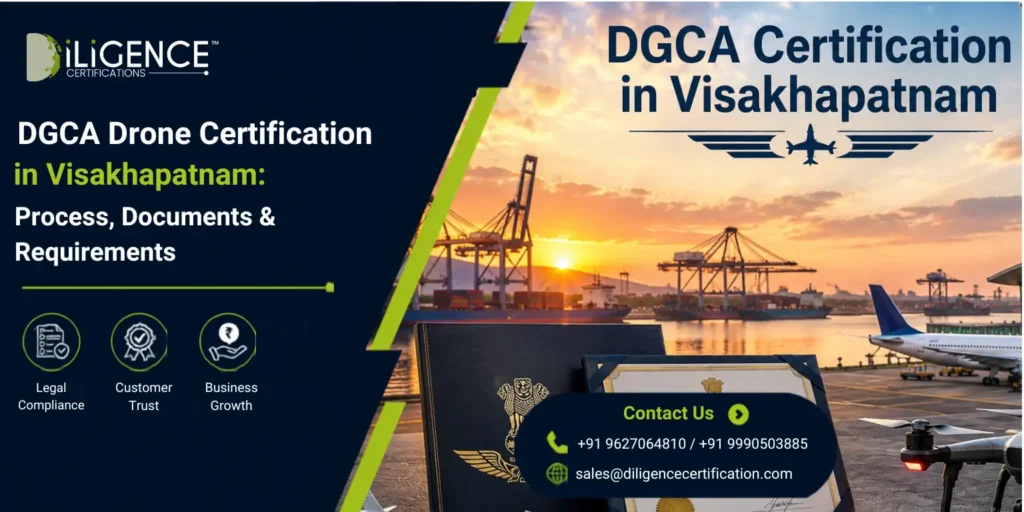
By - DGCA Certification in Visakhapatnam covers the applicable regulatory approvals, certification and registration requirements for drone manufacturers, operators, pilots and training organisations.
- Depending on the activity, compliance may involve Type Certification, UIN-related registration, Remote Pilot certification or RPTO authorisation.
- Businesses should verify the current DGCA requirements before applying because India’s drone regulatory framework and digital processes continue to evolve
Introduction
A technology company in Visakhapatnam can have a technically impressive drone ready for a mining survey, port inspection or agricultural application. The engineering team may have completed the flight tests, the camera may deliver excellent imagery and the customer may already be interested.
DGCA Certification in Visakhapatnam should therefore be planned before the drone reaches the commercial deployment stage. The applicable requirement depends on whether the organisation manufactures the aircraft, operates it, trains pilots or performs another regulated activity.
India’s drone framework is national rather than city-specific. A manufacturer in Visakhapatnam follows the applicable Directorate General of Civil Aviation requirements just as a manufacturer in Hyderabad, Bengaluru or Pune does. The location determines where the business operates, but it does not create a separate local DGCA certification framework.
What Is DGCA Certification in Visakhapatnam
DGCA Certification in Visakhapatnam refers to the applicable certification, registration or authorisation
Directorate General of Civil Aviation required under India’s civil aviation framework for a particular drone-related activity.
There is no single certificate that covers every drone business.
Depending on the activity, an applicant may need to address requirements relating to:
- Type Certification
- UAS registration or UIN-related requirements
- Remote Pilot certification
- Operational compliance
- Remote Pilot Training Organisation approval
- Other applicable DGCA requirements
The Drone Rules framework applies to persons involved in activities including manufacturing, importing, trading, leasing, operating, transferring or maintaining drones in India.
The practical point is straightforward: identify the activity before identifying the certificate.
A manufacturer should not use an operator’s checklist. Likewise, a pilot should not assume that a drone manufacturer’s Type Certificate is a substitute for pilot certification.
Why Drone Certification Matters in Visakhapatnam
Visakhapatnam has a strong industrial and infrastructure ecosystem. Drone applications can be relevant to:
- Port and logistics operations
- Industrial inspection
- Construction
- Land surveying
- Mining-related surveys
- Agriculture
- Real estate
- Infrastructure monitoring
- Environmental surveys
- Security applications
- Photography and videography
Consider an engineering company that wants to use drones for periodic infrastructure inspection.
The business may initially think the important investment is the drone itself. In reality, the compliance system surrounding the drone can be equally important.
The company needs to know which aircraft can be used, who can operate it, what registration or certification applies and what operational restrictions must be observed.
A technically capable drone without the appropriate compliance pathway can become a commercial liability.
Who Needs DGCA Certification in Visakhapatnam
The exact compliance requirement depends on the role of the organisation or individual.
Drone Manufacturers
Manufacturers developing an unmanned aircraft for commercial use should assess the applicable Type Certification requirements.
The manufacturer’s responsibility goes beyond building a working prototype. Technical documentation, testing and conformity with applicable requirements form an important part of the certification exercise.
Drone Operators
Businesses using drones for surveying, mapping, inspection, agriculture, photography or other professional services should identify the requirements applicable to their operations.
An operator should not assume that purchasing a certified drone automatically completes all regulatory obligations.
Remote Pilots
A person flying a drone professionally may need the appropriate remote pilot certification depending on the aircraft and activity.
The pilot requirement should be reviewed separately from the aircraft’s certification status.
Training Organisations
Businesses that intend to train professional drone pilots need to assess the requirements for becoming an authorised Remote Pilot Training Organisation.
DGCA’s current dashboard separately tracks approved RPTOs, demonstrating that training organisations form a distinct part of the regulatory ecosystem.
DGCA Type Certification in Visakhapatnam
For drone manufacturers, Type Certification is one of the most important regulatory areas.
A Type Certificate is associated with a particular type or model of unmanned aircraft system and is not simply a certificate confirming that the manufacturer exists.
This is why certification planning should begin while the drone is still being developed.
What Does Type Certification Involve
The process can involve:
- Identification of the applicant
- Definition of the UAS configuration
- Technical documentation
- Prototype preparation
- Testing
- Compliance assessment
- Test reports
- Regulatory review
- Issuance of the applicable Type Certificate when requirements are met
The applicant should ensure that the prototype presented for testing corresponds with the technical information submitted during the application.
That sounds obvious, but it is one of the practical areas where projects can become difficult.
Suppose a manufacturer changes the flight controller, communication module or battery configuration after preparing its documentation. Those changes should not be treated as minor simply because the drone still flies. They may have regulatory implications.
Step-by-Step DGCA Certification Process for Drone Manufacturers
Step 1: Identify the Certification Route
Start by defining what the company is actually seeking.
Is it Type Certification? Drone registration? Pilot certification? RPTO approval?
The answer determines the rest of the project.
Step 2: Review the Drone Configuration
Record the aircraft specifications carefully.
The model name, serial information, weight, propulsion system, communication architecture and other relevant characteristics should be consistent throughout the documentation.
Step 3: Conduct a Compliance Gap Assessment
Compare the proposed aircraft against the applicable DGCA requirements.
This is where professional review can save time.
It is considerably cheaper to identify a missing requirement before testing than after a prototype has already been submitted.
Step 4: Prepare the Documentation
Technical documents should be organised before submission.
The documents should not simply be collected in a folder. They should tell a consistent story about the aircraft.
Step 5: Prepare the Prototype
The prototype should represent the configuration documented in the application.
If there are multiple variants, the manufacturer should clearly define the version being presented for certification.
Step 6: Complete Applicable Testing
Testing is performed through the applicable authorised testing mechanism and according to the relevant requirements.
The purpose is to establish conformity with the prescribed technical and safety criteria.
Step 7: Regulatory Review
The application, supporting documents and test outcomes are considered through the applicable regulatory process.
Questions or requests for clarification may arise during review.
Step 8: Certification or Further Compliance Action
Once the applicable requirements have been satisfactorily addressed, the relevant certification or approval can proceed.
Documents Required for DGCA Certification in Visakhapatnam
The document list depends on the exact approval.
For a manufacturer, however, the preparation commonly involves both corporate and technical information.
Business Information
Potential documents may include:
- Company incorporation details
- PAN and GST information, where applicable
- Registered office details
- Authorised signatory information
- Manufacturer information
- Applicant declarations
- Relevant ownership or authorisation documents
Technical Information
Depending on the certification route, the technical file may include:
- Drone specifications
- Aircraft configuration
- Weight information
- Dimensions
- Propulsion details
- Battery information
- Communication system details
- Navigation system details
- Flight-control information
- Photographs
- Drawings
- Manuals
- Maintenance information
- Test reports
- Safety-related documentation
- Other documents prescribed for the applicable application
The exact list should be confirmed against the current DGCA requirements.
DGCA Requirements for Drone Training Organisations
Visakhapatnam businesses considering a drone training centre should not treat training as an informal extension of drone operations.
A Remote Pilot Training Organisation operates under its own regulatory requirements.
An RPTO may need to demonstrate suitable arrangements for:
- Training infrastructure
- Qualified personnel
- Training aircraft
- Flying facilities
- Safety procedures
- Training records
- Operational controls
- Application documentation
DGCA’s current online dashboard separately reports approvals for RPTOs, reinforcing that this is a distinct regulatory category.
A business interested in setting up an RPTO should therefore undertake an eligibility and infrastructure assessment before investing heavily in the facility.
Common Mistakes During DGCA Drone Certification
Applying Before Understanding the Requirement
The first question should not be “Where is the application form?”
It should be “Which regulatory pathway applies to our activity?”
Using an Outdated Checklist
Drone regulations have changed significantly over recent years.
Current official notices should take priority over older online material.
Inconsistent Technical Details
A model number on one document should not differ from the prototype identification.
Likewise, specifications should be consistent across drawings, manuals and application records.
Changing the Prototype Too Late
Late technical changes can create documentation and testing complications.
Manufacturers should establish configuration control early.
Confusing Certification With Registration
A Type Certificate, UIN-related registration and pilot certification are different compliance concepts.
Ignoring the Pilot
A business may focus entirely on the drone and forget that the operator may have separate requirements.
How Diligence Certification Can Help
At Diligence Certification, the focus is on helping businesses understand the compliance route before they begin the application process.
For a Visakhapatnam-based drone company, support can include:
- Initial regulatory assessment
- Approval-route identification
- Document checklist preparation
- Application assistance
- Technical documentation coordination
- Compliance gap identification
- Type Certification support
- UIN-related guidance
- Remote Pilot certification guidance
- Regulatory follow-up
- Compliance update support
Diligence Certification‘s existing DGCA service covers drone approval, UIN, Remote Pilot Certificate and Type Certificate-related compliance guidance.
The value of consultancy is not simply filling an online form. A good compliance process should help the client understand what the regulator will expect and identify gaps before they become expensive.
Conclusion
DGCA Certification in Visakhapatnam should be treated as part of the drone business plan, not as paperwork to complete after the product or operation is ready.
For manufacturers, the starting point is a clear understanding of the aircraft configuration, applicable Type Certification requirements, testing and technical documentation. For operators and pilots, the focus may be different and can include registration, remote pilot requirements and operational compliance.
The regulatory framework applies nationally, but the practical challenges are very real for businesses operating from Visakhapatnam.
If your business is developing drones, manufacturing UAS, providing surveying services, operating commercial drones or planning a drone training organisation, Diligence Certification can help identify the applicable DGCA pathway and organise the compliance process.
Frequently Asked Questions
What is DGCA Certification in Visakhapatnam?
It refers to the applicable DGCA certification, registration or authorisation required for a particular drone-related activity.
Can a Visakhapatnam company obtain DGCA Type Certification?
Yes. Eligible manufacturers can follow the applicable national Type Certification process.
Is DGCA certification different in Andhra Pradesh?
No. DGCA drone regulations are national. A Visakhapatnam business follows the applicable Indian framework.
What is a Type Certificate for a drone?
It is certification associated with a particular type of unmanned aircraft system after the applicable requirements are satisfied.
Is UIN the same as Type Certification?
No. UIN-related registration and Type Certification have different regulatory purposes.
Do drone pilots need certification?
The applicable remote pilot requirements depend on the drone and proposed operation.
What documents are required for DGCA drone approval?
Requirements vary, but may include company details, technical specifications, drawings, prototype information and test-related records.
How much does DGCA Certification in Visakhapatnam cost?
There is no fixed cost. It depends on the approval type, testing, technical work and consultancy requirements.
How long does DGCA drone approval take?
The timeline varies according to documentation, testing, clarifications and regulatory review.
Can Diligence Certification assist with DGCA drone compliance?
Yes. Diligence Certification provides consultancy support for applicable drone certification and compliance requirements.