BIS Certification
 CDSCO
CDSCO
 PESO
PESO
 CPCB
CPCB
 LMPC
LMPC
 WPC Approval
 Global Approvals
 TEC
TEC
 ARAI
ARAI
 BEE
BEE
 ISO Certification
 DGCA Certification
 NOC For Steel
 APEDA Registration























 Business Registration
 FSSAI Mark Certification












 (32).jpg)
 Legal Services
 Trademark Registration
 Copyright Registration
 Patent Registration
 By
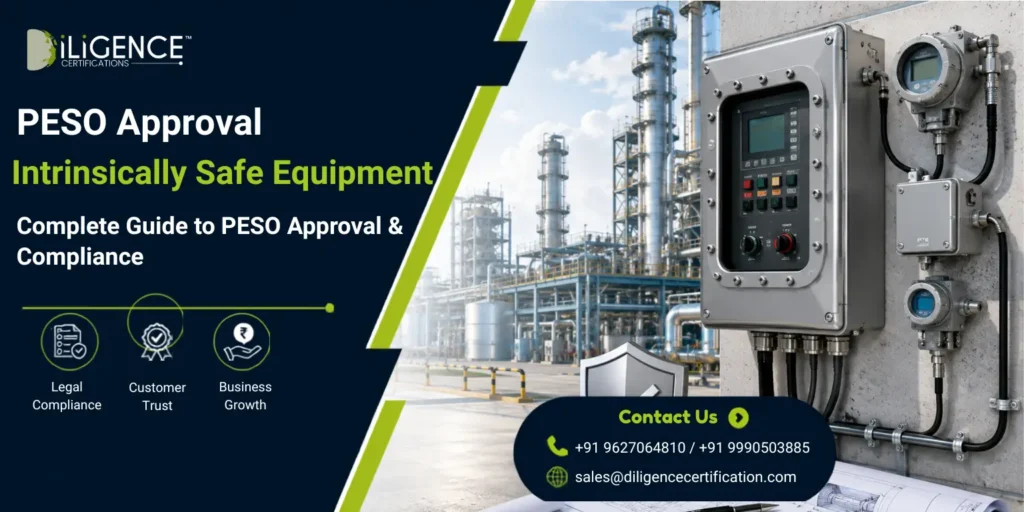
By - Details on PESO Approval for Intrinsically Safe Equipment must be taken into account by manufacturers, importers, suppliers, industries, petroleum installations, chemical plants, oil & gas companies, and others involved in handling electrical equipment meant for hazardous locations.
- Information on the eligibility criteria, process, documentation, technical specifications, testing, inspection, verification, approval, and continued compliance for intrinsically safe electrical equipment is provided herein.
- Details on PESO Approval for Intrinsically Safe Equipment are provided herein.
Introduction
Intrinsically safe equipment has been specifically designed for applications in hazardous conditions where there could be flammable gases, vapors, or any other combustible atmosphere.
The underlying theory of intrinsical safety lies in limiting the amount of electrical and thermal energy available in the equipment and circuits in such a way that the available energy cannot ignite the explosive atmosphere in the surroundings.
The applications of intrinsically safe equipment can range from installations involving petroleum, oil and gas, chemicals, refineries, petrochemicals, storage, process plants, etc., and other such hazardous conditions where there is a need to protect electrical equipment.
There are hazards involved in using normal electrical equipment in hazardous locations as there may be instances when electrical sparks, arcs, overheating, and other possible ignition sources might get in contact with the flammable atmosphere.
The organization which regulates such matters in the context of petroleum, explosives, compressed gases, pressure vessels, and other hazardous substances is the Petroleum and Explosives Safety Organization (PESO).
What is PESO Approval for Intrinsically Safe Equipment?
Regulatory Approval for Intrinsically Safe Electrical Equipment means the approval that applies to electrical equipment suitable for use in hazardous locations under (PESO) Petroleum and Explosives Safety Organization regulations. Such equipment uses intrinsic safety or another approved form of protection in its design and must satisfy the applicable technical and safety requirements.
Intrinsic Safety is not the same thing as having a tough electrical device or one that is well-enclosed. The design of the equipment is meant to ensure the management of electrical and thermal energy in such a way as to avoid ignition of the surrounding hazardous atmosphere under the conditions covered by the concept of protection.
The review may include the design of the equipment, technical data, drawings, test reports, certificates, manufacturing data, quality arrangements, and other pertinent data.
The services associated with PESO Approval for Intrinsically Safe Equipment may include:
- PESO Approval Assistance
- Intrinsically Safe Equipment Approval
- Hazardous Area Equipment Compliance
- Technical Documentation Support
- Application Filing
- Testing and Certification Guidance
- Regulatory Advisory
- Approval Documentation
- Query Resolution
Following the applicable PESO Approval for Intrinsically Safe Equipment requirements helps manufacturers and businesses establish a structured regulatory pathway for equipment intended to operate in hazardous areas.
Applications of PESO Approval for Intrinsically Safe Equipment
The approval of PESO for intrinsically safe equipment could be applicable to various organizations engaged in the manufacture, importation, supply, installation, or use of electrical equipment used in hazardous locations.
This is determined by the type of equipment, the use to which it is to be put, the hazardous location, the protection principle employed, legislation and standards, among others.
Some of the organizations and industries where such equipment may be relevant include:
- Oil and Gas Companies
- Petroleum Installations
- Refineries
- Petrochemical Industries
- Chemical Manufacturing Companies
- Petroleum Storage Facilities
- Fuel Handling Facilities
- Process Industries
- Industrial Manufacturing Units
- Hazardous Area Equipment Manufacturers
- Electrical Equipment Manufacturers
- Electrical Equipment Importers
- Industrial Automation Companies
- Instrumentation Companies
- Industrial Electrical Suppliers
- Engineering Companies
- Industrial Equipment Distributors
- Businesses Supplying Hazardous Area Equipment
Using properly approved equipment helps organizations maintain appropriate electrical safety arrangements in hazardous environments while supporting regulatory compliance.
Who Needs PESO Approval for Intrinsically Safe Equipment?
Companies that engage in the production, importation, supply, and/or intended use of intrinsically safe electrical apparatus in explosive atmospheres should be aware of the PESO approval that is needed.
These companies that might require approval/authorization include:
- Electrical Equipment Manufacturers
- Intrinsically Safe Equipment Manufacturers
- Industrial Automation Companies
- Instrumentation Manufacturers
- Electrical Equipment Importers
- Petroleum Companies
- Oil and Gas Companies
- Refineries
- Petrochemical Units
- Chemical Industries
- Petroleum Storage Facilities
- Industrial Process Plants
- Hazardous Area Equipment Suppliers
- Electrical Equipment Distributors
- Industrial Equipment Dealers
- Engineering and Project Companies
- Other Organizations Dealing with Regulated Hazardous Area Equipment
The actual requirement should be assessed according to the equipment, proposed installation, hazardous-area classification, applicable rules, and regulatory requirements.
Proper compliance enables eligible organizations to use or supply suitable equipment while maintaining the necessary technical, safety, and regulatory discipline.
Types of Compliance Under PESO Approval for Intrinsically Safe Equipment
The compliance requirements relating to intrinsically safe equipment depend upon several factors, including the equipment design, intended hazardous area, protection concept, applicable standards, electrical characteristics, testing requirements, manufacturing arrangements, certification, documentation, and regulatory requirements.
Compliance is particularly important because electrical equipment installed in a hazardous atmosphere must not become an ignition source.
Equipment Design & Technical Compliance
Intrinsically safe equipment needs to be designed according to the applicable protection requirements and technical standards.
The equipment design should address electrical energy, thermal effects, component selection, circuits, construction, protective measures, and other technical parameters relevant to intrinsic safety.
Some of the issues that fall under equipment design and technical compliance include:
- Suitable Equipment Design
- Intrinsic Safety Protection
- Electrical Circuit Protection
- Thermal Safety
- Component Selection
- Technical Specifications
- Engineering Drawings
- Product Construction
- Protection Parameters
- Hazardous Area Suitability
- Applicable Standards
Useful for:
- Electrical Equipment Manufacturers
- Instrumentation Companies
- Industrial Automation Companies
- Hazardous Area Equipment Suppliers
- Petroleum Industries
- Chemical Industries
Proper technical compliance helps establish that the equipment has been developed with the required hazardous-area safety considerations.
Testing & Certification Compliance
Testing and certification are important parts of the approval process for equipment intended for hazardous areas.
The manufacturer may need to provide appropriate test reports, certificates, technical information, and other evidence demonstrating conformity with the applicable requirements.
PESO’s official FAQ indicates that manufacturers seeking approval for indigenous electrical equipment are expected to furnish technical information and prototype test certification from an approved testing laboratory, among other documents.
Compliance may include:
- Prototype Testing
- Approved Laboratory Testing
- Test Reports
- Product Certification
- Technical Evaluation
- Conformity Assessment
- Protection Certification
- Product Specification Verification
- Manufacturing Quality Information
- Supporting Technical Records
Useful for:
- Equipment Manufacturers
- Electrical Product Manufacturers
- Imported Equipment Suppliers
- Instrumentation Manufacturers
- Industrial Automation Companies
- Hazardous Area Equipment Suppliers
Proper testing and certification documentation provides technical evidence supporting the regulatory evaluation of the equipment.
Documentation & Inspection Compliance
Documentation and regulatory verification form an important part of PESO Approval for Intrinsically Safe Equipment.
An applicant is expected to provide accurate information relating to the equipment, manufacturer, design, testing, certification, manufacturing facilities, quality arrangements, and intended application.
Documentation may generally include:
- Equipment Details
- Manufacturer Details
- Technical Specifications
- Engineering Drawings
- Product Datasheets
- Test Reports
- Certification Documents
- Manufacturing Facility Details
- Quality Control Details
- Testing Facility Details
- Technical Manpower Details
- Application Documents
- Authorization Documents
- Other Regulatory Documents
Maintaining complete and updated records helps businesses respond to regulatory queries and demonstrate conformity during technical evaluation or verification.
Documents Required for PESO Approval for Intrinsically Safe Equipment
The documents required for PESO Approval for Intrinsically Safe Equipment depend on the equipment type, manufacturer, country of origin, intended application, applicable standards, testing arrangements, and regulatory requirements.
Generally, the required documents may include:
- PAN Card
- GST Registration Certificate
- Business Registration Certificate
- Identity Proof of Authorized Signatory
- Address Proof
- Manufacturer Profile
- Equipment Technical Specifications
- Engineering Drawings
- Product Datasheet
- Circuit Diagrams
- Technical Construction Details
- Test Reports
- Certification Documents
- Approved Laboratory Test Certificate
- Manufacturing Facility Details
- Testing Facility Details
- Quality Control Details
- Technical Manpower Details
- Indian Agent Details, if applicable
- Authorization Letter, if applicable
- Digital Signature Certificate, if applicable
- Other documents required under applicable regulations
For imported equipment, additional information relating to the foreign manufacturer, Indian representative or agent, product history, and supporting certification may be relevant depending on the approval requirements.
PESO’s official FAQ separately identifies manufacturer infrastructure, engineering and technical details, prototype test certification, and other supporting information as part of the documentation for electrical equipment approval.
Preparing accurate and consistent documentation helps make the PESO Approval for Intrinsically Safe Equipment process more organized and reduces avoidable regulatory queries.
Step-by-Step Process for PESO Approval for Intrinsically Safe Equipment
Getting approval for intrinsically safe devices will be easier if the manufacturer or applicant knows the regulatory and technical requirements before applying for the approval.
The process involves eligibility determination, technical assessment, documentation, testing, application, verification, regulatory evaluation, approval, and compliance.
The systematic way of handling the approval requirement can facilitate its management.
Step 1: Eligibility Assessment
The first stage in the PESO Approval for Intrinsically Safe Equipment process is identifying whether the proposed equipment falls within the applicable PESO approval requirements.
Eligibility may depend on:
- Type of Equipment
- Intended Application
- Hazardous Area
- Protection Concept
- Equipment Design
- Electrical Characteristics
- Applicable Standards
- Installation Environment
- Manufacturer Details
- Import or Domestic Manufacturing Status
- Regulatory Jurisdiction
Proper eligibility assessment helps businesses understand the approval pathway applicable to their equipment.
Step 2: Gathering All Required Documents
After determining the relevant requirements, the next stage is compiling all the technical, business, production, testing, and regulatory documentation required for the certification.
It is necessary because the documents provided will give the regulatory body an overview of the equipment and its intended application.
The common documents may include:
- Business Registration Certificate
- PAN Card
- GST Registration Certificate
- Manufacturer Profile
- Equipment Specifications
- Technical Drawings
- Circuit Diagrams
- Test Reports
- Certification Documents
- Manufacturing Facility Details
- Quality Control Details
- Testing Facility Information
- Authorization Documents
Proper documentation provides clarity during technical evaluation and supports a smoother application review.
Step 3: Testing and Technical Evaluation
It may be necessary for the equipment to be tested against applicable standards and technical requirements prior to or in conjunction with the approval process.
This is necessary since intrinsic safety relies on the physical electrical and thermal properties of the equipment.
The evaluation may involve:
- Equipment Testing
- Prototype Testing
- Electrical Testing
- Thermal Evaluation
- Protection Verification
- Technical Assessment
- Certification Review
- Test Report Verification
PESO’s official material specifically discusses recognized testing laboratories for electrical equipment intended for hazardous areas and refers to conformity with applicable standards.
Step 4: Filling Out the Application
Once the technical documentation and supporting records are prepared, the application for the appropriate PESO approval must be submitted with accurate information relating to the manufacturer, equipment, technical design, testing, certification, and intended use.
All information in the application should remain consistent with the supporting documentation.
The application generally covers:
- Business Information
- Applicant Information
- Manufacturer Information
- Equipment Information
- Technical Information
- Testing Information
- Certification Information
- Application Information
- Compliance Information
Careful preparation of the application helps avoid inconsistencies and unnecessary regulatory queries.
Step 5: Verification of the Application
After submission, the concerned authority may review the application and supporting documents to determine whether the proposed equipment satisfies the applicable technical, safety, testing, and regulatory requirements.
The verification procedures may include:
- Business Verification
- Manufacturer Verification
- Documentation Verification
- Technical Documentation Verification
- Test Report Verification
- Certification Verification
- Equipment Specification Verification
- Compliance Verification
In some cases, additional technical clarification, information, documents, or supporting evidence may be requested.
The applicant should provide appropriate responses to regulatory queries within the applicable process requirements.
Step 6: Grant of PESO Approval
Once the applicable technical, testing, documentation, and regulatory requirements have been successfully fulfilled, the relevant PESO approval may be granted by the competent authority.
The benefits of obtaining applicable approval under PESO Approval for Intrinsically Safe Equipment include the following:
- Safety Standards Compliance
- Hazardous Area Equipment Compliance
- Regulatory Recognition
- Improved Equipment Credibility
- Efficient Industrial Operation
The grant of approval indicates that the equipment has undergone the applicable regulatory evaluation for the particular approval scope.
Step 7: Ongoing Compliance
Obtaining PESO Approval for Intrinsically Safe Equipment is not the end of the manufacturer’s or applicant’s compliance responsibilities.
Businesses should continue to maintain the approved equipment configuration, relevant technical documentation, manufacturing quality arrangements, certification records, and other applicable regulatory requirements.
These obligations may consist of:
- Technical Monitoring
- Quality Control
- Testing Records
- Certification Records
- Equipment Configuration Monitoring
- Manufacturing Compliance
- Regulatory Documentation
- Product Change Monitoring
- Application Information Updates
- Compliance Monitoring
Regular monitoring helps organizations identify potential compliance gaps and maintain the integrity of approved equipment.
Timeline, Cost & Validity of PESO Approval for Intrinsically Safe Equipment
The timeline, cost, and validity of PESO Approval for Intrinsically Safe Equipment depend on several factors, including the type of equipment, technical documentation, testing requirements, certification, application review, regulatory verification, manufacturing details, imported or indigenous status, and applicable regulatory requirements.
| Timeline | Cost | Validity |
| The approval timeline depends on technical documentation, testing, certification review, application processing, and regulatory verification. | The cost depends on the applicable government fee and professional service charges, if any. | PESO equipment approval remains subject to the applicable approval conditions, regulatory requirements, and terms specified by the competent authority. |
| Proper documentation and complete technical records help reduce avoidable processing delays. | Additional charges may vary depending on equipment type, testing requirements, certification, and compliance requirements. | Businesses should comply with applicable update, modification, renewal, or re-approval requirements whenever necessary. |
| Processing time may vary based on the completeness of the application and the technical evaluation required. | Proper planning helps manage the approval and compliance cost efficiently. | Maintaining updated technical, manufacturing, certification, and business information helps support continued regulatory compliance. |
Importance & Benefits of PESO Approval for Intrinsically Safe Equipment
| Importance | Benefits |
| Helps organizations comply with applicable hazardous-area electrical safety and regulatory requirements. | Enhances business credibility and demonstrates commitment to equipment safety and regulatory compliance. |
| Supports the safe use of electrical equipment in hazardous environments where flammable gases or vapours may be present. | Improves confidence among customers, industrial users, business partners, and regulatory authorities. |
| Encourages responsible design, testing, manufacturing, and supply of intrinsically safe equipment. | Supports smoother compliance with applicable hazardous-area and electrical safety requirements. |
| Promotes long-term equipment reliability and regulatory discipline. | Reduces compliance risks and improves operational confidence. |
| Helps businesses fulfill their legal, technical, and regulatory responsibilities. | Strengthens long-term business growth and industry reputation. |
Why is PESO Approval for Intrinsically Safe Equipment Important?
The reason for the importance of PESO Approval of Intrinsically Safe Equipment relates to the need to mitigate hazards in relation to ignition sources within hazardous environments where explosive atmospheres containing flammable gases, vapor, or combustible substances may occur.
Electrical apparatus becomes an ignition hazard when it generates spark, arcs, heat, or any form of energy that can cause ignition of the surrounding atmosphere.
Companies involved in oil and gas business, refineries, petrochemical plants, chemical factories, petroleum installations, industrial process units, equipment manufacturers, instrument suppliers, and other enterprises working with hazardous area electrical equipment should be familiar with the approval process requirements.
Compliance may relate to aspects of design, testing, certification, technical documentation, manufacturing, application information, and regulatory conformity.
For companies producing and supplying intrinsically safe equipment, approval is not simply a formality. It has direct relation to the proof that the equipment has been assessed according to the requirements relevant to its hazardous environment application.
The importance of PESO Approval for Intrinsically Safe Equipment includes:
- Regulatory Compliance
- Hazardous Area Safety
- Equipment Reliability
- Technical Compliance
- Industry Recognition
- Risk Reduction
- Responsible Equipment Manufacturing
PESO Approval for Intrinsically Safe Equipment requirements help businesses establish a more structured approach to hazardous-area electrical equipment while supporting regulatory compliance and industrial safety.
Consequences of Non-Compliance with PESO Approval for Intrinsically Safe Equipment
Non-compliance with the relevant requirements regarding the use of electrical equipment in hazardous areas may cause major issues for companies that manufacture, import, supply, or utilize intrinsically safe equipment.
Equipment which does not meet the relevant requirements regarding its approval or technical aspects may cause numerous concerns.
Some of the consequences include:
Failure to Comply with Regulations
Failure to follow applicable PESO approval requirements may occur when equipment is manufactured, imported, supplied, installed, or used without meeting the applicable regulatory conditions.
Action of the Competent Authority
The competent authority may take appropriate action where regulated equipment does not comply with applicable safety or approval requirements.
Operational Constraints
An organization may face restrictions on the use, installation, supply, or operation of equipment until applicable compliance requirements are fulfilled.
Lag Time of Business Operations
Non-compliance may result in delays in obtaining approvals, completing projects, commissioning installations, supplying equipment, or carrying out regulated industrial activities.
Suspension or Revocation of Approvals
Serious or repeated non-compliance may affect an existing approval or authorization, subject to the applicable regulatory provisions and conditions.
Risk of Hazards
Using unsuitable or inadequately evaluated electrical equipment in hazardous areas can increase the possibility of ignition-related incidents and other safety risks.
Business Reputation
Lack of compliance may affect the reputation of manufacturers, suppliers, contractors, and industrial businesses among customers, project partners, employees, and regulatory authorities.
Bad Reputation Risk
Repeated failure to comply with applicable equipment safety requirements may raise concerns regarding the quality, reliability, and responsible conduct of the business.
Development of the Business
Non-compliance can create difficulties for businesses seeking to participate in regulated industrial projects, expand product offerings, enter new markets, or work with major industrial customers.
Compliance with relevant PESO Approval for Intrinsically Safe Equipment requirements helps businesses operate in a more organized, technically responsible, and compliant manner.
Renewal of PESO Approval for Intrinsically Safe Equipment
The renewal, updating, modification, or continuation of the applicable PESO approval may become important when there are changes to the equipment, manufacturer, design, certification, production arrangements, technical specifications, or other approval-related information.
Organizations should periodically review their approval status to determine whether any changes have occurred in relation to:
- Equipment Design
- Technical Specifications
- Manufacturing Facility
- Manufacturer Details
- Testing Arrangements
- Certification
- Product Configuration
- Quality Control Arrangements
- Indian Agent Details, where applicable
- Other Approval Information
Reviewing approval information in advance helps businesses identify regulatory responsibilities and reduce the possibility of disruption to their operations.
The typical process of updating or renewing applicable PESO approval may include:
- Updating Business Information
- Reviewing Approval Details
- Reviewing Equipment Details
- Updating Technical Information
- Reviewing Certification Documents
- Updating Manufacturer Information
- Submitting Required Documents
- Maintaining Technical Compliance
- Checking Regulatory Requirements
Keeping PESO Approval for Intrinsically Safe Equipment information updated helps manufacturers and suppliers continue their regulated activities efficiently while maintaining applicable technical, safety, and regulatory compliance.
How Professional Assistance Helps in PESO Approval for Intrinsically Safe Equipment?
However, it is often challenging for companies to navigate the regulations concerning technical specifications, testing, certification, documentation, procedures and evaluation of hazardous area electrical equipment without the appropriate support.
In case of intrinsic safety devices, the technical information is crucial since the certification process may include design of the product, testing, parameters of protection, certification, production and documentation.
Professional advice will help companies to learn about the relevant regulations and structure the documentation and procedure accordingly.
Professional assistance generally includes:
- Understanding PESO Approval Requirements
- Eligibility Assessment
- Technical Documentation Preparation
- Testing and Certification Guidance
- Application Filing Assistance
- Regulatory Compliance Guidance
- Technical Compliance Guidance
- Documentation Review
- Application Status Tracking
- Query Resolution
- Post-Approval Compliance Support
The professional services generally cover:
- Eligibility Verification
- Documentation Assistance
- Application Support
- Regulatory Compliance Guidance
- Technical Documentation Support
- Testing Documentation Assistance
- Inspection or Verification Preparation
- End-to-End Approval Assistance
- Ongoing Compliance Advisory
With suitable professional guidance, manufacturers and businesses dealing with intrinsically safe equipment can organize their approval and compliance requirements more efficiently while focusing on their core industrial activities.
Why Choose Diligence Certifications for PESO Approval for Intrinsically Safe Equipment?
Requirements for intrinsic safety equipment certification include knowledge about hazardous area legislation, technical requirements, test standards, certificates, product design, manufacturing data, application procedures, and compliance.
Professional advice may help organize the whole process and simplify the management of technical documentation, testing data, application submissions, questions to regulatory bodies, certification requirements, and post-certification compliance.
Diligence Certifications can be of use for companies that have certification and compliance issues with respect to hazardous area electrical equipment, industrial safety, petroleum facilities, chemical industries, and others.
The advantages of choosing Diligence Certifications include:
- Documentation Assistance
- Application Filing Support
- Regulatory Compliance Guidance
- Approval Query Resolution
- Technical Documentation Assistance
- End-to-End Approval Assistance
- Continuous Compliance Support
- Regulatory Guidance
- Process Management
With professional support from Diligence Certifications, managing PESO Approval for Intrinsically Safe Equipment requirements becomes a more structured process, helping businesses handle applicable documentation, testing, technical, regulatory, and compliance requirements efficiently.
Conclusion
Approvals for Intrinsically Safe Electrical Equipment from PESO is an essential regulatory aspect when considering electrical equipment to be used in hazardous areas that come under the purview of PESO jurisdiction.
This is due to the fact that, in hazardous locations, there may be presence of flammable gases or vapors. As such, it is necessary to have adequate measures to ensure that the electrical equipment is not an ignition source. One of the ways in which this can be done is through intrinsic safety as a method of protection concept, with its key principle being the limitation of electrical and thermal energy in order to avoid ignition.
Compliance does not only involve acquiring an approval document. There is also the need to ensure technical integrity, adequate documentation, proper testing, and quality compliance among other things.
Design, technical specifications, prototyping, testing, certification, engineering drawings, manufacturing, quality assurance, regulatory documents and applications among others are some of the key aspects.
Frequently Asked Questions
What is PESO Approval for Intrinsically Safe Equipment?
It is the applicable regulatory approval for intrinsically safe electrical equipment intended for regulated hazardous areas.
Who needs PESO Approval for Intrinsically Safe Equipment?
Manufacturers, importers, suppliers, and businesses dealing with hazardous-area electrical equipment may need it.
Is PESO Approval mandatory for intrinsically safe equipment?
It may be required when the equipment falls under the applicable PESO regulatory requirements.
What documents are required for PESO Approval?
Technical specifications, drawings, test reports, certification documents, manufacturer details, and other applicable documents may be required.
How long does PESO Approval take?
The timeline depends on documentation, testing, technical evaluation, and regulatory processing.
What is the validity of PESO Approval?
Validity depends on the applicable approval conditions and regulatory requirements.
Why is PESO Approval important?
It supports regulatory compliance and safe use of electrical equipment in hazardous areas.
Can consultants help with PESO Approval?
Yes, consultants can assist with documentation, application filing, technical compliance, and regulatory queries.
What are the benefits of PESO Approval?
It supports regulatory compliance, improves equipment credibility, and promotes safer use in hazardous areas.
What happens if PESO requirements are not followed?
Non-compliance may lead to regulatory action, operational restrictions, approval issues, and safety risks.