BIS Certification
 CDSCO
CDSCO
 PESO
PESO
 CPCB
CPCB
 LMPC
LMPC
 WPC Approval
 Global Approvals
 TEC
TEC
 ARAI
ARAI
 BEE
BEE
 ISO Certification
 DGCA Certification
 NOC For Steel
 APEDA Registration























 Business Registration
 FSSAI Mark Certification












 (32).jpg)
 Legal Services
 Trademark Registration
 Copyright Registration
 Patent Registration
 By
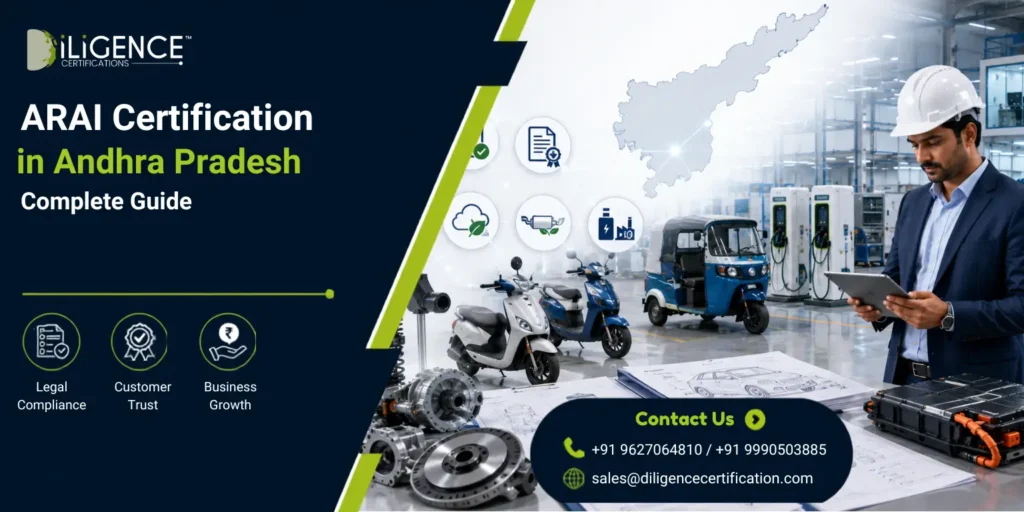
By - ARAI Certification in Andhra Pradesh ensures that the automobile manufacturers meet CMVR, safety, emission and performance requirements.
- The process of certification depends upon the kind of vehicle, component, engine, electric vehicle, fuel type and other equipment used.
- Diligence Certifications can help you in certification consultancy service.
Introduction
Even a vehicle manufacturer in Andhra Pradesh could be in a situation wherein their product is technically ready for manufacturing but their regulatory activities are not up to mark. The product functions well; the components required are available and the production process is set up; however, the tests and type approval documents required have not yet been identified and mapped out.
This is far more common than most people think, especially in cases where a company wants to manufacture an electric vehicle, three-wheeler, special purpose vehicle, automotive components, and any other vehicle which uses some alternate fuel.
This is where the ARAI Certification in Andhra Pradesh.
Testing, certification and homologation services are available from Automotive Research Association of India (ARAI) for vehicles, systems and components.
The range of activities related to the field of certification provided by ARAI consists of vehicle type approval, engine certification, component certification, conformity of production, export homologation and many other compliance services related to automobiles.
It is not enough for a manufacturer to fill in an application form in order to get certified from ARAI; all other related activities should be consistent with the requirement.
At Diligence Certifications, we take the practical approach and start from understanding of the product, mapping of the requirements, organizing documentation and only after that coordinating the whole process of certification.
What Is ARAI Certification?
ARAI Certification means all activities pertaining to testing, type approvals, certifications, and homologations conducted via ARAI for automotive products and technologies.
ARAI stands for the Automotive Research Association of India, which is a prestigious automotive research & engineering institution working in various aspects of vehicle engineering and technologies.
Certifications from ARAI include:
- Vehicle type approval
- Engine type approval
- Automotive component certification
- Genset certification
- Equipment certification
- Retrofitment certification
- Conformity of Production
- Export homologation
- Bus body certification
- Selected electric and hybrid vehicle testing and certification activities
The exact requirement depends on what a company manufactures and how the product is intended to be used.
For example, the compliance route for an electric two-wheeler is not necessarily the same as that for a diesel commercial vehicle or an automotive safety-critical component.
Why Is ARAI Certification Important in Andhra Pradesh?
Andhra Pradesh has a developing manufacturing and industrial eco-system that includes automobiles, engineering, electronics, batteries, machinery, logistics and upcoming electric mobility businesses.
A manufacturer who plans to enter such an industry should pay heed to regulatory compliance in the early stages of development rather than waiting for the production phase.
ARAI Certification in Andhra Pradesh is vital in cases where a vehicle/automotive product qualifies for CMVR type approval.
The homologation activities at ARAI include two-wheeled, three-wheeled and four-wheeled vehicles, CNG/LPG & alternative fuel vehicles, construction equipment vehicles, battery operated vehicles, agricultural tractors, gensets and many others.
This is because compliance involves not only documentation but a need for certain technical requirements, test reports of components and prototypes among others to get the relevant approval.
Which Products May Need ARAI Certification?
There is no single ARAI certificate that applies to every automotive business.
The applicable route depends on the product category, intended application, propulsion system, technical characteristics and relevant regulations.
Two Wheeled Vehicles
The ARAI’s vehicle type approval scheme covers petrol, diesel, CNG, LPG and alternative fuel two wheeled vehicles beyond the specified thresholds, and some electric two wheeled vehicles.
It includes vehicles such as motorcycles, scooters, and other eligible two wheelers.
For an electric vehicle manufacturer, technical compliance can include issues such as battery safety, electrical systems, performance criteria and other CMVR requirements.
Three Wheeled Vehicles
Three wheelers that carry passengers or goods can come under the respective type approval scheme.
The passenger and goods carriers, fully built and certain incomplete three wheeler vehicles are part of ARAI’s certification of three wheeler vehicles.
Four Wheeled Vehicles
Four wheeled vehicles can be passenger and goods carriers, fully built vehicles and certain incomplete vehicles.
The relevant requirement can vary depending on the classification of the vehicle which could include M1, N1, M2, M3, N2 and N3 categories.
Petrol, diesel, CNG, LPG, alternative fuel and electric vehicles can be covered in the certification of ARAI depending on the relevant requirements.
Electric Vehicles
Electric mobility has brought a new compliance scenario for manufacturers.
The requirement for an EV manufacturer can include issues like constructional and functional safety, traction batteries, electrical energy consumption, range, power and other applicable regulatory requirements.
Hybrid and Battery operated vehicles are separately mentioned by ARAI as one of the automotive regulatory requirements.
Automotive Components
Apart from vehicle type approval, ARAI also offers component type approval for safety critical components listed under Central Motor Vehicles Rules.
The component may require testing in accordance with specific standards prior to its use in the concerned vehicle manufacturing process.
Engines and Gensets
Engine certification may be relevant for engine manufacturing for automotive or any other purposes.
ARAI mentions that the automotive engines of vehicle weight above the specified categories may be tested independently for emissions and power.
What Does ARAI Type Approval Mean?
Type approval by ARAI means the technical review of a vehicle or product type based on the relevant regulatory requirements.
The objective of the process is to ensure that the vehicle, engine, part, or product meets the requirements as prescribed in the regulations.
The Homologation Management & Regulation division at ARAI serves as the coordinating body for type approval activities and services.
A helpful way of explaining type approval is by considering it as a technical review of a product design before it is accepted for its relevant regulation.
It means that the manufacturer should have the correct product configuration right from the start.
Types of ARAI Certification Services
Vehicle Type Approval
Vehicle type approval is one of the important certification activities undertaken by ARAI.
It can be undertaken for different types of two-wheelers, three-wheelers, four-wheelers, electric vehicles, alternate fuel vehicles, agricultural tractors and construction equipment vehicles based on the relevant regulations.
Component Type Approval
Automotive components, which are considered to be safety critical as notified under CMVR, may require component level approval.
The manufacturer should determine the relevant component requirement and prepare the product and related documentation as per the same.
Engine Type Approval
Engine testing and type approval could involve testing for emission and power as per the category and relevant requirements.
The technical specifications have to be prepared as per the format prescribed.
Conformity of Production
Type approval is not necessarily the end of a manufacturer’s compliance responsibilities.
Conformity of Production (commonly called as COP), is the area where the compliance for the production vehicles / engines are ensured in relation to approved type.
ARAI offers COP services for vehicles and engines as per the relevant regulations.
Export Homologation
Manufacturers from Andhra Pradesh looking to export vehicles might also look at export homologation.
ARAI offers export homologation services for many international markets and has tie-ups with certification authorities in many countries such as Singapore, Netherlands and Australia.
What Documents Are Required for ARAI Certification?
The document list depends on the certification category and product.
For vehicle type approval, ARAI states that manufacturers may need to submit documents including an application letter, authorisation letter, technical specifications as prescribed under AIS 007, drawings and layouts, relevant type-approval or component certificates, WMI/WMC certificates where applicable and information concerning prototype submission.
A practical documentation package may include:
| Document | Purpose |
| Application documents | Establishes the certification request |
| Technical specifications | Defines vehicle or product characteristics |
| Drawings and layouts | Shows construction and configuration |
| Component certificates | Demonstrates compliance of applicable components |
| Test reports | Provides technical evidence |
| Prototype details | Supports physical testing |
| Manufacturer information | Establishes applicant and production details |
| Authorisation documents | Identifies responsible representatives |
| Previous approval documents | Useful for extensions or modifications |
| Supporting declarations | Confirms required technical information |
The important point is consistency.
If the battery capacity shown in one technical document differs from the prototype, or the vehicle dimensions in the drawing do not match the submitted vehicle, the manufacturer may have to resolve the discrepancy before the process can proceed smoothly.
ARAI Certification Process in Andhra Pradesh
Although the exact procedure depends on the certification category, a typical project can be structured into the following stages.
Step 1: Product Applicability Assessment
The first question should not be “Which form do we submit?”
It should be:
What exactly are we manufacturing, and which regulatory requirements apply to it?
The product category, fuel type, vehicle class, technical configuration and intended use should be established first.
Step 2: Identify Applicable Standards
Once the product category is established, the applicable CMVR provisions, AIS requirements and other technical standards need to be mapped.
ARAI maintains information on Automotive Industry Standards and related regulatory material through its official platform.
Step 3: Technical Documentation
The manufacturer prepares technical specifications, drawings, component information and other supporting documents.
This stage deserves careful attention because poor documentation can create problems later during testing or review.
Step 4: Component Compliance
Where component-level approvals are applicable, the relevant components should be assessed before vehicle-level certification.
ARAI notes that component certification can be completed for notified safety-critical components under Rule 126 through authorised testing agencies.
Step 5: Prototype or Test Sample Submission
The required prototype, vehicle, component, engine or test sample must be made available according to the certification requirements.
Testing cannot be treated as an informal demonstration. The submitted product should represent the configuration documented in the application.
Step 6: Testing and Technical Evaluation
Testing is carried out against the applicable requirements.
Depending on the product, this may involve areas such as emissions, braking, lighting, safety, noise, electrical systems, electromagnetic compatibility, battery-related requirements or other technical parameters.
Step 7: Query and Clarification
Technical questions may arise during the certification process.
A manufacturer should respond using clear technical evidence rather than simply submitting generic explanations.
Step 8: Type Approval or Certification
After the applicable requirements have been satisfied, the relevant approval or certification documentation can be issued according to the applicable procedure.
Step 9: Post-Certification Compliance
Manufacturers should maintain production conformity and monitor changes to the approved product configuration.
A design change that appears minor internally can sometimes have regulatory implications.
How Long Does ARAI Certification Take?
There is no universal timeline for every ARAI certification.
The duration depends on the product, number of tests, documentation quality, availability of prototypes, applicable components and whether the application is a new approval, partial approval or documentation-only change.
For vehicle type approval, ARAI currently indicates indicative timelines of 45 working days for full-level approval, 30 working days for partial-level approval and 10 working days for documentation approvals, subject to conditions such as correct documentation, timely prototype submission and completion of component-level certification where applicable.
These should be treated as indicative ARAI timelines rather than a guaranteed completion date.
How Much Does ARAI Certification Cost in Andhra Pradesh?
ARAI certification cost varies according to the product and testing requirements.
Factors can include:
- Vehicle category
- Number of variants
- Testing requirements
- Component testing
- Prototype requirements
- Emission testing
- Safety testing
- Battery or electrical testing
- Documentation changes
- Retesting requirements
- Export homologation requirements
Therefore, quoting one fixed “ARAI certification fee” without understanding the product can be misleading.
A proper estimate should be prepared after reviewing the vehicle or component specifications and identifying the applicable testing scope.
Common Mistakes During ARAI Certification
Starting Testing Before Regulatory Mapping
A manufacturer may send a prototype for testing without first establishing the complete regulatory requirement.
That can result in additional testing later.
Incomplete Technical Specifications
Technical specifications need to accurately describe the product. Missing or inconsistent information can create unnecessary queries.
Ignoring Component-Level Approval
Some vehicle manufacturers focus entirely on the complete vehicle while overlooking component-level compliance requirements.
This can become a problem when the vehicle-level application depends on supporting component certification.
Modification of Product After Testing
After testing, the manufacturer may change certain technical aspects of the battery, motor, chassis, braking system, etc.
The effect of such modification on compliance must be studied in order to decide whether such modification has any influence on the existing certification status.
Approach to EV Compliance Like That of Conventional Vehicle Compliance
There are certain technical aspects of electric vehicles.
The regulatory areas of ARAI include traction battery safety, electrical energy use, range, and other aspects of hybrid/battery operated vehicles.
ARAI Certification for EV Manufacturers in Andhra Pradesh
Andhra Pradesh businesses developing electric scooters, three-wheelers, commercial EVs, electric utility vehicles or related systems should consider certification during product development.
For an EV project, technical planning may include:
- Battery specifications
- Battery-management system
- Electric motor
- Charger and charging interface
- Electrical safety
- Vehicle structure
- Braking system
- Lighting
- Performance parameters
- Range and energy consumption
- Applicable component approvals
ARAI’s Green Mobility Centre also provides testing and compliance services relating to EV and hybrid technologies, including CMVR type approval and EMC-related activities.
Why Choose Diligence Certifications for ARAI Certification?
Diligence Certifications provides compliance consultancy for businesses that need structured support during automotive certification projects.
The company’s current service portfolio specifically lists ARAI Vehicle Certification under its ARAI/Automotive services.
The support can include:
- ARAI applicability assessment
- Product and category evaluation
- Applicable requirement mapping
- Technical documentation support
- Application preparation
- Testing coordination
- Component certification coordination
- Query-response support
- Type-approval follow-up
- Compliance support for modifications
- Guidance for post-certification requirements
In this respect, the value in a consultant for a company comes from linking up all the components together.
The vehicle engineer would be able to comprehend the product perfectly well, yet he might not find the time to keep track of all the regulatory documents. Here a compliance consultant could help build the link between the engineering documents and certification.
Diligence Certifications also offers a wide range of certification and regulatory compliance services for Indian and international businesses.
Conclusion
ARAI Certification in Andhra Pradesh is an aspect to be kept in mind by manufacturers who wish to develop products within the scope of the automotive regulations in India.
It is always easier to manage when the requirements for certification are taken care of while the product is being developed and not after its manufacture. The right technical specifications, standards, component approvals, testing requirements and documentation can make all the difference to the entire process of certification.
Diligence Certifications can provide your business with help in assessment of applicability, documentation, testing arrangement, applications and any other assistance that you may need regarding certification.
If your company wishes to develop a vehicle, EV, automotive component or any other product in Andhra Pradesh, do consult Diligence Certifications before undergoing the whole procedure of testing. A preliminary examination of the product can help in taking the right certification route even before the unnecessary testing or documentation commences.
Frequently Asked Questions
What is ARAI Certification in Andhra Pradesh?
ARAI Certification verifies that eligible vehicles, components, engines, and automotive products meet applicable safety, emission, performance, and regulatory requirements.
Who provides ARAI Certification in India?
The Automotive Research Association of India (ARAI) provides testing, type approval, homologation, and related automotive certification services.
Which vehicles require ARAI Type Approval?
Eligible two-wheelers, three-wheelers, four-wheelers, electric vehicles, alternative-fuel vehicles, tractors, and other regulated vehicles may require type approval.
Is ARAI Certification mandatory for electric vehicles?
Eligible electric vehicles must satisfy applicable CMVR type-approval and technical requirements before commercial introduction.
What documents are required for ARAI Certification?
Documents may include technical specifications, drawings, component certificates, application documents, prototype details, and supporting test reports.
How long does ARAI Certification take?
The timeline depends on the product category, testing requirements, documentation, prototype availability, and type of approval required.
What is the cost of ARAI Certification in Andhra Pradesh?
The cost varies according to vehicle category, testing scope, variants, component testing, prototype requirements, and possible retesting.
Can automotive components require ARAI approval?
Yes. Certain safety-critical automotive components may require separate testing and approval under applicable CMVR requirements.
What is ARAI Conformity of Production?
Conformity of Production ensures that vehicles or engines manufactured after approval continue to conform to the approved type.
Can Diligence Certifications help with ARAI Certification?
Yes. Diligence Certifications can assist with applicability assessment, documentation, testing coordination, application support, and certification follow-up.