BIS Certification
 CDSCO
CDSCO
 PESO
PESO
 CPCB
CPCB
 LMPC
LMPC
 WPC Approval
 Global Approvals
 TEC
TEC
 ARAI
ARAI
 BEE
BEE
 ISO Certification
 DGCA Certification
 NOC For Steel
 APEDA Registration























 Business Registration
 FSSAI Mark Certification












 (32).jpg)
 Legal Services
 Trademark Registration
 Copyright Registration
 Patent Registration
 By
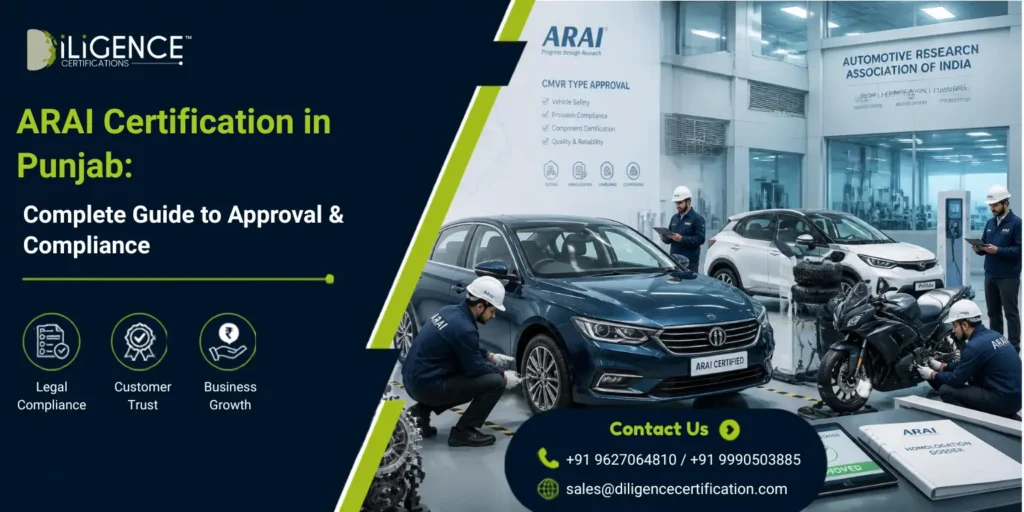
By - ARAI Certification in Punjab helps eligible vehicle, engine, component and automotive-product manufacturers demonstrate compliance with applicable Indian automotive requirements.
- The process can involve product classification, CMVR and AIS requirement mapping, technical documentation, application, prototype submission, testing, evaluation and applicable type approval.
- Punjab-based vehicle manufacturers, EV startups, component suppliers, importers and automotive businesses can use professional compliance support to organise the certification process and reduce avoidable delays.
Introduction
A vehicle manufacturer in Punjab can have an excellent prototype ready for production and still discover that the launch cannot move ahead until the regulatory side is properly addressed.
Consider a hypothetical manufacturer in Ludhiana developing an electric commercial three-wheeler. The engineering team has focused on payload, battery range, motor performance and operating cost. The sales team is already speaking with fleet operators. Then the compliance review begins and raises a more fundamental question: Which type-approval requirements apply to this exact vehicle configuration
This is where ARAI Certification in Punjab becomes relevant. ARAI’s certification framework covers vehicles, engines, components, gensets, equipment and retrofitment. Its vehicle certification activities include multiple vehicle categories and battery-operated vehicles.
What Is ARAI Certification in Punjab
ARAI Certification in Punjab refers to the applicable automotive testing, certification or vehicle type-approval process undertaken under India’s regulatory framework, where ARAI is the relevant testing and certification agency.
The Automotive Research Association of India (ARAI) provides certification and homologation services for automotive vehicles, systems and components. Its official certification categories include vehicle, engine, component, genset, equipment and retrofitment approvals.
A motorcycle manufacturer, an electric three-wheeler company, an automotive lighting supplier and a heavy commercial vehicle manufacturer will not necessarily follow the same certification route.
ARAI’s vehicle type-approval information covers two-wheelers, three-wheelers, four-wheelers, agricultural tractors, construction equipment vehicles and battery-operated vehicles, among other categories.
Therefore, a manufacturer searching for ARAI Certification in Punjab should begin with product classification rather than with a generic certificate checklist.
Which Products May Need ARAI Certification
Two-wheelers
ARAI’s vehicle certification framework covers specified two-wheelers powered by petrol, diesel, CNG, LPG and alternate fuels, as well as qualifying battery-operated vehicles.
Punjab has a substantial manufacturing and engineering ecosystem, so businesses developing motorcycles, scooters or other two-wheeled vehicles should establish the applicable category and standards before starting the approval process.
Three-wheelers
Three-wheeler manufacturers may require type approval for passenger or goods vehicles, depending on the configuration.
The framework also covers relevant electric and alternate-fuel three-wheelers.
For a startup in Punjab developing an electric cargo vehicle, for example, the certification plan should be created alongside the engineering specification.
Four-wheelers
Passenger and goods vehicles fall into different regulatory categories, and the applicable requirements depend on factors such as vehicle classification, gross vehicle weight, propulsion system and intended application.
ARAI’s vehicle certification framework includes relevant M and N category vehicles and different propulsion technologies.
Electric vehicles
EV certification requires particular attention because the vehicle combines conventional automotive requirements with electrical and energy-storage systems.
ARAI states that it is developing and maintaining testing and certification infrastructure for electric and hybrid vehicles through its E-Mobility Centre of Excellence.
For Punjab EV manufacturers, compliance planning should therefore cover the complete vehicle rather than treating the battery or motor as an isolated issue.
Automotive components
Specific safety-critical automotive components can be subject to notified standards and approval requirements.
ARAI explains that the Central Government notifies safety standards for parts, components or assemblies used in vehicles, and component approval is conducted by testing agencies notified under Rule 126.
ARAI’s published AIS:037 conformity information lists examples including lighting devices, rear-view mirrors, seat belts, wheel rims, safety glass, brake hose, horns, tyres and other components with corresponding technical standards.
Engines
Engine certification follows requirements appropriate to the engine and its intended application.
For example, ARAI notes that automotive engines for vehicles above 3.5 tonnes GVW are normally tested on an engine dynamometer for separate emission and power approval, while certain vehicles in the 2.5-to-3.5-tonne range may also opt for engine-dynamometer emission testing for diesel engines.
Why Is ARAI Certification Important for Punjab Manufacturers
The practical value of certification is not limited to receiving an approval document.
It provides a structured mechanism for demonstrating that a regulated automotive product conforms to the applicable technical requirements.
Product safety
Vehicle type approval evaluates the aspects of the product that are relevant to the applicable regulations.
Depending on the vehicle, testing can involve areas such as braking, emissions, lighting, noise, electrical systems, structural characteristics and performance.
Regulatory compliance
A manufacturer needs evidence that the vehicle or component satisfies the requirements applicable to its category.
ARAI’s certification services are specifically designed around type approval, certification and homologation activities for automotive products.
Better market preparation
A properly planned certification project can expose technical issues before the company invests heavily in production tooling.
This is especially important for startups. A young company may have excellent engineering talent but limited experience with the documentation and regulatory sequencing involved in type approval.
Production consistency
Approval also needs to be considered alongside continuing production compliance.
ARAI provides separate Conformity of Production processes for vehicles, engines, components and gensets.
A production vehicle should continue to conform to the approved configuration.
ARAI Certification Process in Punjab
The exact process varies by product, but manufacturers can broadly plan the work through the following stages.
Step 1: Determine the Product Category
First, define exactly what is being submitted for approval.
For a vehicle, identify:
- Vehicle category
- Propulsion system
- Seating or loading arrangement
- Gross vehicle weight
- Dimensions
- Engine or motor specifications
- Intended application
- Variant and model-family information
For a component, determine whether it is covered by a notified safety requirement and identify the applicable technical standard.
This classification affects everything that follows.
Step 2: Identify Applicable CMVR and AIS Requirements
After classification, the manufacturer should map the relevant Central Motor Vehicles Rules, Automotive Industry Standards and other applicable technical requirements.
Do not assume that an old approval for a similar model automatically establishes compliance for a new model.
A small change in vehicle architecture can alter the applicable test scope.
Step 3: Prepare Technical Documentation
ARAI’s current vehicle type-approval information identifies documentation such as:
- Application letter
- Authorisation letter
- Technical specifications in the AIS 007 format
- Drawings and layouts
- Type approval certificates
- Conformity of Production certificates, where applicable
- BIS licences for safety-critical components, where applicable
- WMI/WMC certificates
- Tentative dates for prototype vehicle, systems and component submission
Additional documents may be required depending on the product.
For an electric vehicle, the technical file can include detailed information about the battery, electrical architecture and relevant systems.
Step 4: Submit the Application
ARAI provides the CMVR Type Approval Software platform for relevant certification applications.
At this point, consistency is critical.
The specifications in the application, drawings, component details and physical prototype should describe the same product.
Step 5: Submit the Prototype or Samples
The required vehicle, system, sub-assembly, BIW or component must be made available for testing as applicable.
ARAI’s published vehicle type-approval timelines specifically depend on correct documents, timely prototype or sub-assembly submission and completion of applicable component-level certification.
Step 6: Testing and Evaluation
The test programme depends on the product.
Possible evaluation areas can include:
- Braking performance
- Lighting and signalling
- Emissions
- Noise
- Electrical systems
- Structural requirements
- Vehicle dimensions and weights
- Performance
- Safety-critical components
- Other category-specific requirements
The manufacturer should establish the expected testing scope before committing the final prototype.
Step 7: Correct Non-Conformities
If the product does not meet an applicable requirement, the manufacturer needs to identify the reason and implement the appropriate corrective action.
That may mean changing a component, correcting documentation, modifying an engineering feature or undertaking additional testing.
A failed test is best treated as a technical finding. The response should be based on the exact non-conformity rather than on assumptions.
Step 8: Obtain the Applicable Approval
Once the required requirements have been demonstrated, the applicable type approval or certification documentation can be issued.
The manufacturer should then maintain production consistency with the approved configuration.
Documents Required for ARAI Certification in Punjab
There is no universal document list for every product.
However, manufacturers should generally prepare a product-specific technical file containing the relevant corporate, technical and compliance information.
| Document / Information | Purpose |
| Application documentation | Establishes the certification request |
| Manufacturer details | Identifies the applicant |
| Technical specifications | Defines the product |
| Engineering drawings | Supports technical assessment |
| Component details | Establishes configuration |
| Applicable certificates | Supports component compliance |
| Test reports | Provides supporting technical evidence where accepted |
| WMI/WMC documents | Supports applicable vehicle identification requirements |
| Prototype details | Facilitates testing |
| Authorisation documents | Identifies authorised representatives |
ARAI’s vehicle approval guidance specifically identifies application and authorisation letters, AIS 007 technical specifications, drawings/layouts, applicable approval and CoP certificates, WMI/WMC certificates and prototype-submission information.
The final checklist should be based on the specific product and approval route.
Common Reasons for ARAI Certification Delays
Incorrect product classification
If the manufacturer starts with the wrong regulatory category, the subsequent documentation and test plan can also be wrong.
Incomplete documents
Missing technical specifications, drawings or component information can result in additional clarification.
Prototype does not match the application
This creates a particularly avoidable problem.
The testing agency is assessing the product described in the application. If the physical product is materially different, the manufacturer may need to resolve the discrepancy before the assessment can proceed smoothly.
Component approvals are incomplete
ARAI explicitly identifies completion of applicable component-level certification as a condition associated with its vehicle type-approval timelines.
Late design changes
Changing the battery, motor, braking system, lighting system or another regulated feature after testing begins can affect the approval strategy.
Poor internal coordination
Engineering, production, regulatory and management teams need to work from one controlled technical specification.
If each department uses a different version of the product data, compliance becomes difficult to manage.
How Diligence Certifications Helps With ARAI Certification in Punjab
Diligence Certifications provides ARAI vehicle certification assistance for vehicles, engines and components. Its service information describes support for documentation, application and certification coordination.
For a Punjab manufacturer, the support can include:
Regulatory assessment
Understanding the product and identifying the likely approval pathway.
Documentation support
Organising technical specifications, drawings, certificates and supporting information.
Application assistance
Helping prepare the application package and maintain consistency between documents.
Testing preparation
Helping the manufacturer understand what needs to be prepared before prototype or component submission.
Compliance gap review
Identifying documentation and technical gaps before formal evaluation.
Post-test support
Helping the manufacturer understand observations and organise the appropriate corrective response.
A consultant does not replace the testing and certification authority. The useful role is to help the applicant arrive at that process with a properly prepared compliance file.
Conclusion
ARAI Certification in Punjab should be planned during product development, not treated as a final paperwork exercise.
The process starts with the product category. From there, the manufacturer identifies the applicable CMVR and AIS requirements, prepares the technical documentation, checks component compliance, submits the application, arranges the required prototype or samples and completes testing and evaluation.
For EV startups, vehicle manufacturers, automotive component suppliers and engineering companies, early compliance planning can prevent a costly situation in which an otherwise promising prototype has to be redesigned because of a regulatory issue discovered late in the project.
Frequently Asked Questions
What is ARAI Certification in Punjab?
ARAI Certification in Punjab refers to the applicable automotive testing, certification or type-approval process for qualifying vehicles, engines, components and other regulated automotive products under India's regulatory framework.
Is ARAI Certification mandatory for vehicles manufactured in Punjab?
Where applicable CMVR and notified requirements require type approval, the manufacturer must complete the prescribed approval process before the vehicle can be legally introduced into the Indian market.
Who can apply for ARAI Certification in Punjab?
Vehicle manufacturers, EV manufacturers, automotive component companies, engine manufacturers and other eligible automotive businesses can apply for the relevant certification or type-approval route
What documents are required for ARAI Certification in Punjab?
Depending on the product, documents can include an application letter, authorisation letter, AIS 007 technical specifications, engineering drawings, applicable certificates, WMI/WMC documents and prototype information.
How long does ARAI Certification take in Punjab?
ARAI currently publishes 45 working days for full-level vehicle type approval, 30 working days for partial-level approval and 10 working days for documentation-only approval, subject to specified conditions
How much does ARAI Certification cost in Punjab?
There is no universal fee. Costs depend on the product category, testing requirements, prototypes, component approvals, additional evaluation and documentation requirements
Can EV manufacturers in Punjab obtain ARAI approval?
Yes. ARAI's certification framework includes battery-operated vehicles and supports testing and certification activities for electric and hybrid vehicles.
Does ARAI certify automotive components?
Yes. Applicable safety-critical components can be subject to type approval under the notified regulatory framework, with testing performed by agencies notified under Rule 126.
What happens if a vehicle fails ARAI testing?
The manufacturer must identify the non-conformity and take the appropriate corrective action. Depending on the issue, this can involve engineering changes, document corrections or additional testing.
Is ARAI approval required after a vehicle receives type approval?
Applicable vehicles can remain subject to continuing compliance requirements, including Conformity of Production. ARAI maintains separate CoP procedures for vehicles, engines and components.