BIS Certification
 CDSCO
CDSCO
 PESO
PESO
 CPCB
CPCB
 LMPC
LMPC
 WPC Approval
 Global Approvals
 TEC
TEC
 ARAI
ARAI
 BEE
BEE
 ISO Certification
 DGCA Certification
 NOC For Steel
 APEDA Registration























 Business Registration
 FSSAI Mark Certification












 (32).jpg)
 Legal Services
 Trademark Registration
 Copyright Registration
 Patent Registration
 By
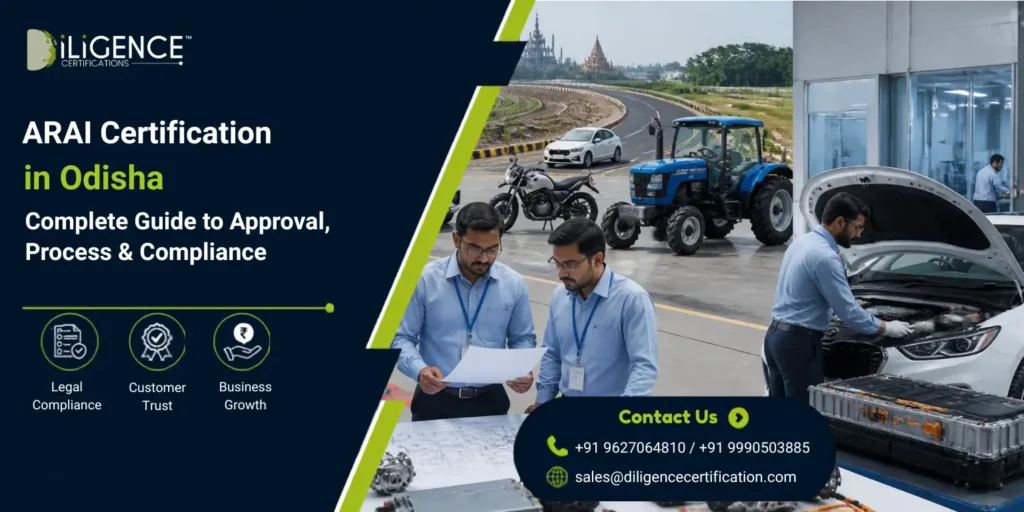
By - ARAI certification in Odisha allows automotive manufacturers whose products fall under ARAI certification in Odisha to showcase their compliance with pertinent Indian standards.
- Typically, this entails product classification, CMVR and AIS requirement mapping, technical documentation, components compliance, prototype development, application, testing, and approval.
- Our team at Diligence Certifications can offer assistance in compliance checking, documentation, and ARAI certification application processes.
Introduction
An automotive company which designs a new vehicle in Odisha can take several months to get its engineering correct. Everything is fine and the prototype is ready, the suppliers have been selected and the process of production has begun. However, once the company reaches the stage of certification, it realizes that the certificate for one of the components is missing or the prototype is different from the specifications submitted.
This is when the project may waste a lot of time.
ARAI Certification in Odisha is not as simple as applying for a certificate. It all depends on the particular vehicle, engine, component or equipment and the requirements imposed upon it.
The Automotive Research Association of India (ARAI) offers the services of certification and homologation of vehicles, engines, components, gensets, equipment and retrofitment. It also offers services related to conformity of production and export homologation.
In order for an Odisha-based company to proceed with the process practically, it should select the appropriate regulatory pathway while the product is being designed.
What Is ARAI Certification in Odisha?
ARAI Certification for Odisha, India means the certification, testing, type approval, and homologation of the automobile, engine, or automotive component that is covered under the motor vehicle regulations of India.
ARAI means Automotive Research Association of India.
There is no universal ARAI certificate that covers all types of automotive products. The following are some of the considerations for the requirements:
- Vehicle category
- Propulsion system
- Engine or motor specifications
- Intended application
- Vehicle configuration
- Component type
- Applicable CMVR provisions
- Relevant Automotive Industry Standards
- Testing requirements
The current certification scheme used by ARAI considers type approval of vehicles, components, engines, gensets, equipment, and retrofitment.
This is important in the sense that the manufacturer of an electric three-wheeler will not necessarily go through the same compliance process as that of a tractor manufacturer, passenger car, or automotive component manufacturer.
Why Is ARAI Certification Important for Odisha Manufacturers?
Manufacturing enterprises in Odisha operate in sectors like manufacturing, engineering, logistics, agriculture, construction, and mobility solutions. In the case of firms venturing into the automotive sector, regulatory compliance is an essential aspect of their product commercialization.
The scope of type approval for vehicles by ARAI covers motorcycles, three-wheelers, four-wheelers, electric vehicles, agricultural tractors, combine harvesters, and construction vehicles, amongst others.
Certification planning by manufacturers could help set up:
- Applicable regulatory requirements
- Vehicle and component conformity
- Safety compliance
- Applicable emission compliance
- Type-approval readiness
- Component-level compliance
- Testing requirements
- Documentation consistency
- Production conformity planning
The useful analogy is simple: engineering creates the product, while homologation demonstrates that the product meets the applicable regulatory rulebook.
Both need to move together.
Which Products May Need ARAI Certification?
The applicable requirement depends on the exact product and its specifications.
Two-Wheeler Vehicles
ARAI’s published vehicle type-approval scope includes applicable petrol, diesel, CNG, LPG and alternate-fuel two-wheelers with engine capacity above 25 cc, along with specified electric two-wheelers having power above 250 W and maximum design speed above 25 km/h.
Manufacturers should not rely on these thresholds alone, however. The complete vehicle category and applicable regulatory provisions should be checked before filing.
Three-Wheeler Vehicles
Passenger and goods carriers, fully built vehicles and certain incomplete vehicles can fall within the relevant three-wheeler type-approval framework.
The scope also covers specified electric three-wheelers and vehicles using petrol, diesel, CNG, LPG or alternate fuels For an Odisha manufacturer, the first step should be to establish the exact vehicle category before planning tests.
Passenger and Commercial Four-Wheelers
Applicable passenger and goods vehicles can require type approval under the CMVR framework ARAI identifies separate requirements for M1/N1 vehicles and other categories such as M2, M3, N2 and N3.
This classification can influence the applicable technical requirements and testing scope.
Electric Vehicles
Electric mobility introduces additional technical considerations involving batteries, motors, electrical systems and other components.
ARAI’s certification infrastructure includes dedicated capabilities for electric and hybrid vehicle testing and certification An EV manufacturer should therefore build the compliance matrix before freezing the final vehicle architecture.
Agricultural Tractors
Agricultural tractors and combined harvesters are covered under the CMVR type-approval framework identified by ARAI.
This is particularly relevant for manufacturers and engineering businesses connected with Odisha’s agricultural equipment market.
Construction Equipment Vehicles
Construction Equipment Vehicles can also be subject to specific design, safety and emission requirements under the CMVR framework.
ARAI identifies CEV type approval within its vehicle certification activities.
ARAI Certification Process in Odisha
The exact ARAI Certification in Odisha process depends on the product, but manufacturers generally follow these nine stages:
Step 1: Define Product Classification
Define the vehicle type or component category, propulsion type, specifications, intended use and proper classification.
Step 2: Understand the CMVR and AIS Standards
Identify applicable CMVR and AIS requirements in terms of safety, emissions, electrical safety, performance, component standards, test methods, documentation and production requirements.
Step 3: Prepare the Required Technical Documentation
Prepare manufacturer details, technical details, engineering drawings, layout drawings, electrical drawings, powertrain details, component certification documents, test reports and prototype information. All information must be related to the real product.
Step 4: Review Safety-Critical Components
Check compliance of all applicable safety-critical components prior to testing the vehicle. Check component approval, standards, documentation, test reports and compatibility with the final vehicle configuration.
Step 5: Get Ready the Prototype
Prototype must reflect the configuration submitted for approval. Changing the batteries, motors, tires, braking, lighting or other important components will impact compliance assessment.
Step 6: Submission of the Application
Submit the required technical data and other information via the proper ARAI process, which includes the use of the CMVR-TAS Online Portal where applicable.
Step 7: Testing and Evaluation
Testing will vary based on the product and applicable regulations. It could include such areas as braking, performance, emissions, lighting, structure safety, electrical safety, noise and component performance.
Step 8: Correction of Non-Conformances
In case of non-conformity found during testing, corrections may be required, including engineering corrections, part replacement, documentation corrections, additional test information or retesting.
Step 9: Approval
Once all requirements have been met, the appropriate type-approval/certification document can be provided. The manufacturer should keep copies of the approved drawings, specifications and reports for future modification or variants.
Documents Required for ARAI Certification in Odisha
The exact documents vary according to the product.
For vehicle type approval, ARAI currently identifies documents such as application and authorisation letters, AIS 007 technical specifications, drawings/layouts, applicable type-approval or component certificates, WMI/WMC certificates and tentative prototype submission information.
A broader documentation package may include:
- Company and manufacturer details
- Application documents
- Technical specifications
- Engineering drawings
- Vehicle layouts
- Electrical schematics
- Powertrain specifications
- Brake and steering details
- Lighting details
- Safety-system information
- Component certificates
- Test reports
- Prototype details
- Manufacturer declarations
Do not use a generic checklist blindly The correct document list should be mapped against the specific vehicle or component category.
ARAI Certification for EV Manufacturers in Odisha
For an electric vehicle manufacturer, certification should be thought about when developing the product rather than just prior to launching the product.
Consider for example a startup from Odisha that is making an electric cargo three-wheeler. While the initial efforts of the team might be geared towards such things as range, payload, battery and motor, there are also issues around the regulations that must be considered.
ARAI provides specific testing and certification services for electric and hybrid vehicles via its E-Mobility Centre of Excellence.
A good EV compliance strategy would take into account:
- Vehicle category
- Motor specifications
- Battery system
- Electrical safety
- Charging-related systems
- Relevant component certification
- Vehicle-level testing
- Technical documentation
- Applicable production conformity
The earlier this mapping is done, the less likely it is that an engineering change will arrive as a certification surprise.
ARAI Certification for Automotive Components in Odisha
The component makers need to check separately if their products comply with the safety standards notified.
According to ARAI, safety standards for certain parts/components/assemblies are notified by the Central Government, whereas testing/evaluation is done by agencies notified under Rule 126.
Some of the examples of components which have separate requirements are as follows:
- Horns
- Mirrors
- Lighting and signalling devices
- Seats
- Safety glass
- Brake hoses
- Tyres
- Fuel tanks
- CNG regulators
- LPG components
The component information issued by ARAI associates a particular component to the relevant AIS or Indian Standards.
For instance, the requirement regarding compliance of a component is not restricted to the component itself; installation on a particular vehicle may have its own set of requirements This is crucial for component manufacturers as well as vehicle manufacturers.
ARAI Type Approval and Homologation: What Is the Difference?
Product type approval means product approval based on the requirements for that type of product and Homologation, on the other hand, is generally considered as the process of establishing conformity to regulations.
The ARAI’s Department of Homologation Management & Regulation says their function includes coordinating the vehicle type approval process to fulfill CMVR requirements through concerned departments and labs.
The bottom line for the manufacturer, then, is quite simple: understand the specific approval that must be obtained for the product and not treat an “ARAI certificate” as a blanket term for all approvals.
ARAI Certification and Conformity of Production
Just getting type approval is no guarantee that all regulatory responsibilities have ended.
Depending on the product at hand, manufacturers may have ongoing obligations concerning Conformity of Production (COP).
ARAI offers Conformity of Production services for vehicles, engines, and parts. It also specifies requirements and standards related to safety critical part type approval and COP This is done so that the manufacturing process remains in compliance with the type-approved design.
It becomes important for manufacturers to follow the following practices:
- Supplier control
- Production consistency
- Approved component management
- Engineering change control
- Test records
- Quality documentation
Certification should therefore be viewed as part of a continuing compliance system, not a one-time administrative task.
How Much Does ARAI Certification Cost in Odisha?
There is no single fixed cost for ARAI Certification in Odisha and The overall project cost depends on the product and its testing requirements.
Factors can include:
- Vehicle or component category
- Number and type of tests
- Prototype preparation
- Component testing
- Technical documentation
- Repeat testing
- Engineering modifications
- Laboratory requirements
- Compliance scope
A manufacturer should distinguish between the authority’s applicable charges and the total project cost.
A realistic budget should also consider prototype preparation, testing logistics, component compliance and possible corrective work.
How Long Does ARAI Certification Take?
The time frame differs depending on the product and the certification process.
Currently, ARAI releases timelines for vehicle type approvals. The details released by ARAI show that there is a period of 45 working days for a full level of vehicle type approval, 30 working days for a partial level of approval, and 10 working days for document approval, provided certain conditions are met.
This is not an assurance of how long the total project will take.
Engineering preparations, suppliers’ preparations, prototype logistics, tests, corrective actions and retests will influence the total time frame.
Common Reasons for ARAI Certification Delays
Incorrect Product Classification
If the wrong category is selected at the beginning, the compliance plan may need to be rebuilt.
Incomplete Technical Documents
Missing drawings, specifications or certificates can delay the review.
Component-Level Gaps
A vehicle may be ready for testing while a relevant safety-critical component still lacks the required approval.
Prototype Mismatch
The physical test vehicle should correspond with the configuration described in the technical submission.
Last-Minute Engineering Changes
Changing a major component before or during testing can affect previously completed compliance work.
Weak Change Control
Every significant engineering change should be reviewed for its possible regulatory impact.
In practical terms, most avoidable delays are easier to fix before testing than after a test has identified a non-conformity.
How Diligence Certifications Can Help
Diligence Certifications provides support for ARAI vehicle certification covering vehicles, engines and components. Its published service information describes assistance with documentation and the certification process.
For a manufacturer without a dedicated homologation team, external compliance support can help organise the regulatory side of the project.
Diligence Certifications can assist with:
- Requirement assessment
- Applicable certification route
- Documentation preparation
- Compliance review
- Application support
- Testing coordination
- Query management
- Non-conformity follow-up
- Component compliance review
- ARAI certification guidance
The consultant’s role is not to replace ARAI. It is to help the manufacturer understand the requirements, prepare the submission correctly and coordinate the compliance work.
Conclusion
Certification of Vehicles/Components by ARAI in Odisha is a crucial compliance measure for those vehicle/ev/engine/auto parts manufacturers who are eligible. The procedure is not merely about submission of an application, but the product needs to be classified and the CMVR & AIS requirements should be mapped. Technical data, component conformity and testing of the prototype also requires proper coordination.
The manufacturer, who studies about the requirements well in advance, can save himself from documentation errors, testing delays and redesigning. Proper maintenance of certification data will also help in future extensions and modifications.
In case you are considering certification of vehicles/components in Odisha, Diligence Certifications can help you out with the right certification process. Contact Diligence Certifications to know about the right way of ARAI certification for your product.
Frequently Asked Questions
What is ARAI Certification in Odisha?
ARAI Certification in Odisha refers to the applicable testing, type approval and homologation process for eligible vehicles, engines, automotive components and related products.
Is ARAI Certification mandatory for every vehicle?
No. The requirement depends on the vehicle category, technical specifications, propulsion system and applicable CMVR provisions.
Who needs ARAI Certification in Odisha?
v
Is ARAI approval required for electric vehicles?
Applicable electric vehicles can require type approval and compliance with relevant safety, technical and regulatory requirements.
What documents are required for ARAI Certification?
Documents can include technical specifications, drawings, layouts, application documents, component certificates, WMI/WMC information and prototype details, depending on the product.
Does ARAI certify automotive components?
Yes. ARAI undertakes type approval for applicable notified safety-critical automotive components.
What happens if a vehicle fails ARAI testing?
The manufacturer must address the identified non-conformity and complete the applicable corrective assessment or re-testing.
Does ARAI certification apply to agricultural tractors?
Yes. Agricultural tractors and combined harvesters are included in ARAI's published vehicle type-approval scope.
Does ARAI certification continue after type approval?
Depending on the product and applicable regulations, continuing conformity obligations such as COP may apply after type approval.
Can Diligence Certifications help with ARAI Certification in Odisha?
Yes. Diligence Certifications provides assistance with ARAI vehicle certification, documentation, application support and related compliance activities.