BIS Certification
 CDSCO
CDSCO
 PESO
PESO
 CPCB
CPCB
 LMPC
LMPC
 WPC Approval
 Global Approvals
 TEC
TEC
 ARAI
ARAI
 BEE
BEE
 ISO Certification
 DGCA Certification
 NOC For Steel
 APEDA Registration























 Business Registration
 FSSAI Mark Certification












 (32).jpg)
 Legal Services
 Trademark Registration
 Copyright Registration
 Patent Registration
 By
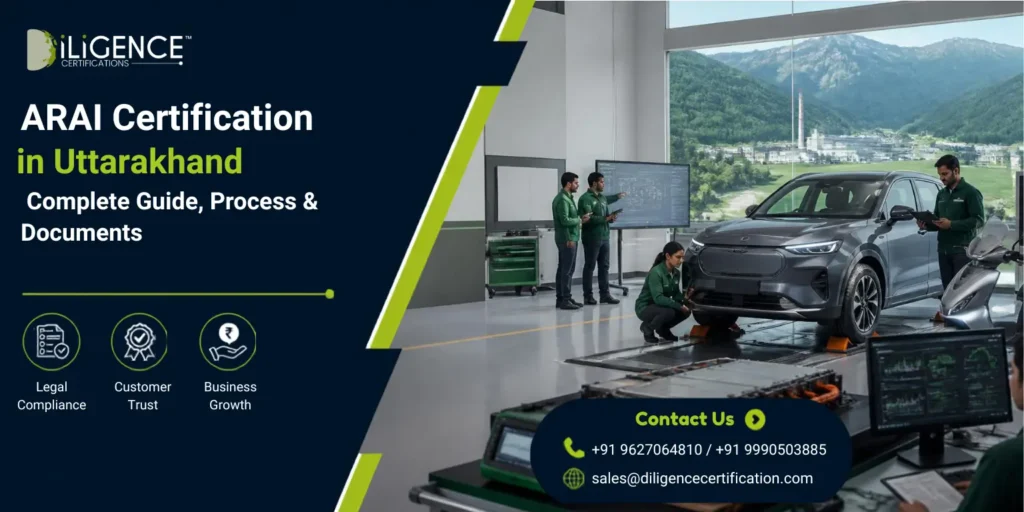
By - ARAI Certification of Uttarakhand will enable qualified automobile manufacturers, EVs, engines, and automobile component manufacturers to adhere to Indian automotive testing and type approval standards.
- The process may include product classification, technical documentation, prototype testing, compliance evaluation, and type approval, depending on the product.
- Diligence Certifications is here to guide businesses through all aspects of the certification process.
Introduction
A manufacturer might have an excellent technical design ready for production, but due to the discrepancy between the design and the documentation, they can face some delays. Such cases occur frequently in rapidly expanding or start-up automotive companies when they enter the market for the first time.
For instance, an EV manufacturer produces an electric two-wheeler in Uttarakhand. They have already produced a battery pack, a motor, chassis, and all necessary components. However, what kind of testing and approval procedures must be conducted prior to the commercialization of their product?
This is where ARAI Certification in Uttarakhand comes into play.
ARAI provides vehicle certification and homologation of vehicles, engines, automotive parts, genset, equipment, and retrofitment. ARAI certification for vehicles covers two-wheelers, three-wheelers, four-wheelers, electric vehicles, agricultural tractors, and construction equipment vehicles.
For a manufacturer, certification should not be seen as a last-minute documentation procedure. What they should actually do is to understand the requirements of compliance during the process of design development.
What is ARAI Certification in Uttarakhand?
ARAI Certification in Uttarakhand means the relevant process of testing, certification, homologation and type approval of automotive products which are manufactured or designed by companies based in Uttarakhand.
ARAI is the full form of Automotive Research Association of India. ARAI is an important automotive research, testing, certification and homologation company in India.
The requirement for approval will depend on the specific product. The requirements for a new electric scooter, passenger car, commercial vehicle, engine and important automotive parts will be different from each other.
ARAI provides vehicle certification services in respect of petrol, diesel, CNG, LPG, alternate fuel and electric vehicles within various vehicle categories.
Hence, companies should ascertain the right category of the product and its relevant regulations instead of assuming the same certification requirement for all automotive products.
Why is ARAI Certification Important for Automotive Businesses?
Automotive certification is intended to verify that applicable vehicles and components meet prescribed technical and safety requirements.
Depending on the product, assessment may involve areas such as:
- Vehicle safety
- Performance
- Emissions
- Electrical systems
- Construction requirements
- Safety-critical components
- Applicable Automotive Industry Standards
ARAI also offers services for type approval of automotive components that are notified. The Central Government has notified standards for some of the parts, components, and assemblies used in automobiles. This is done based on the relevant laws through notified testing laboratories.
Early planning by manufacturers helps to avoid an expensive situation where there is need for modification of the end product after testing.
Who May Need ARAI Certification in Uttarakhand?
The exact requirement depends on the product and applicable regulations. However, the following businesses may require relevant ARAI testing or approval.
Automobile Manufacturers
Manufacturers that make motorcycles, scooters, automobiles, commercial vehicles, and other regulated vehicles might have to do vehicle type approval.
Electric Vehicle Manufacturers
Start-ups and existing companies making EVs could be required to get type approval and testing done for their vehicles.
In particular, ARAI’s vehicle type approval applies to electric vehicles. For instance, under its current provisions, electric two-wheelers having power over 250 W and max design speed over 25 km/h fall under the type approval of two-wheeler vehicles.
Automotive Components Manufacturers
Manufacturers of notified and safety-critical components may require component level approval depending on CMVR requirements applicable to them.
Engine Manufacturers
Manufacturers of engines might have to undertake separate type approvals based on applications and applicable requirements. ARAI offers engine type approval services for relevant applications.
Agricultural and Construction Equipment Businesses
ARAI’s scope of certification also covers agricultural tractors, combined harvesters, and construction vehicles subject to relevant CMVR requirements.
ARAI Certification Process in Uttarakhand
The ARAI Certification in Uttarakhand process depends on the vehicle or component category and its applicable regulatory requirements. Manufacturers generally follow these key steps:
Step 1: Establish the Applicable Requirements
Firstly, identify the vehicle or the product category and its appropriate standards as an electric two wheeler, commercial vehicle, tractor or the automotive part will have different requirements for testing. This will help in avoiding compliance of requirements which are not necessary.
Step 2: Prepare the Technical Documentation
Technical documents including the application form, technical specifications, drawings, layouts, approval certificates and other documents are prepared by the manufacturers. In addition, ARAI may ask for the BIS licence of some safety critical parts and WMI/WMC details, if any.
Step 3: File the Application
The manufacturer files the application along with the required documents as per the appropriate certification procedure. For the vehicle and engine type approval applications, ARAI uses the CMVR-TAS online portal.
Step 4: Prototype Testing
The vehicle, component or prototype will be tested in terms of its safety, performance, emissions, electronics, or any other criteria.
Step 5: Responding to Observations
In case of any non-conformance, the manufacturer may have to explain or make technical changes.
Step 6: Type Approval
Following the testing and document examination, type approval may be granted. In addition, the manufacturers should comply with the Conformity of Production (COP) when necessary.
Documents Required for ARAI Certification
The exact document list depends on the product and approval category. Common requirements may include:
- Manufacturer details
- Application letter
- Authorisation letter
- Technical specifications
- Vehicle drawings and layouts
- Component information
- Previous approval certificates, where applicable
- BIS licence for applicable safety-critical components
- WMI/WMC certificates where applicable
- Prototype or component submission information
ARAI’s published vehicle type approval requirements specifically refer to AIS 007 formats for technical specifications and drawings.
Manufacturers should ensure that the information submitted in different documents is consistent with the actual vehicle or component.
ARAI Certification for Electric Vehicles in Uttarakhand
The growing EV market has made automotive compliance increasingly important for manufacturers in Uttarakhand.
An EV manufacturer may need to consider requirements related to:
- Electric powertrain
- Battery systems
- Electrical safety
- Vehicle performance
- Charging-related systems
- Applicable safety components
- Vehicle category requirements
ARAI has specifically included electric vehicles within its vehicle type approval services and has developed infrastructure for testing and development of electric and hybrid vehicles.
For an EV startup, compliance should ideally be considered during product development. Making major changes to the battery system, electrical architecture, braking system, or other technical features after testing can result in additional engineering work.
Difference Between ARAI Certification and Vehicle Registration
There have been instances where ARAI Certification in Uttarakhand and vehicle registration have been confused with one another by businesses. These two processes are distinct and have separate roles in automotive regulation.
The former is a process in which the technical and regulatory aspects of a vehicle, engine, or respective part are evaluated prior to compliance under the pertinent regulations.
The latter, meanwhile, is a process that pertains to registering the vehicle for road use, and which would be conducted by the pertinent transportation department.
In simpler terms,
ARAI Type Approval
Technical and Regulatory Compliance
Vehicle Registration
Legal Registration for Road Use of Vehicle
As an example, one can conduct the process of type approval for a certain vehicle model. This process does not guarantee that all the vehicles produced from that model will undergo registration for their road use.
This clarification will help manufacturers understand the difference between both processes.
How Long Does ARAI Certification Take?
The duration of certification for ARAI Certification in Uttarakhand would vary according to the following factors: vehicle category; approval levels; need for testing; quality of the documents; and availability of prototypes, etc.
According to current estimates from ARAI, it takes 45 working days for full level vehicle type approval, 30 working days for partial level approval and 10 working days for some documentation approvals.
However, these estimates should not be considered as fixed deadlines and delays may be caused due to several reasons, including incomplete documents; unavailability of the prototype; component approval not being completed; and non-conformity with testing results, etc.
Manufacturers are, therefore, advised to initiate work on documentation and other preparations well before the deadline.
Cost Factors for ARAI Certification
The cost of ARAI certification in the state of Uttarakhand depends upon the kind of product that needs to be certified along with the number of tests and evaluations required.
The major cost determinants can be listed as follows:
- Category of the vehicle/component
- Number and type of tests required
- Technical complexity of the product
- Prototype testing
- Component level certification
- Additional testing or modifications
It is important for the manufacturer to know what will be involved in the entire process of certification before planning a budget for compliance.
For example, it is always more economical to find out any gap in technicalities and documentation prior to prototype testing.
Common Challenges in ARAI Certification
Incomplete Documentation
Missing technical specifications, drawings, authorisation documents, or supporting certificates can slow down the certification process.
Incorrect Product Classification
Different vehicle categories have different requirements. Selecting the wrong category can result in unnecessary testing or documentation work.
Component-Level Compliance
Some components may have independent approval requirements. A vehicle manufacturer should therefore review component compliance along with vehicle-level requirements.
Design Changes After Testing
Changes to important technical characteristics after testing may require further evaluation. Manufacturers should coordinate engineering and compliance teams before submitting the final prototype.
How Diligence Certifications Helps with ARAI Certification in Uttarakhand
Diligence Certifications assists automotive manufacturers, EV startups, component suppliers, and other businesses with professional compliance support.
Our assistance can include:
Requirement Identification
We help businesses understand the likely certification route based on their vehicle, component, or technology.
Documentation Guidance
Our team helps organise technical and supporting documents according to the applicable requirements.
Compliance Gap Assessment
Reviewing documentation before submission can help identify missing information and inconsistencies at an early stage.
Application Support
We assist businesses in understanding the application process and coordinating the required certification activities.
Regulatory Guidance
Automotive compliance can involve technical standards, testing requirements, and continuing production obligations. Diligence Certifications helps clients understand these requirements in practical terms.
Conclusion
Arai Certification in Uttarakhand is one such regulatory compliance issue that needs to be addressed by automotive vehicle manufacturers, electric vehicle startup companies, engine manufacturers, automotive component manufacturers, and other companies manufacturing regulated automotive products.
It is not just about filling up an application form. It involves understanding which category it belongs to, knowing the requirements, preparing technical documentation, conducting necessary tests, responding to observations, and complying on an ongoing basis.
The present information about ARAI Certification shows that different requirements and timeframes are applicable to different categories of vehicles and levels of approval.
This means that early compliance planning may help make the whole certification process much more organized and avoid unnecessary redesigning, documentation correction, or retesting.
If you require any assistance with ARAI Certification in Uttarakhand, please contact Diligence Certifications.
Frequently Asked Questions
What is ARAI Certification in Uttarakhand?
ARAI Certification in Uttarakhand covers applicable automotive testing, homologation, certification, and type approval for vehicles, engines, and components.
Who needs ARAI certification?
Vehicle, EV, engine, and automotive component manufacturers may require ARAI approval depending on applicable regulations.
Is ARAI certification required for electric vehicles?
Applicable electric vehicles may require ARAI type approval and testing based on their category and regulatory requirements.
What documents are required for ARAI approval?
Documents may include application forms, technical specifications, drawings, certificates, applicable BIS licences, WMI/WMC details, and prototype information.
How long does ARAI certification take?
The timeline varies by approval level and project readiness, with ARAI indicating specific timelines subject to applicable conditions.
How much does ARAI certification cost?
The cost depends on the product category, testing scope, technical complexity, documentation, and any required retesting.
Can EV startups in Uttarakhand obtain ARAI approval?
Yes, eligible EV manufacturers can apply for applicable ARAI testing and type approval based on their vehicle category.
What is vehicle type approval?
Vehicle type approval verifies that a vehicle model meets applicable technical, safety, performance, and regulatory requirements.
Is ARAI certification the same as vehicle registration?
No, ARAI certification covers technical compliance, while vehicle registration is a separate process for individual vehicles.
Can Diligence Certifications help with ARAI certification?
Yes, Diligence Certifications provides support with requirement assessment, documentation, compliance preparation, and certification procedures.