BIS Certification
 CDSCO
CDSCO
 PESO
PESO
 CPCB
CPCB
 LMPC
LMPC
 WPC Approval
 Global Approvals
 TEC
TEC
 ARAI
ARAI
 BEE
BEE
 ISO Certification
 DGCA Certification
 NOC For Steel
 APEDA Registration























 Business Registration
 FSSAI Mark Certification












 (32).jpg)
 Legal Services
 Trademark Registration
 Copyright Registration
 Patent Registration
 By
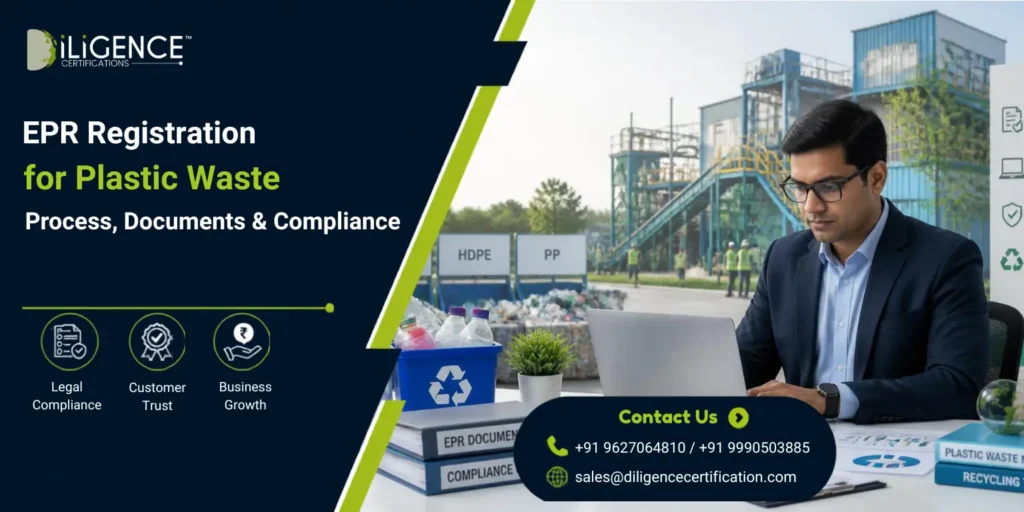
By - EPR Registration for Plastic Waste is mandatory for all Producers, Importers, and Brand Owners that qualify for the plastic packaging EPR scheme of India.
- Registration takes place on a centralised EPR portal of CPCB, with responsibilities being dependent upon plastic packaging in the Indian market.
- Correct registration, achievement of targets, documentation, and reporting contribute toward keeping businesses in compliance and avoiding environmental compensation.
Introduction
The brand would have spent months designing the package, selecting its suppliers and manufacturing its products for launch to the market. However, a compliance issue that arises later relates to whom the plastic packaging belongs to after the end-user has made use of it.
This is where EPR registration of plastic waste plays an important role.
Under India’s EPR regulations, the obligation to manage plastic packaging falls under eligible organizations which bring plastic packaging into the market. The scheme is premised on plastic packaging waste registration, reporting, recycling and management as opposed to just viewing the packaging as a commercial input.
The scheme derives from the Plastic Waste Management Rules, 2016 and its various amendments. Plastic Waste Management rules and its amendments, including those of 2022 and 2024, can be found in the Ministry of Environment, Forest and Climate Change’s official rules repository.
The message to any business is clear; plastic packaging compliance ought to be considered at the product launch phase, not later after selling the product.
What Is EPR Registration for Plastic Waste?
EPR registration for plastic waste is the process of regulatory registration through the CPCB process of eligible entities that are responsible for plastic packaging that enters the Indian market.
EPR means Extended Producer Responsibility. In such an approach, the obligation to take care of plastic packaging goes further than just manufacturing and selling the packaging. Such an entity should assist in the proper collection, recycling, reuse or disposal of plastic packaging.
The centralized EPR process includes Producers, Importers and Brand Owners, also known as PIBOs, as well as registered Plastic Waste Processors for relevant actions. CPCB provides such a registration process through its EPR website.
It is important to make such a distinction because a company cannot avoid the obligation if some other entity produced packaging for it.
For instance, an Indian brand buying packaged products from a third party producer may have to look into its EPR obligations as a Brand Owner.
Why Is Plastic Waste EPR Registration Required?
Plastic Packaging forms an important component of the supply chain today. Plastic packaging is widely used in food products, cosmetics, pharmaceuticals, electronics, household goods and eCommerce items in the form of rigid, flexible or multi-layer plastic packaging.
The EPR scheme seeks to link the amount of packaging put into the market with waste management obligations.
CPCB has established a central portal and process for registration and implementation of EPR for plastic packaging. In its published material, CPCB mentions that Registered Plastic Waste Processors may give certificates which help Producers, Importers and Brand Owners to fulfill their EPR obligations.
This means compliance may have implications beyond just filling in forms It may impact:
- Product launch planning
- Packaging procurement
- Recycling arrangements
- Annual EPR targets
- Compliance reporting
- Environmental compensation exposure
- Documentation and audit readiness
- Brand sustainability claims
A good compliance system should work like an accounting system: every relevant quantity entering the market should be traceable to the corresponding responsibility.
Who Needs EPR Registration for Plastic Waste?
The exact applicability depends on the company’s activities, product structure and packaging.
Generally, the plastic packaging EPR framework covers:
Producers
Businesses producing or packaging products falling under the concerned framework could be classified under the Producers head.
Importers
Importers who import products having plastic packaging into India could also be classified as entities having Extended Producer Responsibility obligations because the plastic packaging enters the Indian market via their supply chain.
Brand Owners
Brand owners placing their products into the Indian market bearing their own brand name also fall under the scope of EPR framework.
It becomes highly important for FMCG businesses, private label businesses and online sellers.
Plastic Waste Processors
Entities carrying out activities like recycling and other activities related to plastic waste processing have their own registration and obligations.
The published document by CPCB confirms that Plastic Waste Processors require registration on the centralized EPR portal and only registered plastic waste processors are allowed to issue certificates for fulfilling EPR under PIBO.
What Types of Plastic Packaging Are Covered?
The EPR approach classifies plastic packaging based on their properties.
Some of the main classifications are as follows:
- Classification I - Rigid plastic packaging
- Classification II - Flexible plastic packaging
- Classification III - Multilayer plastic packaging
- Classification IV - Compostable plastic packaging
The reason why the classification is important is that the EPR compliance requirements and calculation methodologies may vary depending on the type and volume of packaging that enters the market.
According to CPCB material, Classification I refers to rigid plastic packaging, Classification II refers to flexible plastic packaging, including single/multilayer plastic packaging and related products, Classification III refers to multilayered plastic packaging containing plastic/non-plastic materials, and Classification IV refers to compostable plastic packaging.
EPR Registration Process for Plastic Waste
The EPR registration process for plastic waste should be treated as a compliance exercise rather than just an online application. The first step is to determine whether the business operates as a Producer, Importer, Brand Owner or Plastic Waste Processor and identify the plastic packaging placed in the Indian market.
Step 1: Determine EPR Applicability
Classify the business and identify the applicable plastic packaging. Incorrect classification can affect registration and EPR obligations.
Step 2: Classify Plastic Packaging
Prepare a packaging inventory covering material type, category, quantity, weight, product association, origin and brand details. Accurate packaging data is essential for calculating obligations.
Step 3: Prepare Documents
Common information includes company registration details, PAN, GST, authorised signatory details, product information, packaging quantities and, where applicable, IEC and import details. Diligence Certifications can assist in organising the required documentation.
Step 4: Prepare the EPR Plan
Develop a compliance plan based on the company’s actual packaging volumes and business activities. It should address how applicable obligations will be fulfilled through appropriate waste-management channels.
Step 5: Submit the Application
Submit the application through the CPCB’s centralised EPR system. Before filing, verify company details, packaging information and supporting documents to minimise clarification requests.
Step 6: Regulatory Review
The submitted information is reviewed under the applicable framework. Authorities may request additional information or clarification.
Step 7: Registration and Compliance
After approval, the registration is issued according to the applicable process. However, EPR registration is not the end of compliance. Businesses must continue managing applicable targets, certificates, records and reporting requirements.
Documents Required for EPR Registration for Plastic Waste
The exact list can change according to the applicant’s category and business structure, but businesses should generally prepare the following information:
| Document / Information | Purpose |
| Certificate of incorporation / business registration | Establishes legal identity |
| PAN | Applicant identification |
| GST registration | Tax and business verification |
| IEC | Relevant for importers |
| Product details | Identifies products placed in the market |
| Packaging details | Determines plastic packaging obligations |
| Brand information | Establishes Brand Owner details |
| Plastic quantity data | Supports EPR calculations |
| EPR plan | Explains compliance approach |
| Authorised signatory details | Supports application filing |
| Supporting recycler/PWP information | Supports waste-management arrangements |
The key issue is not the number of documents. It is whether the information tells one consistent story.
If procurement records show one packaging weight while the EPR application reports another, the company should resolve the difference before filing.
How Are EPR Plastic Waste Targets Fulfilled?
EPR is not merely a registration certificate.
Businesses which qualify need to comply with their respective responsibilities with respect to plastic packaging This could include the use of certificates or services provided by registered Plastic Waste Processors to demonstrate compliance.
It must be noted that in CPCB’s published framework, the use of certificates provided by registered Plastic Waste Processors can help in meeting EPR obligations of Producers, Importers and Brand Owners.
The process involved in practical terms would entail:
Packaging information -> EPR obligation -> authorized processing -> certificates -> reporting -> record keeping
This sequence needs to be recorded carefully.
What Happens If EPR Obligations Are Not Fulfilled?
Failure to comply will put businesses at risk of facing regulatory penalties and environmental compensation.
According to the CPCB’s published evaluation framework, environmental compensation will be applicable due to failure to meet EPR objectives set out for Producers, Importers and Brand Owners based on the polluter pays policy.
Apart from the financial cost, there are other challenges that businesses can face.
These include:
- Regulatory review
- Delay in compliance closure
- Additional documentation burden
- Challenges in inspections
- Issues with compliance to sustainability
- Reputational challenges with customers and business partners
Businesses are advised not to wait till the last moment but keep track of their EPR compliance all through the year.
EPR Compliance for E-Commerce and Online Sellers
Online sellers often misunderstand their responsibility because they may not manufacture the product themselves.
An e-commerce seller, private-label business or marketplace participant should first determine whether it is functioning as a Brand Owner, Importer, Producer or another regulated entity under the applicable rules.
Packaging used for shipping can also require careful review depending on the circumstances.
Diligence Certifications’ guidance for online sellers highlights plastic packaging, product and packaging disclosures, EPR registration, authorised recycler arrangements, target fulfilment, record maintenance and reporting as important compliance considerations.
The safest approach is to map the commercial relationship before deciding whether registration is required.
EPR Registration for Plastic Waste for Importers
Importers should examine EPR before bringing covered products or packaging into India.
This becomes especially important where the imported product is sold under the importer’s own brand or where imported goods contain plastic packaging.
The importer should maintain accurate records of:
- Imported product quantities
- Packaging material
- Packaging weight
- Product categories
- Brand ownership
- Import documentation
- EPR registration information
- Waste-management records
Diligence Certifications also provides guidance specifically covering EPR obligations for importers of plastic products.
Common Mistakes Businesses Make
A few mistakes appear repeatedly in plastic waste compliance projects.
Using estimated packaging data
Packaging weight should be supported by reliable internal records rather than an arbitrary estimate.
Treating registration as one-time compliance
EPR requires ongoing attention to targets, reporting and documentation.
Ignoring component packaging
Companies often account for the primary product packaging while overlooking secondary or transport-related packaging that may need regulatory review.
Using unverified processing partners
Certificates and waste-processing documentation should come from appropriate registered entities under the applicable framework.
Filing inconsistent information
Company names, addresses, product data, packaging quantities and supporting documents should match.
Waiting until the reporting deadline
Late compliance work creates unnecessary pressure and increases the chance of errors.
What Is the Difference Between EPR Registration and Plastic Waste Management?
Plastic Waste Management Regulations are the larger body of regulations that regulate plastic waste.
EPR Registration is one of the compliance tools used by eligible Producers, Importers, and Brand Owners to meet their obligations regarding the plastics packaging.
Simplifying it further:
- Plastic Waste Management Regulations = regulatory framework
- EPR = producer/importer/brand responsibility tool
- EPR Registration = formal process under the EPR framework
Keeping these terms apart will make compliance simpler.
Official Regulatory Resources
Businesses should verify their compliance position against the latest notifications, amendments and CPCB directions rather than relying solely on older articles.
The Ministry of Environment, Forest and Climate Change rules repository provides official notifications relating to the Plastic Waste Management Rules and their amendments.
CPCB’s published EPR documentation also provides information on registration and Plastic Waste Processor requirements.
Because environmental regulations can change, the latest applicable notification should always be checked before filing or renewing a compliance application.
Why Choose Diligence Certifications?
Diligence Certifications would be helpful if one chooses a compliance partner who would focus on making the process of dealing with complex regulatory processes easy. Usually, certifications require technical documentation, government filing, testing, inspections, regulation communication and follow up and any kind of documentation error may cause delay. Diligence Certifications offers full support services for the particular product and relevant regulation.
Having experience in dealing with various types of certification and compliance services, the company offers its services related to various requirements including but not limited to BIS, EPR, CPCB, ARAI, PESO, WPC, CDSCO, ISO and many more. This service does not consist only in filing an application but involves getting knowledge about the relevant scheme, preparation of documentation and conducting testing/inspection if it is required.
Having one consultant with the relevant experience will save you much time and effort especially in case there are several kinds of approvals required for one product. Diligence Certifications is ready to cooperate with clients all over India.
The idea is pretty simple: get rid of unnecessary delays in complying, improve the quality of documentation, and get the right regulation guidelines from application to approval. Business entities may turn to Diligence Certifications for an analysis specific to each requirement and select the appropriate certification path accordingly.
Conclusion
Plastic Waste EPR Registration must be viewed from an environmental compliance perspective, and not simply as just another form of registration certificate.
The proper approach to begin for Producers, Importers & Brand Owners will be to classify their business, trace their plastic packaging, estimate their quantities and create supporting documents accordingly.
For companies that have recently started manufacturing a new product, importing packaged items or growing their brands, proactive planning in respect of EPR registration for plastic waste can save them from future non-compliance situations.
Should you require assistance in relation to EPR registration for plastic waste, please connect with us at Diligence Certifications for a business-specific compliance assessment prior to applying.
Frequently Asked Questions
Who needs EPR registration for plastic waste?
Eligible Producers, Importers and Brand Owners dealing with covered plastic packaging may require registration under the applicable EPR framework.
Is EPR registration mandatory for plastic packaging?
For entities covered by the applicable Plastic Waste Management EPR framework, registration and fulfilment of relevant obligations are mandatory.
Does EPR apply to plastic packaging used by e-commerce businesses?
It can, depending on the business's role and the nature of the packaging introduced into the market. The business should determine its regulatory category before filing.
What documents are required for plastic EPR registration?
Common information includes company registration, GST, PAN, product and packaging details, quantity data, authorised signatory information and applicable EPR planning documents.
Can an importer require plastic EPR registration?
Yes, an importer may fall within the EPR framework when importing covered plastic packaging or products with such packaging into India.
What happens if EPR targets are not fulfilled?
Environmental compensation and other regulatory consequences may apply for non-fulfilment of applicable EPR obligations.
Is EPR registration the end of compliance?
No. Registration is only one part of the process. Businesses must also manage applicable targets, records, certificates and reporting requirements.
How long does EPR registration for plastic waste take?
The timeline depends on the completeness of the application, supporting documents and regulatory review. Errors or clarification requests can extend processing.
How can a business apply for plastic waste EPR registration?
Businesses covered by the applicable framework can submit their application through the relevant CPCB EPR portal with the required company, product and packaging information.
Can Diligence Certifications help with plastic EPR compliance?
Yes. Diligence Certifications can assist businesses with applicability assessment, documentation, EPR registration, CPCB filing and ongoing compliance support.