 BIS Certification
 CDSCO
CDSCO
 PESO
PESO
 CPCB
CPCB
 LMPC
LMPC
 WPC Approval
 Global Approvals
 TEC
TEC
 ARAI
ARAI
 BEE
BEE
 ISO Certification
 DGCA Certification
 NOC For Steel
 APEDA Registration























 Business Registration
 FSSAI Mark Certification












 (32).jpg)
 Legal Services
 Trademark Registration
 Copyright Registration
 Patent Registration
 By
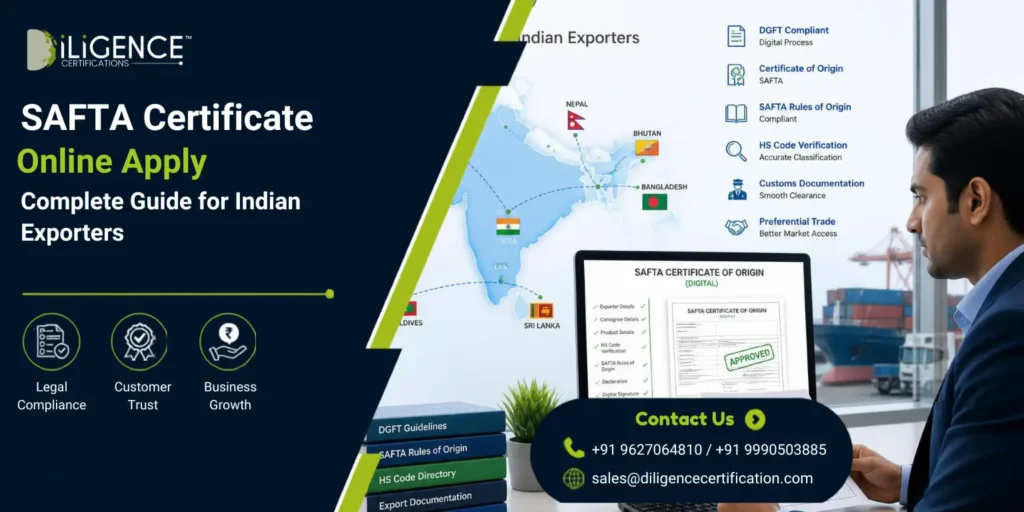
By - SAFTA Certificate Online Apply is an online platform through which qualified Indian exporters get their Certificate of Origin for their qualified goods in accordance with SAFTA rules.
- This certificate enables the buyer to get preferential tariffs provided that the good meet the required SAFTA rules of origin.
- It is recommended for Indian exporters to check the HS code, origin criteria, documents, issuing body, and DGFT filing process before applying.
Introduction
Recently, one Indian exporter received an export enquiry from a buyer located in South Asia. Everything was fine and the negotiations were on the right track until a very basic query was raised by the buyer: Are you able to provide us with the SAFTA Certificate of Origin so that we may benefit from a preferential tariff?
The exporter already possessed an IEC, commercial invoice and lots of export experience. But now they had some doubts about whether the product qualifies under the relevant Rules of Origin and what documentation will be needed for the certificate.
It is important to make this distinction when it comes to export compliance. Just because the product is manufactured in India does not necessarily mean that it qualifies for any preferential treatment.
The SAFTA certificate online application process is related to the origin of the goods, its HS code, documentation and conditions of the market to which these goods are exported.
There are procedural guidelines for Certificates of Origin in the SAFTA regime, including the process of verification by the issuing authority. The authority may ask for documentary proof or perform any appropriate checks to confirm the origin.
For an Indian exporter, thus, the best way would be to confirm the eligibility first and then apply online for the certificate.
What Is a SAFTA Certificate?
A SAFTA Certificate is a preferential Certificate of Origin, which is required to prove that the exported goods comply with the applicable origin criteria within the framework of the South Asian Free Trade Area.
SAFTA is an abbreviation of South Asian Free Trade Area. It is a regional economic agreement between SAARC members.
The certificate does not aim at proving the dispatch of the goods from India. It provides documentation relating to the product origin in order to enable the granting of preference by the authorities of the importing country.
According to the SAFTA operational certification procedures, the Certificate of Origin shall be granted by the authority appointed by the government of the exporting Contracting State. The authority may ask for any additional evidence and make checks where necessary.
In simple words
If the exporter of India exports a qualified product to a SAFTA country, the importer will have the opportunity to demand preferential customs treatment of the product on the basis of the SAFTA Certificate of Origin.
Why Is a SAFTA Certificate Important for Indian Exporters?
Customs duties form a component of the landed cost for the exporter.
In cases where the specific goods are eligible for preferential treatment according to the relevant SAFTA tariff system, then such a duty position may help the buyer in achieving a better landed cost situation. Such a situation may influence the competitiveness of the Indian supplier.
The certificate has both a commercial objective and compliance objective.
It can be used for:
- Determining the origin of the eligible products.
- Getting preferential tariff treatment.
- Supplying documentary evidence to the importer.
- Making up the export documents.
- Helping in the customs clearance at the destination market.
Nonetheless, the SAFTA certificate cannot promise any duty rate.
Who Can Apply for a SAFTA Certificate?
Indian exporters dealing in products that may qualify for preferential treatment under SAFTA can apply through the prescribed Certificate of Origin system and designated issuing route.
Before applying, the exporter should establish:
- The destination is covered by the relevant SAFTA arrangement.
- The product has been correctly classified under the applicable HS code.
- The product satisfies the relevant Rules of Origin.
- Required commercial documents are available.
- Supporting origin evidence can be produced if requested.
- Exporter and transaction details are accurate.
A trader or manufacturer should not assume that the application itself establishes eligibility and The more important question is: Does the product actually meet the applicable origin criteria?
Which Countries Are Covered Under SAFTA?
The SAFTA framework covers the SAARC regional trade arrangement.
The participating countries are:
- India
- Bangladesh
- Bhutan
- Maldives
- Nepal
- Pakistan
- Sri Lanka
- Afghanistan
The tariff benefit is not necessarily identical for every product or destination.
An exporter must therefore check the applicable product classification and preferential treatment rather than assuming that every product receives the same concession across all SAFTA markets.
What Are the SAFTA Rules of Origin?
This is one of the most important parts of the entire process.
The Rules of Origin are what determines whether the products are originating products This becomes especially relevant when the Indian company makes use of imported raw material, components or semi-finished products.
For instance, let us take an example of an Indian firm making an engineering component. In this case, the manufacture of the component is done in India, but there are certain specialized inputs that are imported.
The exporter should not just declare that the product is Indian in origin without looking into the applicable SAFTA Rules of Origin.
There are provisions in the SAFTA agreement regarding the following:
- HS classification
- Source of raw materials
- Manufacturing operations
- Value of inputs
- Origin of components
- Final product classification
- Applicable SAFTA rules
This is why origin assessment should be completed before the application is submitted.
SAFTA Certificate Online Apply: Current Process
The Indian Certificate of Origin regime has adopted an electronic filing system.
DGFT has made available the facility of e-filing of preferential Certificates of Origin, which include shipments to Nepal under the SAFTA/SAPTA scheme, via their online portal.
This electronic system has also undergone upgrades. DGFT has launched the new version eCoO 2.0 system that comes equipped with various capabilities like multi-user support, e-signing functionality and an integrated dashboard via Trade Connect.
Hence, exporters looking for the SAFTA certificate online should follow the process via the latest DGFT portal and not rely on the old portal process.
Step-by-Step SAFTA Certificate Online Apply Process
Step 1: Determine the Export Goods
Determine the name, description, purpose, quantity, cost and manufacturing details of the goods that have to be exported.
Step 2: Determine the HS Code of the Goods
Make sure that the HS code of your goods matches its type and the documents provided. Incorrect HS coding can affect the application of preferential treatment.
Step 3: Check the Rules of Origin of the Goods
Check the applicable rules of origin under the SAFTA agreement. In case any imported goods are involved in production, keep in mind their origin and cost.
Step 4: Gather Necessary Documentation
Keep the commercial invoice, packing list, IEC data, product specifications and information on manufacturing process available.
Step 5: Get Access to DGFT Certificate of Origin Website
Log in to the website for issuance of preferential CO according to the current DGFT Certificate of Origin procedure.
Step 6: Select Agreement and Provide the Data
Choose the preferential agreement and provide the exporter, importer, invoice, HS code, quantity, cost and origin of goods.
Step 7: Upload and Submit the Data
Upload all necessary documents and check the entered data.
Step 8: Answer Possible Questions
In case any clarification is asked, you may provide the information.
Step 9: Check the Issued Certificate
After the certificate is issued, check carefully all the data and share it with your importer.
Documents Required for SAFTA Certificate Online Apply
The exact requirements can vary according to the product, issuing authority and transaction.
Generally, exporters should be prepared with:
IEC Details
The Importer Exporter Code identifies the exporter in the DGFT system.
Commercial Invoice
The invoice establishes the commercial details of the export transaction.
Packing List
This provides information concerning packages, quantities, weight and other shipment details.
Product Details
A clear description of the product and its applicable HS classification is important.
Manufacturing Information
Where required for origin verification, information about the manufacturing process can help establish how the product qualifies.
Raw Material Information
If the product uses imported materials, relevant source and value information may be required for origin assessment.
Supporting Origin Documents
Depending on the case, additional evidence may be requested by the issuing authority.
The SAFTA framework expressly allows the issuing authority to seek documentary evidence when verifying preferential eligibility.
How Does the SAFTA Certificate Get Verified?
The issuing agency can check if the data supplied by the exporter is backed by any evidence.
This could include:
- Product information
- Export information
- HS Classification
- Manufacturing information
- Origin declarations
- Inputs information
- And other related documentation
Pre export verification of manufacturing places under SAFTA operational procedures is allowed, where applicable This is why it is important for exporters to keep proper records and not just prepare origin documents on receiving export orders.
SAFTA Certificate Online Apply for Nepal Exports
Exports from India to Nepal are an important practical use case for SAFTA/SAPTA preferential Certificates of Origin.
DGFT’s earlier electronic filing notice specifically identified exports to Nepal under SAFTA and SAPTA among the preferential CoO applications handled through its online platform.
For current transactions, exporters should still follow the latest DGFT digital workflow rather than relying on the original portal instructions.
The applicable product eligibility, tariff treatment and origin conditions should also be checked before making a preferential claim.
Common Mistakes in SAFTA Certificate Applications
Incorrect HS Code
An incorrect HS code can affect the assessment of the product and its preferential tariff treatment.
Assuming Indian Manufacture Is Enough
A product being manufactured in India does not automatically mean that it satisfies every SAFTA origin requirement.
Ignoring Imported Components
Imported materials can affect the origin assessment. Their source and value should be properly documented.
Mismatch Between Documents
Differences between the invoice, packing list and application can lead to queries.
Using Old Portal Instructions
The digital CoO process has evolved, including the move to eCoO 2.0. Exporters should verify the current filing process before submitting an application.
Applying Without Checking Destination Requirements
A certificate alone does not determine the final customs duty. The importer should also confirm the destination-country requirements.
SAFTA Certificate vs Certificate of Origin
The Certificate of Origin (CoO) is a general commercial document which certifies the country of manufacture or source of production of the product. The Certificate of Origin is usually required in international trade by customs authorities and the buyers for various purposes.
SAFTA Certificate is a kind of preferential CoO which provides a facility for qualified exporters to avail preferential tariff treatment provided the products meet certain criteria of SAFTA Rules of Origin.
A preferential CoO is related to a certain trade agreement like SAFTA and its primary objective is the utilization of reduced or zero customs duty advantages offered under such an agreement.
However, the non-preferential CoO simply certifies the origin of products but does not offer any advantage in terms of reduced tariffs or any free trade agreement/ preferential trade agreement.
It is advisable for exporters to make sure about the requirement of importer for a preferential SAFTA certificate or general CoO before making an application as this will help to save from any kind of customs problems, delay in shipment and rejection of claims for preferential benefits. The classification of products according to HS code and origin is a pre-requisite for Indian exporters for CoO application.
Benefits of SAFTA Certificate
Supports Preferential Tariff Claims
A qualifying Certificate of Origin provides documentary support for preferential treatment under the applicable SAFTA framework.
Can Improve Export Competitiveness
Where preferential treatment applies, lower customs costs may improve the landed price of Indian products.
Establishes Documentary Origin Evidence
The certificate provides formal evidence connected with the product’s originating status.
Helps International Buyers
Importers can use the appropriate origin documentation when completing their customs procedures.
Supports Structured Export Compliance
Maintaining origin records can also make future export documentation easier to manage.
Practical Example: Indian Manufacturer Exporting Under SAFTA
Now let us assume an Indian exporter supplying manufactured engineering parts to a South Asian importer.
The importer asks for a preferential Certificate of Origin.
The exporter finds out through HS classification that some valuable parts are imported parts. Before the online application form, a review of the production process and origin criteria takes place.
Then comes the preparation of supporting documents to make sure that there is consistency between the product description, invoice and HS number.
This is the practical side of the SAFTA certificate online application process, where the application online is just one of many compliance steps.
How Diligence Certifications Helps With SAFTA Certification
Diligence Certifications facilitates Indian exports through professional help related to SAFTA Certification and other export compliance needs. The professionals offer guidance on understanding the Certificate of Origin procedure, documentation needs and rules of origin to be followed before making an application.
SAFTA compliance becomes difficult in case of imported products and multiple manufacturing processes of exported products. For instance, exported products with imported raw materials, different stages of manufacture or different HS codes and other destination-related needs make it difficult for exporters to make applications without errors.
Diligence Certifications offers services related to analysis of product description, analysis of documentation needs, assessment of certification need and record-keeping in support of SAFTA certificate application.
Whether it is engineering goods, consumer goods or other eligible products, it is essential for manufacturers exporting their goods to SAFTA member countries to ensure proper documentation and origin assessment.
In terms of practical experience of the process, Diligence Certifications assists business in managing the SAFTA Certificate online apply process in a systematic way.
Conclusion
Online application for the SAFTA certificate is much more than simply completing an online form. For Indian exporters, the key preparation takes place prior to submission: choosing the right HS code, going through the SAFTA Rules of Origin and verifying the imported goods and their commercial/origin documents.
An effectively issued Certificate of Origin may be used for obtaining the preferential tariff treatment in case the goods meet the SAFTA conditions; however, it does not secure any particular custom duty rate.
As the DGFT Certificate of Origin procedure has been already updated to eCoO 2.0 and Trade Connect, exporters have to make sure that they know the proper procedure for submitting the application and not follow outdated online instructions.
In case you are going to apply for the SAFTA Certificate online, Diligence Certifications will assist you in checking your documentation and understanding the applicable requirements for the certification process.
CTA: Get SAFTA Certificate Services from Diligence Certifications
Frequently Asked Questions
What is a SAFTA Certificate?
A SAFTA Certificate is a preferential Certificate of Origin used to support preferential tariff treatment for qualifying goods under the SAFTA framework.
Can I apply for a SAFTA Certificate online?
Yes, preferential Certificate of Origin applications are handled through the DGFT's digital CoO framework, with the current system incorporating eCoO 2.0 and Trade Connect.
Who issues a SAFTA Certificate?
The certificate is issued by an authority designated by the government of the exporting SAFTA Contracting State.
What documents are required for a SAFTA Certificate?
Typical documentation includes IEC details, commercial invoice, packing list, product information and supporting evidence for the applicable Rules of Origin.
Is a SAFTA Certificate mandatory for every export?
No. It is relevant when preferential treatment is being claimed and the product satisfies the applicable SAFTA conditions.
Does manufacturing in India automatically qualify a product for SAFTA benefits?
No. The product must satisfy the applicable SAFTA Rules of Origin.
Can products containing imported materials qualify?
They may qualify where the applicable SAFTA origin requirements are satisfied and the relevant calculations and evidence support the claim.
How long is a SAFTA Certificate valid?
The SAFTA operational procedures specify a validity period of 12 months from the date of issuance.
Can one SAFTA Certificate be reused for different shipments?
Exporters should not assume that a certificate can be reused for unrelated transactions; the certificate is connected with the relevant export and preferential claim.
Where should exporters check the current online application process?
Indian exporters should verify the latest DGFT/Trade Connect Certificate of Origin instructions before filing.
