BIS Certification
 CDSCO
CDSCO
 PESO
PESO
 CPCB
CPCB
 LMPC
LMPC
 WPC Approval
 Global Approvals
 TEC
TEC
 ARAI
ARAI
 BEE
BEE
 ISO Certification
 DGCA Certification
 NOC For Steel
 APEDA Registration























 Business Registration
 FSSAI Mark Certification












 (32).jpg)
 Legal Services
 Trademark Registration
 Copyright Registration
 Patent Registration
 By
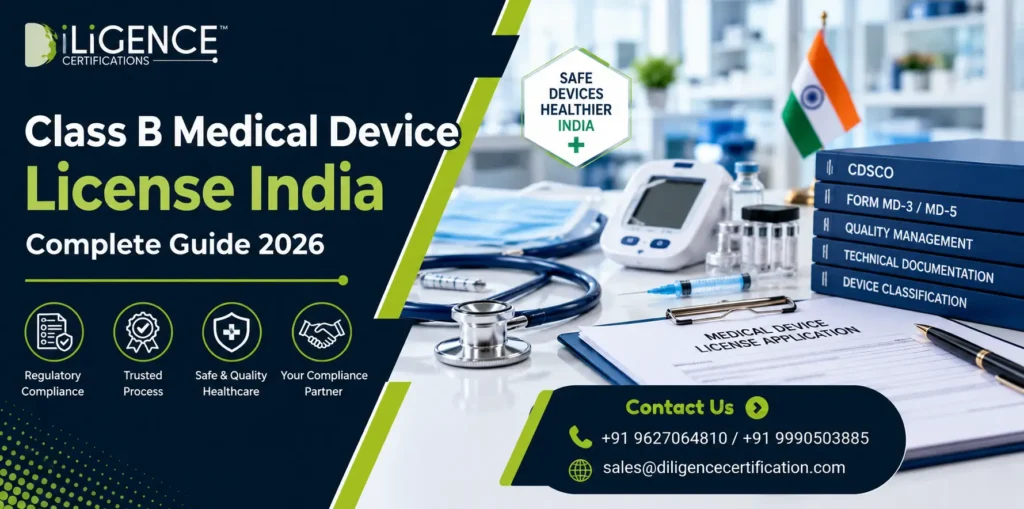
By - Class B Medical Device License in India is required for certain low-to-moderate-risk medical devices under the Medical Devices Rules, 2017.
- Manufacturers generally apply through Form MD-3 and receive Form MD-5, while importers use Form MD-14 and receive Form MD-15 through CDSCO.
- The Class B medical device registration process includes device classification, SUGAM portal registration, document preparation, quality management, application submission, and factory audit.
- Important documents may include the Device Master File, Plant Master File, manufacturing site details, quality documents, technical staff details, and business registration documents.
- Businesses should choose the correct device classification and application form, maintain consistent documents, respond to regulatory queries, and track the five-year retention fee requirement to avoid licensing delays.
Introduction
If you make, bring or sell devices in India you may need a Class B medical device license before you start business activities.
Many businesses find the licensing process hard. Questions about device classification, application forms, documents, factory audits and approval timelines can make the process confusing.
This guide explains the Class B medical device license in India in language. You will learn which Class B medical device license you need, how to apply for it what documents are required, how the audit works and how long the process may take.
What Is a Class B Medical Device License in India?
A Class B medical device license is a license required for certain low to moderate risk medical devices in India.
Medical devices, in India are regulated under the Medical Devices Rules, 2017.
The application process depends on what your business does:
- Manufacturing in India: Apply through Form MD-3 and receive Form MD-5.
- Using another manufacturer’s licensed facility: Apply for a loan license through Form MD-4 and receive Form MD-6.
- Importing medical devices: Apply to CDSCO through Form MD-14 and receive Form MD-15.
- Selling or storing medical devices: Apply through Form MD-41 and receive Form MD-42.
Applications are submitted through the SUGAM portal.
What Is a Class B Medical Device?
India classifies medical devices into four risk categories:
- Class A - Low risk
- Class B - Low to moderate risk
- Class C - Moderate to high risk
- Class D - High risk
Class B devices are generally considered low-to-moderate-risk medical devices.
Examples commonly associated with Class B include:
- Syringes
- Hypodermic needles
- Suction equipment
However you should not decide classification by looking at online lists.
Different websites may show classifications for the same product. Therefore classification is important; you must check the CDSCO classification list before starting your application.
Which Class B Medical Device License Do You Need?
The right license depends on what your business does.
1. Class B Manufacturing License
If you make a Class B device in India you usually apply using Form MD-3.
Once approved the manufacturing license is given in Form MD-5.
2. Class B Loan License
If you want to produce your device using another company’s licensed factory you can apply for a loan license.
You submit the application through Form MD-4. The license is issued in Form MD-6.
3. Class B Import License
If you are bringing a Class B device into India you must apply to CDSCO using Form MD-14.
After approval the import license is issued in Form MD-15.
4. Registration for Selling or Storing Medical Devices
If your business only sells or stores devices you may need to apply using Form MD-41.
You will receive a registration certificate, in Form MD-42.
Picking the license and form from the start can help avoid delays.
How to Get a Class B Medical Device License in India
For a manufacturer the process generally involves the following steps.
Step 1: Confirm Your Device Classification
Before preparing your application confirm that your medical device falls under Class B. Use the CDSCO classification information rather than relying only on third-party websites.
Step 2: Register on the SUGAM Portal
Applications for medical device licensing are submitted online through the SUGAM portal. Make sure your business and applicant information is accurate before proceeding.
Step 3: Prepare Your Quality Management System
Your manufacturing facility needs a quality system and must follow the applicable requirements under the Fifth Schedule. Many manufacturers use ISO 13485 as part of their quality management system.
Step 4: Prepare the Required Documents
Prepare the business, manufacturing, quality and personnel documents required for your application. Make sure all information is consistent, across your documents.
Step 5: Submit Form MD-3
Complete Form MD-3 upload the required documents. Pay the applicable government fee online. The applicable fee should be checked against the requirements because fees can change.
Step 6: Factory Audit
For Class B manufacturing a Notified Body generally audits the manufacturing facility. The audit checks whether your facility and quality system meet the requirements.
Step 7: Respond to Queries
During the application process the authorities may raise queries. Request additional information. Responding accurately and promptly can help prevent delays.
Step 8: Receive the License
Once the application and required assessments are completed successfully the manufacturing license is issued in Form MD-5.
Documents Required for Class B Medical Device License
The exact document checklist should always be confirmed through the current SUGAM portal requirements.
However, manufacturers should generally be prepared to provide documents such as:
- Company or partnership registration documents
- Premises and address documents
- Manufacturing site layout
- Device Master File
- Plant Master File
- Quality management system documents
- Fifth Schedule compliance information
- Details of qualified technical staff
- Consent letter for a loan license, where applicable
- Copy of the main manufacturer’s license for a loan license
One important point is consistency.
Your company name, address, product information, dates, and other details should match across the application and supporting documents.
Small differences can lead to additional queries and delays.
Class B Medical Device Factory Audit
The factory audit is an important part of the Class B manufacturing process.
A Notified Body is an organisation registered with CDSCO that can assess and audit medical device manufacturing facilities.
During the audit, the facility may be checked to determine whether:
- The quality system is properly implemented
- Manufacturing processes are controlled
- Required records are maintained
- Equipment and facilities are appropriate
- Employees and technical staff meet requirements
- Actual practices match the submitted documentation
The audit is important because having quality documents on paper is not enough. Your manufacturing facility should actually follow the procedures described in those documents.
Importing Class B Medical Devices into India
The process is different if you are importing a Class B medical device.
The importer or authorised agent of the foreign manufacturer generally applies to CDSCO using Form MD-14.
If approved, the import license is issued through Form MD-15.
The foreign manufacturer may need to provide documents such as:
- Manufacturing license from its home country
- Free Sale Certificate
- Technical documentation
- Other documents required by CDSCO
The factory audit applicable to Indian manufacturers is different from the import licensing process.
How Long Does Class B Medical Device Licensing Take?
The Class B medical device license timeline can vary depending on the application and the applicant’s readiness.
Some sources report approximately 4 to 5 months for Class B manufacturing licenses, while one 2026 guide reports approximately 6 to 12 months for certain import license applications.
The actual timeline can depend on factors such as:
- Document preparation
- Quality management system readiness
- Factory audit
- Regulatory queries
- Applicant responses
- Completeness of the application
For this reason, businesses should avoid planning their launch around the shortest timeline available online.
It is better to allow additional time for preparation and possible queries.
How Long Is a Class B Medical Device License Valid?
According to the CDSCO FAQ referenced in the source material, licenses issued under the Medical Devices Rules, 2017 remain valid until they are suspended or cancelled, provided the required retention fee is paid every five years.
This means a Class B license should not simply be described as a “five-year license.”
The five-year period relates to the retention fee requirement.
Businesses should keep track of the relevant retention date and pay the required fee on time.
There were also draft amendments published in December 2025 and April 2026. The source material could not confirm that these drafts had been finalised, so businesses should check the latest CDSCO information before relying on them.
Common Mistakes to Avoid
Several common mistakes can create delays during the Class B medical device licensing process.
1. Choosing the Wrong Device Class
Do not guess your device classification.
Always check the official classification information.
2. Selecting the Wrong Application Form
Manufacturers, loan license applicants, importers, and sellers may have different requirements.
Choose the correct form before submitting your application.
3. Providing Weak or Inconsistent Documents
Your documents should accurately represent your manufacturing facility, quality system, products, and business information.
4. Delaying Responses to Queries
Regulatory queries should be answered carefully and within the required timeframe.
Unanswered queries can create problems for an application.
5. Forgetting the Retention Fee Date
Keep a record of your five-year retention date so that you do not miss the applicable payment requirement.
Why Choose Diligence Certification for Class B Medical Device License Services?
Applying for a Class B medical device license in India involves several steps, including classification, documentation, quality system preparation, application filing, and audit preparation.
Diligence Certification can help businesses understand these requirements and organise the application process.
The team can assist with:
- Medical device classification
- Selecting the appropriate application form
- Document preparation
- Application support
- Quality documentation
- Audit preparation
- Regulatory guidance
Diligence Certification does not promise regulatory approval or fixed timelines because the final decision and processing depend on the relevant authorities.
The objective is to help businesses submit a clear and complete application.
Conclusion
Getting a *Class B medical device license, in India** needs correct classification, proper documents, good quality preparation and following the rules. Using the form and making sure the documents are complete can help avoid delays.
If you need help with **Class B medical device licensing, CDSCO registration, documents or audit preparation** Diligence Certification can help you through the process.
Frequently Asked Questions
What is a Class B medical device license in India?
A Class B medical device license in India is a license that is needed for medical devices that have low to moderate risk.
Which form is used for a Class B manufacturing license?
Manufacturers usually use **Form MD-3** to apply and get **Form MD-5** after the application is approved.
Which form is required for importing Class B devices?
Importers usually use **Form MD-14** to apply and get **Form MD-15** after the application is approved.
Is a factory audit required for Class B devices?
Yes. For Class B devices a factory audit is usually. Is done by a **Notified Body**.
What documents are required for a Class B license?
The documents that are needed include company information, site layout, Device Master File, Plant Master File, quality documents and details about staff.
How long does a Class B medical device license take?
The time it takes can vary based on the completeness of the documents the audit, any questions that come up and how ready the application is.
Is a Class B license valid for five years?
A Class B license stays valid until it is taken away or canceled. It needs a retention fee to be paid every five years.
Can I use another companys factory?
Yes. You can apply for a *loan license** using the right process.
Where do I apply for a Class B medical device license?
Applications for a Class B medical device license are made online using the *SUGAM portal**.
What are common Class B license mistakes?
Common mistakes include classification using the wrong form not providing all the documents and not responding quickly to questions from regulators.