BIS Certification
 CDSCO
CDSCO
 PESO
PESO
 CPCB
CPCB
 LMPC
LMPC
 WPC Approval
 Global Approvals
 TEC
TEC
 ARAI
ARAI
 BEE
BEE
 ISO Certification
 DGCA Certification
 NOC For Steel
 APEDA Registration























 Business Registration
 FSSAI Mark Certification












 (32).jpg)
 Legal Services
 Trademark Registration
 Copyright Registration
 Patent Registration
 By
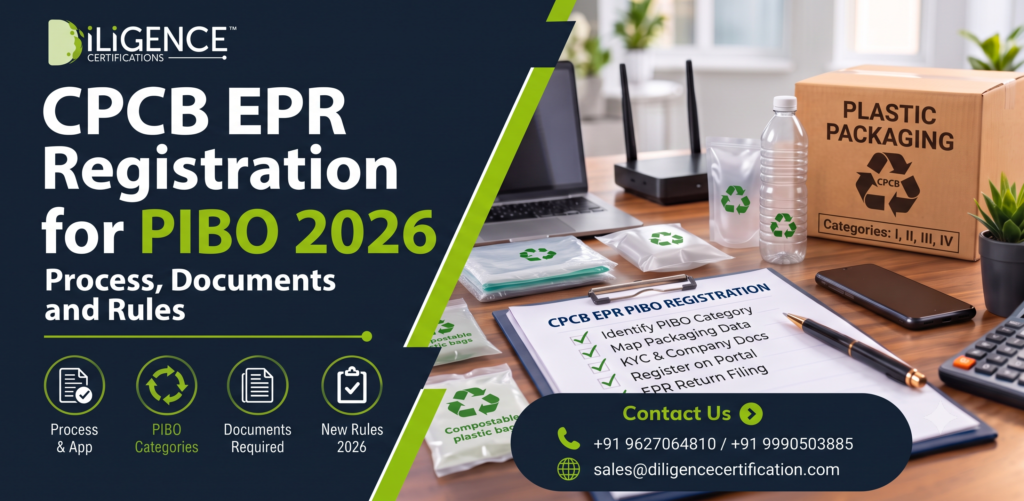
By - CPCB EPR registration for PIBO applies to covered Producers, Importers and Brand Owners dealing with plastic packaging.
- PIBO stands for Producer, Importer and Brand Owner.
- The plastic packaging EPR framework includes types of packaging. Rigid flexible and multilayered.
- Before starting registration businesses must have details, like company name, authorised person’s name, GST number, PAN and packaging information.
- The old Plastic EPR Portal stopped working on 28 June 2026. All data was moved to the Common EPR Portal.
Introduction
A packaged-product business can seem legal on the outside and still have an extended producer responsibility issue hiding in its documents.
Think about a case. A company sells personal-care products under its name. A separate company makes the products while a different supplier provides the bottles, bags and boxes. The business owner believes that the manufacturer is, in charge of the waste because the manufacturer actually puts the product into the packaging.
That assumption can create a compliance gap.
Under India’s plastic packaging EPR framework, responsibility can follow the entity that introduces plastic packaging into the market, imports packaged products or sells products under its own brand. This is why CPCB EPR registration for PIBO matters to producers, importers and brand owners.
The compliance position has also moved forward in 2026. CPCB’s earlier Plastic EPR Portal was discontinued from 28 June 2026, with registered data migrated to the Common EPR Portal. CPCB has subsequently reiterated mandatory registration for entities covered under the Plastic Waste Management Rules.
For a business EPR should not be treated as a one‑time certificate exercise.
The real work starts with identifying the entity category measuring packaging keeping records meeting EPR obligations and filing accurate EPR returns.
What Is CPCB EPR Registration for PIBO?
CPCB EPR registration for PIBO is the registration process through the CPCB’s EPR framework for eligible entities involved in plastic packaging.
PIBO stands for:
- P - Producer
- I - Importer
- BO - Brand Owner
The Extended Producer Responsibility system makes businesses that are covered by the rules for handling the plastic packaging waste that comes from their work.
The system was started by changing the Plastic Waste Management Rules from 2016. Then in 2022 the EPR Guidelines, for Plastic Packaging were officially announced. The CPCB provides a system that allows businesses to register and manage their EPR responsibilities.
In simple terms, the government does not want plastic packaging to disappear from the records once a product is sold. The business introducing that packaging into the market has continuing responsibilities connected with its management.
Who Needs PIBO Registration Under the Plastic EPR Framework?
This is one of the first questions a business should answer before preparing an application.
Producers
A producer is generally a business involved in manufacturing plastic packaging covered by the applicable framework.
For example, a company manufacturing plastic bottles, containers or other covered plastic packaging may fall within the producer category.
The important point is that producer and brand owner are not always the same entity.
A company can manufacture packaging for another company’s brand. In that situation, both businesses need to examine their respective responsibilities rather than assuming one registration covers everyone.
Importers
Importers can come under the EPR framework when they import plastic packaging, plastic packaging of imported products or other covered materials.
For example, suppose an Indian company imports finished cosmetic products from another country. The products arrive in plastic bottles and other plastic packaging. The importer should assess its EPR position rather than assuming that the overseas manufacturer has completed the Indian compliance.
The 2026 rules also contain specific recycled-content obligations for imported plastic packaging.
Brand Owners
A brand owner is a business selling products under its own brand where the applicable EPR framework makes it an obligated entity.
This is especially relevant to D2C companies, private-label businesses and companies using contract manufacturers.
A useful practical test is:
Who owns the brand under which the packaged product reaches the Indian market?
That answer should be considered together with who manufactures, imports and supplies the packaging.
CPCB material has also specifically addressed online platforms, marketplaces and supermarkets/retail chains within the brand-owner framework, subject to the applicable MSME provisions and amendments.
Important 2026 Update: The Plastic EPR Portal Has Changed
This is where many older articles become misleading.
The previous CPCB Plastic EPR Portal states that its operations were discontinued from 28 June 2026. CPCB says registered user data was migrated to the newly developed Common EPR Portal, and users were asked to verify the migrated information.
The current Common EPR Portal is available through CPCB’s EPR system.
[Internal link placeholder: CPCB/EPR compliance service by Diligence Certifications
For an existing PIBO, this means the compliance exercise is not simply about creating another account. Businesses should check whether their migrated company information, authorised-person details and registration data are correct.
CPCB’s older portal guidance also states that matching PAN details are important when linking an existing account to the Common EPR Portal.
What Plastic Packaging Categories Are Covered?
Correct classification is one of the most important parts of the application.
The EPR framework identifies plastic packaging categories, including:
Category I - Rigid Plastic Packaging
This covers rigid plastic packaging that retains its shape.
Examples can include certain bottles, containers and rigid packs.
Category II - Flexible Plastic Packaging
This includes flexible plastic packaging, plastic sheets and similar materials, as well as items such as plastic covers, carry bags, sachets and pouches where covered by the applicable category.
Category III - Multilayered Plastic Packaging
This category concerns packaging having at least one layer of plastic and at least one layer of another material.
This is particularly important for businesses using composite packaging because simply looking at the outer appearance of a pack may not be enough to classify it correctly.
Category IV - Compostable Plastic Packaging
The framework also contains provisions for plastic sheet-like packaging and carry bags made from compostable plastics.
Businesses should not classify packaging only by its marketing description. The actual material, structure and applicable regulatory definition should be checked.
Documents Required for CPCB EPR Registration for PIBO
One reason EPR applications get delayed is that businesses start the online form before organising their records
CPCB’s PIBO guidance identifies core KYC information such as company PAN, CIN and GST details, together with authorised-person PAN and Aadhaar.
Depending on the applicant type and application requirements, businesses should prepare information such as:
- Company PAN
- GST registration details
- CIN, where applicable
- Authorised person’s PAN
- Authorised person’s Aadhaar
- Import-related information, where applicable
- Product details
- Plastic packaging details
- Packaging category information
- Quantity of plastic packaging
- Previous registration information, where applicable
- EPR action-plan information
- Supporting declarations and documents required by the portal
The exact document requirement should always be checked against the current CPCB portal instructions instead of relying on a checklist copied from an old application.
Why Packaging Data Matters
This is usually the part that takes the effort from, within the company.
A company might know that it uses packaging. That doesn’t mean it has all the information needed for EPR reporting.
For example a brand that sells 50,000 units might need to find out:
- What type of packaging is used?
- Which EPR category does each package belong to?
- What is the weight of each packaging part?
- How much packaging was put into the market?
- Which amount belongs to each category?
- Which packaging is made from plastic?
- How much recycled plastic is being used?
- A strong system starts with these numbers not with the form.
How to Apply for CPCB EPR Registration for PIBO
The process can be understood in six practical stages.
Step 1: Find Out What Kind of Business You Are
First figure out if your business is working as a Producer, an Importer, a Brand Owner or another type of business that has rules to follow.
Don’t pick a category just because someone like a consultant or worker used that word in an email. Look at how the business works and how the packaging moves.
Step 2: Show All Your Plastic Packaging
Make a list of packaging for each product.
For every product write down the kind of packaging the type, the weight and how many of them are put into the market.
If one product has a bottle, a lid, a sticker and a big plastic cover the company needs to know how each part is handled in the rules that apply.
Step 3: Get Company and KYC Details Ready
Have PAN, GST, CIN and documents about the person authorized to act for the company.
Importers need to have all the import-related information on hand.
The CPCB guidance manual clearly says that company details, PAN, CIN when needed GST information and details, about the person authorized are required during the registration process.
Step 4: Register Through the Current Common EPR System
The old plastic portal is no longer the active portal for new updates.
Businesses should use the current Common EPR Portal and follow CPCB’s latest instructions. Existing users should also verify migrated data.
Step 5: Submit the Required EPR Information
The application requires more than basic company details.
The business needs to provide the applicable packaging information, quantities and other compliance data required for its entity category.
Incorrect figures can create problems later because the same data may be relevant to EPR target calculations and annual reporting.
Step 6: Maintain Compliance After Registration
This is the step businesses sometimes overlook.
Registration does not mean the file can be closed.
PIBOs need to maintain supporting records, fulfil applicable EPR obligations and submit the required annual information.
CPCB has previously stated that PIBOs are required to file annual returns relating to plastic packaging waste collected and processed towards EPR obligations.
What Are the 2026 Recycled Plastic Requirements?
The Plastic Waste Management (Amendment) Rules, 2026 announced on 31 March 2026 bring changes regarding recycled plastic content. For Producers the mandatory recycled‑plastic‑content targets are:
| Packaging category | 2025-26 | 2026-27 | 2027-28 | 2028-29 onwards |
| Category I | 30% | 40% | 50% | 60% |
| Category II | 10% | 10% | 20% | 20% |
| Category III | 5% | 5% | 10% | 10% |
The same broad category-wise percentages apply to Importers and Brand Owners under the respective provisions of the 2026 rules.
There are important qualifications.
Where recycled plastic is not permitted because of a law, regulation, mandatory Indian Standard or specified statutory requirement, the target may not apply. However, the applicable legal or regulatory basis must be submitted in the annual return when claiming the exemption.
For Category III multilayered packaging, the recycled-content target is limited to the weight of the plastic layers.
This is a major area where businesses should avoid making assumptions.
Reuse Requirements for Brand Owners
The 2026 rules also introduce specific reuse obligations for certain Category I rigid plastic packaging.
For example, for Category I rigid packaging of at least 0.9 litre/kg but below 4.9 litres/kg, the reuse target increases from 10% in 2025-26 to 15% in 2026-27, 20% in 2027-28 and 25% from 2028-29 onwards.
Separate targets apply to larger Category I packaging, including specified drinking-water packaging.
The rules also include a way to carry forward some targets that were not met in 2025 to 2026. This is only possible if the conditions in the notice are met.
For a brand owner this means that the teams responsible, for packaging design and buying materials must now work together with the compliance team.
Changing the size of a bottle, the type of material or the way the product is packaged can change how compliance is calculated.
What Happens If a Business Uses an Unregistered Supplier?
This is another important 2026 development.
CPCB’s August 2026 public notice addressed situations where covered entities were operating without registration and where transactions were being conducted with unregistered entities. CPCB stated that declaration or recording of transactions with unregistered entities on the Common EPR Portal would be discontinued, subject to specified exceptions.
For businesses, the practical lesson is straightforward:
Do not check only your own registration. Check the EPR status of relevant business partners as well.
For example, if a packaging supplier, buyer or other obligated entity is expected to be registered, its status should be verified as part of the company’s compliance process.
This turns EPR from an isolated regulatory filing into a supply-chain compliance issue.
Common Mistakes in PIBO EPR Registration
Using the old CPCB portal information
Many online guides still direct users to the old Plastic EPR Portal.
That information is outdated for new portal activity because CPCB discontinued that portal from 28 June 2026.
Treating EPR as only a certificate
A certificate is not the whole compliance programme.
Packaging records, EPR targets, certificates, annual returns and supporting evidence also matter.
Incorrect plastic category
A flexible pouch, multilayer pack and rigid bottle should not automatically be treated as the same type of packaging.
Classification should be based on the applicable regulatory definitions.
Using estimated figures without records
An estimate may seem convenient during registration, but unsupported numbers can become difficult to reconcile later.
Maintain sales, purchase and packaging-weight records from the beginning.
Ignoring contract manufacturing
A business may say, “Our third-party manufacturer handles the packaging.”
That does not automatically remove the brand owner’s own EPR responsibilities.
The parties should map who manufactures, who imports, who owns the brand and who introduces the packaging into the Indian market
Forgetting the 2026 recycled-content rules is not an option.
These rules are now making packaging procurement about compliance.
Purchasing teams must know what material they are buying.
They also need to make sure the business can back up any claim, about content.
A Practical PIBO Compliance Checklist
Before submitting or reviewing your registration, check:
- Correct PIBO category identified
- Company PAN verified
- GST details verified
- CIN checked, where applicable
- Authorised person’s details verified
- Packaging mapped product-wise
- Plastic category identified correctly
- Packaging quantity calculated
- Import data checked, where applicable
- Recycled-content data reviewed
- Applicable reuse obligation checked
- EPR action-plan information prepared
- Current Common EPR Portal used
- Migrated registration data checked, if previously registered
- Supplier/customer registration status reviewed where relevant
- Annual compliance records maintained
This checklist is useful because it separates registration from ongoing compliance.
Why Choose Diligence Certifications for CPCB EPR Registration for PIBO Certification?
Businesses often struggle not because the EPR concept is difficult, but because their company records, packaging data and regulatory requirements are sitting in different places.
Diligence Certifications provides regulatory and certification support for businesses dealing with CPCB and environmental compliance requirements. Diligence Certifications
The practical value of professional support is in connecting the different pieces: identifying the relevant EPR route, reviewing documentation, organising packaging information and helping the business follow the applicable CPCB process.
Diligence’s wider compliance services also cover CPCB and other regulatory requirements for Indian businesses.Diligence Certifications
For a company with multiple products or packaging formats, this structured approach can be more useful than simply filling an online form and waiting for a response.
Conclusion
CPCB EPR registration for PIBO is no longer something a business should approach as a simple registration formality.
For a Producer, Importer or Brand Owner, the better approach is to first understand the business model, map every relevant plastic packaging component, classify the packaging correctly and organise reliable quantity records.
The 2026 regulatory environment makes this even more important. The Common EPR Portal has replaced the old plastic portal, CPCB has reiterated registration requirements, and new recycled-content and reuse obligations need to be considered in day-to-day packaging decisions.
If your company is unsure whether it falls under the PIBO framework, which plastic category applies, or how its packaging data should be prepared, getting the classification and documentation reviewed before filing can save considerable correction work later.
Frequently Asked Questions
What is CPCB EPR registration for PIBO?
CPCB EPR registration for PIBO is the registration required for eligible Producers, Importers and Brand Owners dealing with products covered under plastic packaging EPR rules.
Who needs CPCB EPR registration for PIBO?
Producers, Importers and Brand Owners (PIBOs) covered under the applicable plastic packaging EPR requirements need to register with CPCB and meet their EPR obligations.
What documents are required for PIBO EPR registration?
Common documents include PAN, GST details, company incorporation details, authorised person details, IEC where applicable, product information and plastic packaging data.
How can I apply for CPCB EPR registration for PIBO?
Eligible businesses need to submit their details and required documents through the applicable CPCB EPR registration system and provide accurate plastic packaging information.
What are the plastic packaging categories under EPR?
Plastic packaging is generally classified into Category I (rigid packaging), Category II (flexible packaging), Category III (multilayered packaging) and Category IV (compostable plastic packaging).
Is CPCB EPR registration mandatory for Brand Owners?
Yes, eligible Brand Owners placing covered plastic packaging in the Indian market are required to comply with applicable EPR requirements.
What is the difference between a Producer, Importer and Brand Owner?
A Producer manufactures covered products or packaging, an Importer brings covered products or packaging into India, while a Brand Owner sells products under its own brand name.
What information is required about plastic packaging during registration?
Businesses may need to provide details such as the type and category of plastic packaging, quantity placed on the market and other information required for EPR compliance.
What happens if a PIBO does not complete EPR compliance?
Failure to meet applicable EPR requirements can create compliance issues and may lead to regulatory action or environmental compensation as applicable under the relevant rules.
How can Diligence Certifications help with CPCB EPR registration for PIBO?
Diligence Certifications can assist businesses with understanding eligibility, preparing required information and documents, completing the registration process and supporting EPR compliance.