BIS Certification
 CDSCO
CDSCO
 PESO
PESO
 CPCB
CPCB
 LMPC
LMPC
 WPC Approval
 Global Approvals
 TEC
TEC
 ARAI
ARAI
 BEE
BEE
 ISO Certification
 DGCA Certification
 NOC For Steel
 APEDA Registration























 Business Registration
 FSSAI Mark Certification












 (32).jpg)
 Legal Services
 Trademark Registration
 Copyright Registration
 Patent Registration
 By
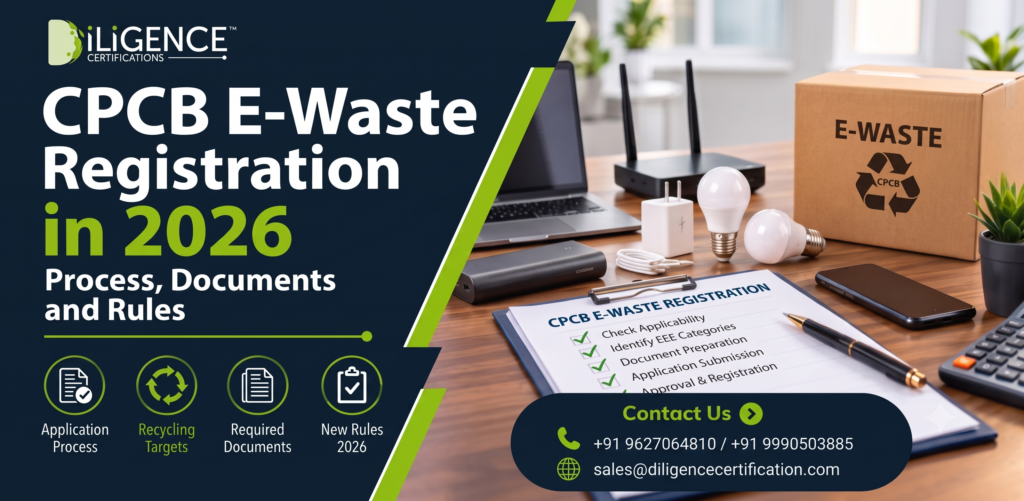
By - CPCB e-waste registration is needed for producers, manufacturers, recyclers and refurbishers who’re eligible under the E-Waste Management Rules.
- The registration process is done online using the CPCB E-Waste EPR Portal.
- Companies need to have papers such as GST, PAN details for EEE products sales information, a CA certificate and the required statements.
- Manufacturers must meet the EPR recycling goals that’re relevant to them and save information, about recycling and following the rules.
- Registration is not something that is done once and forgotten; companies need to handle returns EPR certificates, product records. Keep up with all the ongoing requirements, from CPCB.
Introduction
A consumer-electronics company had already begun selling its products across India when its compliance team realized that its e-waste responsibilities had not been properly mapped. The company had GST, IEC, product records and invoices.. One key question remained: Does the business need CPCB e-waste registration?
This is a situation. Many businesses assume that e-waste compliance only starts when old electronic products are collected.. Under India’s E-Waste (Management) Rules, 2022 the responsibility can start much earlier. It depends on the company’s role and the kind of electronic equipment it places on the Indian market.
CPCB e‑waste registration is the system that producers, manufacturers, recyclers and refurbishers must use because they fall under the rules. For producers registration is tied to Extended Producer Responsibility, known as EPR. That means producers must meet recycling targets and report progress through the CPCB E‑Waste EPR Portal.
For businesses creating a login is not the part. The real challenge lies in figuring out the category identifying the electrical and electronic equipment gathering past sales data matching all the documents and staying compliant after registration is done.
What Is CPCB E-Waste Registration?
CPCB e-waste registration is the registration of covered stakeholders on the CPCB E-Waste EPR Portal under the E-Waste (Management) Rules, 2022.
The Rules provide an EPR framework covering four main categories:
- Manufacturer
- Producer
- Refurbisher
- Recycler
Entities that fall into more than one category are required to register separately for the applicable categories.
For producers, the registration certificate is connected with their EPR obligations. The CPCB portal is used for registration, EPR targets, certificates and compliance reporting.
Who Needs CPCB E-Waste Registration?
The first step should always be applicability checking.
A producer under the E-Waste Rules includes a person or entity that, among other activities:
- Manufactures EEE and sells it under its own brand.
- Sells assembled EEE under its own brand where another manufacturer or supplier produced it.
- Offers imported EEE for sale in India.
- Imports used electrical and electronic equipment.
The equipment must fall within the notified scope of the Rules.
Manufacturer
A manufacturer of electrical and electronic equipment listed under the applicable Schedule may need registration as a manufacturer.
Producer
This category is especially important for businesses selling electronics under their own brand or importing covered EEE for sale in India.
For example, an Indian company may outsource production to another factory but sell the finished product under its own brand. The compliance question does not end with identifying the factory. The company’s role as a producer must also be assessed.
Recycler
A recycler handling e-waste for recycling must register under the applicable CPCB framework and meet the requirements relevant to its recycling facility and operations.
Refurbisher
Businesses refurbishing covered electrical and electronic equipment also fall within the registration framework.
CPCB’s FAQ confirms that registration is issued to producers, recyclers, refurbishers and manufacturers of EEE listed in Schedule
Who Does Not Need Producer Registration?
Not every company that touches an electronic product automatically becomes a producer.
CPCB has issued clarifications for certain import situations. For example, imports of EEE not listed in Schedule I may fall outside producer registration requirements. Certain imports made for sale to already registered producers, self-use or captive consumption may also fall under specific clarification conditions.
This is why a blanket statement such as “every electronics importer needs CPCB registration” can be misleading.
The product, business role, purpose of import and applicable CPCB clarification should be checked before filing.
CPCB E-Waste Registration Process
The CPCB e-waste registration process is online.
A practical process looks like this:
Step 1: Check if it Applies
Find out if your business is a producer, a manufacturer, a recycler or a refurbisher.
For producers make sure the products are included in EEE under the Schedule.
Do this before you start the application. Picking the category can lead to extra work later.
Step 2: Identify the Correct EEE Categories
Prepare a clear list of the electrical and electronic equipment for which registration is required.
The CPCB producer SOP requires applicants to select applicable EEE items and their codes.
Do not simply copy a product name from a sales catalogue.
Match the actual product, model, function and applicable EEE category.
Step 3: Prepare Company Information
The portal requires business information such as:
- Company or trade name
- Legal name
- GST details
- PAN
- CIN/incorporation information, where applicable
- IEC, where applicable
- Corporate office details
- Authorised person’s details
- Contact information
CPCB specifically states that the address and supporting documents should be consistent with the information submitted in the application.
Step 4: Prepare Historical Sales Data
This is one of the most important parts of the application.
For applicable producers, CPCB requires EEE placed on the market to be reported year-wise by weight in metric tonnes for the relevant period based on the average end-of-life of the EEE.
For example, if a product has an average life of five years, the required historical sales period can extend across those relevant years.
This means the finance, sales and compliance teams should work together before the application is submitted.
Step 5: Obtain the CA Certificate
The SOP for the producer under CPCB asks for a certificate from the auditor or an independent Chartered Accountant. This certificate must confirm the EEE sales or import quantities in weight.
A common problem, in practice is that a business keeps track of sales in units but has not converted that information into the weight-based format.
This data must be. Made accurate before submitting the report.
Step 6: Prepare Declarations
The application can require:
- Covering letter
- Undertaking regarding correctness of information
- Self-declaration
- RoHS compliance declaration
- Declaration regarding availability of technical documents
- Enclosure A
- Awareness-plan details
CPCB’s SOP specifically requires producers to maintain technical documentation relating to RoHS compliance and make it available for verification when required.
Step 7: Submit the Application Online
Physical applications are not the normal route for producer registration under the CPCB SOP. Applications are submitted through the designated E-Waste EPR Portal.
Step 8: CPCB Review
CPCB reviews the application and supporting information.
If shortcomings are found, they are communicated through the portal. The SOP states that shortcomings for incomplete applications may be communicated within 25 working days, with the producer required to respond within the specified period.
Step 9: Registration Certificate
Once the application is complete and has been approved CPCB sends the EPR Registration Certificate through the portal.
For the producers the certificate includes the registration number, the list of EEE and the EPR obligations.
Documents Required for CPCB E-Waste Registration
The exact documents depend on the stakeholder category, but producer registration commonly involves the following:
| Document / Information | Purpose |
| GST certificate | Business identification |
| PAN | Company identification |
| CIN / Incorporation Certificate | Legal entity verification |
| IEC | Import-related information, where applicable |
| Authorised person’s details | CPCB communication |
| EEE product list | Product classification |
| Historical sales data | EPR calculation |
| CA certificate | Verification of sales/import weight |
| Covering letter | Formal registration request |
| Undertaking | Confirmation of data accuracy |
| RoHS declaration | Environmental compliance |
| Enclosure A | EEE-related declaration |
| RoHS technical-document declaration | Record availability |
| Awareness plan | Consumer awareness requirements |
CPCB’s producer SOP provides the underlying checklist and specifies the required information and declarations.
Important document checking tip
The company name and address should not be considered as details.
If the GST certificate has one address the IEC has another and the application has an address the difference can result in needing to explain things later.
A five minute check of the documents before sending them can avoid a conversation, about following the rules later.
CPCB E-Waste Recycling Targets
Registration is not the end of EPR compliance.
For producers, EPR recycling obligations apply according to the Rules and applicable schedules.
Under Schedule III, the recycling target is:
- FY 2023-24: 60%
- FY 2024-25: 60%
- FY 2025-26: 70%
- FY 2026-27: 70%
- FY 2027-28: 80%
- FY 2028-29 onwards: 80%
The goal is connected to how many EEE productsre sold in the specific time before and how long the product usually lasts.
A company that just started might use calculations under Schedule IV so businesses should not always use the normal Schedule III calculation, for everything.
What Happens After CPCB E-Waste Registration?
A common mistake is to treat the certificate as the finish line.
For producers, ongoing compliance can include:
- Monitoring EPR obligations
- Working with registered recyclers
- Procuring or managing applicable EPR certificates through the portal
- Maintaining sales and product records
- Filing required returns
- Keeping RoHS-related technical records available
- Updating the registration when relevant business or product details change
- Tracking CPCB notifications and portal instructions
The CPCB portal currently reminds stakeholders to file quarterly returns regularly and states that late filing is considered non-compliance.
CPCB also publishes SOPs and instructions for annual returns, profile amendments, EPR certificate generation and other portal activities.
EPR certificates and Registered Recyclers
A producer cannot meet EPR obligations by gathering old electronics in an informal way. The CPCB framework links a producer’s EPR fulfilment, with registered recyclers and EPR certificates. CPCB defines EPR as a producer’s duty to hit the required recycling targets by using registered e‑waste recyclers and to keep waste management friendly. For a company this means that the compliance team must check the recycler’s status and keep records of all transactions and certificates. Using a recycling channel can cause a compliance problem even if the business has sincerely tried to dispose of its waste.
Common Reasons for CPCB E-Waste Registration Problems
1. Wrong EEE category
The product is placed under a category that does not correctly represent the equipment.
2. Incorrect sales data
The finance team provides unit numbers when CPCB requires weight-based information.
3. Historical data is incomplete
The applicant does not prepare the sales history for the relevant average-life period.
4. Address mismatch
GST, IEC, incorporation documents and the application contain inconsistent addresses.
5. CA certificate does not match portal data
The quantity in the application and the certified quantity should be reconciled.
6. RoHS documentation is overlooked
The applicant signs the declaration but does not maintain the underlying technical documentation.
7. Registration is treated as one-time compliance
The company obtains the certificate but does not maintain quarterly, annual and EPR-related obligations.
8. Portal queries are not answered properly
A CPCB query should be answered with the exact supporting information requested rather than a generic reply.
CPCB E-Waste Registration Compliance Checklist
Before submitting the application, check:
- Correct stakeholder category identified
- Applicable EEE products identified
- Correct EEE codes selected
- Company name verified
- Corporate address checked
- GST details verified
- PAN verified
- IEC checked where applicable
- CIN/incorporation details checked
- Authorised person confirmed
- Historical sales data prepared
- EEE quantity converted into metric tonnes
- CA certificate arranged
- Covering letter signed
- Undertaking prepared
- RoHS declaration completed
- Enclosure A checked
- RoHS technical records available
- Awareness plan prepared
- All portal information cross-checked
This checklist is simple, but it catches many of the issues that otherwise appear only after submission.
CPCB E-Waste Registration Validity
The CPCB producer-registration SOP states that producer registration is valid for five years from the date of issue. It also states that renewal should be applied for 120 days before expiry.
Businesses should therefore maintain a compliance calendar instead of waiting for the certificate to expire.
The same approach should be used for product additions, company changes, authorised-person changes and other amendments that may require portal updates.
Why Choose Diligence Certifications for CPCB E-Waste Registration Certification?
For a business the hard part of CPCB ewaste registration is not usually the online form. It is to line up the classification product list past sales data, documents and declarations before submitting.
Diligence Certifications can help businesses with applicability assessment, documentation review, application preparation and compliance coordination.
The broader Diligence Certifications compliance services cover Indian certification and regulatory requirements which can be useful for companies handling several compliance requirements at once.
For an understanding of the organisation and its regulatory approach you can also visit the Diligence Certifications homepage.
The key point is that professional support should not replace the applicants responsibility, for business information. Sales figures, product classifications and declarations must always be backed by company records.
Conclusion
From my experience CPCB e-waste registration is a rule that producers, makers, recyclers and refurbishers who work with covered electrical and electronic equipment must follow. CPCB e-waste registration is not about filling out an online form. Businesses must correctly spot their EEE category gather sales records collect the necessary papers and satisfy the related EPR duties.
Once CPCB e-waste registration is complete companies must keep track of recycling goals EPR certificates, returns, records and other CPCB duties. Maintaining these details up, to date can stop compliance problems and hold-ups.
If a business is not sure whether CPCB e-waste registration is required or if help is needed with documents, application setup or EPR compliance seeking advice before filing can make the process simpler and more orderly.
Frequently Asked Questions
1. What is CPCB e-waste registration?
CPCB e-waste registration is the registration process for eligible manufacturers, producers, recyclers and refurbishers under the E-Waste (Management) Rules, 2022. It helps covered businesses meet applicable e-waste EPR and compliance requirements.
2. Who needs CPCB e-waste registration?
Manufacturers, producers, recyclers and refurbishers covered under the E-Waste (Management) Rules, 2022 may need CPCB e-waste registration. Applicability depends on the business activity and the type of electrical and electronic equipment involved
3. How can I apply for CPCB e-waste registration?
The CPCB e-waste registration process is completed online through the CPCB E-Waste EPR Portal. Applicants need to provide business details, EEE information, relevant sales or import data and supporting documents.
4. What documents are required for CPCB e-waste registration?
Common CPCB e-waste registration documents include GST, PAN, incorporation details, IEC where applicable, EEE product information, historical sales data, CA certificate, declarations, RoHS-related documents and an awareness plan.
5. Is CPCB e-waste registration mandatory for electronic product producers?
CPCB e-waste registration can be mandatory when a business falls within the producer definition and deals with electrical and electronic equipment covered under the applicable E-Waste Rules. The product and business role should be checked before applying
6. What are the EPR obligations for e-waste producers?
E-waste producers must meet applicable EPR recycling targets, maintain relevant records, fulfil reporting requirements and manage applicable EPR certificates through the CPCB framework.
7. How long is CPCB e-waste registration valid?
According to the CPCB producer-registration SOP, CPCB e-waste producer registration is valid for five years from the date of issue. Businesses should plan renewal before the registration expires.
8. What are the CPCB e-waste recycling targets?
Under the applicable Schedule III targets, the recycling target is 60% for FY 2023-24 and FY 2024-25, 70% for FY 2025-26 and FY 2026-27, and 80% from FY 2027-28 onwards.
9. Can a CPCB e-waste registration application be rejected or delayed?
Yes. Incorrect EEE classification, incomplete historical sales data, mismatched documents, incorrect quantities, missing declarations or inadequate responses to CPCB queries can cause delays or other application issues
10. Is CPCB e-waste registration a one-time compliance requirement?
No. CPCB e-waste registration is only one part of e-waste compliance. Businesses may also need to manage EPR obligations, recycling targets, EPR certificates, returns, records, RoHS documentation and relevant CPCB updates after registration.