 BIS Certification
 CDSCO
CDSCO
 PESO
PESO
 CPCB
CPCB
 LMPC
LMPC
 WPC Approval
 Global Approvals
 TEC
TEC
 ARAI
ARAI
 BEE
BEE
 ISO Certification
 DGCA Certification
 NOC For Steel
 APEDA Registration











 Business Registration
 FSSAI Mark Certification








 (32).jpg)
 Legal Services
 Trademark Registration
 Copyright Registration
 Patent Registration
 By
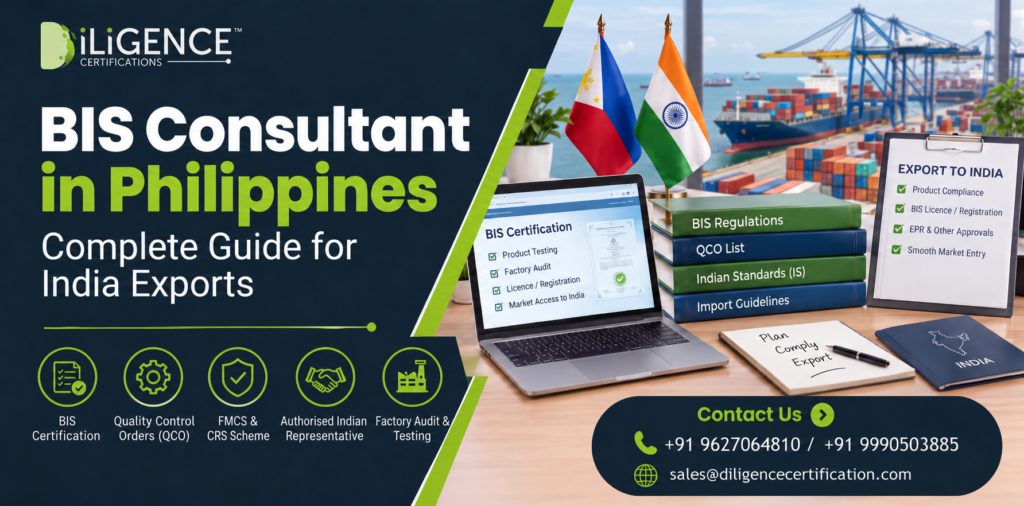
By - BIS Consultant in Philippines means the Bureau of Indian Standards. It is different from the Philippine BPS, and you need it only for goods going to India.
- Products on India’s compulsory list cannot be imported or sold without a BIS licence or registration. Always check the latest list on the official BIS website.
- Electronics and IT goods mostly go through CRS, and other regulated products mostly go through FMCS. FMCS needs a factory audit, and both schemes need an Authorised Indian Representative (AIR).
- A BIS consultant in the Philippines can help with the scheme choice. They can help with the documents. They can help with the testing. They can help with the audit preparation. They can help with the filing. They can help with the renewals.
- Only BIS can grant the approval. Be careful, with anyone who guarantees the approval. Start early. Keep your papers consistent. Track marking fees and renewal dates. A lapsed licence can stop your exports.
Introduction
A Philippine manufacturer was ready to ship a full container to India. The buyer had paid an advance, the goods were packed, and the date was fixed. Then the buyer asked for a BIS licence, and the owner did not even know what that was. The shipment waited for weeks.
A BIS Consultant in Philippines helps manufacturers and exporters understand the BIS certification requirements for selling eligible products in the Indian market. The right guidance can help businesses prepare documents, arrange product testing and understand the applicable certification pro
Stories like this are common, and they are easy to avoid. If you export regulated products to India, a BIS consultant in Philippines can tell you early which scheme applies, which papers you need and what the factory audit will check. In this blog, we explain the whole process in simple words, so you can plan your India exports without surprises.
Why Choose a BIS Consultant in Philippines?
In words a BIS consultant, in the Philippines helps a factory get BIS approval so that the factory can sell in India. First the BIS consultant checks whether the product needs BIS approval all. Then the BIS consultant brings the scheme the documents, product testing, factory audit, online filing and regular follow‑up until the BIS licence is granted.
Think of it like visiting a new city with a local friend. You know your own business very well. The consultant knows the BIS forms, the rules and the usual places where people get stuck.
One thing should be clear from day one. A consultant cannot give you approval. Only BIS can. What a good consultant does is make your file complete and correct, so BIS has fewer reasons to send it back.
A BIS Consultant in Philippines can guide foreign manufacturers through the applicable certification requirements, documentation, product testing and factory inspection procedures. The certification route depends on the product category and the relevant Indian regulations.
Do Philippine Manufacturers Need BIS Certification?
If your product is covered by a compulsory order, yes. India keeps a list of products that cannot be imported or sold without BIS approval. These come under Quality Control Orders, or QCOs. Many electrical goods, electronics, and some steel and chemical products are on it.
The list keeps changing. Some orders have been postponed or modified, and new products get added now and then. So please do not rely on an old blog or an old email from your buyer. Check the product list on the official BIS website,or ask a consultant to check your exact product.
BIS vs BPS: Do Not Mix Them Up
A lot of people in the Philippines search for BIS and end up on Philippine standards pages. That is because the Philippines has its own body, the Bureau of Philippine Standards, under the Department of Trade and Industry. It looks after Philippine rules.
BIS in this article means the Bureau of Indian Standards, and you need it only for goods going to India. A Philippine PS or ICC mark will not replace a BIS licence in the Indian market.
FMCS vs CRS: Which One Is for Your Product?
BIS has different routes. For a foreign factory, these two matter the most.
| Point | FMCS | CRS |
| Full name | Foreign Manufacturers Certification Scheme | Compulsory Registration Scheme |
| Product type | Products other than electronics and IT | Listed electronics and IT products |
| Mark | ISI mark | Standard mark with an R-number |
| Factory audit | Yes, BIS audits the overseas factory | Usually not needed |
| Testing | Samples tested as per the Indian Standard | Testing in a BIS-recognised lab |
| AIR needed | Yes | Yes |
FMCS has been run by BIS since the year 2000, under the BIS Act, 2016 and the Conformity Assessment Regulations, 2018. Simply put, it allows a factory outside India to put the ISI mark on goods it sends to India.
Not sure which one fits your product? Please do not guess. The scheme depends on the exact product and its Indian Standard, and a wrong choice means a wrong application and lost time.
7 Steps to Get BIS Approval from the Philippines
The flow changes slightly from scheme to scheme, but most exporters follow this path.
A BIS Consultant in Philippines can help manufacturers understand the Foreign Manufacturers Certification Scheme (FMCS), where applicable, and prepare for the required assessment and inspection process.
Step 1: Check if your product is covered. Find it in the BIS compulsory list and note down the Indian Standard that applies.
Step 2: Choose the scheme. FMCS or CRS, depending on the type of product.
Step 3: Appoint your AIR. This is the person in India who deals with BIS on your behalf. We explain this in the next section.
Step 4: Get documents and samples ready. Collect the factory, product and quality control details, and arrange testing as the scheme asks.
Step 5: File the application online. BIS applications go through the Manak Online portal. For FMCS, the application must be made by the foreign manufacturer itself, not by an importer on its behalf. Fees are paid at this stage.
Step 6: Face the factory audit (for FMCS). A BIS officer visits your factory to see whether you can make the product to the standard, again and again. Your process, machines, testing facilities and records will be checked.
Step 7: Get the licence, then keep it alive. Once BIS is satisfied, the licence or registration is granted and you can use the mark. After that, keep an eye on marking fees and renewal dates. A lapsed licence can stop your exports.
Who Is an Authorised Indian Representative?
An AIR is a person living in India whom the foreign manufacturer names to represent it before BIS. As per BIS guidance, the AIR must be an Indian national and a resident of India. One AIR normally represents only one manufacturer. The exception is when the manufacturers belong to the same group, or when a related importer is nominated.
The AIR’s name is written on the licence, and BIS can call the AIR for any clarification. So the choice matters. Pick someone who is reliable and who will reply to BIS quickly, because a slow AIR means a slow file.
Documents You Will Usually Need
The exact list changes based on the scheme and the product. BIS gives a product manual and a Scheme of Inspection and Testing for each Indian Standard and these papers decide what you have to give.. Most files usually include company registration and proof of the factory address, a factory layout along with a description of the manufacturing process the list of machines and testing equipment, a quality control plan with test records, product test reports as required by the scheme an authorisation letter that names the AIR and the product and brand details.
Not having the documents or having wrong documents is one of the main reasons for delays. Even a tiny spelling error in a factory address or a model name can stop the file from moving. A consultant checks everything before submitting so that everything is correct from the page to the last page.
Before applying, a BIS Consultant in Philippines can help businesses review the required application documents, product details, test reports and factory information applicable to their certification route.
Fees and Time: What to Expect
BIS fees have parts: an application fee, a licence fee, an inspection fee for the audit and a marking fee for using the BIS mark. Under FMCS the fees are the same as those for manufacturers and the first licence can be given for up to two years after the advance minimum marking fee is paid. BIS can change the fees so make sure to look at the schedule on its website before you plan your budget.
About time it depends on your product, the test lab schedule, how fast the audit can be set up and how complete your documents are. Be careful about any consultant who says they can do it in a number of days. Only BIS can control the date.
Mistakes Philippine Exporters Make
Most delays happen because of the few mistakes. Some exporters start only after the buyer has placed the order. Certification takes time so start early. Some apply under the scheme because a friend or a buyer said the product is ‘under BIS’. Always check with the product list.
There are also exporters who have a licence for one factory but send products from another. BIS approval is linked to the manufacturer the factory location and the product so all three have to match. Some forget about the renewals and marking fees once the licence is given which can put the export plan at risk.
If you are an importer is an extra tip. Ask your supplier for the BIS licence or registration number. Check it on the official BIS portal before the shipment leaves, not after it arrives at the port.
How to Choose the BIS Consultant, in Philippines
When you look at options some direct questions will give you a lot of information. Ask which scheme they will use for your product and why because a clear answer shows knowledge. Ask who will act as your AIR and what that persons job’s. Ask how the factory audit will be handled with your team in the Philippines including time zone and language.
Also ask for a written scope of work so you know what is included and what costs more. Be careful of anyone who says they can get approval because BIS makes the decision, not the consultant. Check that they will help you with renewals and marking fees after the licence is given.
Why Choose Diligence Certifications for BIS Consultant in Philippines Certification?
BIS work is long. You need a partner who keeps things clear and honest. Diligence Certifications supports manufacturers with BIS compliance. We keep our approach simple.
We first check whether the product really needs BIS approval and which scheme fits the product. The documents are reviewed before filing so mistakes are caught early. We help with AIR nomination, test coordination, audit preparation and application follow-up. We explain the fees, the steps and the likely delays openly without making promises that nobody can keep. Once the licence is, in hand we support you with renewal reminders.
To see the services in detail, you can read about our BIS Consultant in Philippines registration and certification service and then share your product details with our team.
Conclusion
BIS approval seems difficult at first. It becomes simpler if you take it one step at a time. Look at your product pick the scheme select an AIR make sure your documents are in order and get ready for the audit and renewals. A trusted BIS consultant in Philippines helps you avoid mistakes and makes sure your India orders continue without problems.
If your next shipment, to India is blocked because of a BIS license send your product details to the Diligence Certifications team today. We will help you find out what to do.
Working with a BIS Consultant in Philippines can help exporters understand Indian product compliance requirements and prepare for the certification process. Before applying, confirm the applicable BIS scheme and requirements for your specific product.
Frequently Asked Questions
1. What does a BIS Consultant in Philippines do?
A BIS Consultant in Philippines helps manufacturers and exporters understand Indian BIS certification requirements, prepare documents, coordinate product testing and follow the applicable certification process.
2. Is BIS certification mandatory for products exported from the Philippines to India?
BIS certification is mandatory for products covered by applicable Indian quality control orders or other relevant regulations. Exporters should check whether their specific product requires certification before shipping it to India.
3. What is the BIS certification process for Philippines exporter
The process generally involves identifying the applicable Indian Standard, selecting the correct certification scheme, submitting the required documents, arranging product testing and completing any required factory inspection or assessment.
4. What is the Foreign Manufacturers Certification Scheme (FMCS)?
FMCS is a BIS certification scheme for eligible foreign manufacturers producing products covered by the scheme. It allows qualifying manufacturers outside India to obtain a BIS licence for products intended for the Indian market, subject to applicable requirements.
5. What is BIS CRS registration?
The Compulsory Registration Scheme (CRS) applies to specified product categories notified by the Indian government. Eligible manufacturers must complete the applicable registration requirements before selling covered products in India.
. What documents are required for BIS certification for foreign manufacturers?
Depending on the product and certification scheme, documents may include company registration details, factory information, product specifications, details of manufacturing equipment, quality control information, test reports and an authorised signatory's documents.
7. Is product testing required for BIS certification in India?
Product testing is generally required under the applicable certification procedure. The testing requirements, laboratory arrangements and applicable Indian Standard depend on the product category and the selected certification scheme
8. Does BIS certification require a factory inspection in the Philippines?
A factory inspection may be required under schemes such as FMCS. The inspection requirements depend on the applicable BIS scheme and product. Exporters should confirm the current procedure before applying.
9. Can a foreign manufacturer apply for BIS certification without an Indian office?
The requirements depend on the certification scheme. Under FMCS, foreign manufacturers must comply with the applicable requirements for an authorised Indian representative and other prescribed documentation. The exact requirements should be verified with BIS before applying.
10. How can a BIS Consultant in Philippines help exporters?
A BIS Consultant in Philippines can help exporters identify the applicable certification route, understand documentation requirements, coordinate testing and prepare for required assessments. Professional assistance can make the process easier to manage, but certification depends on meeting the applicable BIS requirements.