BIS Certification
 CDSCO
 PESO
 CPCB
 LMPC
 WPC Approval
 Global Approvals
 TEC
 ARAI
 BEE
 ISO Certification
 DGCA Certification
 NOC For Steel
 APEDA Registration























 Business Registration
 FSSAI Mark Certification












 (32).jpg)
 Legal Services
 Trademark Registration
 Copyright Registration
 Patent Registration
 By
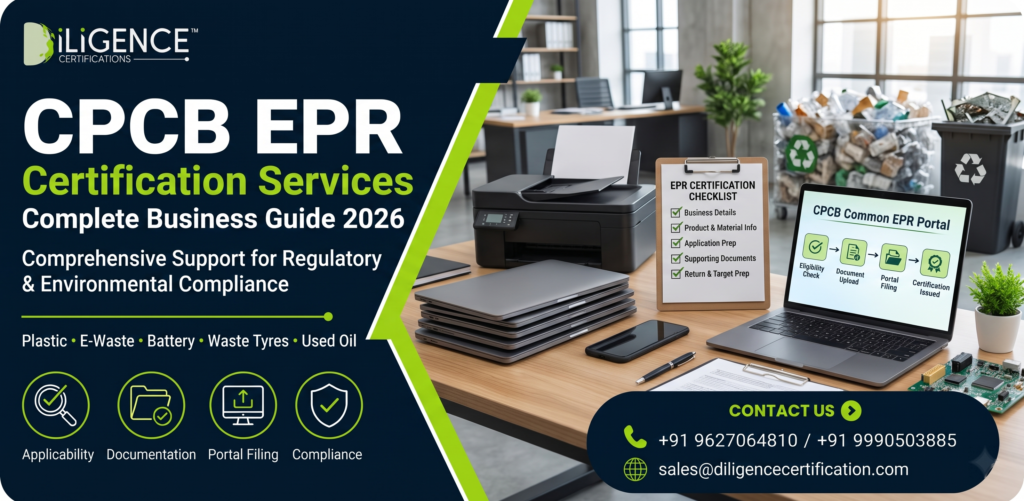
- CPCB EPR certification services help businesses find the registration and environmental compliance requirements.
- EPR means Extended Producer Responsibility, which puts waste‑management duties, on regulated businesses.
- Plastic packaging, electronic waste, batteries and other regulated waste streams may each have registration procedures.
- Applicants may need to give company details, product information, sales or import records and other category‑specific documents.
Introduction
A business can spend months working on a product building its brand and finding customers. Then suddenly it finds out it has rules it didn’t plan for. This often happens to importers, manufacturers, private-label companies and online sellers. They’re not sure if they need to register or what papers they must get ready.
CPCB EPR certification services help businesses understand Producer Responsibility (EPR) rules. They guide companies on how to apply for registration gather the needed documents and plan for staying compliant over time. The exact steps depend on the type of product the kind of waste it creates and the company’s role in the supply chain.
Take a company that sells packaged food under its brand. It might buy goods from a manufacturer and focus on selling and shipping. Still it needs to check if its actions bring any packaging rules into play.
An importer of equipment faces a different challenge. Its registration and recycling duties may fall under the E-Waste (Management) Rules, 2022 as updated. Battery companies and other regulated groups also need to follow the rules that apply to what they do.
Knowing the differences is the step, to getting things right. This guide explains CPCB EPR certification services, which businesses might need to register the documents involved how to apply, errors to avoid and how professional compliance help can make the process easier.
What Are CPCB EPR Certification Services?
CPCB EPR certification services are services that help businesses understand and manage their responsibilities under the Extended Producer Responsibility rules that apply to them.
The Central Pollution Control Board (CPCB). Manages the environmental compliance processes.. Depending on the rules some responsibilities may fall to State Pollution Control Boards (SPCBs) Pollution Control Committees (PCCs) or other authorities that are in charge.
Extended Producer Responsibility is a policy where certain businesses must take care of the waste created by their products or packaging. This is required by the rules that apply to them.
In India there is no same process, for every industry when it comes to EPR. Different types of waste have rules, definitions, ways to register and reporting duties.
For example if a company puts packaging into the market it must check the Plastic Waste Management Rules, 2016 including any changes made later and the related EPR guidelines. If a business imports electronic equipment that is covered under the rules it must review the E-Waste (Management) Rules, 2022 and any updates since then.
A consultant can help a business answer three important questions:
- Does the company fall within a regulated category?
- Which registration process and documents apply to its activities?
- What responsibilities must it fulfil after registration?
The purpose of CPCB EPR certification services is not simply to obtain a certificate. It is to help a business understand its regulatory position and establish a process for maintaining compliance as its products, packaging, sales and operations change.
Why Is EPR Registration Important for Businesses in India?
Environmental compliance is now a key part of day‑to‑day work for companies that sell goods and packaging. The rules that apply can change how a company buys supplies launches items chooses packaging keeps records and files reports.
Imagine a personal‑care brand that sells products in bottles and containers. The brand might let a third‑party factory make the products and then focus on marketing and selling. Letting another factory do the making does not get rid of every EPR duty.
The brand must look closely at its part in the law. Likewise an importer might think that the overseas factory is the one who must handle waste. That belief can be wrong if the rules, in India say that the importer also has duties.
Professional CPCB EPR certification services can help a business answer these questions before the need to apply becomes urgent.
Key Benefits of Proper EPR Compliance
Clear understanding of responsibilities: Businesses can identify the relevant waste stream and determine which regulatory category may apply.
Better documentation: Company details, product specifications, packaging information and supporting records can be organised before submission.
Improved reporting: Relevant quantities and business information can be checked against source records before returns are filed.
Better operational planning: Businesses can consider environmental obligations while introducing new products, changing packaging or expanding into additional markets.
Fewer avoidable application errors: Reviewing information before submission can help reduce inconsistencies, incomplete applications and unnecessary clarification requests.
It is important to understand that registration does not automatically prove that all applicable obligations have been fulfilled. Businesses must continue to meet the conditions and requirements that apply to their category.
Which Businesses May Need CPCB EPR Certification Services?
The need for registration depends on the waste-management rules that apply the type of product or packaging involved and what the company actually does. A business should not just look at its size. Whether it has a factory to decide if it needs to register.
1. Plastic Packaging Producers, Importers and Brand Owners
Businesses that make bring in or sell products with plastic packaging should check the Plastic Waste Management Rules, 2016 as updated and the EPR guidelines that go with them.
This includes food brands, in packages, cosmetic companies, makers of household goods and importers of products that come in packaging.
Depending on what they do companies may need to look into which packaging categories they fall under how packaging they put on the market what EPR targets apply any recycled-content rules and what reports they must submit.
Just because a company uses packaging doesn’t mean all kinds of plastic are treated the same. Each packaging type must be checked for its category and current rules.
2. Electronics Manufacturers and Importers
The E-Waste (Management) Rules, 2022 set out what’s needed for electronic and electrical equipment and the groups listed under those rules.
Depending on their work companies may need to figure out if they’re producers, manufacturers, refurbishers, recyclers or another regulated group.
A producer’s duties may include registering, meeting recycling targets using EPR certificates and submitting reports on time. Exactly what is required depends on the rules and the company’s role.
Businesses can check the CPCB E-Waste Management System for registration details and how to use the portal.
3. Battery Manufacturers and Importers
Businesses dealing with covered batteries should review the Battery Waste Management Rules, 2022, and subsequent amendments.
The applicable requirements depend on the battery category and the business’s role. Companies should check their product details, sales records, import information and relevant EPR obligations before applying.
The official Battery Waste EPR Portal provides access to the relevant registration system and guidance.
4. Businesses Dealing With Waste Tyres
Businesses dealing with tyres imported tyres or other covered activities should examine the waste‑tyre rules. I have learned that depending on the category businesses may need to register meet EPR rules and report. Businesses should confirm the rules before deciding which process to follow.
5. Waste Processors and Recyclers
Waste processors and recyclers may have their registration, operation rules and record‑keeping rules. I have seen that waste processors and recyclers play a role because EPR rules must be followed. Businesses should check that the relevant recycler or processor is registered and that any certificates or transactions meet the system rules. Businesses should never assume that a document from a provider will automatically satisfy its legal obligations.
6. E‑Commerce and Private‑Label Businesses
Selling products through a marketplace does not by itself decide whether a business needs EPR registration. I have found that a company importing products and selling them under its brand may have different duties, from a seller reselling products supplied by another business. The relevant product, packaging, import activity and legal definitions must be checked. An early check helps businesses understand their duties before launching products or increasing sales.
Types of EPR Registration and Compliance Support
CPCB EPR certification services should be selected according to the relevant waste stream. The following table provides a general overview.
| Waste stream | Main areas to review |
| Plastic packaging | Business category, packaging quantities, applicable targets and returns |
| Electronic waste | Covered products, producer status, registration and recycling obligations |
| Batteries | Battery category, registration, applicable targets and reporting |
| Waste tyres | Relevant business category, registration and EPR obligations |
| Used oil and other regulated waste streams | Applicable definitions, registration conditions and reporting requirements |
Not every EPR application follows the same route. Some processes are administered through CPCB systems, while others may involve an SPCB, PCC or another competent authority.
A consultant should identify the correct regulatory route before asking the business to prepare documents or proceed with an application.
Step-by-Step Process for CPCB EPR Certification Services
The following steps describe a practical approach to registration and compliance. Exact portal fields, documents, approval procedures and timelines depend on the applicable rules and current official instructions.
Step 1: Assess the Business and Its Products
Begin by gathering facts, about the Business and its activities.
Identify whether the Business makes Products, imports Products sells Products under its brand supplies packaging or processes Waste.
Prepare a list of Products, packaging types, product categories and operating locations.
This assessment helps determine which registration category may apply and stops the Business from following a process.
Step 2: Identify the Applicable Rules
Review the Waste rules, amendments, EPR guidelines and CPCB instructions.
For packaging examine the applicable Plastic Waste Management Rules and EPR guidelines.
For equipment and batteries review the corresponding rules and category‑specific requirements.
If the Business handles Waste streams assess each one separately.
A single general checklist may not cover every obligation.
Step 3: Prepare the Supporting Documents
Create a document checklist based on the selected category. Typical information may include business registration details, PAN, GST information where applicable, authorised-person details, product specifications, sales records and other category-specific documents.
Importers may need relevant import information. Waste processors may have additional facility or operational documents to provide.
Do not rely on a generic list without confirming the current requirements for the specific application.
Step 4: Access the Relevant Official Portal
Use the website that is suitable for the type of business. The CPCB Common EPR Portal is the place to access the right EPR systems.
The process might include making an account verifying it choosing an entity category and finishing the application. People who are registered should also check if their information has been moved or if any details need to be fixed.
The old plastic EPR website said it would stop working for updates starting on 28 June 2026 and all the information will be moved to the Common EPR Portal. Companies need to check their information and follow the instructions, on the portal instead of using old guides.
Step 5: Submit Accurate Application Information
Enter the business, product, packaging, sales or operational information that is requested. Before you submit check the application, against source documents carefully.
Common issues include mismatched names, incorrect product categories, incomplete records and inconsistent quantities.
For example if the GST records for the company use one legal entity name but the application uses a name the discrepancy must be resolved or explained clearly before you submit.
Step 6: Respond to Clarification Requests
The competent authority may ask for information or request that the applicant fix any inconsistencies. Respond using the process and include correct supporting documents. A consultant can assist with preparing the reply and keeping track of any pending items. The final decision always stays with the competent authority.
Step 7: Review the Registration and Its Conditions
Once registration is granted check the details of the registered entity, its scope, its conditions and the obligations that are specific to its category.
Keep the certificate the copies of the application and the supporting records, within reach of employees who handle procurement, operations, finance and compliance.
Step 8: Manage Ongoing EPR Obligations
Getting registered is not the step. Depending on the rules that apply a business must meet EPR targets get or move EPR certificates keep records file returns and update information when needed.
Assign the duty of tracking deadlines and reconciling data. This is especially key, for businesses that have products, suppliers or places of operation.
Documents Required for CPCB EPR Certification Services
The documents required depend on the waste stream, applicant category and current portal instructions. Preparing the information in advance can reduce avoidable delays.
The following checklist is a starting point, not a universal list of mandatory documents.
| Document or information | Why it may be needed |
| Certificate of incorporation or business registration | To establish the legal identity of the applicant |
| PAN and GST details, where applicable | To verify business and tax information |
| Authorised person’s details | To identify the person responsible for the application |
| Registered office and operating address | To establish business and facility information |
| Product or packaging details | To identify the applicable category and scope |
| Sales, import or production records | To support relevant quantity and obligation calculations |
| Import documents, where relevant | To support information about imported products or materials |
| Previous registration or portal records | To verify existing information and registration history |
| Facility or waste-processing documents, where applicable | To support applications from relevant processors or recyclers |
How Should Businesses Organise These Records?
Create a compliance folder and keep separate records, for each waste stream. Keep source documents submitted application copies, acknowledgement numbers, official communications and registration certificates together.
Where product quantities or packaging data are involved keep a record of how the figures were calculated. Finance teams may hold invoice information while procurement teams may have packaging specifications. These records should be reconciled before submission.
For a company selling hundreds of products a spreadsheet listing product identifiers, packaging type, relevant quantities, reporting period and source documents can make compliance work easier to manage.
How Much Do CPCB EPR Certification Services Cost?
There is no price that applies to every EPR registration or compliance assignment.
The total cost depends on factors.
The total cost depends on the waste stream, the business category the number of products the condition of existing records how complex the application. The scope of professional support.
A straightforward application that has all the needed information may need preparation, than a business that has several product categories, many facilities or records that are not consistent.
When comparing quotations, ask the provider to explain the following:
- Whether the fee includes an initial eligibility assessment.
- Which documents and application activities are covered.
- Whether responses to authority queries are included.
- Whether annual returns and ongoing compliance support are covered.
- Whether statutory fees, testing, audits or third-party services cost extra.
- What happens if the business category or scope changes.
Request a written scope of work before proceeding. Be cautious of anyone promising guaranteed approval, claiming that every business needs the same registration or offering a certificate without explaining the applicable regulatory process.
A transparent quotation should distinguish consultancy charges from statutory or third-party costs and clearly explain what the service does and does not cover.
Common Mistakes Businesses Should Avoid
Businesses often face compliance difficulties because important details are overlooked during routine operations.
1. Selecting the Wrong Business Category
An importer, brand owner, manufacturer and waste processor may have different responsibilities. Selecting a category without checking the relevant legal definitions can lead to an incorrect application.
2. Using Incomplete or Inconsistent Data
Company names, addresses, product details and relevant quantities should match the underlying records. Resolve discrepancies before submission wherever possible.
3. Treating Registration as the End of Compliance
Some businesses focus on obtaining the certificate but do not assign responsibility for targets, certificates, returns and recordkeeping. This creates avoidable problems later.
4. Relying on Outdated Portal Instructions
Regulatory portals and procedures can change. Businesses using old screenshots, saved guides or previous portal links should verify the current instructions before submitting information.
5. Assuming Every Recycler or Certificate Is Acceptable
The applicable rules and portal procedures determine which entities, certificates and transactions can be used for EPR fulfilment. Verify registration status and relevant conditions before relying on a provider or certificate.
6. Missing Reporting Deadlines
Maintain a compliance calendar with the applicable reporting periods, target deadlines and return dates. Confirm extensions or revised deadlines through official notices rather than relying on informal messages.
7. Ignoring Changes in Business Activities
New product lines, packaging changes, additional imports and changes in brand ownership may affect the compliance assessment. Review the applicable obligations whenever business activities change.
How CPCB EPR Certification Services Support E-Commerce Businesses
E-commerce businesses may have complicated supply chains. A seller might source products from a domestic manufacturer, import finished goods, sell private-label products or distribute products supplied by other brands.
These arrangements can create confusion about who is responsible for product or packaging waste obligations.
Consider an online brand selling kitchen accessories in plastic packaging. The company may not operate a manufacturing plant, but it should still examine whether its role as an importer, producer or brand owner brings it within the applicable EPR provisions.
A practical assessment should cover:
- Who manufactures or imports the product.
- Which business places the product or packaging on the market.
- Whether the company sells under its own brand.
- Which product components and packaging materials are relevant.
- What sales, packaging or import records are available.
- Which registration, target and reporting requirements apply.
This assessment is useful before a new product launch. It gives the company time to organise its records, understand its responsibilities and plan compliance activities alongside inventory and marketing.
Does Every E-Commerce Seller Need EPR Registration?
There is no answer that fits every seller. The requirement changes depending on the rules that apply on the product or the packaging and, on the role of the seller. A marketplace seller, an importer and a private‑label brand owner can each face responsibilities. It is better for businesses to evaluate their activities instead of simply assuming that selling online will automatically add or remove an EPR obligation.
What Should Businesses Check About EPR Compliance in 2026?
Businesses should pay attention to changes in portal access and category-specific instructions, not only amendments to the underlying rules.
One important operational development is the move to the Common EPR Portal. The former centralised plastic EPR portal announced the discontinuation of new updates from 28 June 2026 and instructed users to verify migrated information on the new portal.
Existing businesses should review their records and report discrepancies through the prescribed process.
Other waste streams have their own portal notices, registration procedures and reporting requirements. A change affecting plastic packaging should not automatically be assumed to apply to batteries, electronic waste or another category.
Before filing an application or return, businesses should:
- Check the latest notification relevant to their waste stream.
- Verify the current portal and registration procedure.
- Confirm the applicable reporting period and deadline.
- Reconcile historical records and migrated data where relevant.
- Save the submission acknowledgement and supporting documents.
Regulatory requirements can change through notifications and amendments. Official rules and current instructions take precedence over general information in a blog. Businesses should confirm the requirements with CPCB or the relevant SPCB/PCC before acting.
How to Choose the Right CPCB EPR Certification Consultant
The right consultant should help you understand your obligations, prepare an accurate application and plan for compliance after registration. The lowest quotation is not necessarily the best option if it excludes important work or does not address your business category.
Check the Consultant’s Understanding of Your Waste Stream
Ask how the consultant will determine whether your business falls under plastic packaging, electronic waste, batteries or another regulated category.
The assessment should be based on your business activities and the relevant rules, not a generic promise to arrange a certificate.
Ask for a Document Checklist
A reliable provider should explain which records are required, why they are needed and which items remain outstanding. The checklist should match your application category.
Confirm the Scope of Support
Clarify whether the service includes application preparation, portal assistance, responses to clarification requests, registration review and post-registration compliance.
Understand the Reporting Arrangements
If you need ongoing support, ask how the consultant will help track applicable targets, returns, records and deadlines. Confirm which activities remain your company’s responsibility.
Look for Transparent Communication
You should receive clear updates about missing information, outstanding actions, possible delays and regulatory questions. A consultant should explain uncertainty honestly rather than promise a fixed approval date without considering the circumstances.
Verify the Basis for Every Claim
Ask for the relevant rule, official guidance or portal instruction when a provider says that a particular registration, exemption or certificate is required. This is particularly important if your business handles several product categories.
Why Choose Diligence Certifications for CPCB EPR Certification Services Certification?
EPR compliance is not about filling out an online form. It involves knowing the regulatory category getting all the information ready and clear and understanding what responsibilities come after registration.
Diligence Certifications offers help with compliance matters, including support for CPCB and EPR rules. Their goal is to help businesses understand their situation manage documents properly and make the application process easier.
You can find more about the company’s compliance support on the Diligence Certifications homepage.
Businesses looking to check their needs should visit the CPCB and environmental compliance services page to see what kind of support is available.
When you talk to a consultant, about your requirements make sure you have the following information ready:
- Your company’s legal name and business activity.
- The products, packaging or waste stream involved.
- Whether you manufacture, import, sell under your own brand or process waste.
- Any existing CPCB or SPCB/PCC registration details.
- The records and documents currently available.
- The support you need, from initial assessment to ongoing compliance.
This information helps establish the likely scope of work and identify questions that need to be resolved before an application is prepared.
The final registration decision rests with the competent authority. A professional service should provide clear guidance and a defined scope of work rather than guarantee approval or exemption.
Conclusion:
Environmental compliance should be considered when a business plans its products, packaging, imports and sales, not only when a registration deadline approaches.
CPCB EPR certification services can help businesses identify the relevant rules, prepare accurate applications and understand their continuing responsibilities. The first step is to establish whether the business falls within a regulated category and which registration process applies.
Once that is clear, organise your documents, verify the latest official instructions and create a system for tracking applicable targets, returns and reporting dates. If the requirements are unclear, professional compliance guidance can help you plan the next steps.
If your company manufactures products, imports goods, sells private-label items or works in waste processing, review your EPR position before making assumptions about registration.
Contact Diligence Certifications to discuss your business activities, identify the applicable CPCB EPR requirements and understand the documentation and compliance support you may need.