BIS Certification
 CDSCO
 PESO
 CPCB
 LMPC
 WPC Approval
 Global Approvals
 TEC
 ARAI
 BEE
 ISO Certification
 DGCA Certification
 NOC For Steel
 APEDA Registration























 Business Registration
 FSSAI Mark Certification












 (32).jpg)
 Legal Services
 Trademark Registration
 Copyright Registration
 Patent Registration
 By
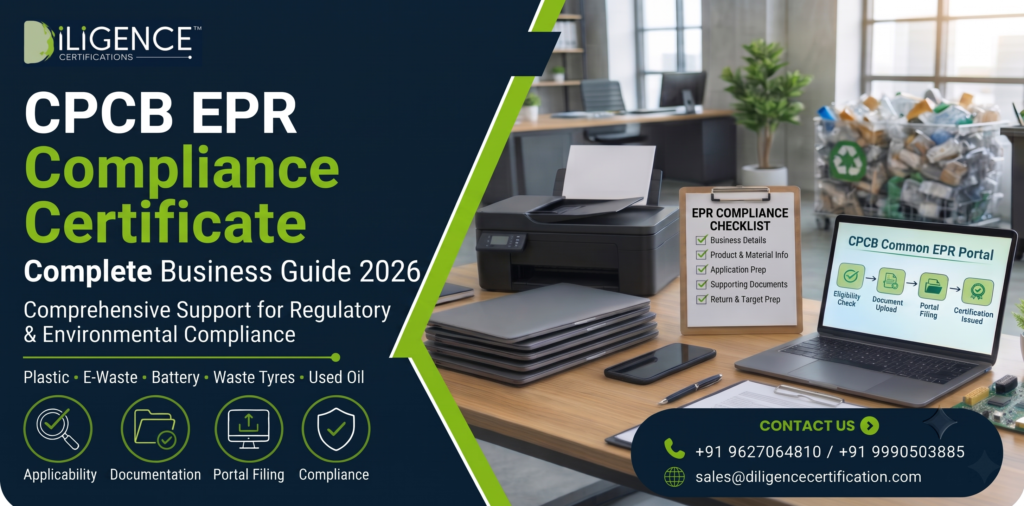
- A CPCB EPR compliance certificate relates to compliance under the applicable Extended Producer Responsibility framework.
- EPR registration and fulfilment of EPR obligations are separate steps.
- Requirements depend on the waste category, business activity and applicable rules.
- Businesses dealing with plastic packaging, batteries, e-waste, used oil and waste tyres must check the relevant framework.
- Company PAN, GST details, business registration documents and product or packaging records may be required, depending on the applicant category.
Introduction
Imagine a business based in Noida that sells packaged snacks over India. The products are made by another company put into bags and sent through online stores. Sales are going up. The company has never looked into whether its packaging creates any Extended Producer Responsibility (EPR) duties.
The owner thinks the manufacturer or the company that makes the packaging will handle everything.
This way of thinking can cause problems with following the rules.
Depending on what the company does and the rules that apply it might need to check what responsibilities it has as the brand owner. Just because another company makes the product does not mean the brand owner is free of all duties.
This is why the CPCB EPR compliance certificate becomes a thing for businesses that want to know about their registration and what they need to do.
Extended Producer Responsibility makes certain businesses responsible for handling the waste from the products or packaging they put into the market. The rules in place might ask for registration, meeting goals keeping records getting certificates and giving reports regularly.
There is a big difference between getting a registration certificate and finishing all the things that need to be done. Companies should know both before thinking their EPR work is done.
This guide explains the things needed how to get ready, for the application what documents are needed what needs to be done over time and common errors in simple words.
What Is a CPCB EPR Compliance Certificate?
A CPCB EPR compliance certificate is a term that businesses might use when talking about the papers they need for their Extended Producer Responsibility registration or for meeting their responsibilities. What this certificate means exactly depends on the type of waste and the specific paper being talked about. A registration certificate, an EPR certificate created by a waste processor and proof that a company has met its duties are all different kinds of papers.
CPCB stands for Central Pollution Control Board. This group. Checks the EPR systems that are required by the rules in place. State Pollution Control Boards and Pollution Control Committees also help with some steps in the registration and checking process.
The main goal of EPR is to make the companies that are covered take care of waste management of letting others deal with it.
For instance a company that is allowed to produce something might need to reach recycling goals. A company that is registered to recycle might create EPR certificates under the system. The original company can then use these certificates or other allowed ways to meet its duties as long as the rules allow it.
The exact steps can be different, for each type of waste.
Is an EPR Registration Certificate the Same as an EPR Compliance Certificate?
No, not necessarily.
An EPR registration certificate shows that a business has got the registration according to the rules that are, in place. It does not mean that all the yearly goals, reporting tasks or other things that need to be done have been finished.
An EPR certificate given by a waste processor can have a different use. According to the rules these certificates might help in meeting EPR duties.
Companies should find out exactly which paper is needed by a customer, a shop, an inspector or a government group before they ask for or get a certificate.
Which Businesses May Need CPCB EPR Compliance?
The requirement depends on what a business manufactures, imports, sells under its own brand or processes, and which waste management rules apply.
The following examples help explain the main categories.
1. Producers and Manufacturers
A producer might need EPR registration if its work is in a category that is controlled by rules.
For example a company that makes batteries using its brand might have duties under the Battery Waste Management Rules, 2022. The exact duties depend on the definitions and the rules that are in place.
Making any product does not mean that all EPR frameworks apply to that company.
2. Importers
Importers should check EPR rules before bringing items or packaging into India.
Think of a company that brings items or packaged goods into India for selling in the local market. The act of importing the type of product and the role the company has in putting the items, on the market may decide if registration is needed.
Importers should look at product details, bills, import records and packaging information before deciding which rules apply.
3. Brand Owners
A brand owner might need to check its duties when a third-party factory makes its products.
For example a company that sells beauty products in bottles under its own name should look at the rules about plastic packaging.
The company should not think that a manufacturing contract automatically gives all EPR duties to the factory that makes the products.
4. E-Commerce Businesses
Selling online does not mean there is a pass from EPR rules.
An e-commerce company might need to check its role if it brings in products that are controlled sells items under its name or is in a group that is covered.
A seller on a marketplace who sells another companys items could have a duty than an importer or a brand owner. The real work being. The legal meaning are more important, than the place where the sales happen.
5. Recyclers and Waste Processors
Eligible recyclers and waste processors might need their registration and operational records.
Their role can include handling waste reporting the amounts that’re relevant and creating EPR certificates when allowed by the rules that are, in place.
Businesses that buy certificates should check that the source is allowed and that the deal follows the rules that’re important.
CPCB EPR Compliance Certificate Requirements by Waste Category
EPR is not one single registration covering every type of waste. Different categories have separate rules, procedures and reporting requirements.
| Waste category | Main regulatory framework or area | What businesses should assess |
| Plastic packaging | Plastic Waste Management Rules, 2016, as amended, and applicable EPR guidelines | Producer, importer or brand-owner status, packaging categories, targets and returns |
| E-waste | E-Waste (Management) Rules, 2022, as amended | Product classification, registration, recycling targets and reporting |
| Batteries | Battery Waste Management Rules, 2022, as amended | Producer status, battery data, EPR targets and applicable returns |
| Waste tyres | Applicable waste tyre EPR framework | Covered business activity, registration and relevant targets |
| Used oil | Applicable used oil EPR framework | Producer or other covered stakeholder status and required records |
The official framework for each waste stream should be checked separately. A registration or certificate under one category should not be treated as proof of compliance under another.
For example, a company selling electronics with plastic packaging may need to assess both its e-waste responsibilities and its plastic packaging responsibilities. Whether both frameworks apply depends on its actual activities and the relevant rules.
How to Apply for a CPCB EPR Compliance Certificate
The application process begins by figuring out the category. Getting documents before checking if you’re eligible can lead to extra work or an application that doesn’t fit the business activity.
Step 1: Find Out What Kind of Business You Have
Decide if the business is a producer, an importer, a brand owner, a recycler, a refurbisher or another type that is covered by the rules.
Look at the products, packaging, imports and manufacturing activities.
A business that sells different products should check each waste stream instead of thinking one registration covers everything.
Step 2: Check the Applicable Rules
Take a look, at the current rules any amendments, the official guidance and the registration instructions.
For packaging the required rules are based on the Plastic Waste Management Rules, 2016 as amended and the relevant EPR guidelines.
Battery producers and e-waste producers must follow their frameworks.
This step is important because an old blog post or saved screenshot may no longer show the portal procedure.
Step 3: Prepare the Required Documents
The documents depend on the category and current portal checklist. Commonly relevant information may include:
- Company PAN.
- GST registration details, where applicable.
- Certificate of incorporation or other business registration proof.
- Authorised person’s details.
- Importer Exporter Code (IEC), where relevant.
- Product specifications and category information.
- Plastic packaging details and quantity records, where relevant.
- Production, import, purchase and sales records.
- Existing registration details, where applicable.
- Facility permissions and operational documents for relevant waste processors.
Not every applicant needs every document listed above. The official requirements for the specific category determine the final checklist.
Check that names, addresses, registration details and reported quantities match the supporting records.
Step 4: Use the Current Official Portal
Businesses must use the portal and registration method that applies to their specific type of waste.
For packaging the old EPR portal that was created specifically for this waste type stopped taking new updates after 28 June 2026. All the old information was moved to a system and people who were already registered were told to check the moved information using the Common EPR Portal.
Official portal: https://epr.cpcb.gov.in/
People who were registered need to go through the official account-linking and verification steps. New people who want to sign up should follow the registration steps and not try to use an old way.
Different types of waste might have their special instructions even if they use the same system for access.
Step 5: Complete the Application Carefully
Enter the information requested by the portal, using current business records.
For a plastic packaging application, this may include the relevant packaging categories and quantities. For another waste stream, the form may request different product, manufacturing, import or processing information.
Do not estimate figures simply to complete a mandatory field. Use records that can support the information being reported.
Before submitting, review the application for:
- Incorrect company names or addresses.
- Missing documents.
- Wrong applicant categories.
- Inconsistent product information.
- Unsupported quantities.
- Incorrect authorised-person details.
Step 6: Respond to Queries and Track the Application
The right government department might ask for papers or more details.
Answer all questions with facts and the necessary papers. Make sure to keep the application numbers and all official messages in order so that the company can see how the application is going.
The time it takes to get registered can be different. Do not think there is a time for approval unless it is written clearly in the official rules for the group that the application belongs to.
Step 7: Review the Registration Outcome
Once the registration is approved check the information on the paper that was given out or, on the website.
Look at the name of the company, the type of registration and other important details. If something is not right use the way to fix it.
Do not stop here. Getting registered is one part of the whole process of following the rules.
What Happens After EPR Registration?
Many businesses focus on getting registered and postpone compliance until the end of the financial year. This makes it harder for businesses to match packaging, production, sales and recycling data.
After registration businesses should identify the obligations that apply to businesses category.
Fulfil the EPR targets.
Covered producers may need to meet targets by using the methods allowed by the applicable rules.
Depending on the waste stream this can involve recycling or refurbishment mechanisms, certificates or other recognised forms of compliance.
Targets should be calculated using the regulatory basis and reporting period. Do not use one categorys calculation method, for another category without checking the rules.
Maintain Accurate Records
Maintain records that support the figures submitted to the portal.
For a business using plastic packaging, relevant records may include packaging types, quantities introduced into the market, sales information and supporting supplier or processor documents, as required.
A battery producer may need different product and sales records.
The practical objective is simple: reported figures should be traceable to reliable business records.
File Required Returns
Applicable rules may require annual or other periodic returns.
The reporting deadline and information required can differ by waste category and stakeholder type. Check the current official schedule rather than relying on a deadline from a previous financial year.
The CPCB battery portal, for example, publishes category-specific notices and instructions relating to registration, EPR certificates and annual returns.
Verify EPR Certificates and Transactions
Where a framework permits the use of EPR certificates, businesses should verify that the certificates are issued by eligible entities and are appropriate for the relevant obligation.
Maintain the records needed to support the transaction and the fulfilment claim.
Do not assume that a certificate from an unverified source will be accepted.
Review Changes in Rules and Portal Instructions
EPR procedures can change through amendments, notifications and portal updates.
Assign responsibility for checking official communications and updating internal records. Businesses that handle multiple waste categories should monitor each relevant framework.
CPCB EPR Compliance Certificate: Common Mistakes to Avoid
A few avoidable mistakes can complicate registration or ongoing reporting.
Choosing the wrong category: A brand owner, importer and manufacturer may have different responsibilities. Identify the correct category before applying.
Using outdated portal instructions: The former plastic packaging portal was discontinued for new activities from 28 June 2026. Always check the current official portal.
Assuming registration completes compliance: Registration does not automatically fulfil every applicable EPR target or reporting duty.
Submitting inconsistent data: Mismatches between GST details, business records, packaging figures and application information may lead to questions.
Ignoring post-registration obligations: Targets, returns, record maintenance and certificate-related responsibilities may continue after registration.
Treating all EPR frameworks as identical: Plastic packaging, batteries and e-waste have different rules and procedures.
Assuming small businesses are automatically exempt: Business size alone should not be treated as a universal exemption. Check the specific definitions and applicable provisions.
How to Maintain EPR Compliance Throughout the Year
A business does not need to wait until a filing deadline to organise its EPR records.
A simple internal process can help.
Keep One Record for Each Relevant Waste Category
Separate plastic packaging, batteries, e-waste and other applicable categories in the company’s compliance records.
This reduces the risk of mixing figures that follow different reporting rules.
Reconcile Business Data Regularly
Compare relevant production, import, sales and packaging records at regular intervals.
If the company discovers a discrepancy, investigate it while the supporting documents are still easy to access.
Assign Responsibility to a Team Member
An employee should be responsible for tracking applicable targets, portal notices, records and filing deadlines.
For a small company, this may be part of an existing finance, operations or compliance role. Larger businesses may need a more formal compliance process.
Keep Evidence of Compliance Activities
Store relevant registrations, submissions, acknowledgements, certificates, invoices and official communications in an organised location.
The records retained should match the requirements of the applicable rules and the company’s reporting needs.
Review Before Filing
Before submitting a return, check the reporting period, data sources, quantities, supporting documents and any certificate transactions.
A short review can help identify errors before they become more difficult to correct.
What Are the Benefits of Getting EPR Compliance Right?
EPR compliance is a regulatory responsibility, but a well-managed process can also support better business operations.
Better documentation: Organised records make it easier to explain how reported figures were calculated and which documents support them.
Improved planning: Understanding applicable targets and reporting duties helps businesses plan their compliance work in advance.
Reduced administrative confusion: Correct category identification reduces the risk of following the wrong registration or reporting process.
Stronger supply-chain coordination: Businesses can clarify responsibilities with manufacturers, suppliers and eligible waste processors instead of relying on assumptions.
More informed business decisions: Accurate packaging and waste data can help companies review their material choices and waste-management processes.
These benefits depend on the quality of the company’s actual compliance practices. Registration alone does not guarantee them.
Why Choose Diligence Certifications for CPCB EPR Compliance Certificate Certification?
EPR requirements can be difficult to interpret when a business handles several product categories, imports goods or sells products under its own brand.
Diligence Certifications can help businesses understand the relevant registration route, prepare supporting information and organise their compliance process.
Support may include:
- Reviewing the business activity and identifying the relevant EPR category.
- Helping prepare the documents required for an application.
- Checking the consistency of company and product information.
- Assisting with the applicable registration process.
- Explaining relevant post-registration targets, records and reporting duties.
- Helping businesses understand current portal instructions and the next steps in their compliance process.
Businesses can learn more about the company through Diligence Certifications.
For service-related guidance, visit the CPCB EPR Certification Services page.
The appropriate support depends on the business category and its actual requirements. A consultant can help prepare an application and explain the process, but cannot guarantee approval or replace the company’s legal responsibilities.
Before starting, businesses should confirm which registration or compliance document they need and whether their existing records are complete.
Conclusion
A CPCB EPR compliance certificate needs to be looked at in the way that the registration and compliance rulesre for a specific business. It is important to find out the type of waste go through the latest online process and keep documents that show the company is following the rules.
Companies also need to keep in mind that getting registered does not finish all the EPR duties. Targets that apply certificate needs keeping records and submitting reports can still happen after registration.
For makers people who bring goods in from countries, owners of brands and those who can process waste a clear way to follow the rules can make these tasks easier to handle.
If you are not sure which EPR framework is for your business or which papers you need, get help from a professional before you send in an application. Diligence Certifications can help you learn the rules and get ready, for the next steps.
Frequently Asked Questions