BIS Certification
 CDSCO
 PESO
 CPCB
 LMPC
 WPC Approval
 Global Approvals
 TEC
 ARAI
 BEE
 ISO Certification
 DGCA Certification
 NOC For Steel
 APEDA Registration























 Business Registration
 FSSAI Mark Certification












 (32).jpg)
 Legal Services
 Trademark Registration
 Copyright Registration
 Patent Registration
 By
- Producers, importers and brand owners who use packaging must follow the CPCB certification process. This applies to every business regardless of its size.
- Manufacturers and importers of goods must get e-waste registration. This is required under the E-Waste (Management) Rules, 2022.
- Producers and importers of batteries must do registration. This is needed under the Battery Waste Management Rules, 2022.
- Used oil producers and importers are also part of CPCB certification process, though Hazardous and Other Wastes Rules.
- Recyclers and waste processors, in any of these areas also need to get registration for their activities.
Introduction
Here is a situation we see again and again. A brand owner launches a packaged food product, gets GST, FSSAI and trademark in place, and starts selling online. Then a retail partner asks for his EPR registration number, and he has none. “I thought CPCB certification is only for big factories,” he says.
That thought is very common, and it is usually wrong. The CPCB certification process is not hard, but it has many small steps, and one wrong category choice can hold up the whole file. This guide explains who needs it, which registration applies to which business, what documents to keep ready, and how the application moves on the CPCB portal in 2026.
What Is the CPCB Certification Process?
The CPCB certification process is a system where businesses register with the Central Pollution Control Board mainly under Extended Producer Responsibility rules. You choose the type of waste your business deals with fill in your business and product details on the CPCB website wait for the review and then get your registration certificate. After that you must file returns. Meet your annual targets.
A point that many people often misunderstand is this: CPCB does not give out one CPCB certificate” to all businesses. When people search for a CPCB certificate they usually mean EPR registration for packaging, e-waste, batteries, waste tyres or used oil. The permissions like Consent to Establish and Consent to Operate are handled by the State Pollution Control Board. That is a process altogether.
The official portal is managed directly by the CPCB. You can find the login details and user manuals, on the Common EPR Portal of CPCB.
Who Needs to Follow the CPCB Certification Process?
If your business puts regulated products or packaging into the Indian market, or recycles the waste that comes out of them, the rules most likely apply to you. Size does not decide this. A small importer and a large manufacturer can both be covered.
Typically, these businesses need registration:
- Producers, importers and brand owners (PIBOs) who use plastic packaging
- Manufacturers and importers of electrical and electronic equipment
- Producers and importers of batteries
- Tyre producers and importers
- Producers and importers of lubricating oil, and recyclers of used oil
- Recyclers and processors who handle these waste streams
Do Online Sellers Need CPCB Registration?
If you sell packaged goods online under your brand or if you import goods and then sell them you are usually seen as a brand owner or importer. That means you must go through the CPCB certification process for the packaging you use. The CPCB certification process is required for your packaging. The rules for marketplaces and, for sellers who only resell brands’ goods can be different. Therefore please read the rule text and the latest CPCB notices before you decide.
Which CPCB Registration Fits Your Business?
Each waste stream has its own rules and its own module. Choosing the wrong one is the most common reason for delay.
| Waste stream | Governing rules | Who registers |
| Plastic packaging | Plastic Waste Management Rules, 2016, as amended | Producers, importers, brand owners, plastic waste processors |
| E-waste | E-Waste (Management) Rules, 2022 | Manufacturers, producers, refurbishers, recyclers |
| Battery waste | Battery Waste Management Rules, 2022 | Producers including importers, recyclers, refurbishers |
| Waste tyre | Hazardous and Other Wastes Rules, as amended | Tyre producers, importers, recyclers |
| Used oil | Hazardous and Other Wastes Rules, as amended | Oil producers, importers, recyclers |
A single business can belong to, than one category. An electronics importer for instance might have to register the product for e‑waste register the batteries that’re inside the product and register the plastic box that the product is shipped in.
Documents to Keep Ready
Incomplete documents cause more delay than any rule. Keep these scanned and readable before you log in:
- PAN of the company or proprietor
- GST registration certificate
- Certificate of incorporation, partnership deed or proprietorship proof
- Import Export Code, if you import
- Identity proof and authorisation letter of the signatory
- Address proof of the registered office and, where relevant, the factory or facility
- List of products, brands and packaging types you place on the market
- Yearly quantity data for products or packaging
- A working email ID and mobile number for OTPs
Recyclers and processors will also need facility details and their State Pollution Control Board permissions.
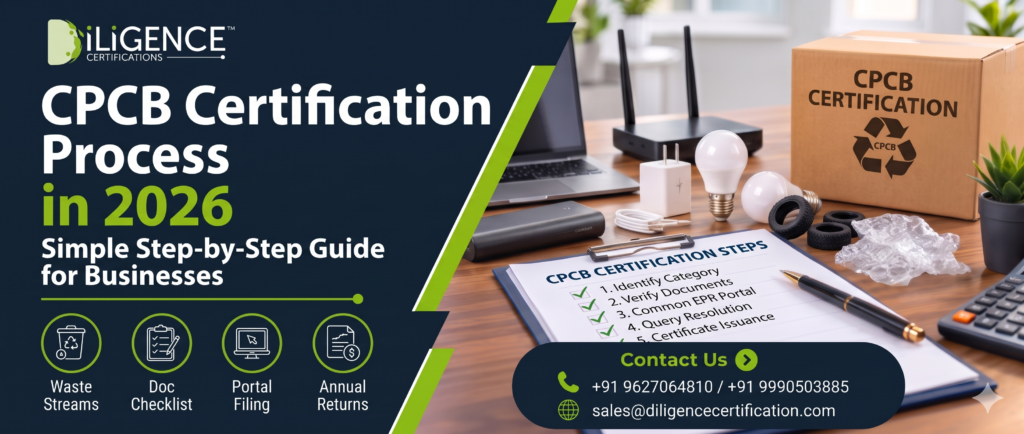
Step-by-Step CPCB Certification Process on the Common EPR Portal
In 2026 the CPCB moved its EPR portals onto one Common EPR Portal. This new portal has sign-on and a Common EPR ID. The standalone plastic portal was closed on 28 June 2026. All existing user data was moved across. The screens and labels can change. So read the user manual on the portal before you begin.
Step 1: Identify Your Waste Stream and Category
Match your products with the table. For packaging write down which of the notified categories your packaging belongs to, for example rigid, flexible or multi-layered. Record this before you open the portal.
Step 2:. Check Your Documents
Verify names, addresses and GST details on every paper. A spelling error, between PAN and GST is a mistake that can lead to major questions later.
Step 3: Create or Link Your Account
New users will register on the Common EPR Portal. Will receive a Common EPR ID. If you already have an account, on an older stream portal link that account through the sign‑on option instead of creating a duplicate.
Step 4: Fill the Application Form
Select the module and fill in the entity details, product data, packaging data and signatory information. Take your time when filling the form. The answers entered in the Application Form will be compared with your returns.
Step 5: Upload Documents and Submit
Be sure to Upload Documents that fit the portal size limits. Pay the government fee online when you are ready. Then Submit every document. After you Submit save the acknowledgement page. Store the application number safe. The application number will matter later.
Step 6: Reply to Queries
The Central Pollution Control Board may ask for corrections or extra proof. Reply to each point one, by one. For each request upload the supporting document. Late replies keep the application stays pending. Always reply on time.
Step 7: Download the Certificate and Plan Compliance
When the approval arrives you should download your registration certificate from the dashboard away. It is an idea to write down the registration details because buyers, retailers and auditors often ask for the registration details. After that move on to the compliance calendar, for your stream.
How Long Does the CPCB Certification Process Take?
There is no number that fits everyone. Many applications finish in a weeks but the time depends on the waste stream on the completeness of the file and on how fast you respond to queries. Anyone who says a date is simply guessing.
Government fees vary by category and by the size of the business. The portal shows the amount that applies to you at the time of payment so we are not giving numbers that might be, out of date when you read this.
What Happens After Registration?
This is the part many first-time applicants do not expect. Registration gives you the legal right to operate under EPR, and it also starts your reporting duty.
- File annual returns on the portal within the dates CPCB notifies. These dates have been extended in some years, so always check current circulars.
- Meet your EPR targets by procuring or generating EPR certificates from registered recyclers or processors.
- Keep purchase invoices, sales data and recycler certificates safe for audit.
- Watch for renewal or reconfirmation requirements, which differ by stream.
- Expect verification checks. Under the latest plastic rules, verification by a registered environment auditor has also been brought in.
Missing targets can lead to Environmental Compensation, so compliance is not something to leave for the last month.
Common Mistakes That Slow Down the CPCB Certification Process
- Choosing the wrong waste stream or plastic category.
- Using different business names or addresses across PAN, GST and the form.
- Treating State Pollution Control Board consent and CPCB registration as the same thing.
- Uploading blurred or expired documents.
- Ignoring portal messages after submission.
- Registering for one stream when the business is covered under two or three.
- Forgetting that registration brings yearly returns and targets.
Why Choose Diligence Certifications for CPCB certification process Certification?
The CPCB certification process looks simple on paper, but small errors in category selection or data entry create weeks of back-and-forth. At Diligence Certification, our work is to remove those errors before they reach the portal.
Here is how we usually help:
- Map your products and packaging to the correct waste stream and category
- Check every document for name, address and number mismatches before upload
- Prepare and file the application on the CPCB portal
- Draft clear replies to CPCB queries
- Explain your return and target calendar so nothing is missed after registration
We do not promise approval dates or outcomes, because the decision rests with CPCB. What we can do is make your file complete, consistent and easy to review. If you want to see how this works for plastic packaging, you can read about our CPCB EPR registration service.
Conclusion
The CPCB certification process rewards preparation. Know your waste stream keep your documents clean and organized apply on the Common EPR Portal and respond to any queries soon as they come. Then mark your returns and targets on a calendar. Registration is not the end of compliance-it’s the beginning.
If you’re not sure which registration is right, for your business talk to our team before you apply. A quick call now can save you time and trouble later. Contact Diligence Certification today and we will guide you through every step of your CPCB certification process.
Frequently Asked Questions
What is the CPCB certification process?
It is the online procedure to register with the Central Pollution Control Board, mainly for EPR compliance. You select your waste stream, submit documents on the CPCB portal, answer any queries, and receive a registration certificate.
Who needs CPCB registration in India?
Producers, importers and brand owners of regulated products or packaging, along with recyclers and processors of plastic, e-waste, battery, tyre and used oil waste, need to register under the relevant rules.
Is there a single CPCB portal now?
Yes. CPCB has introduced a Common EPR Portal with single sign-on and a Common EPR ID. The older standalone plastic portal was closed on 28 June 2026, and its data was moved across.
How long does CPCB registration take?
It depends on the waste stream and the quality of your file. Many cases take a few weeks, but queries and corrections can add time.
Is CPCB registration the same as State Pollution Control Board consent?
No. EPR registration is handled through CPCB. Consent to Establish and Consent to Operate are issued by the State Pollution Control Board and follow a different process.