BIS Certification
 CDSCO
 PESO
 CPCB
 LMPC
 WPC Approval
 Global Approvals
 TEC
 ARAI
 BEE
 ISO Certification
 DGCA Certification
 NOC For Steel
 APEDA Registration























 Business Registration
 FSSAI Mark Certification












 (32).jpg)
 Legal Services
 Trademark Registration
 Copyright Registration
 Patent Registration
 By
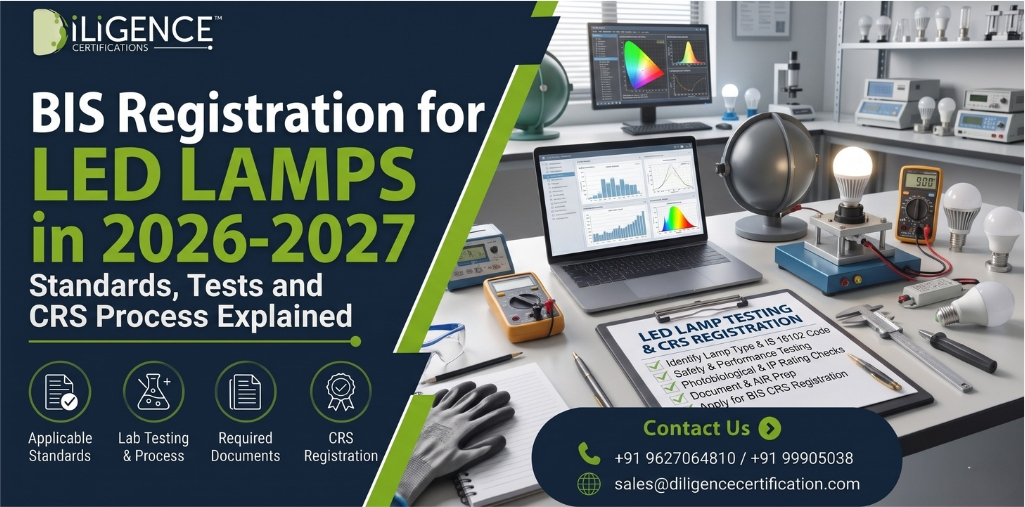
- Self-ballasted LED lamps come under the BIS Compulsory Registration Scheme (CRS), so testing is a must before sale.
- Testing is done only in a BIS-recognised lab, as per IS 16102 (Part 1) for safety and IS 16102 (Part 2) for performance.
- IS 16102 (Part 1):2026 has replaced the 2012 version. BIS has extended the implementation date to 2 February 2027.
- New tests include photobiological safety, abnormal operating conditions, IP rating and Edison cap axial strength.
- A wrong model list or weak marking can fail an otherwise good lamp.
- Start testing early. Lab slots and re-testing take more time than people expect.
Introduction
Think about a helmet. It looks fine in the shop. But you only know it is safe after someone tests it for impact. An LED lamp is the same. It lights up on day one, but that doesn’t tell you if it will overheat, give a shock or go dim in three months.
That is why LED lamp testing matters. In India, self-ballasted LED lamps are covered under the BIS CRS. No test report from a recognised lab means no registration. No registration means you can’t legally make, import or sell them.
In this blog, we will go through the standards, the tests, the process and the usual mistakes. Simple language, no jargon overload.
What Is LED Lamp Testing?
LED lamp testing means checking your lamp sample against the Indian Standard in a lab recognised by BIS. The lab checks if the lamp is safe to use and if it performs as claimed on the pack.
It is not a one-time formality only. The testing report is the base of your BIS registration. After registration, BIS can also pick samples from the market or factory to check again.
By self-ballasted we mean the driver is built inside the lamp. You screw it into a normal holder and it works. Most household LED bulbs are like this.
Which Standards Apply?
| Standard | What it covers |
|---|---|
| IS 16102 (Part 1) | Safety requirements of self-ballasted LED lamps for general lighting |
| IS 16102 (Part 2) | Performance requirements of the same lamps |
| IS 16103 (Part 1 and Part 2) | Safety and performance of LED modules, a different product |
| IS 10322 series | LED luminaires (the fittings), not bare lamps |
A simple example. A 9W LED bulb with an E27 cap falls under IS 16102. A ceiling downlighter fitting falls under the luminaire standard. Don’t mix the two.
One important update. BIS revised IS 16102 (Part 1):2012 and published it as IS 16102 (Part 1):2026. BIS issued implementation guidelines on 24 February 2026. The first last date was 2 August 2026, but a BIS circular dated 31 July 2026 extended it to 2 February 2027. Please check the BIS portal once before you apply, because dates can change.
Why Is LED Lamp Testing Important?
- It is a legal requirement under CRS. Without it, you can’t get registration.
- It reduces risks like electric shock, overheating and fire.
- It protects your brand. One bad batch in the market can hurt a lot.
- It makes customs clearance smoother for importers.
- It helps in government and bulk tenders, where valid BIS registration is asked.
- It gives the buyer a lamp that actually matches its claimed watt and lumen.
What Tests Are Conducted on LED Lamps?
The exact list depends on the standard version and the lamp type. But the tests broadly fall in these groups.
- Marking and information. Rated voltage, wattage, manufacturer details, cap type, and the model name must be clear and durable. The lab even rubs the marking with a wet cloth to check.
- Safety checks.
- Protection against accidental contact with live parts
- Insulation resistance and electric strength
- Creepage distances and clearances
- Mechanical strength and cap fitting
- Heat and fire checks. Resistance to heat, to fire and to tracking, and the behaviour of the lamp in fault conditions.
- Performance checks.
- Rated power and power factor
- Luminous flux and efficacy (lumens per watt)
- Colour temperature and colour rendering
- Endurance, switching cycles and lumen maintenance
- New 2026 tests. Covered in the next section.
What Is New in IS 16102 (Part 1):2026?
This is the section most people skip, and then they get surprised at the lab. Here is the short version.
| Change | What it means for you |
|---|---|
| Power up to 60W | Rated input power coverage is now up to 60W |
| Photobiological safety | A new test, plus a marking of the safety class |
| Rechargeable lamps | Lamps with non-removable rechargeable batteries are now covered |
| Abnormal conditions | Lamp is tested under abnormal operation |
| IP test | Ingress protection requirements are added |
| Edison cap strength | Axial strength test for the cap |
| New markings | Marking for lamps not suitable for water contact |
Tip before sending samples: check your cap quality and your marking text first. Cap and marking issues are the easiest to fix and the most common to fail.
LED Lamp Performance Parameters Explained in Simple Words
Most buyers only look at watts. The lab looks at much more. These are the numbers that matter, and they must match what you print on the pack.
| Parameter | What it means | Why it matters |
|---|---|---|
| Rated power (W) | Electricity the lamp uses | Pack claim must match the measured value |
| Luminous flux (lumens) | Total light the lamp gives out | This is the real brightness, not the watt |
| Efficacy (lm/W) | Lumens produced per watt used | Shows how energy efficient the lamp is |
| Colour temperature (K) | Warm white or cool daylight look | Pack says 2700K or 6500K, lab checks it |
| Colour rendering (CRI) | How natural colours look under the lamp | Low CRI makes clothes and food look dull |
| Power factor | How well the lamp uses the supply | A poor driver design often fails here |
| Lumen maintenance | How much light remains after long use | Cheap LEDs fade fast, and endurance tests show it |
A small example. If your pack says 800 lumens but the lab measures far less, that is a mismatch. The report will show it clearly. So always test your own sample in-house before sending it, and print only the claims you can back with data.
Two Kinds of Testing: Factory Lab vs Recognised Lab
Your own factory lab does routine checks. This is good for daily quality control. But for BIS registration, the report must come from a BIS-recognised lab. Your in-house report alone will not be accepted.
So keep both. In-house testing catches problems early, and the recognised lab report goes into the application.
Step-by-Step Process for LED Lamp Testing and Registration
- Confirm your product type. Lamp, module or luminaire? The standard changes with it.
- Check the latest standard version and dates on the BIS portal.
- Prepare the samples. Make them the same as your mass-production units, with correct marking.
- Pre-check in-house. Test power, flux and marking before the lab visit.
- Choose a BIS-recognised lab that has IS 16102 in its scope.
- Submit samples and the model list to the lab.
- Get the test report. If any test fails, fix the design and re-test.
- File the BIS CRS application online with the report and documents.
- Get registration and mark the product with the Standard Mark and R-number as required.
Which BIS Registration Is Needed?
LED lamps go through CRS registration, not the ISI licence route. Who applies depends on your business type.
| Business type | Route |
|---|---|
| Indian manufacturer | Applies directly for registration with testing of own products |
| Importer | The foreign manufacturer registers, and the importer needs the registered product |
| Overseas manufacturer | Appoints an Authorised Indian Representative and applies |
| Private label brand | Needs the brand details linked, as per BIS rules |
If you change the design, the lamp rating or the standard version, the registration may need an update. Don’t assume the old report covers it.
Documents Required for LED Lamp Testing and Registration
The exact list can change with your business type and the latest BIS portal requirements. But these are usually asked.
Company documents
- Application form and authorisation of the person signing it
- Factory or manufacturing unit details, with address
- For overseas makers, the Authorised Indian Representative documents
- Brand or trademark details for private label products
Product documents
- Model list with wattage, cap type and series models
- Circuit diagram and list of critical components
- Marking and label details, with a sample of the pack
- Photographs of the lamp from all sides
Testing records
- Test report from a BIS-recognised lab as per the applicable IS 16102 version
- Your in-house test records, if the application asks for them
Keep one clean folder for all this. Missing papers are a common reason for query rounds, and each round costs you days.
How Long Does LED Lamp Testing Take?
There is no fixed time. It depends on lab load, how many models you submit and whether anything fails the first time. A clean sample moves faster. A failed sample means fixing, resubmitting and waiting again. So plan some buffer, especially near deadlines when every lab gets busy.
Cost of LED Lamp Testing
We are not giving a single number here, because it would be misleading. The cost depends on these factors:
- Number of models and series models
- Lamp type, wattage and cap
- Whether the 2026 additional tests are needed
- Lab charges and sample cost
- Re-testing, if the first attempt fails
- Consultant and application support, if you take it
Ask the lab and your consultant for a written breakup before you start.
Common Mistakes to Avoid
- Using the old 2012 standard for a new application without checking dates
- Sending hand-made samples that don’t match production
- Weak or rubbed-off marking on the lamp or pack
- Printing lumen or watt claims that the test report doesn’t support
- Mixing up lamp, module and luminaire standards
- Choosing a lab that doesn’t have the standard in its scope
- Ignoring the new IP and photobiological requirements
- Waiting for the last week of the deadline
Who Needs This?
- Manufacturers who make LED bulbs in India
- Importers who bring LED lamps from other countries
- Private label brands who sell under their own name
- Overseas manufacturers who want to sell in India
- E-commerce sellers who list LED lamps online and need valid registration details
Why Choose Diligence Certifications for LED Lamp Testing Certification?
LED lamp rules keep changing, and the dates keep moving. You need someone who tracks the updates so you don’t have to.
Diligence Certifications helps you check which standard applies to your lamp, plan the lab testing, arrange documents and file the application. Our team explains each step in plain language and tells you upfront what to expect.
We don’t promise approvals, because approval depends on your product and the BIS process. What we promise is clear guidance and no surprises. You can read more about our BIS CRS registration support and then reach out for a quick discussion.
After Registration: Market Checks and Staying Compliant
Getting the registration is not the end of the story. Testing continues in some form.
BIS may check registered products through surveillance, which can include sample checks from the market or the factory. So the lamp you sell every day must match the lamp you tested. Same design, same driver, same components.
A few habits help:
- Don’t change the driver or LED chips without checking if re-testing is needed
- Keep batch records and supplier details for critical parts
- Run routine in-house checks on every production lot
- Track BIS circulars, because standard versions and dates keep changing
- Keep the marking and the registration number on the lamp as per rules
Practical Tips to Pass LED Lamp Testing in the First Attempt
Re-testing eats both time and money. These simple steps reduce the risk.
- Read the standard first. Don’t depend only on what the supplier tells you.
- Do a gap check against the 2026 version. Look at IP, photobiological safety and cap strength before anything else.
- Use quality caps and holders. Weak Edison caps are an easy failure point.
- Keep the driver design stable. Last-minute driver changes can break power factor and safety results.
- Print honest claims. Watt, lumen and colour temperature on the pack must match measured values.
- Check the marking durability. Rub it with a damp cloth yourself and see if it fades.
- Send a few extra care checks. Verify insulation and creepage in-house if you have the setup.
- Talk to the lab early. Ask about sample count, scope and slot availability before you ship.
Conclusion
LED lamp testing is not just paperwork. It is how you prove that your lamp is safe and performs as claimed. With IS 16102 (Part 1):2026 and the extended date of 2 February 2027, you have some time. Use it well. Check your design, fix the marking, test early and keep your documents ready.
Frequently Asked Questions
1. Is BIS registration compulsory for LED lamps?
Yes. Self-ballasted LED lamps are covered under the BIS Compulsory Registration Scheme.
2. Which standard applies to LED bulbs?
IS 16102 (Part 1) for safety and IS 16102 (Part 2) for performance.
3. Can I test my LED lamp in my own lab?
You can do pre-checks, but the report for registration must come from a BIS-recognised lab.
4. What is IS 16102 (Part 1):2026?
It is the revised safety standard that replaces the 2012 version for self-ballasted LED lamps.
5. What is the latest implementation date?
BIS extended it to 2 February 2027 through a circular dated 31 July 2026. Please verify on the BIS portal before applying.
6. What new tests were added?
Photobiological safety, abnormal operating conditions, IP rating and Edison cap axial strength, along with new markings.
7. Does the 2026 standard cover higher wattage?
Yes. Rated input power is now covered up to 60W.