BIS Certification
 CDSCO
 PESO
 CPCB
 LMPC
 WPC Approval
 Global Approvals
 TEC
 ARAI
 BEE
 ISO Certification
 DGCA Certification
 NOC For Steel
 APEDA Registration























 Business Registration
 FSSAI Mark Certification












 (32).jpg)
 Legal Services
 Trademark Registration
 Copyright Registration
 Patent Registration
 By
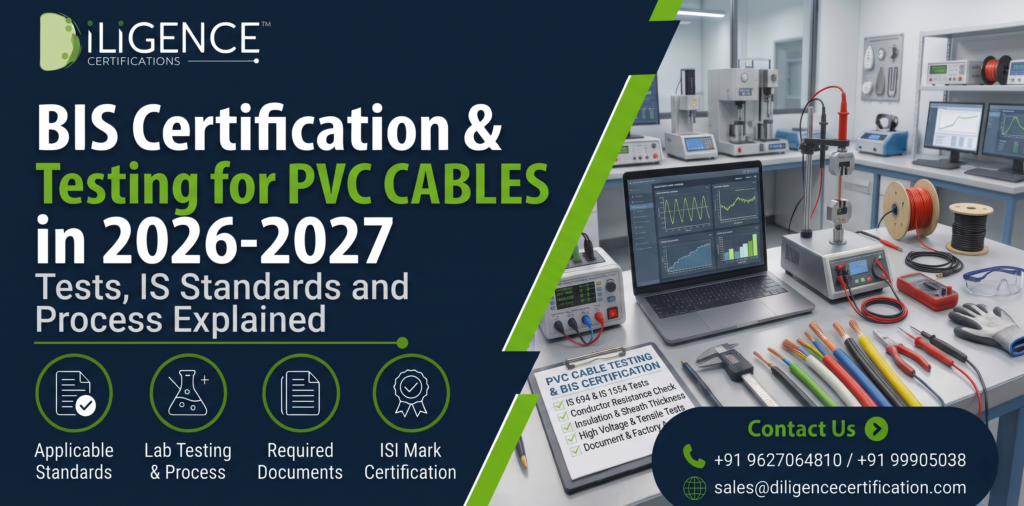
- PVC cable testing checks if a wire is safe in terms of conductor, insulation, fire behaviour and marking.
- Most PVC cables in India follow IS 694 or IS 1554, and many of them need BIS certification. Check the current notification before you start.
- Testing is of two kinds: routine tests in your own factory lab and type tests in a recognised lab.
- Conductor resistance, insulation thickness, ageing tests and the high voltage test are where most samples fail.
- Samples must come from the same line and the same size range you want to certify.
- Plan the testing early. Repeat sampling wastes both time and money.
Introduction
Cable toh sab lagwate hain, but testing ki baat kaun karta hai? Most people only see the outer plastic and the brand name. What is inside matters much more.
Think of it like a medical check-up before you join a gym. You may look fit, but the doctor still checks your heart. In the same way, a cable may look fine, but the lab checks the copper, the plastic layer and the fire behaviour before it goes inside a wall.
A bad cable does not fail on day one. It heats up slowly, the plastic gets weak, and one day there is a short circuit. That is why PVC cable testing is not a formality. It protects homes, offices and factories.
In this blog, we will explain the standards, the tests, the process and the common mistakes in very simple words.
What Is PVC Cable Testing?
PVC cable testing means checking a cable sample in a laboratory against an Indian Standard. PVC is the plastic used as insulation and sheath. The lab tests both the plastic and the conductor inside it.
The tests are done as per the method standard IS 10810. The lab compares every result with the limit given in the product standard, like IS 694 or IS 1554.
For many PVC cables, BIS certification is also compulsory under the Quality Control Orders. This means a manufacturer needs a valid BIS licence and has to put the ISI mark on the cable. Since notifications and dates can change, please confirm the latest position on the BIS website before planning.
After the licence, testing does not stop. BIS officers can pick samples from the factory or the market for checking, which is called surveillance.
Which Standards Apply to PVC Cables?
| Standard | What it covers | Where it is used |
|---|---|---|
| IS 694:2010 | PVC insulated unsheathed and sheathed cables and cords, rigid and flexible conductor, up to 450/750 V | House wiring, panels, lighting |
| IS 1554 (Part 1):1988 | PVC insulated heavy duty electric cables up to and including 1100 V | Power cables, armoured cables |
| IS 1554 (Part 2):1988 | PVC insulated heavy duty electric cables from 3.3 kV up to 11 kV | Higher voltage distribution |
| IS 5831 | PVC insulation and sheath compounds | Material requirement |
| IS 8130 | Conductors for insulated cables and flexible cords | Copper and aluminium conductor |
| IS 10810 | Methods of test for cables | How each test is done |
Simple example: A 1.5 sq mm single core house wire follows IS 694. A 3.5 core armoured power cable for a factory follows IS 1554 (Part 1). Note that XLPE cables are covered by IS 7098, not by the PVC standards.
Why PVC Cable Testing Is Important
- Safety: weak insulation can cause shock, short circuit and fire.
- Correct current carrying: if copper is less than needed, the cable heats up.
- Long life: ageing tests show how the plastic behaves after years of heat.
- Legal need: a licence and the ISI mark are needed where the order applies.
- Buyer trust: tenders, dealers and electricians ask for test proof.
- Fewer complaints: you find the problem in the lab and not at the customer site.
1. Types of PVC Cables and Their Testing Requirements
PVC cables are available in different designs depending on their application. Each type has different testing requirements based on its construction, voltage rating and intended use.
- Single Core PVC Cable: Commonly used for domestic electrical wiring, lighting and small electrical installations.
- Multi-Core PVC Cable: Contains two or more insulated conductors inside one cable. It is used in electrical equipment and industrial connections.
- Flexible PVC Cable: Designed for applications where cables need to bend or move regularly.
- Armoured PVC Cable: Includes an additional protective layer to protect the cable against mechanical damage.
- Unarmoured PVC Cable: Used in installations where additional mechanical protection is not required.
- FR PVC Cable: Designed to resist the spread of flames under specified test conditions.
- FRLS PVC Cable: Designed to provide flame retardancy with lower smoke emission and reduced acid gas generation as applicable.
What Tests Are Conducted on PVC Cables?
| Test group | What the lab checks | In simple words |
|---|---|---|
| Conductor | Strand count, diameter, resistance | Is the copper enough and good enough |
| Thickness | Insulation and sheath thickness (average and minimum) | Is the plastic layer thick enough everywhere |
| Physical tests of PVC | Tensile strength and elongation, before and after oven ageing, heat shock, loss of mass | Does the plastic stay strong with heat and time |
| Electrical tests | High voltage test, insulation resistance | Does the cable stop current from leaking |
| Fire tests | Flammability. For FR and FRLS types, oxygen index, smoke and acid gas checks | How the cable behaves if there is a fire |
| Low temperature | Cold bend and cold impact | Will it crack in winter |
| Marking and dimensions | Overall diameter, core colour, length, ISI mark, printing | Is the cable labelled correctly |
Not every test applies to every cable. The list depends on the standard, the voltage and the type, such as armoured or unarmoured.
Two Kinds of Testing: Factory Lab and Recognised Lab
People often mix these two. Let us make it clear.
Factory lab (routine testing): Done in your own factory on regular production. Normally tests like conductor resistance, thickness and the voltage test. BIS expects proper records and calibrated instruments.
Recognised lab (type testing): Done in a lab recognised by BIS, on samples drawn for certification. These cover the full list of tests, including ageing and fire tests that need special machines.
A good factory lab does not replace the recognised lab. Both are needed.
Step-by-Step Process for BIS Certification of PVC Cables
- Confirm the standard. Decide if your product falls under IS 694, IS 1554 or another standard.
- Check the QCO position. Confirm on the BIS website if certification is required for your cable.
- Set up the factory. Machines, test equipment and a trained person for quality control.
- Prepare the quality plan. Raw material checks, in-process checks and final checks.
- Apply on the BIS portal. Fill the application with documents and fees.
- Factory inspection. A BIS officer visits and checks your process and lab.
- Sample testing. Samples are drawn and tested at a recognised lab.
- Review of results. If all results meet the limits, BIS moves ahead with the grant of licence.
- Use the ISI mark. Print the mark and licence number as BIS allows, and keep records for surveillance.
Which BIS Route Is Needed?
| Business type | Usual route |
|---|---|
| Indian manufacturer | BIS licence under the product certification scheme |
| Foreign manufacturer | Foreign Manufacturers Certification Scheme (FMCS) |
| Importer | Buy from a BIS licensed maker. Check the licence is valid for that cable |
| Private label or brand owner | Check with BIS how the brand can be linked to a licensed factory |
Your licence needs a fresh look when you add a new size range, change the cable type, change the factory location or shift to a new raw material source.
Documents Required
Company documents: business registration, GST, factory address proof, authorised person details.
Product documents: product list with sizes, cable construction details, raw material details, drawings and brand name.
Testing records: calibration certificates of instruments, raw material test reports, routine test records and earlier lab reports, if any.
How Long Does It Take?
The time depends on how ready your factory is, how fast the inspection is scheduled and the lab slot for samples. A factory with clean records and calibrated instruments usually moves faster. Delays mostly happen because of missing documents or failed samples, so plan some buffer.
What Affects the Cost?
We are not giving a fixed figure because every case is different. These factors decide the final cost:
- number of cable types and sizes
- BIS fees and inspection charges
- lab testing charges for each sample
- cost of instruments, if your factory lab needs upgrading
- repeat testing, in case of failure
- consultant support, if you take one
Ask for a clear breakup in writing before you start.
Common Failures and Easy Fixes
| Failure | Why it happens | Easy fix |
|---|---|---|
| High conductor resistance | Thin strands or poor copper grade | Check strand diameter and copper quality at receiving |
| Thin insulation at one point | Die not centred on the extruder | Check setup often and measure at regular gaps |
| Low tensile strength after ageing | Too much filler in the PVC compound | Review the compound recipe and the supplier |
| Failure in voltage test | Pinholes, moisture or dust in the insulation | Dry the material and keep the line clean |
| Wrong marking | Printing mistakes on the sheath | Check the print against the standard every shift |
Common Mistakes to Avoid
- Sending samples from a different line than the one you will certify.
- Using a recycled or low grade PVC compound to save cost.
- Skipping calibration of the test instruments.
- Not keeping daily test records.
- Assuming one size passing means all sizes will pass.
- Mixing up IS 694 and IS 1554 for the same cable.
- Printing the ISI mark before the licence is granted.
- Ignoring surveillance samples after getting the licence.
Who Needs PVC Cable Testing?
- Manufacturers of house wires, flexible cables and power cables.
- Importers who bring cables from outside India.
- Private label brands that get cables made by others.
- Overseas manufacturers who want to sell in India.
- Export-only units should check the rules of the buyer country and confirm with BIS whether Indian rules apply to them.
Why Choose Diligence Certifications for PVC cable testing Certification?
BIS paperwork looks simple on paper, but small errors can cost weeks. Our team at Diligence Certifications helps you with the documents, the quality plan and the application, and explains each step in simple words.
We also guide you on which tests apply to your cable and how to prepare your samples. You can read more about our work on our BIS certification services page.
We do not promise approval, because only BIS can grant it. What we promise is clear guidance, proper preparation and honest advice.
Tips to Pass in the First Attempt
- Test every raw material lot before production.
- Keep the extruder setup checked and recorded.
- Measure thickness at many points, not just one.
- Run your own pre-test on a sample before sending it.
- Calibrate instruments on time.
- Check marking and colour coding with the standard.
- Keep a clean file of all records.
- Talk to an expert before the BIS inspection, not after it.
Conclusion
PVC cable testing may look like an extra step, but it is the base of every safe cable. The standards are clear, the tests are known, and most failures can be avoided with a little care in the factory.
Pick the right standard, keep your records clean, and test early. If you need help, a good consultant can save you from repeat samples and delay.
Frequently Asked Questions
1. What is PVC cable testing?
It is the lab checking of a PVC cable against an Indian Standard for conductor, insulation, fire and marking.
2. Which standard is used for PVC house wires?
IS 694 is the main standard for PVC insulated house wiring cables and cords.
3. Which standard is used for PVC power cables?
IS 1554 (Part 1) covers heavy duty PVC cables up to 1100 V. Part 2 covers 3.3 kV to 11 kV.
4. Is BIS certification compulsory for PVC cables?
For many PVC cables, yes, under the Quality Control Orders. Please check the latest notification for your product.
5. Which test method standard is used?
IS 10810 gives the methods of testing cables.
6. Can I do all the tests in my own factory?
No. Some tests need special machines and a recognised lab.
7. Which test do cables fail most?
Conductor resistance, insulation thickness and ageing tests are common failure points.