BIS Certification
 CDSCO
 PESO
 CPCB
 LMPC
 WPC Approval
 Global Approvals
 TEC
 ARAI
 BEE
 ISO Certification
 DGCA Certification
 NOC For Steel
 APEDA Registration























 Business Registration
 FSSAI Mark Certification












 (32).jpg)
 Legal Services
 Trademark Registration
 Copyright Registration
 Patent Registration
 By
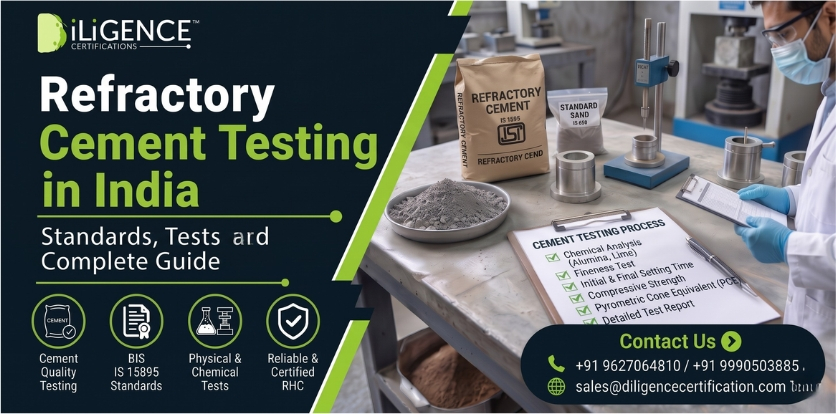
- Refractory cement testing checks if your cement can handle high heat, set on time and hold strength inside furnaces, kilns and boilers.
- In India, high alumina refractory cement is covered by IS 15895:2018, which the BIS portal lists under mandatory certification.
- IS 6452 is a different standard. It covers high alumina cement for structural use, and it does not cover refractory use.
- The main checks are chemical composition, fineness, setting time, compressive strength and pyrometric cone equivalent (PCE).
- Testing happens in two places: your own factory lab and a BIS recognised lab.
- Most failures come from raw material changes, poor sampling and weak lab records. Fix these before you send samples.
Introduction
Think of a tandoor. The clay lining takes live fire every single day. If the clay is poor, the tandoor cracks within a month, and no patching really helps. A furnace, kiln or boiler works the same way. It is just bigger, hotter and much costlier to repair.
Refractory cement is the binder that holds such linings together. You find it in castables, mortars and repair mixes. So if the cement is weak, the whole lining suffers.
That is why refractory cement testing matters. It tells you, with proof, that the cement you make or buy will behave properly inside the heat. In this blog, we will go step by step in simple words, so even a first-timer can follow it easily.
What Is Refractory Cement Testing?
Refractory cement is a special cement made mainly from calcium aluminates. In plain words, it is made from bauxite-type raw material and limestone, so it keeps its strength at very high temperatures where normal cement would crumble. People also call it high alumina refractory cement or calcium aluminate cement.
Refractory cement testing means checking this cement in a lab against a standard. The lab looks at its chemistry, fineness, setting time, strength and heat behaviour. Then everything goes into a test report.
Three simple reasons why you need it:
- To be sure the cement is fit for hot service.
- To get or keep BIS certification (ISI Mark), where it applies.
- To keep quality steady, batch after batch.
One thing to remember. Testing is not a single test. It is a group of tests, and each test answers a different question.
Which Standards Apply?
First, know which standard you are working with. This is where many people get confused.
| Standard | What it covers |
|---|---|
| IS 15895:2018 | High alumina refractory cement: classification, evaluation procedure and properties |
| IS 6452:1989 | High alumina cement for structural use (refractory use is not covered) |
| IS 4031 (different parts) | Physical test methods for hydraulic cement, like fineness, setting time and strength |
| IS 4032 | Chemical analysis of hydraulic cement |
| IS 650 | Standard sand used to make test cubes |
| IS 10570:2011 | Methods of testing refractory castables (useful when cement goes into a castable) |
A simple example: Suppose a plant makes high alumina cement for furnace linings. It should be tested against IS 15895:2018. If another plant makes high alumina cement only for structural use in cold regions, IS 6452 is the standard for that product. Same family of cement, different standard, different purpose.
Note on revisions: The older version, IS 15895:2011, now shows as withdrawn on the BIS portal. The first revision, IS 15895:2018, is the current one. It sets requirements for PCE, fineness, chemical composition, strength and setting time for the different grades. Rules and orders can change, so always check the BIS portal once before you apply.
Why Is Refractory Cement Testing Important?
- Safety: A weak lining can fail in service. In a hot furnace, that is a real danger for workers.
- Money: Relining a kiln means shutdown, labour and lost production. Testing the cement first is far cheaper.
- Legal need: Where certification is mandatory, you cannot sell the product with the ISI Mark without proper testing and a licence.
- Buyer trust: Steel plants, foundries and cement plants often ask for test reports before they place an order.
- Batch control: Raw material changes with each lot. Regular testing catches problems early.
- Fewer disputes: A clean test report settles arguments with customers quickly.
What Tests Are Conducted?
Here is the list in simple words. Exact limits depend on the grade, so always read the standard for your grade.
| Test group | What the lab checks | In simple words |
|---|---|---|
| Chemical analysis | Alumina, lime, iron oxide, silica and other oxides, plus loss on ignition | What is the cement actually made of? |
| Fineness | How fine the powder is | Too coarse and it reacts slowly. Too fine and it can behave oddly. |
| Setting time | Initial and final setting time | How long before it starts to harden and how long before it is fully set? |
| Compressive strength | Strength of mortar cubes made with standard sand | Can it take the load after curing? |
| Pyrometric cone equivalent (PCE) | Heat resistance, compared with standard cones | At what temperature does it start to soften? |
| Packing and marking | Bag weight, marking and label | Is it packed and marked as per the standard? |
Let us look at each group a little closer.
1. Chemical Analysis
This is the base test. The lab measures the oxides in your cement. Alumina content is the star here, because high alumina is what gives the cement its heat resistance. Lime and impurities like iron oxide and silica also matter. Too much of the wrong thing can pull down the heat performance.
The grade of the cement, like medium purity or high purity, depends on this chemistry. So the chemical report decides which grade limits will be applied to your sample.
2. Fineness
Fineness tells how finely the cement is ground. It affects how fast the cement reacts with water and how smooth the mix feels at site. It is a simple test, but plants fail it more often than you would think, mostly because of mill setting changes.
3. Setting Time
The lab makes a paste of cement and water and checks when it starts to stiffen and when it fully sets. Refractory cement can set quite fast. If it sets too fast, the mason gets no working time. If it sets too slow, the lining work gets delayed.
4. Compressive Strength
The lab makes small mortar cubes with standard sand, cures them in the prescribed way and crushes them at the stated ages. The reading shows if the cement gains strength as expected.
5. PCE (Pyrometric Cone Equivalent)
This is the heat test everyone talks about. A small cone made from the sample is heated along with standard reference cones. The lab notes which standard cone bends at the same time. That gives the PCE value, which is a quick indicator of heat resistance.
6. Packing and Marking
This check looks simple but still catches people. The lab or auditor checks bag weight, markings and labels, and also whether the ISI Mark is applied correctly on products that carry it.
Castable Tests: When Your Cement Goes Into a Lining
Many buyers do not use refractory cement alone. They mix it with graded refractory aggregates to make a castable. For that, the methods in IS 10570:2011 are commonly used. This standard covers sampling and testing of refractory castables, but it leaves out silicon carbide based castables.
Typical castable checks include cold crushing strength, bulk density and apparent porosity, and permanent change in size after firing. The exact list depends on the method and your customer’s requirement.
Why does this matter to a cement maker? Because your customer will test the castable, not only your cement. If your cement test report is good but the castable fails, the customer will still come back to you. So it helps to run a few trial castables on your own.
Two Kinds of Testing: Factory Lab and Recognised Lab
People often mix these two. They are different.
Factory lab testing
- Done by you, in your own plant lab.
- Routine, batch by batch, as part of your quality control.
- BIS expects you to have a proper lab with calibrated equipment and trained staff.
Recognised lab testing
- Done in a laboratory recognised by BIS for that standard.
- Samples are drawn during the BIS process, and the lab issues a formal report.
- This report goes into your licence file.
Simple way to remember: the factory lab is your daily check, and the recognised lab is the final exam.
Step-by-Step Process
Here is the usual route for an Indian manufacturer who needs the ISI Mark. Steps can vary a little, so confirm each one with BIS or your consultant.
- Confirm the standard and scope. Check that IS 15895:2018 is the right one for your product, and not IS 6452.
- Check your raw materials. Bauxite, alumina sources and limestone should be consistent. Keep supplier records.
- Set up your in-house lab. Equipment must be in working order and calibrated, with trained people to run it.
- Make trial batches. Test them yourself first. Fix problems before BIS gets involved.
- Prepare your documents. Company papers, factory details, process flow, lab details and test records.
- Apply on the BIS portal. Fill the application online and upload the documents.
- Factory inspection and sampling. A BIS officer visits, checks your process and lab, and draws samples.
- Testing in a recognised lab. The samples go for testing against the standard.
- Licence decision and marking. If everything is in order, BIS grants the licence. After that you can apply the ISI Mark as per the rules.
Overseas manufacturers follow the BIS route meant for foreign manufacturers, and that comes with extra steps like an authorised Indian representative. Check the current rules before you start.
Which BIS Route Is Needed?
| Your business type | What generally applies |
|---|---|
| Indian manufacturer | Apply for a BIS licence under the relevant standard |
| Overseas manufacturer | Apply through the foreign manufacturer route, with an Indian representative |
| Importer | Product must come from a licensed manufacturer, with proper marking |
| Trader or dealer | Sell only certified product. Keep invoices and test reports handy |
| Private label brand | The source manufacturer must be licensed. Labels must follow BIS rules |
When does your licence need a change? If you add a new grade, shift your plant, change an important raw material source or change your brand name, tell BIS and check what needs updating. Do not assume the old licence covers it.
Documents Required
Company documents
- Business registration papers and address proof
- Factory or unit details and layout
- Authorised person details
Product documents
- Product grade and standard details
- Manufacturing process flow
- Raw material list with supplier names
- Brand name and label design
Testing records
- Lab equipment list with calibration records
- Recent in-house test results for your batches
- Staff details for the lab
A tip here. Keep records neat and dated. Auditors read records first. Messy papers create doubt, even when your product is good.
How Long Does It Take?
There is no fixed timeline that fits everyone. It depends on how ready your lab is, how fast documents are cleared, how soon inspection is scheduled and how quickly the recognised lab finishes testing. Plants with proper records and tested trial batches usually move faster than those who start from zero.
If you need a timeline for your own case, share your plant details with a consultant and ask for a realistic plan.
Cost of Refractory Cement Testing
We are not giving fixed amounts here, because the total changes from case to case. These are the main factors:
- Number of grades and products you want to cover
- Number of samples and test parameters
- Lab you choose and how many retests are needed
- BIS fees and inspection related charges
- Cost of setting up or upgrading your factory lab
- Travel, courier and documentation support
The best way to control cost is to test well in-house first. A failed sample means retesting, and retesting means delay.
Common Failures and Easy Fixes
| Problem | Why it usually happens | Easy fix |
|---|---|---|
| Alumina content below the limit | Raw material quality changed | Test every lot of bauxite before use |
| Fineness out of range | Mill settings drifted | Check mill and separator settings regularly |
| Setting time not as expected | Sample absorbed moisture | Store samples in sealed containers |
| Low strength | Wrong mixing, curing or sand | Follow the test method exactly and use standard sand |
| PCE lower than expected | Too many impurities | Control iron oxide and silica in the raw mix |
| Records not matching | Poor documentation | Maintain a dated log for every batch |
Common Mistakes to Avoid
- Confusing IS 6452 (structural use) with IS 15895 (refractory use).
- Sending samples without testing in-house first.
- Using an old version of the standard.
- Taking samples in a hurry, without proper mixing and quartering.
- Letting cement absorb moisture during storage or transport.
- Skipping calibration of the lab equipment.
- Changing raw material source without informing anyone or re-testing.
- Applying the ISI Mark before the licence is actually granted.
Who Needs This?
- Manufacturers: Anyone making high alumina refractory cement in India.
- Importers: If you bring in this cement, make sure the overseas maker holds the needed BIS licence.
- Private label brands: You depend on your source plant. Check their licence and test reports.
- Overseas manufacturers: If you ship to India, you need to follow the BIS route for foreign makers.
- Refractory and castable makers: Even if you only buy the cement, test reports help you pick reliable suppliers.
Why Choose Diligence Certifications for Refractory Cement Testing Certification?
BIS work looks easy on paper. In real life, it is full of small details. One wrong document or one missed record can cost you weeks.
Diligence Certifications helps manufacturers handle this in a clear and organised way. Here is how the support usually looks:
- Checking which standard and scope apply to your product
- Reviewing your lab setup and records before BIS visits
- Preparing and filing the application documents
- Guiding you on sample preparation and recognised lab coordination
- Supporting you during the inspection and follow-up queries
If you are planning the ISI Mark for your cement, you can read more on the BIS certification service page. Every case is different, and outcomes depend on your product meeting the standard and BIS’s own review.
Tips to Pass in the First Attempt
- Read the current standard fully. Do not rely on old notes.
- Run at least three trial batches and test each one.
- Calibrate your equipment before the audit.
- Keep raw material records for every lot.
- Draw samples carefully and label them properly.
- Protect samples from moisture at all times.
- Train your lab staff on the exact test methods.
- Do a mock audit with your own team a week before.
Quick Checklist Before Sending Samples
- Correct standard and grade confirmed
- In-house test results look fine
- Lab equipment calibrated
- Samples sealed, labelled and dry
- Documents complete and dated
- Packing and marking checked
- Authorised person available for the inspection
Conclusion
Refractory cement testing is not just a formality. It is the proof that your cement can survive the heat, set properly and hold strength where it matters most. Know your standard, test in-house first, keep clean records and use the recognised lab wisely.
Start early, fix small issues at the trial stage and do not rush the paperwork. That is the simplest way to avoid retests and delays.
Frequently Asked Questions
1. What is refractory cement testing?
It is the lab checking of refractory cement for chemistry, fineness, setting time, strength and heat behaviour, as per the relevant standard.
2. Which Indian standard covers high alumina refractory cement?
IS 15895:2018. The older 2011 version shows as withdrawn on the BIS portal.
3. Is IS 6452 the same as IS 15895?
No. IS 6452 covers high alumina cement for structural use and does not cover refractory use. IS 15895 is for refractory cement.
4. What is PCE in refractory cement testing?
PCE means pyrometric cone equivalent. It compares a cone made from your sample with standard cones to show heat resistance.
5. Is BIS certification mandatory for refractory cement?
The BIS portal lists IS 15895 under mandatory certification. Rules can change, so confirm on the BIS portal before you apply.
6. Which tests are done on refractory cement?
Chemical analysis, fineness, setting time, compressive strength and PCE, along with packing and marking checks.