 BIS Certification
 CDSCO
 PESO
 CPCB
 LMPC
 WPC Approval
 Global Approvals
 TEC
 ARAI
 BEE
 ISO Certification
 DGCA Certification
 NOC For Steel
 APEDA Registration











 Business Registration
 FSSAI Mark Certification



 (32).jpg)
 Legal Services
 Trademark Registration
 Copyright Registration
 Patent Registration
 By
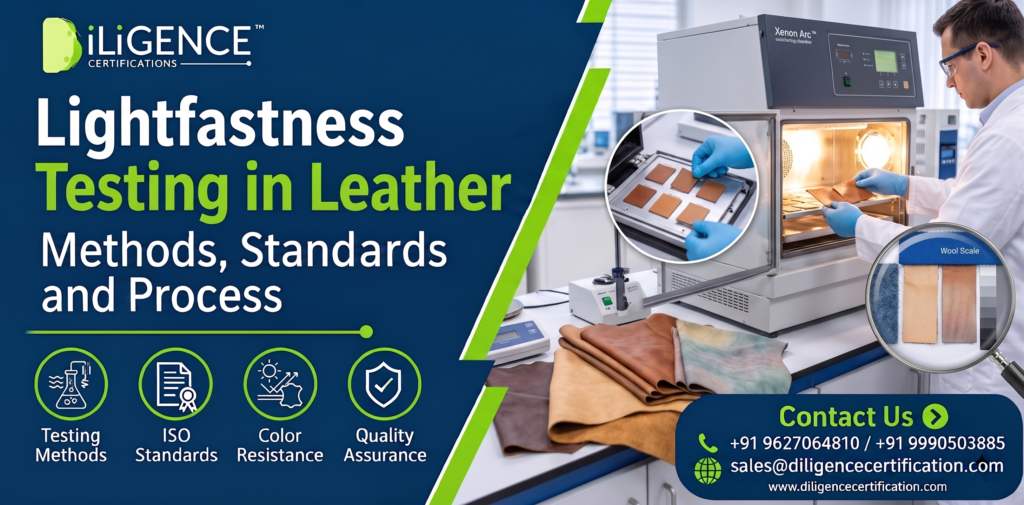
- Lightfastness testing in leather measures how well leather maintains its original colour when exposed to sunlight or artificial light.
- UV radiation and continuous sunlight can cause leather to fade, discolour or lose its original appearance.
- Xenon arc testing is a commonly used method for evaluating leather colour resistance to light.
- ISO 105-B02 is a recognised method for assessing colour fastness to artificial light using a xenon arc lamp.
- ISO 7906:2022 explains general principles of colour fastness testing for leather.
- Lightfastness testing is useful for footwear, furniture, automotive interiors, handbags and leather garments.
- Manufacturers should select testing methods according to product requirements and applicable standards.
Introduction
Leather is widely used in products such as shoes, jackets, handbags, car seats, furniture, wallets and other accessories. Customers expect these products to maintain their original colour and appearance for a long time. However, regular exposure to sunlight, ultraviolet (UV) radiation and artificial lighting can gradually affect leather colour.
For example, a black leather car seat may become lighter after continuous exposure to sunlight. Similarly, a brown leather sofa placed near a window may develop uneven colour patches over time. These problems can affect the appearance, quality and market value of leather products.
This is why lightfastness testing in leather is important for manufacturers, exporters, suppliers and leather product brands.
Lightfastness testing helps determine how well dyed or finished leather can resist colour changes when exposed to light. It allows manufacturers to evaluate the durability of leather colours before products reach customers.
In this guide, we will explain what lightfastness testing is, why it matters, the testing methods, relevant ISO standards, the testing process and common mistakes manufacturers should avoid.
What Is Lightfastness Testing in Leather?
Lightfastness testing in leather is a laboratory procedure used to evaluate the resistance of leather colour to fading or changing when exposed to light.
During normal use, leather products may experience different lighting conditions. Direct sunlight, UV radiation and artificial lighting can affect dyes, pigments and surface finishes.
The purpose of this test is to understand whether the original colour of leather remains stable after exposure to a specified light source for a defined period.
The test can be performed on different types of leather, including:
- Genuine leather
- Finished leather
- Full-grain leather
- Top-grain leather
- Suede leather
- Nubuck leather
- Pigmented leather
- Aniline leather
- Coated leather
The results help manufacturers identify whether their leather products meet the required colour durability expectations.
It is important to understand that lightfastness is different from colour fastness to rubbing, washing or water. Each test evaluates resistance to a different environmental condition.
Why Is Lightfastness Testing Important for Leather?
Leather products are often exposed to sunlight and environmental conditions during storage, transportation and everyday use. Without proper colour resistance, leather may fade and lose its attractive appearance.
Here are some important reasons why lightfastness testing is necessary.
1. Prevents Colour Fading
The main purpose of lightfastness testing is to determine whether leather can maintain its original colour after exposure to light.
It helps manufacturers identify dyes and finishing materials that may fade quickly. This is particularly important for products that are regularly exposed to outdoor conditions or strong indoor lighting.
2. Improves Product Quality
Colour consistency is an important part of leather product quality. Testing helps manufacturers evaluate whether their leather materials meet the required appearance and durability specifications.
3. Supports Export Requirements
International buyers often specify colour fastness requirements for leather products. Testing provides technical evidence that helps manufacturers demonstrate product quality to customers.
4. Increases Customer Satisfaction
Customers expect leather shoes, bags, jackets and furniture to maintain their appearance during normal use.
Better colour stability can improve customer confidence and reduce complaints related to fading.
5. Helps Select Better Dyes and Finishes
Different dyes, pigments and surface coatings react differently to light.
Testing allows manufacturers to compare materials and select suitable colour formulations for their products.
6. Reduces Product Rejection
Leather products that fade quickly may fail customer quality inspections. Conducting testing during product development can help manufacturers identify problems before large-scale production.
What Causes Leather Colour to Fade?
Leather colour fading can happen due to several factors. Understanding these factors helps manufacturers improve the quality of their materials.
1. Ultraviolet Radiation: UV radiation from sunlight can affect the chemical structure of certain dyes and pigments. This may cause gradual fading or colour changes.
2. Continuous Sunlight Exposure: Leather products placed near windows, car dashboards or outdoor areas may experience long-term exposure to sunlight.
3. Poor-Quality Dyes: Some dyes have lower resistance to light. Using unsuitable dyes can increase the chances of fading.
4. Incorrect Finishing Process: The finishing process plays an important role in leather colour durability. Poor selection or application of finishing chemicals may affect colour stability.
5. Heat and Environmental Conditions: High temperatures combined with light exposure can influence the ageing behaviour of leather finishes and dyes.
6. Uneven Colour Application: If dyes or pigments are not applied uniformly, different areas of the leather may show different levels of fading.
Common Methods of Lightfastness Testing in Leather
Different testing methods can be used to evaluate the colour resistance of leather to light. The selected method depends on the leather type, product application and customer requirements.
1. Xenon Arc Lightfastness Testing
Xenon arc testing is a widely used method for evaluating the colour fastness of leather to artificial light.
The test uses a xenon arc lamp that produces light with a spectrum similar to natural daylight.
Leather samples are placed inside a testing chamber and exposed to controlled light conditions for a specified duration.
During the test, different environmental parameters may be controlled according to the selected method.
These include:
- Light intensity
- Temperature
- Relative humidity
- Exposure duration
- Filter conditions
After exposure, the leather sample is compared with an unexposed reference sample to identify colour changes.
Why is this method important?
It helps manufacturers understand how leather colours may respond to prolonged light exposure under controlled laboratory conditions. It is particularly useful for automotive leather, furniture, footwear and other products where colour durability is important.
2. Daylight Exposure Testing
Daylight exposure testing evaluates the resistance of leather colour to natural daylight.
Leather samples are exposed to daylight under specified conditions, and the colour changes are assessed after exposure.
This method can provide useful information about the behaviour of leather under natural lighting.
However, environmental conditions such as sunlight intensity, weather and exposure duration can influence the results.
3. Artificial Light Exposure Testing
Artificial light testing evaluates how leather colour responds to a specified artificial light source.
This may be useful when manufacturers want to understand colour stability under particular indoor lighting conditions.
The selected light source and testing procedure should be clearly defined in the test specification.
4. Accelerated Light Ageing Testing
Accelerated light ageing evaluates the effects of controlled artificial light exposure, sometimes combined with elevated temperature.
It helps manufacturers assess possible colour changes and ageing behaviour within a shorter laboratory testing period than natural outdoor exposure.
The results should not automatically be treated as an exact prediction of the number of years a leather product will last.
Important ISO Standards for Lightfastness Testing in Leather
International standards provide recognised procedures for testing and evaluating leather colour fastness.
Manufacturers should select the appropriate standard according to their product requirements and the testing objective.
| Standard | Description |
|---|---|
| ISO 105-B02:2014 | Colour fastness to artificial light using a xenon arc lamp |
| ISO 105-B01:2014 | Colour fastness to light: Daylight |
| ISO 7906:2022 | General principles of colour fastness testing for leather |
| ISO 105-A02:1993 | Grey scale for assessing change in colour |
| ISO 105-B06:2020 | Colour fastness and ageing to artificial light at high temperatures using xenon |
Important standards clarification: ISO 7906:2022 provides general principles for leather colour fastness testing. ISO 105-B02 is a recognised method for assessing colour fastness to artificial light using a xenon arc lamp. Its suitability for a particular leather product should be confirmed against the applicable IULTCS/IUF method, customer specification and testing requirements.
These standards should not be treated as interchangeable. The laboratory must select the method that matches the required product performance evaluation.
BIS Standards and Requirements for Leather Products
BIS stands for the Bureau of Indian Standards. It is India’s national standards body and develops Indian Standards for different products, materials and industries.
For leather manufacturers, understanding BIS requirements is important when producing or selling products in the Indian market.
However, it is important to understand that a specific lightfastness test requirement does not automatically apply to every leather product.
The applicable requirements depend on:
- Type of leather product
- Relevant Indian Standard (IS)
- Product category
- Applicable Quality Control Order (QCO)
- Customer and industry specifications
- Export market requirements
Manufacturers should verify whether their particular leather product falls under any applicable mandatory BIS certification requirement.
Where an applicable Indian Standard or buyer specification includes colour fastness requirements, the testing laboratory should follow the relevant prescribed method.
Important: A laboratory test report is not the same as BIS certification. Passing a lightfastness test does not automatically provide a BIS licence or certification mark. Manufacturers must fulfil the applicable certification requirements separately.
Step-by-Step Process of Lightfastness Testing in Leather
Lightfastness testing follows a controlled laboratory procedure. The exact steps depend on the selected testing standard.
Step 1: Sample Collection
The first step is collecting suitable leather samples for testing.
The sample should represent the actual leather material or finished product being evaluated.
Important details may include:
- Leather type
- Colour shade
- Finish type
- Thickness
- Batch number
- Product application
Samples should be properly identified to avoid confusion between different materials or production batches.
Step 2: Sample Preparation
The laboratory prepares the leather specimens according to the selected testing method.
Samples are cut into the required dimensions, and their surfaces are checked for defects.
Proper sample preparation helps ensure reliable and consistent results.
Step 3: Initial Colour Assessment
Before exposure, the original colour of the leather is recorded.
The laboratory may use a grey scale or suitable instrumental colour measurement equipment to evaluate the initial condition.
This provides a reference for comparing the sample after testing.
Step 4: Light Exposure
The prepared leather specimens are placed inside the xenon arc testing equipment or another specified light exposure apparatus.
The samples are exposed under controlled conditions according to the selected test method.
Exposure conditions may include:
- Light intensity
- Temperature
- Humidity
- Filter type
- Exposure duration
The laboratory must maintain the specified conditions throughout the testing process.
Step 5: Sample Evaluation
After the exposure period, the leather specimens are removed and examined.
The laboratory compares the exposed sample with the original reference to determine whether fading or colour changes have occurred.
Step 6: Colour Fastness Rating
The degree of colour change is evaluated using the applicable assessment method.
For example, ISO 105-A02 provides a grey scale for assessing changes in colour.
For lightfastness assessment, a Blue Wool reference scale may also be used according to the selected method.
Step 7: Test Report Preparation
Finally, the laboratory prepares a test report containing relevant testing information.
The report may include:
- Sample identification
- Testing standard
- Testing equipment
- Exposure conditions
- Test duration
- Evaluation method
- Colour fastness rating
- Observations and results
The report helps manufacturers understand the light resistance performance of their leather samples.
Understanding Lightfastness Test Results
Test results help manufacturers determine how much the leather colour has changed after light exposure.
Two commonly used assessment systems are the Blue Wool Scale and Grey Scale.
1. Blue Wool Scale
The Blue Wool Scale is used to assess resistance to light exposure.
It contains eight reference levels, generally numbered from 1 to 8.
| Rating | General Interpretation |
|---|---|
| 1 | Very poor lightfastness |
| 2 | Poor lightfastness |
| 3 | Fair lightfastness |
| 4 | Moderate lightfastness |
| 5 | Good lightfastness |
| 6 | Very good lightfastness |
| 7 | Excellent lightfastness |
| 8 | Outstanding lightfastness |
A higher rating generally indicates better resistance to fading.
The required rating depends on the leather product and applicable specification.
2. Grey Scale
The Grey Scale is used to evaluate the degree of colour change between the original and exposed leather samples.
It generally uses ratings from Grade 1 to Grade 5.
- Grade 1: Very severe colour change.
- Grade 2: Significant colour change.
- Grade 3: Noticeable colour change.
- Grade 4: Slight colour change.
- Grade 5: No significant visible colour change.
A higher grey scale rating generally indicates better colour retention.
Note: Blue Wool and Grey Scale ratings measure different aspects of colour fastness. Their ratings should not be directly compared or converted into each other.
Leather Products That Require Lightfastness Testing
Lightfastness testing is useful for many leather products where colour appearance is important.
1. Leather Footwear
Shoes and sandals may be exposed to sunlight during regular use. Testing helps evaluate the colour stability of leather used in footwear.
Manufacturers can use the results to improve dye selection and finishing processes.
2. Leather Handbags and Wallets
Handbags and wallets are available in many colours and finishes. Lightfastness testing helps maintain their appearance during regular use.
It is particularly relevant for premium leather accessories where colour consistency is an important quality requirement.
3. Automotive Leather
Car seats, steering covers and interior leather materials may experience strong sunlight and elevated temperatures.
Testing helps manufacturers assess the colour stability of automotive leather and select suitable materials for vehicle interiors.
4. Leather Furniture
Leather sofas and chairs placed near windows may receive continuous sunlight. Testing helps evaluate their resistance to fading.
It can also help furniture manufacturers select appropriate dyes and protective finishes.
5. Leather Garments
Leather jackets, trousers and other fashion accessories should maintain their original colour during normal use.
Lightfastness testing supports quality evaluation for these products and helps manufacturers meet customer expectations.
Common Factors That Affect Lightfastness Results
Several factors can influence the final results of leather lightfastness testing.
Leather dye quality: The chemical composition and stability of dyes affect colour resistance.
Pigment selection: Different pigments have different levels of resistance to UV radiation.
Surface finishing: Coatings and protective finishes can influence how light interacts with the leather surface.
Sample thickness and structure: Different leather structures and finishes may respond differently to light exposure.
Testing conditions: Incorrect temperature, humidity or light exposure conditions can affect the reliability of results.
Sample preparation: Poorly prepared or damaged specimens may produce inconsistent results.
Manufacturers should control these factors during product development and production.
Common Mistakes to Avoid During Lightfastness Testing
Some manufacturers experience testing problems because of incorrect sample preparation or unsuitable testing methods.
Here are common mistakes to avoid:
- Using an incorrect testing standard for the product.
- Selecting poor-quality dyes and pigments.
- Ignoring the required exposure conditions.
- Using samples that do not represent the actual production batch.
- Comparing results obtained through different testing methods without checking their suitability.
- Ignoring the required colour fastness rating.
- Failing to maintain proper testing records.
- Assuming that passing a lightfastness test guarantees complete resistance to all environmental conditions.
Avoiding these mistakes helps improve testing accuracy and product quality.
Documents and Information Required for Leather Testing
Manufacturers may need to provide certain details when submitting leather samples to a testing laboratory.
Common information includes:
- Company name and contact details
- Leather product description
- Leather material type
- Colour and shade details
- Manufacturing batch information
- Sample identification
- Applicable testing standard
- Customer specifications
- Required testing parameters
- Intended product application
The exact documentation requirements may vary depending on the laboratory and testing scope.
Providing accurate product details helps the laboratory select a suitable test method and prepare a relevant report.
How to Choose the Right Leather Testing Laboratory?
Selecting an appropriate testing laboratory is important for obtaining reliable results.
Before selecting a laboratory, manufacturers should consider the following points.
1. Testing Experience: Choose a laboratory with experience in leather and colour fastness testing.
2. Equipment Availability: Confirm that the laboratory has suitable equipment, such as xenon arc testing machines, for the required method.
3. Standard Compliance: Check whether the laboratory follows the applicable ISO or IULTCS testing procedures.
4. NABL Accreditation: Verify whether the laboratory has NABL accreditation under ISO/IEC 17025 and whether the specific lightfastness test is included in its accredited scope.
5. Reporting Quality: The laboratory should provide clear results, testing conditions and applicable evaluation ratings.
6. Customer Requirements: Confirm that the laboratory can conduct testing according to the buyer’s technical specifications.
7. Testing Method: Ask whether the laboratory uses the exact method required by the customer or relevant product specification.
Choosing a suitable laboratory helps manufacturers obtain meaningful results and make better quality decisions.
Role of Diligence Certifications in Leather Testing and Compliance
Diligence Certifications supports manufacturers, importers, exporters and businesses with product testing coordination and regulatory compliance guidance.
For companies dealing with leather products, understanding applicable testing standards and certification requirements is important for maintaining product quality and meeting customer expectations.
Diligence Certifications can assist businesses with:
- Guidance on applicable leather testing standards.
- Understanding ISO and IULTCS testing requirements.
- Assistance in identifying suitable testing parameters.
- Coordination and guidance for product testing.
- Support in understanding applicable BIS requirements.
- Documentation and regulatory compliance guidance.
- Assistance with product certification processes where applicable.
It is important to clarify that Diligence Certifications works as a certification and compliance consultancy. It is not a physical testing laboratory and does not independently conduct lightfastness testing.
Businesses can obtain testing through an appropriate laboratory with the required testing facilities and accreditation scope.
With proper guidance, manufacturers can better understand testing requirements, identify relevant standards and prepare for applicable compliance procedures.
Benefits of Regular Lightfastness Testing for Leather Manufacturers
Regular testing can support better quality management throughout leather manufacturing.
Some important benefits include:
- Better control over leather colour quality.
- Improved selection of dyes and pigments.
- Reduced chances of colour fading complaints.
- Better product consistency between batches.
- Support for international buyer requirements.
- Improved confidence during product inspections.
- Better quality documentation.
- Support for product development and improvement.
For manufacturers exporting leather products, testing can also help demonstrate compliance with the technical requirements agreed with international buyers.
It can also help businesses compare different dyeing and finishing formulations before selecting materials for commercial production.
Conclusion
Lightfastness testing in leather is an important quality evaluation process that helps manufacturers understand how leather colours respond to sunlight and artificial light exposure.
It plays an important role in maintaining the appearance and quality of leather products such as footwear, handbags, automotive interiors, furniture and garments.
By using suitable testing methods, following relevant ISO and IULTCS standards, selecting quality dyes and maintaining proper production controls, manufacturers can improve leather colour durability.
Before testing, businesses should identify the correct testing standard, understand customer specifications and select a laboratory with suitable equipment and testing capabilities.
Diligence Certifications helps businesses understand applicable testing standards, certification requirements and compliance procedures so they can make informed decisions about their leather products.
Frequently Asked Questions (FAQs)
1. What is lightfastness testing in leather?
Lightfastness testing in leather is a laboratory procedure used to evaluate how well leather maintains its original colour when exposed to sunlight or artificial light.
2. Why is lightfastness testing important for leather products?
It helps identify colour fading, supports product quality, improves customer satisfaction and helps manufacturers meet buyer specifications.
3. Which ISO standard is used for lightfastness testing in leather?
ISO 105-B02:2014 is a recognised method for evaluating colour fastness to artificial light using a xenon arc lamp. ISO 7906:2022 provides general principles for leather colour fastness testing.
4. What is the Xenon Arc Test?
The Xenon Arc Test uses a special lamp that simulates important characteristics of natural daylight. It helps evaluate how leather colours respond to controlled light exposure.
5. What is the Blue Wool Scale in lightfastness testing?
The Blue Wool Scale is an eight-level reference system used to assess the resistance of materials to light-induced fading. A higher rating generally indicates better lightfastness.
6. Which leather products require lightfastness testing?
Leather shoes, handbags, wallets, jackets, car seats, sofas and other leather accessories may require lightfastness testing depending on their intended use and customer requirements.
7. Does lightfastness testing help prevent leather colour fading?
Testing does not prevent fading directly. It helps manufacturers identify materials with better colour resistance and improve their dyeing and finishing processes.