BIS Certification
 CDSCO
 PESO
 CPCB
 LMPC
 WPC Approval
 Global Approvals
 TEC
 ARAI
 BEE
 ISO Certification
 DGCA Certification
 NOC For Steel
 APEDA Registration























 Business Registration
 FSSAI Mark Certification












 (32).jpg)
 Legal Services
 Trademark Registration
 Copyright Registration
 Patent Registration
 By
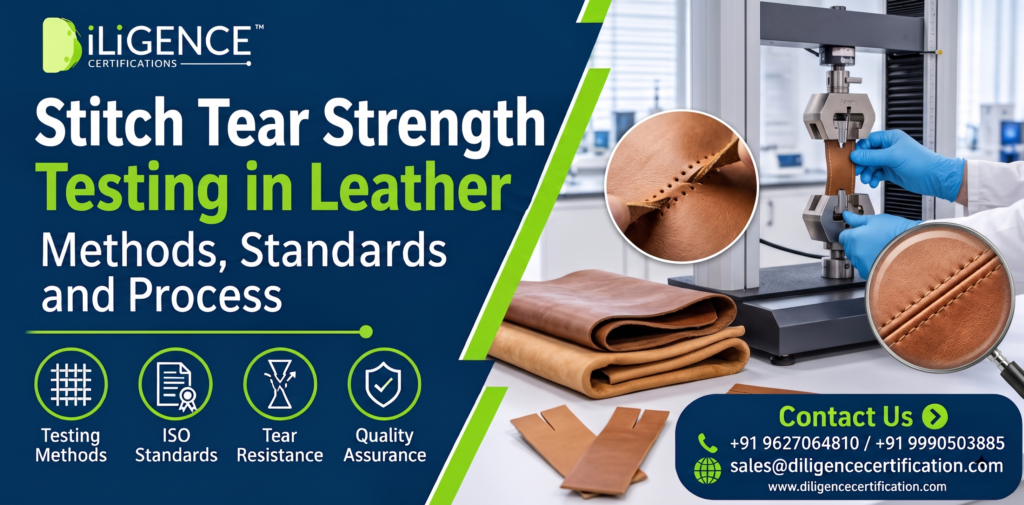
- Stitch tear strength testing in leather measures how much force leather can withstand around a stitch or stitching hole before tearing.
- It helps manufacturers check the strength and durability of leather products.
- The test is important for footwear, leather bags, jackets, belts, upholstery and automotive leather.
- Stitch tear resistance depends on leather thickness, fibre structure, stitch spacing, needle size and manufacturing quality.
- ISO 23910 is an important international standard for determining the stitch tear resistance of leather.
- Testing helps manufacturers identify weak leather before it is used in finished products.
- Proper sample preparation and testing conditions are essential for reliable results.
Introduction
Leather is widely used in products that need strength, flexibility and long-lasting performance. Shoes, handbags, leather jackets, belts, wallets, furniture and automotive seats are some common examples. These products are usually manufactured by joining different leather pieces through stitching.
However, even when leather looks strong from the outside, it may tear around the stitching holes when force is applied. This can cause seams to open, products to lose their shape and customers to experience quality problems.
This is why stitch tear strength testing in leather is important.
Stitch tear strength testing checks how much force leather can withstand before it tears around a stitch or stitching hole. It helps manufacturers understand whether the leather is suitable for stitching and whether it can handle normal use, pulling, bending and mechanical stress.
For leather manufacturers, footwear companies, exporters and product suppliers, this test is an important part of quality control. It helps reduce product failures, improve manufacturing quality and maintain customer satisfaction.
In this guide, we will explain the meaning, importance, testing methods, standards, procedure and factors affecting stitch tear strength testing in leather.
What Is Stitch Tear Strength Testing in Leather?
Stitch tear strength testing in leather is a physical testing method used to measure the resistance of leather against tearing around a stitch or needle hole.
During stitching, a needle creates small holes in the leather. These holes can become weak points, especially when the material is thin, damaged or has a loose fibre structure.
When a stitched leather product is pulled or placed under pressure, force is transferred to the stitching area. If the leather does not have sufficient strength, it may tear around the needle holes.
The purpose of this test is to determine how much force is required to cause this type of failure.
The result helps manufacturers understand:
- Whether leather can hold stitches properly.
- Whether the stitching area is strong enough.
- Whether the material is suitable for its intended application.
- Whether the leather can withstand normal mechanical stress.
- Whether the selected leather meets the required product specifications.
A leather sample with good stitch tear resistance is generally more suitable for products that require strong and durable stitched joints.
Why Is Stitch Tear Strength Testing Important?
Leather products are exposed to different types of stress during manufacturing, transportation and everyday use. Stitching is one of the most important joining methods used in leather products. Therefore, the strength of the material around stitching holes directly affects product durability.
Here are some important reasons why this test is necessary.
1. Prevents Stitching Area Failure
One of the main purposes of this test is to identify whether leather can resist tearing around stitching holes. Weak leather may tear when the stitched area is pulled, even if the thread itself is strong.
2. Improves Product Durability
Products such as leather shoes, bags and jackets are used regularly. They experience pulling, bending and stretching. Good stitch tear resistance helps reduce the chances of stitching-area damage.
3. Supports Leather Quality Control
Manufacturers can use test results to compare different leather batches and identify materials with insufficient strength.
4. Helps in Material Selection
Not every leather type is suitable for every application. A soft leather used for clothing may have different strength requirements from thick leather used in footwear or upholstery.
Testing helps manufacturers select materials according to product requirements.
5. Reduces Customer Complaints
Leather products that tear around stitching areas can lead to returns, repairs and customer dissatisfaction. Proper testing helps identify potential problems before products reach the market.
6. Supports Export Quality Requirements
International buyers may specify physical performance requirements for leather materials. Stitch tear resistance testing provides measurable information that can support supplier quality checks and buyer evaluations.
Where Is Stitch Tear Strength Testing Used?
Stitch tear strength testing is relevant to different leather products where stitching plays an important role.
| Leather application | Why testing is required |
|---|---|
| Leather footwear | Checks resistance to tearing around stitched shoe components |
| Leather handbags | Helps prevent tearing near handles, straps and seams |
| Leather jackets | Checks strength around sleeves, pockets and joining areas |
| Leather belts | Evaluates leather strength around stitched sections |
| Leather upholstery | Helps assess stitched joints in furniture coverings |
| Automotive leather | Supports quality evaluation of stitched seat covers and interior components |
| Leather wallets | Helps assess durability around folded and stitched sections |
| Leather accessories | Checks the strength of stitched leather parts |
The exact testing requirements depend on the product design, leather type and buyer specifications.
Stitch Tear Strength Testing Standards for Leather
Testing standards provide a common procedure for evaluating the physical performance of leather. They help laboratories and manufacturers obtain consistent and comparable results.
The following standards are relevant to stitch tear strength testing.
1. ISO 23910:2019 - Stitch Tear Resistance
Primary international test standard
ISO 23910:2019 - Leather - Physical and Mechanical Tests - Measurement of Stitch Tear Resistance specifies a method for determining the stitch tear resistance of leather.
Important points include:
- It can be used for different types of leather.
- It is particularly suitable for leather above 1.2 mm thickness.
- It uses a specially designed test holder and mandrel.
- It measures the force required to tear the leather.
- It supports physical and mechanical quality evaluation.
As of November 2026, ISO 23910:2019 is the published edition, while its replacement, ISO/DIS 23910, is under development. The draft is not yet a replacement published standard. Manufacturers should confirm the applicable edition before testing. Measurement of stitch tear resistance+1
2. ASTM D4786 - Stitch Tear Strength, Single Hole
ASTM D4786 is another reference for evaluating the stitch-tearing strength of leather.
This method focuses on determining the tearing strength when the tear originates from a single hole.
It can be useful for leather manufacturers and product developers who need to assess the strength of leather around a stitching hole.
The test method and specimen arrangement are different from ISO 23910, so the two methods should not be treated as automatically interchangeable. Antpedia
3. Supporting Leather Testing Standards
Some additional standards support sample preparation and measurement during leather testing.
| Standard | Testing area | Purpose |
|---|---|---|
| ISO 2418 | Sampling location | Identifies suitable sampling locations on leather |
| ISO 2419 | Sample preparation and conditioning | Provides requirements for preparing and conditioning test pieces |
| ISO 2589 | Leather thickness | Determines the thickness of leather |
| ISO 7500-1 | Testing machine verification | Covers verification of the force-measuring system |
These standards support the reliability of the testing process. The exact editions and references should be checked against the selected test method. ITEH Standards+1
BIS Standards and Indian Leather Testing Requirements
In India, leather manufacturers and suppliers may need to meet product-specific quality requirements depending on the intended application, customer specifications and applicable regulations.
It is important to understand that ISO 23910 is an international leather testing standard. It should not automatically be described as a mandatory BIS certification requirement for every leather product.
Before testing, manufacturers should check:
- Whether an applicable Indian Standard covers the finished product.
- Whether any Quality Control Order (QCO) applies to the product.
- Whether the buyer requires ISO or ASTM testing.
- Whether specific minimum tear resistance values are mentioned in the product specification.
- Whether the selected laboratory can perform the required method.
Important: A test report confirms the result of a particular test. It does not automatically mean that a leather product has received BIS certification.
How Is Stitch Tear Strength Testing Performed?
Stitch tear strength testing follows a controlled procedure. The purpose is to apply force to a prepared leather specimen and measure the force required to cause tearing.
ISO 23910 uses a mandrel-based method to evaluate stitch tear resistance.
The general testing process is explained below.
Step 1: Selection of Leather Samples
The first step is selecting suitable leather samples from the material batch.
Samples should represent the leather being evaluated. The sampling location should be selected according to the applicable standard and testing requirements.
Manufacturers may submit different leather samples, including:
- Full-grain leather.
- Corrected-grain leather.
- Split leather.
- Finished leather.
- Upholstery leather.
- Footwear leather.
The sample should not contain unwanted damage that could affect the test results unless the purpose is specifically to evaluate that defect.
Step 2: Sample Preparation
After sample selection, the leather is cut into test pieces according to the dimensions and requirements of the selected standard.
Proper cutting is important because irregular edges, unwanted damage and incorrect dimensions may affect the results.
The test pieces should be prepared using suitable cutting equipment.
Step 3: Conditioning of Samples
Leather properties can change with temperature and humidity.
Therefore, test samples are conditioned before testing to help stabilize their physical condition.
ISO 2419 provides the relevant framework for sample preparation and conditioning.
This step helps reduce variations caused by environmental conditions.
Step 4: Thickness Measurement
The thickness of each leather specimen is measured using a suitable thickness gauge.
Thickness is an important factor because it can influence the force required to tear the leather.
The measured thickness should be recorded as part of the testing information.
Step 5: Placement in the Testing Equipment
The prepared leather specimen is placed in a specially designed test holder.
A mandrel of specified shape and dimensions is inserted through the prepared slit in the leather.
The specimen and holder are positioned correctly in the tensile testing machine.
Step 6: Application of Force
The machine applies a controlled pulling force to the leather specimen.
Under ISO 23910, the standard test arrangement uses a separation speed of 100 ± 20 mm/min.
As the force increases, stress develops around the prepared opening. The leather eventually begins to tear.
Step 7: Recording the Maximum Force
The testing machine records the force required to produce tearing.
The maximum force is recorded in Newtons (N).
This value indicates the stitch tear resistance of the tested leather specimen.
Step 8: Evaluation and Reporting
After testing, the results are reviewed and documented.
The test report generally includes:
- Sample identification.
- Type of leather.
- Applicable testing standard.
- Leather thickness.
- Test conditions.
- Individual test results.
- Recorded tearing force.
- Any deviations from the testing method.
The results are then compared with the applicable buyer specification or product acceptance criteria.
Equipment Used for Stitch Tear Strength Testing
Accurate results depend on suitable testing equipment and proper calibration.
The main equipment used for stitch tear strength testing includes:
| Equipment | Purpose |
|---|---|
| Tensile testing machine | Applies controlled pulling force |
| Metal test holder | Holds the leather specimen |
| Mandrel | Transfers force to the prepared test area |
| Leather thickness gauge | Measures sample thickness |
| Cutting press and die | Prepares test specimens |
| Conditioning chamber | Maintains specified environmental conditions |
| Force measurement system | Records the applied force |
The tensile testing machine should have an appropriate force range and a verified force-measuring system.
Equipment should be maintained and checked according to the relevant testing requirements.
What Factors Affect Stitch Tear Strength in Leather?
Different leather properties and manufacturing conditions can influence the test results.
Understanding these factors helps manufacturers identify possible reasons for poor performance.
1. Leather Thickness
Leather thickness can influence its resistance to tearing. However, thickness alone does not determine strength. The internal fibre structure is also important.
2. Fibre Structure
Leather contains a natural network of collagen fibres. The density, arrangement and condition of these fibres influence mechanical performance.
Leather with a weak or damaged fibre structure may tear more easily.
3. Leather Type
Different leather types have different physical properties.
For example, full-grain leather, split leather and corrected-grain leather may show different mechanical performance depending on their processing and quality.
4. Tanning Process
The tanning process affects the physical characteristics of leather.
Improper processing or unsuitable chemical treatment may affect flexibility, strength and durability.
5. Moisture Content
Moisture can influence the flexibility and mechanical behaviour of leather.
Therefore, proper conditioning is important before testing.
6. Surface Finishing
Coatings, pigments and finishing materials can affect the surface characteristics of leather. However, surface appearance alone cannot establish stitch tear resistance.
7. Manufacturing Defects
Uneven thickness, weak areas, cuts, scars and other defects can influence the strength of leather.
Proper inspection and testing help manufacturers identify these problems.
Difference Between Stitch Tear Strength and Other Leather Strength Tests
Several physical tests are used to evaluate leather quality. However, each test measures a different property.
| Testing type | What it measures |
|---|---|
| Stitch tear strength testing | Resistance to tearing around a prepared stitching hole |
| Tensile strength testing | Resistance to breaking under pulling force |
| Tear strength testing | Resistance to the growth of a tear |
| Bursting strength testing | Resistance to pressure applied to the material |
| Flexing resistance testing | Ability to withstand repeated bending |
| Abrasion resistance testing | Resistance to surface wear caused by rubbing |
These tests are not interchangeable. A leather sample may perform well in tensile strength testing but still have poor stitch tear resistance.
For this reason, manufacturers should select tests according to the actual performance requirements of their products.
Common Problems Found During Stitch Tear Strength Testing
Testing can reveal different weaknesses in leather materials. Identifying these problems helps manufacturers improve their production processes.
1. Low Stitch Tear Resistance
If leather tears under a relatively low force, it may not be suitable for products that experience regular pulling or mechanical stress.
2. Uneven Test Results
Different specimens from the same leather batch may show different results.
Possible reasons include natural variations in leather structure, inconsistent thickness, sample preparation errors or incorrect conditioning.
3. Damage Around Prepared Holes
Improper specimen preparation may create unwanted damage around the testing area.
This can influence the final result and make the test less reliable.
4. Incorrect Sample Orientation
Leather has natural structural variations. Testing specimens in different orientations may produce different results.
Therefore, sample orientation should follow the requirements of the applicable standard.
5. Improper Equipment Calibration
An incorrectly calibrated testing machine may produce unreliable force measurements.
Regular equipment verification and maintenance are necessary for dependable testing.
How Can Manufacturers Improve Stitch Tear Strength in Leather?
Manufacturers can take several steps to improve the resistance of leather around stitched areas.
1. Select suitable raw materials: Choose leather with an appropriate fibre structure, thickness and mechanical performance.
2. Maintain proper processing conditions: Control tanning, drying and finishing processes to maintain consistent leather quality.
3. Use appropriate needle sizes: Select needles according to leather thickness and product requirements.
4. Maintain suitable stitch spacing: Incorrect stitch spacing can create weak areas or excessive perforations in leather.
5. Avoid excessive stitching tension: Very tight stitching may increase stress around needle holes.
6. Inspect leather before production: Check for cuts, scars, weak areas and inconsistent thickness.
7. Perform regular testing: Test leather batches to identify quality variations before large-scale manufacturing.
These practices can help reduce stitching-related failures and improve finished product durability.
Documents Required for Leather Testing
Manufacturers and suppliers may need to provide certain details when submitting leather samples to a testing laboratory.
Commonly required information includes:
- Company name and contact details.
- Leather sample identification.
- Type and grade of leather.
- Product application.
- Sample quantity.
- Applicable testing standard.
- Required test parameters.
- Buyer or customer specifications.
- Previous test reports, if available.
The exact document requirements depend on the laboratory and the scope of testing.
How to Select a Leather Testing Laboratory?
Selecting the right laboratory is important for obtaining reliable test results.
Before submitting samples, manufacturers should consider the following points.
Check Testing Capabilities
Confirm that the laboratory offers stitch tear resistance testing according to the required method.
Verify Accreditation
Check whether the laboratory has NABL accreditation under ISO/IEC 17025 for the relevant testing activity and method. Accreditation should be verified within the laboratory’s actual scope.
Check Equipment Availability
The laboratory should have suitable tensile testing equipment, a proper specimen holder and the required measurement arrangements.
Review Testing Standards
Confirm whether the laboratory follows ISO 23910, ASTM D4786 or another method specified by the buyer.
Understand the Test Report
The final report should clearly identify the testing method, sample details, results and any deviations.
Compare Testing Requirements
Different buyers may specify different acceptance limits. Confirm the required values before starting the test.
Role of Diligence Certifications in Leather Testing and Compliance
Diligence Certifications supports businesses with product certification consultancy, regulatory guidance and compliance-related requirements.
For leather manufacturers, suppliers and exporters, understanding the applicable testing standards is important before supplying products to customers or entering new markets.
Diligence Certifications can help businesses with:
- Guidance on applicable product standards.
- Understanding leather testing requirements.
- Assistance with certification-related documentation.
- Regulatory and compliance guidance.
- Support in understanding buyer-specific testing requirements.
- Guidance on applicable BIS requirements, where relevant.
- Assistance in identifying suitable testing and certification pathways.
It is important to understand that Diligence Certifications works as a consultancy and compliance support provider, not as a physical leather testing laboratory. Actual stitch tear strength testing should be performed by a suitable testing laboratory.
The objective is to help businesses understand their compliance responsibilities and prepare the necessary documentation and testing requirements.
Benefits of Stitch Tear Strength Testing for Leather Manufacturers
Stitch tear strength testing provides useful information for businesses involved in leather manufacturing and product development.
Some important benefits include:
- Better material selection: Helps manufacturers choose leather according to product requirements.
- Improved product quality: Identifies weak stitching areas before production.
- Reduced product failures: Helps prevent tearing around stitched joints.
- Consistent manufacturing: Supports quality checks across different leather batches.
- Buyer confidence: Provides measurable information about leather performance.
- Better product development: Helps manufacturers compare materials during product design.
- Export support: Helps businesses address physical testing requirements specified by international buyers.
Conclusion
Stitch tear strength testing in leather is an important physical testing method for evaluating the durability and mechanical performance of leather materials. It helps manufacturers understand whether leather can withstand force around stitching holes without tearing.
For footwear, handbags, jackets, upholstery, automotive interiors and other stitched leather products, proper stitch tear resistance is essential for maintaining product quality.
Following the relevant testing method, preparing samples correctly and using suitable testing equipment can help manufacturers obtain reliable results.
ISO 23910:2019 provides an internationally recognized method for measuring stitch tear resistance. Manufacturers should also consider buyer specifications and applicable Indian product requirements before selecting a testing method.
By including stitch tear strength testing in their quality control process, leather manufacturers can identify material weaknesses, improve product performance and build greater confidence among customers and buyers.
Frequently Asked Questions (FAQs)
1. What is stitch tear strength testing in leather?
Stitch tear strength testing in leather is a physical test that measures the force required to tear leather around a prepared stitching hole. It helps determine whether leather can withstand stress around stitched areas.
2. Which ISO standard is used for stitch tear strength testing in leather?
ISO 23910:2019 is the international standard used to measure the stitch tear resistance of leather. A revised draft, ISO/DIS 23910, is under development as of November 2026.
3. Why is stitch tear strength testing important?
This test helps manufacturers identify weak leather materials that may tear around stitching holes. It supports product durability, quality control and material selection.
4. Which leather products require stitch tear strength testing?
Leather footwear, handbags, jackets, belts, wallets, furniture upholstery and automotive leather products may require this test depending on their design and buyer specifications.
5. What equipment is used for stitch tear resistance testing?
A tensile testing machine, metal test holder, mandrel, thickness gauge and suitable sample preparation equipment are commonly used.
6. What is the unit of stitch tear strength?
The force required to tear the leather is generally recorded in Newtons (N).
7. Does leather thickness affect stitch tear resistance?
Yes. Thickness can influence tearing resistance, but fibre structure, leather type, processing conditions and natural defects also affect the results.