BIS Certification
 CDSCO
 PESO
 CPCB
 LMPC
 WPC Approval
 Global Approvals
 TEC
 ARAI
 BEE
 ISO Certification
 DGCA Certification
 NOC For Steel
 APEDA Registration























 Business Registration
 FSSAI Mark Certification












 (32).jpg)
 Legal Services
 Trademark Registration
 Copyright Registration
 Patent Registration
 By
- Polymer identification means finding out which plastic a product or raw material is actually made of.
- Simple tests like burn test and density check give a rough idea. Lab tests like FTIR and DSC give a proper answer.
- Wrong polymer means wrong strength, wrong safety and wrong compliance. It can also mean a rejected consignment.
- BIS does not run a separate “polymer identification certificate”. But the polymer type matters a lot for BIS product standards.
- Some raw material QCOs for plastics were withdrawn in November 2025. Product-level rules still apply, so always check the latest notification.
- Test only through a good lab, and keep your records ready. It saves time later.
Introduction
It’s like walking into a kitchen and seeing white powder in three jars. Salt, sugar, maida. They look the same. But if you use the wrong one, the dish is gone. Plastics are exactly like this. PE, PP, PVC, PET look similar in many products. But each one behaves differently when it is heated, stretched or used with food and water.
That’s why polymer identification matters. Manufacturers, importers, recyclers and quality teams all need to know what polymer they are dealing with.
In this blog, we’ll keep things very simple. We’ll cover what polymer identification is, which methods are used, what standards help, and where BIS comes into the picture.
What Is Polymer Identification?
Polymer identification is the process of finding the type of plastic in a sample. The sample can be a granule, a film, a pipe, a toy, a cap or even a small broken piece.
The result tells you the polymer family. For example, polyethylene, polypropylene, polyvinyl chloride, polystyrene or nylon. In some cases the lab also tells you the grade, the additives or whether the material is a blend.
There are two broad ways to do it:
- Quick field checks: visual look, feel, floating in water, burn test. Cheap and fast, but not very accurate.
- Laboratory analysis: FTIR, DSC, TGA and similar methods. Accurate, repeatable and accepted in reports.
If your report is going to a customer, an auditor or a certification body, you need the second one.
Common Polymers and How They Look in Practice
Here’s a quick table. It’s not a replacement for testing, but it helps you understand the basics.
| Polymer | Where it is commonly used | Floats in water? | Quick note |
|---|---|---|---|
| PE (LDPE, HDPE) | Carry bags, films, pipes, tanks, bottles | Yes | Waxy feel |
| PP | Caps, containers, woven sacks, auto parts | Yes | Stiffer than PE |
| PVC | Pipes, cables, window profiles | No | Heavy and rigid or soft with plasticiser |
| PS | Disposable cups, packaging, toys | No | Brittle, makes a sharp sound when dropped |
| ABS | Housings, toys, appliance parts | No | Tough with a glossy finish |
| PET | Water and drink bottles | No | Clear and strong |
| PC | Helmets, lamp covers, sheets | No | Very tough and clear |
| Nylon (PA) | Gears, bushes, fibres | No | Absorbs moisture |
Why Polymer Identification Is Important
- Safety: A wrong plastic in food or drinking water contact can be a health risk.
- Quality: Each polymer has its own strength, heat limit and ageing behaviour. A mix-up shows up as cracks or deformation later.
- Compliance: Many standards are written for one specific polymer. If the material is different, the standard may not apply or the product may fail.
- Import checks: Customs and buyers may ask for material proof for plastic goods.
- Recycling: Mixed plastics spoil a recycled batch. Sorting by polymer keeps the output clean.
- Fighting disputes: When a buyer complains, a proper report settles the matter quickly.
- Cost control: Some suppliers swap a costly polymer with a cheaper one. Testing catches that.
Methods Used for Polymer Identification
1. Visual and Physical Checks
Colour, transparency, flexibility, surface feel, sound on tapping. These give only a hint. Pigments and fillers can fool you easily.
2. Density Test
A small piece is put in water or in a liquid of known density. PE and PP float. PVC, PS, PET and most others sink. It’s a quick way to split the polymers into two groups.
3. Burn Test
A small sample is held to a flame. The lab person watches the flame colour, smoke, drips and smell. It’s a very old method and still used for rough screening. It must be done carefully, in a ventilated place, because some plastics give out harmful fumes.
4. Melting Point Check
Each polymer softens or melts at a certain range. A hot stage or melting point apparatus shows this. It helps to separate look-alike polymers.
5. FTIR Spectroscopy
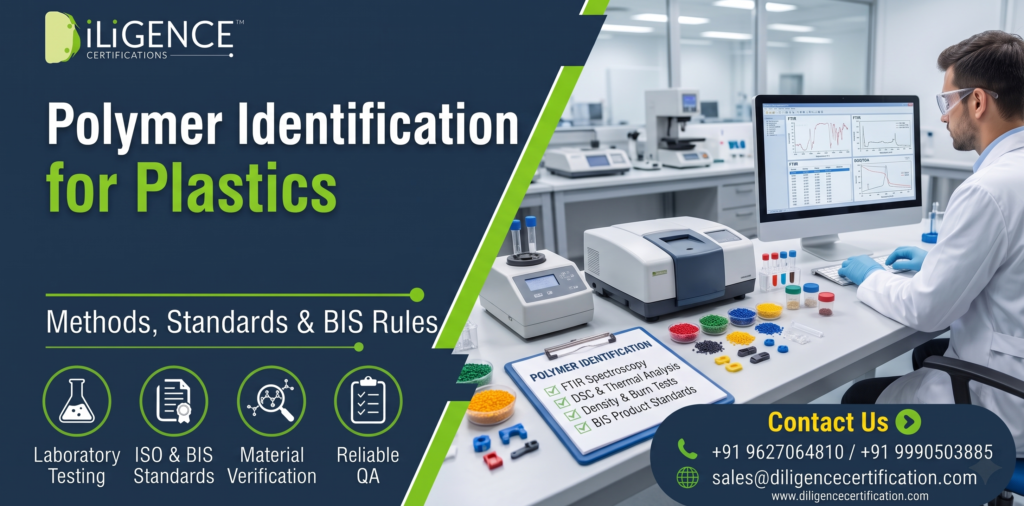
This is the most used lab method. Infrared light is passed through or reflected from the sample. Every polymer absorbs light in its own pattern, like a fingerprint. The lab compares this pattern with a library and gives the polymer name. It works on small samples and is quick.
6. DSC (Differential Scanning Calorimetry)
DSC measures how the sample takes in or gives out heat while it is heated. It shows melting point and glass transition. It’s very useful for blends and for confirming FTIR results.
7. TGA (Thermogravimetric Analysis)
TGA tracks weight loss with rising temperature. It tells you about filler content, additives and the decomposition behaviour of the polymer.
8. Other Methods
Raman spectroscopy, solvent tests, NMR and pyrolysis GC-MS are used for tough or unknown samples. Most routine work does not need them.
Simple Burn Test Guide
This table is only for basic screening. Don’t use it as a final report.
| Polymer | Flame behaviour | Smell (in simple words) | Drips? |
|---|---|---|---|
| PE | Burns, blue flame with yellow tip | Like burning candle wax | Yes |
| PP | Burns steadily | Sharp, slightly sweet | Yes |
| PVC | Goes off when flame is removed, green-edged flame | Sharp, acidic | Little |
| PS | Burns with heavy black smoke | Sweet, chemical | Soft melting |
| PET | Yellow flame, some soot | Mildly sweet | Yes |
| Nylon | Goes off by itself, melts | Like burning hair | Yes, forms beads |
Safety tip: wear gloves and glasses, keep a small sample and never do this near children or in a closed room.
Which Standards Help in Polymer Identification?
Polymer identification does not have just one standard. Different methods and different purposes have their own references.
| Standard type | Example | What it helps with |
|---|---|---|
| Symbols and abbreviations | ISO 1043 series | Common short names like PE, PP, PVC |
| Identification and marking | ISO 11469 | Generic marking of plastic products |
| FTIR method | ASTM E1252 | General techniques for infrared analysis |
| DSC method | ISO 11357 or ASTM D3418 | Melting and transition temperatures |
| TGA method | ISO 11358 | Thermal stability and composition |
| Density | ISO 1183 or ASTM D792 | Density of plastics |
| BIS plastics testing | IS 13360 series | Methods of testing plastics |
| BIS recycling guidance | IS 14534 | Guidelines for recycling of plastics |
A simple example: A manufacturer sends a pipe sample and says it’s HDPE. The lab does FTIR and DSC. The FTIR matches polyethylene and DSC shows a melting point in the HDPE range. The report says HDPE. Now the manufacturer can move ahead with the product standard tests.
Standards get revised from time to time. Please confirm the latest version before you quote any of them in a report.
BIS and Polymer Identification: What You Should Know
This is the part many people get confused about. So let’s clear it up in plain words.
First, the basic point. BIS (Bureau of Indian Standards) does not have a separate certificate called “polymer identification”. It’s a testing step, not a licence. But the identity of the polymer is the base for many BIS product standards.
Where BIS comes in:
- Product standards for plastic items. Standards like IS 4985 (PVC pipes), IS 4984 (HDPE pipes) and IS 12701 (rotational moulded polyethylene water storage tanks) are written for specific polymers. If the raw material is not the right polymer, the product will not meet the standard.
- Food contact plastics. BIS has standards for polyethylene, PVC and polypropylene used with food, such as IS 10146, IS 10151 and IS 10910. Here the polymer type is the very first check.
- BIS test method standards. The IS 13360 series gives test methods for plastics. Labs use these for many property tests.
- Recycling and marking. BIS has guidelines on recycling of plastics, such as IS 14534. Correct polymer identification supports proper sorting and marking.
- Packaging products. Some woven sack products for cement and mail packaging have their own Quality Control Orders. These have had date extensions more than once, so check the latest gazette notification before you plan anything.
An important update on raw materials. In November 2025, the government withdrew a set of chemical and polymer Quality Control Orders. This included several plastic raw materials like polyethylene, polypropylene, PVC and ABS for moulding and extrusion. So the mandatory BIS licence requirement for these raw materials is no longer there in the same form. But please note two things. First, product-level standards and QCOs for finished goods still exist. Second, buyers and importers may still ask for BIS-standard-based test reports. So don’t treat identification as “optional”.
Rules and dates keep changing. Before you start any work, check the latest notifications on the BIS website and the Gazette of India.
Also remember: for BIS product certification, tests must be done by a lab recognised by BIS, and the process depends on the product and the scheme. A general lab report for polymer identification helps you internally. It may not replace the official BIS testing.
Step-by-Step Process for Polymer Identification
- Define the purpose. Is it for quality check, import, customer demand, recycling or BIS compliance?
- Collect the sample properly. Use clean tools. Take samples from different batches if possible.
- Label the sample. Write product name, batch, date and supplier clearly.
- Do quick screening. Visual, density and burn test help you narrow down the options.
- Choose the lab method. FTIR for most cases, DSC or TGA when you need more detail.
- Send to a competent lab. Prefer a lab with proper calibration and a good track record.
- Review the report. Check the polymer name, method used, sample details and date.
- Compare with the product standard. Make sure the identified polymer is what the standard allows.
- Keep records. Store the report with batch records for future audits.
Documents and Details Needed by the Lab
| Category | What to keep ready |
|---|---|
| Company | Name, address, contact person |
| Product | Product name, claimed polymer, use of the product |
| Sample | Batch number, quantity, form (granule, film, moulded part) |
| Supplier | Supplier name and any datasheet or material certificate |
| Purpose | Internal check, customer request, import or BIS-related work |
How Long Does It Take?
Simple FTIR identification can be done in a short time once the sample reaches the lab. Reports with DSC, TGA or multiple samples take longer. Exact time depends on the lab load, the number of samples and the type of report. Ask your lab for a clear timeline before you submit.
Cost of Polymer Identification
The cost depends on a few things:
- Method used (FTIR, DSC, TGA or a combination)
- Number of samples
- Whether you need a plain report or an accredited one
- Urgent or regular turnaround
- Whether extra tests like filler content are added
It’s best to ask the lab for a proper breakup before you send the samples.
Common Mistakes to Avoid
- Trusting the burn test alone and putting that in a final report.
- Sending a painted or printed part without telling the lab. Coatings can change the result.
- Mixing samples from different batches in one packet.
- Not labelling samples properly.
- Believing the supplier’s word without checking.
- Using an old standard version for the report.
- Ignoring blends and recycled content. Many products use more than one polymer.
- Assuming that withdrawn raw material rules mean no testing is needed at all.
Who Needs Polymer Identification?
- Manufacturers of plastic pipes, tanks, toys, containers and appliance parts
- Importers who bring plastic goods and want to verify material claims
- Private label brands that buy from many suppliers
- Recyclers who need clean sorting
- Packaging companies working with food or pharma
- Overseas manufacturers exporting to India who want to be ready for buyer and BIS checks
Why Choose Diligence Certifications for Polymer Identification Certification?
Getting the testing and compliance side right takes patience. Many first-time applicants lose time because of small errors in samples, documents or standard selection.
At Diligence Certifications, we try to keep things clear and practical. Here’s how we can help:
- We help you understand which standard or rule applies to your plastic product.
- We guide you on sample preparation and the right kind of lab report.
- We help you organise your documents before submission.
- We keep you updated on changes in notifications and deadlines.
- We explain every step in simple language, with no confusing jargon.
To know more about how we work, you can visit our services page. We do not promise any approval or result, because the final decision always rests with the concerned authority. What we promise is honest guidance and clear communication.
Conclusion
Polymer identification looks like a small step. But it’s the base of everything that comes after. The right polymer means the right testing, the right standard and fewer problems later.
Use quick tests for screening and lab methods for proper answers. Keep your reports organised. And since BIS rules for plastics keep changing, always check the latest notifications before you plan your next batch.
If you’re unsure where to begin, talk to an expert and get your product and standard matched properly from day one.
Frequently Asked Questions (FAQs)
1. What is polymer identification?
it's the process of finding out which type of plastic a sample is made of, using simple checks or lab methods.
2. Which method is best for polymer identification?
FTIR is the most used method because it is quick and accurate. DSC and TGA are added when more detail is needed.
3. Can I identify plastic at home?
You can do basic checks like the water float test. But for a reliable answer, you need a lab report.
4. Is the burn test reliable?
It's good for rough screening only. Additives, colours and blends can change the result, so don't depend on it for a final report.
5. Does BIS give a polymer identification certificate?
No. BIS does not issue a separate certificate for this. Polymer identification is a testing step that supports compliance with BIS product standards.
6. Are BIS rules for plastic raw materials still mandatory?
Several raw material Quality Control Orders, including for PE, PP, PVC and ABS, were withdrawn in November 2025. But product-level standards and some packaging QCOs still apply, so check the latest notifications.