 BIS Certification
 CDSCO
 PESO
 CPCB
 LMPC
 WPC Approval
 Global Approvals
 TEC
 ARAI
 BEE
 ISO Certification
 DGCA Certification
 NOC For Steel
 APEDA Registration






















 Business Registration
 FSSAI Mark Certification











 (32).jpg)
 Legal Services
 Trademark Registration
 Copyright Registration
 Patent Registration
 By
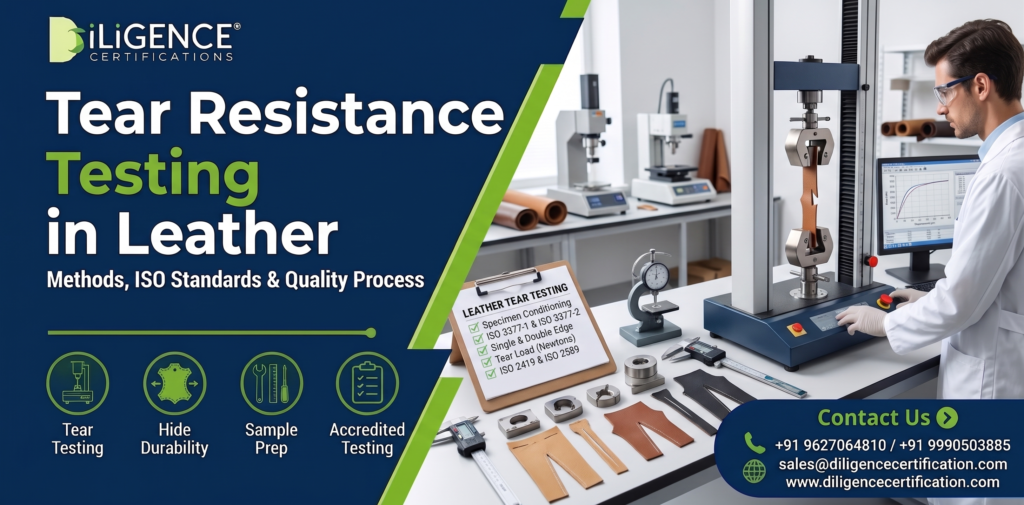
- Tear resistance testing in leather measures how well leather resists tearing when force is applied.
- It helps manufacturers evaluate the strength, durability and performance of leather materials.
- Leather tear strength is important for footwear, handbags, jackets, upholstery, automotive interiors and leather accessories.
- Common testing methods include single-edge tear, double-edge tear and trouser tear tests.
- Sample thickness, grain structure, moisture content and leather processing can affect test results.
- Testing should follow the applicable product specifications and recognised test standards.
- A laboratory test report helps manufacturers check product quality and identify material weaknesses.
Introduction
Leather is widely used in footwear, handbags, jackets, furniture, automotive interiors, belts and many other products. Customers expect leather products to look attractive and last for a long time. However, appearance alone cannot determine the quality of leather. Its mechanical strength is equally important.
One of the most important mechanical properties is tear resistance.
Tear resistance testing in leather checks how much force is required to continue or develop a tear in a leather sample. It helps manufacturers understand whether leather can withstand pulling, stretching, repeated handling and everyday use without easily tearing.
For example, imagine a leather handbag carrying heavy items every day. The leather around its handles and stitching areas experiences repeated pulling forces. If the material has poor tear resistance, small cuts or holes may develop into larger tears. This can damage the product and reduce its useful life.
Similarly, leather used in shoes, car seats and furniture must withstand different types of mechanical stress
What Is Tear Resistance Testing in Leather?
Tear resistance testing in leather is a laboratory test used to measure the force required to tear a leather specimen.
During the test, a prepared leather sample is placed inside a testing machine. The machine applies a controlled pulling force until the material tears or reaches the specified test endpoint.
The force required to produce or continue the tear is recorded as the test result.
In simple words, the test tells manufacturers how strongly leather can resist tearing when mechanical stress is applied.
Tear resistance is different from tensile strength.
- Tensile strength: Measures the force required to stretch and break a material.
- Tear resistance: Measures the force required to initiate or propagate a tear in a material.
A leather sample may have good tensile strength but relatively poor tear resistance. This is because tearing depends on the material’s structure, thickness, fibre arrangement and the presence of cuts or defects.
For this reason, both properties may need to be evaluated during leather quality testing.
Why Is Tear Resistance Testing Important in Leather?
Tear resistance plays an important role in determining the practical durability of leather products. A product may look premium, but weak leather can fail during regular use.
Here are the main reasons manufacturers perform this test.
1. Checks Leather Durability
Leather products are exposed to regular pulling, bending and handling. Tear resistance testing helps determine whether the material can withstand these forces.
It helps manufacturers identify leather that may tear easily during normal product use.
2. Improves Product Quality
Poor-quality leather can lead to customer complaints, product returns and replacement costs.
Testing helps manufacturers identify weak material before it enters the production process.
3. Reduces Product Failure
Leather is frequently used in areas that experience concentrated stress, such as:
- Shoe uppers and lining materials
- Handbag handles
- Belt holes and fastening areas
- Jacket seams
- Furniture upholstery
- Automotive seat covers
Good tear resistance helps reduce the possibility of material failure in these applications.
4. Supports Material Selection
Different leather products require different mechanical properties.
For example, leather used in a heavy-duty work boot may need different performance characteristics from leather used in a decorative wallet.
Testing allows manufacturers to compare leather samples and select suitable materials for their intended applications.
5. Helps Maintain Customer Confidence
Consistent product quality is important for building customer trust.
By checking tear resistance, manufacturers can maintain better control over raw materials and finished products.
6. Supports Quality Control
Manufacturers can use test results to compare production batches, evaluate suppliers and identify changes in leather processing.
This helps maintain consistency throughout the manufacturing process.
Types of Tear Resistance Testing in Leather
Different testing methods are used to evaluate the tear resistance of leather. The selection depends on the leather type, product application and testing requirements.
1. Single Edge Tear Test
The single edge tear test is one of the commonly used methods for measuring leather tear strength.
In this method, a rectangular leather specimen is prepared with a slit on one side. The two resulting sections are placed in the grips of a tensile testing machine.
The machine pulls the sections in opposite directions, causing the tear to continue through the material.
The average force required during the tearing process is recorded.
Purpose of the test:
- Measures resistance to tear propagation.
- Helps identify weak leather materials.
- Evaluates mechanical performance.
- Supports quality checks for footwear and leather accessories.
This method is covered by ISO 3377-1.
2. Double Edge Tear Test
The double edge tear test is also known as the Baumann tear test.
In this method, a specially prepared leather specimen is held in a testing machine. The machine applies force to produce tearing from two edges of the specimen.
The force required to continue the tear is measured and recorded.
Purpose of the test:
- Evaluates leather tear resistance.
- Helps compare different leather materials.
- Identifies weaknesses in leather structure.
- Supports material selection for different applications.
The double edge tear method is covered by ISO 3377-2.
3. Trouser Tear Test
The trouser tear test is another name commonly associated with the single edge tear method.
A prepared specimen has a slit that creates two legs, resembling a pair of trousers. These legs are pulled apart using a testing machine.
The force required to propagate the tear is measured.
This method is useful for understanding how leather behaves when an existing cut or opening experiences pulling force.
4. Tear Propagation Testing
Tear propagation testing focuses on how an existing tear moves through leather when additional force is applied.
This is important because leather products may develop small cuts during manufacturing or everyday use.
The test helps manufacturers understand whether a small tear is likely to remain limited or spread further through the material.
The exact procedure and reporting method should follow the selected testing standard or product specification.
Leather Products That Require Tear Resistance Testing
Tear resistance testing is useful for many leather products because different applications expose the material to different mechanical forces.
Common applications include:
1. Footwear and Leather Shoes
Leather shoes experience repeated bending, pulling and friction during walking.
Weak leather can tear around the upper material, eyelets, seams and other stressed areas.
Tear resistance testing helps footwear manufacturers select suitable leather for daily-use shoes, formal shoes, boots and safety footwear.
2. Leather Bags and Handbags
Handbags and travel bags carry different weights. Their leather handles, corners and attachment points experience regular pulling forces.
Testing helps manufacturers check whether the leather is strong enough for the intended application.
3. Leather Jackets and Clothing
Leather jackets, trousers and other garments experience stretching and movement during everyday activities.
Tear resistance is important for maintaining material strength and preventing damage around seams and high-stress areas.
4. Automotive Leather
Leather used in vehicle seats, steering wheel covers and interior panels must withstand regular use.
Automotive manufacturers evaluate mechanical properties to ensure that the selected leather meets the required quality specifications.
5. Leather Furniture and Upholstery
Leather sofas, chairs and other furniture products experience repeated pressure, movement and friction.
Tear resistance testing helps manufacturers assess the durability of upholstery materials.
6. Leather Belts and Accessories
Belts, wallets, watch straps and other accessories may experience pulling and bending forces.
Testing helps determine whether the leather is suitable for its intended use.
How Is Tear Resistance Testing in Leather Performed?
Tear resistance testing follows a controlled laboratory procedure. The exact steps may vary depending on the selected test method and applicable standard.
However, the general testing process includes the following stages.
Step 1: Sample Collection
A representative leather sample is collected from the material or production batch.
The sampling position should follow the applicable standard because leather properties may vary across different areas of a hide.
Step 2: Sample Preparation
The leather sample is cut into the required shape and dimensions using an appropriate cutting tool.
The specimen must have clean edges and should not contain accidental cuts, damage or irregularities that could affect the result.
Step 3: Conditioning of Samples
Leather properties can change with moisture and temperature.
Therefore, samples are conditioned under the atmosphere specified by the applicable testing standard before testing.
Proper conditioning helps improve the consistency and reliability of test results.
Step 4: Thickness Measurement
The thickness of the leather specimen is measured using a suitable thickness gauge.
Thickness is an important characteristic because it can influence the measured tearing load.
The measurement should follow the relevant procedure.
Step 5: Setting Up the Testing Machine
The prepared specimen is placed inside a tensile testing machine.
The machine grips are adjusted according to the selected test method.
The equipment must be suitable for the expected force range and properly calibrated or verified.
Step 6: Applying the Force
The testing machine applies a controlled pulling force to the specimen.
As the machine pulls the sample, the tear develops through the leather.
The machine records the force during the tearing process.
Step 7: Recording the Results
The force required to tear the specimen is recorded.
Depending on the test method, the result may be expressed as a mean tearing load in newtons (N).
Multiple specimens may be tested to obtain representative results.
Step 8: Preparing the Test Report
After completing the test, the laboratory prepares a report containing the test method, sample details, conditioning information, individual readings and calculated results.
Manufacturers can use this report to evaluate leather quality and compare different material batches.
Important Equipment Used for Leather Tear Resistance Testing
Accurate testing requires suitable laboratory equipment and properly prepared specimens.
The following equipment is commonly used:
| Equipment | Purpose |
|---|---|
| Universal Testing Machine (UTM) | Applies controlled pulling force |
| Leather sample cutting die | Prepares specimens of required dimensions |
| Thickness gauge | Measures leather thickness |
| Specimen grips | Hold the leather sample securely |
| Conditioning chamber | Maintains specified temperature and humidity |
| Force measurement system | Records the tearing load |
| Calibration equipment | Supports measurement accuracy and reliability |
The equipment configuration should match the selected test method.
Standards for Tear Resistance Testing in Leather
Testing standards provide recognised procedures for evaluating the mechanical properties of leather.
They help laboratories and manufacturers follow consistent testing methods and compare results more reliably.
The following international standards are particularly relevant.
| Standard | Testing requirement |
|---|---|
| ISO 3377-1:2011 | Determination of tear load using the single edge tear method |
| ISO 3377-2:2025 | Determination of double edge tear load |
| ISO 2418 | Sampling location for leather testing |
| ISO 2419 | Sample preparation and conditioning |
| ISO 2589 | Determination of leather thickness |
| ISO 7500-1 | Verification of force-measuring systems of tensile/compression testing machines |
Important standard update: ISO 3377-2:2025 was published in October 2025 and replaced the earlier ISO 3377-2:2016 edition. ISO 3377-1:2011 remains the published edition, while its replacement, ISO/DIS 3377-1, is under development. Always confirm the applicable edition before preparing a testing programme. ISO+3
These standards describe testing procedures. They do not establish one universal minimum tear strength for every leather product.
The required acceptance value depends on the product specification, customer requirements, applicable regulations and intended application.
Factors That Affect Tear Resistance in Leather
Several factors can influence the tear resistance of leather. Understanding these factors helps manufacturers improve product quality.
1. Leather Thickness
Leather thickness can influence the force required to tear a specimen.
However, thicker leather does not automatically mean better tear resistance. Fibre structure and material quality are also important.
2. Fibre Structure
Leather contains a natural network of collagen fibres.
The arrangement, density and condition of these fibres influence the material’s mechanical performance.
Poor fibre structure may reduce its ability to resist tearing.
3. Moisture Content
Moisture can change the physical and mechanical properties of leather.
Excessive moisture or unsuitable storage conditions may affect its strength and durability.
4. Tanning Process
The tanning process helps convert raw animal hide into usable leather.
Different tanning chemicals and processing conditions can influence the final material properties.
Improper processing may affect leather flexibility, strength and tear resistance.
5. Leather Quality and Grade
The quality of the original hide plays an important role in determining the final leather performance.
Natural defects, scars, insect damage and weak areas can affect tear resistance.
6. Finishing and Coating
Leather finishing improves appearance and may provide additional surface protection.
However, the finishing process must be suitable for the leather application. Poor processing can affect flexibility and overall performance.
7. Sample Direction
Leather properties may vary depending on the direction and location from which the specimen is taken.
Therefore, sampling and specimen orientation should follow the relevant standard.
Difference Between Tear Resistance and Other Leather Strength Tests
Tear resistance is only one part of leather quality evaluation. Manufacturers may also need to perform other mechanical tests to understand overall material performance.
| Testing method | What it measures |
|---|---|
| Tear resistance testing | Force required to tear leather |
| Tensile strength testing | Resistance to pulling force until failure |
| Elongation testing | Ability of leather to stretch before breaking |
| Flex resistance testing | Ability to withstand repeated bending |
| Abrasion resistance testing | Resistance to surface wear |
| Stitch tear resistance testing | Resistance to tearing around stitched areas |
| Grain crack resistance testing | Resistance of the leather grain layer to cracking |
These tests provide different information. Passing one test does not automatically mean that leather will pass all other mechanical tests.
Common Problems Identified During Leather Tear Testing
Tear resistance testing can help manufacturers identify several material-related problems.
1. Low tearing load: The leather requires less force to tear than the specified acceptance limit.
2. Weak fibre structure: The internal fibre network may not provide sufficient resistance against tearing.
3. Uneven leather quality: Different areas of the hide may show different tearing performance.
4. Processing defects: Incorrect tanning, drying or finishing conditions may affect material strength.
5. Poor raw material selection: Low-quality hides may contain natural defects that reduce mechanical performance.
6. Inconsistent production: Variations between manufacturing batches may result in inconsistent test results.
Identifying these problems early helps manufacturers take corrective action before the leather is converted into finished products.
How Can Manufacturers Improve Tear Resistance in Leather?
Manufacturers can improve leather quality through proper raw material selection, controlled processing and regular quality checks.
Here are some practical approaches.
1. Select Quality Raw Materials
Start with suitable hides that have good fibre structure and fewer natural defects.
Raw material inspection helps reduce the chances of using weak leather.
2. Control the Tanning Process
Maintain proper control over tanning chemicals, processing time and operating conditions.
Consistent processing helps maintain uniform leather properties.
3. Maintain Proper Moisture Conditions
Leather should be stored under suitable environmental conditions.
Excessive dryness or moisture can affect its physical properties.
4. Improve Cutting and Manufacturing Practices
Avoid unnecessary cuts, sharp edges and damage during leather cutting.
Small cuts can become starting points for larger tears when the product is used.
5. Conduct Regular Laboratory Testing
Perform tear resistance testing at appropriate stages of production.
Regular testing helps identify changes in material performance and supports better quality control.
6. Evaluate Supplier Performance
Manufacturers should compare leather test reports from different suppliers.
This helps them identify suppliers that consistently provide materials meeting the required specifications.
Documents Required for Leather Testing
Before sending leather samples to a testing laboratory, manufacturers may need to provide certain details.
Commonly required information includes:
- Company name and contact details
- Leather sample description
- Type and grade of leather
- Intended product application
- Sample identification number
- Required testing method or standard
- Customer specifications, if applicable
- Required acceptance criteria
- Previous test reports, if available
The exact documentation depends on the laboratory and the testing requirements.
Providing accurate sample information helps the laboratory select the appropriate testing procedure.
How to Choose the Right Leather Testing Laboratory?
Selecting a suitable testing laboratory is important for obtaining reliable results.
Manufacturers should consider the following points before choosing a laboratory.
1. Testing Equipment
Check whether the laboratory has suitable equipment for the required leather tear test.
2. Applicable Testing Standards
Confirm that the laboratory can perform the test according to the required ISO or other recognised method.
3. NABL Accreditation
Where relevant, check whether the laboratory is accredited by the National Accreditation Board for Testing and Calibration Laboratories (NABL) under ISO/IEC 17025 and whether the specific leather test is included in its approved scope.
4. Sample Handling
The laboratory should follow proper procedures for sample preparation, conditioning and identification.
5. Test Report Quality
A proper report should clearly mention the testing method, sample details, results and other relevant observations.
6. Industry Experience
A laboratory experienced in leather and footwear testing may better understand the requirements of different leather applications.
Role of Diligence Certifications in Leather Testing and Compliance
Diligence Certifications supports businesses with product testing coordination, certification guidance and regulatory compliance requirements.
For manufacturers, importers and exporters dealing with leather products, understanding the applicable testing requirements is important before launching products in the market.
Diligence Certifications can help businesses with:
- Understanding applicable product testing requirements.
- Identifying relevant Indian and international standards.
- Guidance on selecting suitable testing laboratories.
- Understanding documentation requirements.
- Assistance with product certification and regulatory compliance processes.
- Guidance on interpreting testing and compliance requirements.
It is important to understand that Diligence Certifications is a certification and compliance consultancy, not a physical leather testing laboratory. Actual tear resistance testing must be performed by a suitably equipped laboratory.
A laboratory test report and product certification are also different things. A test report provides the results of a particular test, whereas certification involves a separate conformity assessment process where applicable.
Benefits of Tear Resistance Testing for Leather Manufacturers
Tear resistance testing offers several practical advantages to businesses involved in leather manufacturing and product development.
- Better material selection: Helps identify leather suitable for specific applications.
- Improved durability: Supports the production of products that can withstand regular use.
- Reduced material wastage: Helps detect weak materials before large-scale manufacturing.
- Consistent quality: Allows manufacturers to compare different production batches.
- Fewer customer complaints: Helps reduce failures associated with poor material strength.
- Better supplier evaluation: Provides measurable information for comparing raw material suppliers.
- Export quality support: Helps manufacturers meet the mechanical testing requirements specified by international buyers.
Conclusion
Tear resistance testing in leather is an important quality-control method for evaluating the strength and durability of leather materials. It measures the force required to continue a tear and helps manufacturers understand how leather performs under mechanical stress.
From footwear and handbags to automotive interiors and leather furniture, tear resistance plays an important role in product reliability.
Methods such as single edge tear testing and double edge tear testing provide useful information about the mechanical performance of leather. Following appropriate testing standards, preparing samples correctly and using calibrated equipment are essential for obtaining reliable results.
Manufacturers should not depend only on the appearance or thickness of leather when selecting raw materials. Proper laboratory testing helps identify weaknesses, maintain production quality and meet customer specifications.
With suitable testing procedures and compliance guidance from Diligence Certifications, businesses can make better decisions about leather quality and applicable product requirements.
Frequently Asked Questions (FAQs)
1. What is tear resistance testing in leather?
Tear resistance testing in leather is a laboratory method used to measure the force required to tear a leather specimen. It helps determine the material's ability to resist tearing during regular use.
2. Which standard is used for leather tear resistance testing?
ISO 3377-1 covers the single edge tear method, while ISO 3377-2:2025 covers the double edge tear method. The appropriate standard depends on the testing requirement.
3. What is the difference between single edge and double edge tear testing?
Single edge tear testing measures tear load using a specimen with a single slit, while double edge tear testing uses a different specimen arrangement to determine double edge tear load.
4. Why is tear resistance important in leather products?
It helps ensure that leather can withstand pulling forces and resist tearing during normal product use. It is particularly important for footwear, handbags, jackets and upholstery.
5. Which machine is used for leather tear resistance testing?
A Universal Testing Machine (UTM) with suitable grips and a calibrated force-measuring system is commonly used for leather tear resistance testing.
6. What factors affect leather tear resistance?
Important factors include leather thickness, fibre structure, moisture content, tanning process, finishing, natural defects and sample direction.