BIS Certification
 CDSCO
 PESO
 CPCB
 LMPC
 WPC Approval
 Global Approvals
 TEC
 ARAI
 BEE
 ISO Certification
 DGCA Certification
 NOC For Steel
 APEDA Registration























 Business Registration
 FSSAI Mark Certification












 (32).jpg)
 Legal Services
 Trademark Registration
 Copyright Registration
 Patent Registration
 By
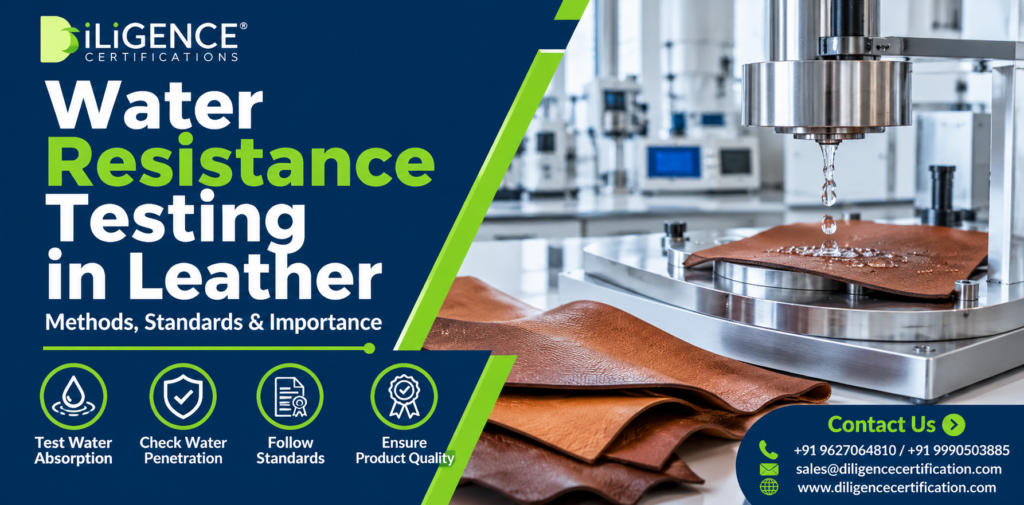
- Water resistance testing in leather evaluates how well leather withstands exposure to water.
- Excessive water absorption can cause stains, swelling, stiffness and damage.
- Common methods include water absorption, water penetration and dynamic water resistance testing.
- Leather footwear, jackets, bags and gloves require suitable moisture resistance.
- ISO standards help laboratories follow consistent testing procedures.
- Regular testing helps manufacturers maintain product quality and durability.
Introduction
Leather is widely used in footwear, handbags, jackets, furniture, automotive interiors and fashion accessories. It is popular because of its durability, flexibility, attractive appearance and comfort. However, exposure to water can affect these properties if leather does not have sufficient water resistance.
For example, leather shoes worn during the rainy season may absorb moisture, develop stains or lose their original shape. Similarly, leather handbags and jackets can experience surface damage when exposed to rain or damp conditions.
This is why Water Resistance Testing in Leather is important for manufacturers, exporters and quality control professionals.
Water resistance testing helps determine how leather behaves when it comes into contact with water. It evaluates whether water remains on the surface, gets absorbed into the material or passes through the leather structure.
The testing process also helps manufacturers evaluate leather treatments, improve production quality and select suitable materials for different applications.
In this guide, we will explain the meaning, importance, testing methods, standards, procedures and applications of water resistance testing in leather.
What Is Water Resistance Testing in Leather?
Water Resistance Testing in Leather is a quality evaluation process used to determine how well leather can withstand exposure to water.
Leather is a natural material with a fibrous structure. Although manufacturers use oils, waxes, coatings and other finishing chemicals to improve its water resistance, the material may still absorb moisture.
The main purpose of this testing is to understand how much water leather absorbs, how quickly moisture passes through it and whether exposure changes its physical properties.
Depending on the product and its intended application, testing may evaluate:
- Water absorption capacity.
- Water penetration through leather.
- Resistance to repeated water exposure.
- Surface water resistance.
- Water vapour permeability.
- Changes in leather thickness.
- Changes in appearance and flexibility.
For example, leather used in outdoor footwear may require greater resistance to water penetration than leather used for decorative furniture.
Therefore, the testing method should be selected according to the leather type, product application and applicable technical requirements.
Why Is Water Resistance Testing Important for Leather?
Water resistance is an important quality characteristic because leather products are frequently exposed to moisture during normal use.
Testing helps manufacturers understand whether their products can maintain their expected performance under different environmental conditions.
1. Protects Leather from Water Damage
Excessive water absorption can affect the structure and appearance of leather. It may cause swelling, stains, stiffness and changes in texture.
Water resistance testing helps identify materials that may not be suitable for products exposed to moisture.
2. Improves Product Durability
Leather products are expected to maintain their performance over time. Repeated exposure to water can weaken certain finishes and affect the material’s physical properties.
Testing helps manufacturers evaluate the durability of leather under specified water exposure conditions.
3. Maintains Product Appearance
Water can leave visible marks, discoloration and uneven patches on leather surfaces.
This is particularly important for premium handbags, leather jackets, footwear and furniture.
4. Supports Footwear Quality
Shoes and boots are frequently exposed to rain, wet surfaces and damp environments.
Water resistance testing helps manufacturers evaluate whether leather footwear materials can provide the required protection against moisture.
5. Helps Maintain Quality Standards
Testing provides measurable information about leather performance. Manufacturers can use these results to improve production processes and maintain consistent product quality.
6. Reduces Product Rejection
Poor water resistance may lead to customer complaints, product returns and rejected export consignments.
Regular quality checks help identify problems before products reach the market.
Common Methods of Water Resistance Testing in Leather
Different testing methods are used to evaluate how leather behaves when exposed to water. Each method measures a different performance characteristic.
1. Water Absorption Testing
Water absorption testing determines how much water leather absorbs during a specified exposure period.
In this method, a prepared leather specimen is exposed to water under controlled conditions. Its weight is measured before and after exposure.
The difference in weight helps determine the amount of water absorbed.
What does this test evaluate?
- Moisture absorption capacity.
- Changes in leather weight.
- Performance of water-resistant treatments.
- Differences between leather materials.
This test is useful for footwear, leather accessories and other products where moisture absorption needs to be controlled.
2. Water Penetration Testing
Water penetration testing checks whether water can pass through leather from one side to the other.
This method is especially important for leather used in shoes, boots and protective products.
During testing, the leather specimen is exposed to water under specified conditions. The test evaluates the time taken for water to penetrate the material and the amount of water passing through it.
Important evaluation factors include:
- Time before water penetration.
- Quantity of water passing through.
- Changes in material structure.
- Resistance under continuous exposure.
3. Dynamic Water Resistance Testing
Dynamic water resistance testing evaluates how leather behaves when it experiences repeated movement while exposed to water.
This method is particularly relevant to footwear because leather bends during walking.
The specimen is placed in a suitable testing apparatus and subjected to repeated flexing in the presence of water.
The test helps determine whether water enters the leather during repeated movement.
It also helps manufacturers evaluate the performance of treated leather under practical usage conditions.
4. Water Vapour Permeability Testing
Water vapour permeability testing measures the ability of leather to allow moisture vapour to pass through its structure.
Water resistance and water vapour permeability are different properties. A material may resist liquid water while still allowing water vapour to escape.
This property is useful in leather footwear, gloves and clothing because it contributes to wearing comfort.
The test helps evaluate:
- Moisture vapour transmission.
- Breathability of leather.
- Suitability for footwear and clothing.
- Performance of leather finishes.
5. Surface Water Resistance Testing
Surface water resistance testing checks how leather reacts when water droplets come into contact with its outer surface.
It helps identify whether water remains on the surface or spreads and gets absorbed.
This evaluation is useful for leather upholstery, handbags, jackets and finished leather products.
It also helps manufacturers compare different surface treatments and protective coatings.
Water Resistance Testing Procedure for Leather
A proper testing procedure is important for obtaining reliable and repeatable results.
The exact procedure depends on the selected test method and applicable standard. However, a general testing process includes the following steps.
Step 1: Sample Selection
The first step is selecting representative leather samples from the production batch.
Samples should be free from unwanted defects unless the purpose of the test is to evaluate defective material.
Step 2: Sample Preparation
Leather specimens are cut according to the dimensions required by the selected testing method.
The samples should be prepared carefully to avoid unnecessary damage.
Step 3: Conditioning
Leather specimens are conditioned under specified temperature and humidity conditions before testing.
This is important because moisture already present in leather can influence the test results.
Step 4: Initial Measurement
Depending on the test, the initial weight, thickness or other relevant properties of the leather are recorded.
These measurements provide a reference for comparison.
Step 5: Water Exposure
The specimen is exposed to water using the selected testing procedure.
Exposure conditions may include:
- Water quantity.
- Exposure duration.
- Temperature.
- Pressure.
- Repeated flexing.
- Contact conditions.
Step 6: Final Measurement
After the exposure period, the sample is examined and measured according to the test method.
The laboratory may evaluate water absorption, penetration, weight changes or visible damage.
Step 7: Result Evaluation
The results are compared with the applicable technical requirements or product specifications.
A test report is then prepared with the observations and measurements.
Important Standards for Water Resistance Testing in Leather
Leather testing methods are supported by international standards that help laboratories follow consistent procedures.
The following standards are particularly relevant to water-related leather testing.
| Standard | Testing Area |
|---|---|
| ISO 2417 | Determination of water absorption of leather |
| ISO 5403-1 | Water resistance of flexible leather - flexing method |
| ISO 5403-2 | Water resistance of flexible leather - Maeser method |
| ISO 14268 | Determination of water vapour permeability of leather |
| ISO 17229 | Determination of water vapour absorption of leather |
Important: These standards cover different testing properties and are not interchangeable. Manufacturers and laboratories should verify the latest published editions, amendments and applicable product requirements before testing.
The correct standard depends on the type of leather, product application and property being evaluated.
Factors That Affect Water Resistance in Leather
Several factors can influence the water resistance performance of leather.
1. Type of Leather
Different leather types have different structures and moisture absorption characteristics.
For example, full-grain leather, corrected-grain leather and suede may behave differently when exposed to water.
2. Leather Thickness
Thickness can influence the time taken for water to penetrate the material. However, greater thickness does not automatically guarantee better water resistance.
3. Surface Finishing
Protective coatings, waxes, oils and other finishing treatments can improve resistance to water absorption.
The quality and uniformity of the finish are important.
4. Tanning Process
The tanning method affects the physical and chemical properties of leather. Different tanning processes may produce different moisture-related performance characteristics.
5. Temperature and Humidity
Environmental conditions can influence the moisture content of leather and affect testing results.
6. Age and Storage Conditions
Leather stored in unsuitable conditions may experience changes in flexibility, surface finish and overall performance.
Common Problems Identified During Water Resistance Testing
Water resistance testing can help manufacturers identify several quality problems.
- Excessive water absorption: Leather absorbs more water than expected, potentially affecting its weight and structure.
- Water penetration: Moisture passes through the material during exposure.
- Surface staining: Water leaves marks or uneven patches on the leather surface.
- Finish damage: Protective coatings may lose their effectiveness after repeated water exposure.
- Swelling: Leather may increase in thickness or change its shape after absorbing moisture.
- Loss of flexibility: Certain leather materials may become stiff after drying.
Identifying these problems helps manufacturers improve raw material selection, finishing processes and product quality.
Applications of Water Resistance Testing in Leather Products
Water resistance testing is relevant to several industries.
| Leather Product | Purpose of Testing |
|---|---|
| Leather footwear | Evaluates resistance to water penetration |
| Leather boots | Checks performance during prolonged water exposure |
| Leather jackets | Evaluates surface protection and moisture behaviour |
| Leather handbags | Helps maintain appearance and material quality |
| Leather gloves | Checks resistance to moisture |
| Leather furniture | Evaluates surface performance against accidental water contact |
| Automotive leather | Supports material quality evaluation |
| Safety footwear | Helps assess leather performance under specified conditions |
Manufacturers should select testing methods based on the actual conditions in which their products will be used.
Documents Required for Leather Water Resistance Testing
When submitting leather samples to a testing laboratory, manufacturers may need to provide certain details.
Commonly required information includes:
- Company or manufacturer details.
- Product name and description.
- Type and grade of leather.
- Sample identification details.
- Intended application of the leather.
- Required testing standard.
- Technical specifications, if available.
- Details of surface treatments or coatings.
Additional documents may be required depending on the laboratory and testing requirements.
Providing accurate sample information helps laboratories select suitable testing methods.
How to Improve Water Resistance in Leather
Manufacturers can improve leather water resistance through suitable material selection and production controls.
Some common approaches include:
- Using appropriate water-resistant leather treatments.
- Applying suitable wax or protective finishes.
- Maintaining consistent coating thickness.
- Selecting suitable tanning and finishing processes.
- Controlling leather storage conditions.
- Conducting regular quality inspections.
- Testing finished products before commercial distribution.
However, improving water resistance should not negatively affect other important leather properties, such as flexibility, breathability, appearance and strength.
Common Mistakes to Avoid During Water Resistance Testing
Incorrect sample preparation and unsuitable testing conditions can affect the reliability of results.
1. Selecting the Wrong Testing Standard
Different standards measure different properties. Selecting an incorrect method may produce results that do not meet the actual testing requirement.
2. Improper Sample Conditioning
Leather contains moisture naturally. Skipping the conditioning process can affect test results.
3. Using Damaged Samples
Unintended cuts, scratches and defects may influence water penetration.
4. Ignoring Leather Thickness
Samples with different thicknesses may produce different results.
5. Not Maintaining Testing Conditions
Water temperature, exposure time and equipment settings should follow the selected method.
6. Confusing Water Resistance with Waterproofing
Water-resistant leather can withstand certain levels of water exposure, but this does not necessarily mean it is completely waterproof.
Role of Diligence Certifications in Leather Testing and Compliance
Manufacturers need proper testing and documentation to maintain the quality of leather products and meet relevant market requirements.
Diligence Certifications provides certification and compliance consultancy support to businesses that require guidance on product testing, applicable standards and regulatory requirements.
For leather manufacturers, understanding the correct testing requirements is important before sending samples to a laboratory.
Diligence Certifications can help businesses with:
- Guidance on applicable product testing requirements.
- Understanding relevant Indian and international standards.
- Assistance with identifying suitable testing requirements.
- Documentation and compliance guidance.
- Support in understanding certification-related procedures.
- General guidance on product quality and regulatory requirements.
It is important to understand that Diligence Certifications is a consultancy service provider, not a physical leather testing laboratory. Actual testing must be performed by a suitably equipped and competent laboratory.
Manufacturers should also remember that a test report and a product certification are different things. A test report provides testing results, while certification involves a separate conformity assessment process where applicable.
Conclusion
Water Resistance Testing in Leather is an important part of leather product quality evaluation. It helps manufacturers understand how leather reacts to water and whether it is suitable for its intended application.
From footwear and handbags to jackets, gloves and automotive interiors, water resistance plays an important role in product durability, appearance and performance.
Methods such as water absorption, water penetration, dynamic water resistance and water vapour permeability provide useful information about different moisture-related properties.
Manufacturers should select the correct testing method, follow applicable ISO standards and maintain proper quality control throughout production.
With suitable testing and compliance guidance from Diligence Certifications, businesses can better understand their testing requirements and work towards maintaining consistent leather product quality.
Frequently Asked Questions (FAQs)
1. What is water resistance testing in leather?
Water resistance testing in leather evaluates how well leather withstands water exposure. It checks properties such as water absorption, penetration and moisture-related performance.
2. Why is water resistance testing important for leather products?
It helps manufacturers identify leather that may absorb excessive moisture, develop stains, lose flexibility or allow water to penetrate.
3. Which tests are used for water resistance testing in leather?
Common methods include water absorption testing, water penetration testing, dynamic water resistance testing and water vapour permeability testing.
4. Which ISO standard is used for water resistance testing in leather?
ISO 5403-1 and ISO 5403-2 are important standards for determining the water resistance of flexible leather. ISO 2417 covers water absorption testing.
5. Is water resistance the same as waterproofing?
No. Water resistance means a material can withstand a certain level of water exposure. Waterproofing generally refers to a higher level of protection against water penetration under defined conditions.
6. Which leather products require water resistance testing?
Leather footwear, boots, gloves, jackets, handbags, automotive leather and other products exposed to moisture may require suitable water-related testing.