BIS Certification
 CDSCO
CDSCO
 PESO
PESO
 CPCB
CPCB
 LMPC
LMPC
 WPC Approval
 Global Approvals
 TEC
TEC
 ARAI
ARAI
 BEE
BEE
 ISO Certification
 DGCA Certification
 NOC For Steel
 APEDA Registration























 Business Registration
 FSSAI Mark Certification












 (32).jpg)
 Legal Services
 Trademark Registration
 Copyright Registration
 Patent Registration
 By
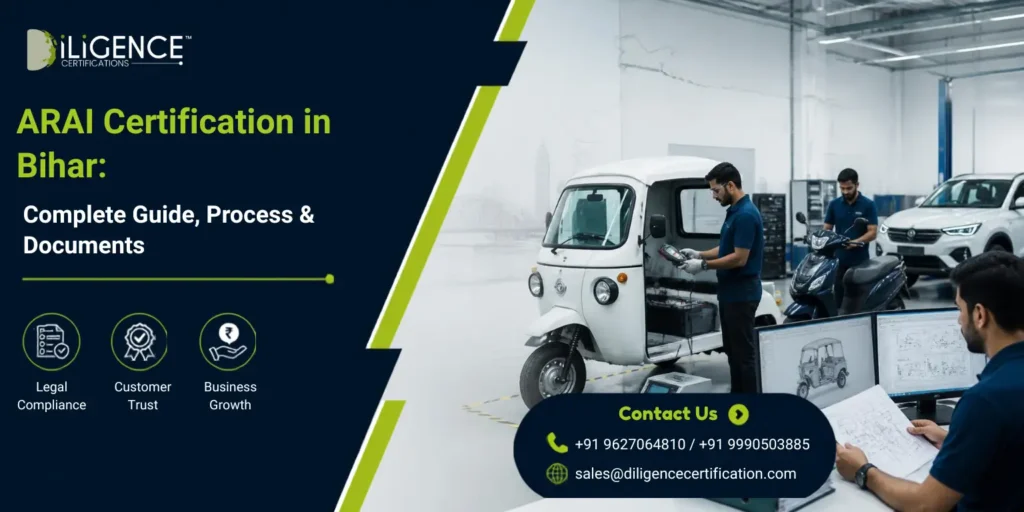
By - ARAI certification in Bihar is usually associated with vehicle, engine, component, equipment, or any other automotive approval and testing necessary for manufacturers in Bihar.
- The Automotive Research Association of India (ARAI) performs CMVR type approval, testing, certification, production conformity, and homologation for various types of automotive vehicles.
- The ARAI certification is not a standalone Bihar certificate; the manufacturers eligible for certification in Bihar have to undergo the relevant national automotive approval process, and the testing and certification has to be coordinated via agencies like ARAI.
Introduction
An automobile company in Bihar may have a good technically designed product but may be facing a big market entry challenge due to poor management of its regulatory approval process.
Imagine a normal scenario. An automobile company from Patna comes up with a new electric three-wheeler and works for months on the design of the battery pack, controller, chassis and body. It tests the prototype and finds it performing very well. Then the managers start asking a different question.
It is not about just getting a certificate after the development phase. The type approval process means having knowledge of relevant Central Motor Vehicles Rules (CMVR), knowing the technical requirements, making drawings and specifications, making arrangements for prototype or component testing, and dealing with compliance observations.
ARAI offers homologation and certification service in respect of various products like vehicles, engines, components, genset, equipment, and retrofitment. Its department named ‘Homologation Management & Regulation’ serves as a facilitation center for the type approval process and other services.
What Is ARAI Certification in Bihar
ARAI Certification in Bihar is generally referred to as the procedure whereby the required tests, type approval, or homologation of a vehicle or any other automobile part are done by ARAI for a particular manufacturer in Bihar state.
ARAI is not a department of the Bihar state government. ARAI Automotive Research Association of India is a very important Indian organization for automotive research, testing, and certification purposes.
Depending on the product, the approval route may involve:
- Vehicle type approval
- Engine type approval
- Component type approval
- Construction Equipment Vehicle approval
- Agricultural tractor approval
- Battery-operated vehicle approval
- Genset certification
- Retrofitment approval
- Bus body certification
- Conformity of Production
- Export homologation
- Specific equipment and testing approvals
ARAI lists two-, three- and four-wheelers, electric vehicles, alternate-fuel vehicles, agricultural tractors, construction equipment vehicles and other categories within its certification activities.
Who Needs ARAI Type Approval in Bihar
This will depend on the product and regulations and not just on where the business is located.
Firms operating in Bihar and who may need automotive type approval or certifications could be:
Electric Vehicles Manufacturers
Firms producing electric two wheelers, three wheelers and four wheelers may need to prove compliance with the respective requirements.
For instance, ARAI’s vehicle type approval scheme includes electric vehicles which qualify according to the required classification. These include electric two wheelers that are above specified power and speed levels, as well as three wheelers and four wheelers.
Three Wheeler Manufacturers
Bihar has a significant market in terms of commercial mobility, hence the relevance of three wheelers here.
ARAI’s type approval scope covers passenger and goods carriers, fully built vehicles, drive-away chassis and vehicles using petrol, diesel, CNG, LPG, alternate fuels and electricity.
Two-Wheeler Manufacturers
Manufacturers of motorcycles, scooters and other qualifying two-wheelers may require type approval before commercial production and sale.
Four-Wheeler Manufacturers
Passenger vehicles, goods carriers and other qualifying four-wheelers fall under the applicable vehicle approval requirements.
Automotive Component Manufacturers
A component manufacturer may require approval where the component is specifically notified under CMVR requirements.
ARAI explains that safety-critical components such as horns, mirrors, lighting and signalling devices and seats can be subject to notified requirements, including applicable AIS or BIS standards.
Agricultural and Construction Equipment Manufacturers
ARAI also covers agricultural tractors, combined harvesters and construction equipment vehicles under relevant certification activities.
What Does ARAI Certification Actually Prove
It is important not to treat ARAI certification as a generic quality certificate.
Type approval is fundamentally a regulatory conformity assessment.
The manufacturer demonstrates that the particular vehicle, engine, component or equipment complies with applicable technical and regulatory requirements.
Depending on the product, testing may involve areas such as:
- Vehicle safety
- Braking
- Lighting and signalling
- Dimensions and construction
- Emissions
- Noise
- Energy consumption or fuel efficiency
- Electromagnetic compatibility
- Electrical safety
- Structural requirements
- Component performance
- Applicable EV requirements
The exact test scope depends on the vehicle category, propulsion system, technical configuration and applicable rules and standards.
This is why selecting the approval route before finalising the prototype can save considerable time.
Types of ARAI Certification and Approval Relevant to Bihar
Vehicle Type Approval
Vehicle type approval is one of the main certification activities associated with ARAI.
It can cover:
- Two-wheelers
- Three-wheelers
- Four-wheelers
- Electric vehicles
- CNG/LPG vehicles
- Alternate-fuel vehicles
- Agricultural tractors
- Construction equipment vehicles
ARAI publishes separate requirements for different vehicle categories because the applicable tests and regulatory provisions are not identical.
Component Type Approval
A component does not automatically require the same approval process as an entire vehicle.
Where a component is covered by a notified safety requirement, the manufacturer needs to demonstrate conformity with the specified standard and testing requirements.
For example, ARAI notes that notified components can have specific CMVR requirements and applicable AIS or BIS standards.
Engine Type Approval
Engines, particularly those used in heavier vehicle categories, may undergo separate testing and approval.
ARAI states that automotive engines for vehicles above certain weight categories are normally tested on an engine dynamometer for emissions and power, with additional options depending on the vehicle category.
Conformity of Production
Obtaining type approval is not necessarily the end of the compliance journey.
Conformity of Production, commonly called COP, deals with maintaining conformity between approved products and products manufactured subsequently.
ARAI’s COP framework operates within the emission-legislation implementation structure overseen by the Ministry of Road Transport and Highways.
For a manufacturer, this distinction matters. A prototype can pass testing, but production units still need to remain consistent with the approved configuration and applicable requirements.
Export Homologation
A Bihar manufacturer planning to export vehicles or components may also need country-specific homologation.
ARAI provides export homologation support and lists international markets and regulatory collaborations among its services.
ARAI Certification in Bihar: Step-by-Step Process
The exact process changes according to the product. However, the practical workflow generally follows a sequence like this.
Step 1: Identify the Product Category
First determine what is actually being certified.
Is it:
- A complete vehicle?
- An EV?
- A three-wheeler?
- An engine?
- A safety component?
- Construction equipment?
- A genset?
- A retrofitment system?
This classification determines the regulatory pathway.
Step 2: Map Applicable Regulations
The manufacturer then identifies the relevant CMVR provisions, AIS requirements, notified standards and applicable testing scope.
This is often where inexperienced applicants lose time.
A test conducted against the wrong requirement does not become useful merely because the laboratory has issued a report.
Step 3: Prepare Technical Documentation
ARAI’s published vehicle type approval requirements include an application letter, authorisation details, technical specifications according to prescribed formats, drawings and layouts, relevant type approval or conformity certificates, BIS licences for applicable safety-critical components and other technical information.
The technical dossier may therefore include:
- Product specifications
- Drawings
- Vehicle layout
- Component details
- Electrical architecture
- Battery information for EVs
- Engine details
- Manufacturing information
- Test reports
- Previous approval references
- Component certificates
- Authorisation documents
Step 4: Submit Application
The application and supporting information are submitted through the applicable process and platform.
ARAI has also developed digital systems for automotive and component certification workflows, including online submission and document handling for relevant certification activities.
Step 5: Prototype or Sample Submission
The manufacturer needs to provide the required prototype vehicle, component, engine, subassembly or other sample for testing.
This sounds straightforward until a prototype arrives with a specification that differs from the technical dossier.
That mismatch can create avoidable questions and additional work.
Step 6: Testing and Technical Evaluation
The product is evaluated against the applicable requirements.
Testing can cover different technical areas depending on the approval category.
If deficiencies are identified, the manufacturer may need to make technical corrections and provide additional evidence.
Step 7: Address Observations
A good compliance consultant does more than upload documents.
The important work often begins when a technical observation is raised.
The manufacturer must understand whether the issue is:
- Documentation-related
- Design-related
- Test-related
- Component-related
- Installation-related
- Configuration-related
The response should address the actual regulatory concern rather than merely supplying more paperwork.
Step 8: Grant of Type Approval
Once applicable requirements have been satisfactorily completed, the relevant approval or certification is issued according to the applicable procedure.
Documents Required for ARAI Certification in Bihar
The document list depends on the product, but manufacturers should generally prepare:
- Company registration documents
- Authorisation letter
- Product technical specifications
- Engineering drawings
- Vehicle layouts
- Model and variant details
- Manufacturing details
- Component information
- Existing test reports
- Applicable component certificates
- Prototype/sample details
- Engine specifications, where applicable
- Battery and electrical specifications for EVs
- Previous approval documents, where applicable
- Test facility or equipment information, where required
ARAI specifically mentions AIS 007 technical specifications and prescribed drawings/layouts among the documents required for vehicle CMVR type approval applications.
The safest approach is to prepare the dossier around the actual product rather than using a generic document checklist.
Common Mistakes Manufacturers Make
Starting Testing Before Regulatory Mapping
This is one of the most expensive mistakes.
The company develops a prototype first and asks about certification later. By then, changing a component can affect drawings, test results, wiring, performance and production planning.
Treating Every Vehicle Variant as Identical
Variants may differ in ways that affect certification requirements.
Engine, battery, motor, chassis, dimensions, seating configuration and other technical differences can influence the applicable testing scope.
Ignoring Component-Level Compliance
A vehicle-level application may depend on compliance of certain components.
ARAI’s component certification information specifically explains the relationship between notified components and vehicle-level compliance.
Submitting Inconsistent Documents
A drawing may show one specification while the prototype contains another.
These inconsistencies are avoidable and usually indicate that the technical dossier was prepared without sufficient engineering coordination.
Assuming Type Approval Means Permanent Compliance
Type approval is linked to an approved configuration and applicable regulations.
Changes to a product can require an extension, additional testing, documentation approval or another regulatory action depending on the nature of the modification.
Why Choose Diligence Certifications for ARAI Certification in Bihar
Choosing the right consultant matters because ARAI certification is not simply an application-filing exercise. Vehicle type approval can involve technical specifications, drawings, component-level certification, prototype submission, testing and responses to observations. ARAI itself specifies technical documentation and prototype-related requirements for vehicle type approval.
Diligence Certifications helps manufacturers approach the process in a structured way, from understanding the likely certification route to coordinating documentation and compliance requirements.
1. End-to-End Certification Support
Diligence Certifications provides assistance across the certification journey rather than limiting support to application submission. The company’s services include ARAI vehicle certification and broader regulatory compliance support.
2. Product-Specific Compliance Assessment
Every vehicle or automotive product has its own technical configuration. An electric three-wheeler, passenger vehicle, engine and automotive component cannot be treated using the same checklist.
Diligence begins by understanding the product and then mapping the relevant certification requirements. This helps reduce the risk of preparing documents that do not match the actual product.
3. Documentation and Application Assistance
Technical documentation is a major part of the type approval process. ARAI identifies documents such as AIS 007 technical specifications, drawings/layouts, authorisation documents and applicable component certification among the requirements for vehicle type approval.
Diligence Certifications can help organise these documents, review information for consistency and support the application process.
4. Testing and Coordination Support
Testing is often where automotive certification becomes technically demanding. Diligence can assist manufacturers in coordinating the certification workflow and preparing for applicable testing requirements.
The objective is not to bypass testing, but to make sure the product and documentation are properly prepared before testing begins.
5. Support for EV and Automotive Businesses
ARAI’s certification scope includes electric vehicles, two-wheelers, three-wheelers, four-wheelers, engines, components and other automotive categories.
This makes structured compliance planning particularly useful for EV startups and automotive manufacturers entering the market with new products.
Conclusion
ARAI Certification in Bihar is an important compliance consideration for manufacturers developing vehicles, electric vehicles, engines, automotive components and other products falling within the applicable automotive regulatory framework.
The process should ideally begin before the prototype is finalised. Understanding the applicable requirements, preparing accurate technical specifications, aligning drawings with the actual product, completing relevant component approvals and planning testing in advance can make the certification journey considerably more manageable.
ARAI’s current certification framework covers vehicle, engine and component type approval along with conformity-of-production and other automotive certification activities.
Frequently Asked Questions
What is ARAI Certification in Bihar?
ARAI Certification in Bihar refers to the applicable vehicle, engine, component or automotive type approval and homologation process undertaken by manufacturers operating in Bihar.
Is ARAI Certification mandatory for every vehicle manufacturer in Bihar?
The requirement depends on the vehicle category, product type and applicable regulatory provisions.
Is there a separate ARAI certificate issued specifically by Bihar?
No. ARAI certification is not a separate Bihar state certification scheme. A manufacturer located in Bihar follows the applicable national automotive certification and homologation requirements.
Can electric vehicle manufacturers in Bihar obtain ARAI certification?
Yes. ARAI's vehicle certification scope includes applicable electric two-wheelers, three-wheelers and four-wheelers.
What documents are required for ARAI vehicle type approval?
The requirements vary by product. For vehicle type approval, ARAI identifies documents including an application letter, authorisation details, technical specifications according to prescribed formats, drawings/layouts, applicable type approval or COP certificates.
How long does ARAI type approval take?
The timeline depends on the approval category and whether the required documents, prototypes and component-level certifications are ready.
What is the cost of ARAI Certification in Bihar?
There is no single fixed cost applicable to every manufacturer. The cost can depend on the vehicle category, number of variants, testing requirements, prototype configuration, component testing and any additional testing or evaluation required.
Does ARAI certify automotive components?
Yes. ARAI provides component type approval services. The Central Government notifies safety standards for specified vehicle parts, components and assemblies, and testing agencies notified under Rule 126 conduct applicable component approval activities.
Is ARAI type approval enough after the vehicle enters production?
Not necessarily. Depending on the applicable requirements, manufacturers may have continuing obligations such as Conformity of Production.
Why should I choose Diligence Certifications for ARAI Certification in Bihar?
Diligence Certifications provides structured support covering certification assessment, documentation, application coordination and broader compliance requirements.