BIS Certification
 CDSCO
CDSCO
 PESO
PESO
 CPCB
CPCB
 LMPC
LMPC
 WPC Approval
 Global Approvals
 TEC
TEC
 ARAI
ARAI
 BEE
BEE
 ISO Certification
 DGCA Certification
 NOC For Steel
 APEDA Registration























 Business Registration
 FSSAI Mark Certification












 (32).jpg)
 Legal Services
 Trademark Registration
 Copyright Registration
 Patent Registration
 By
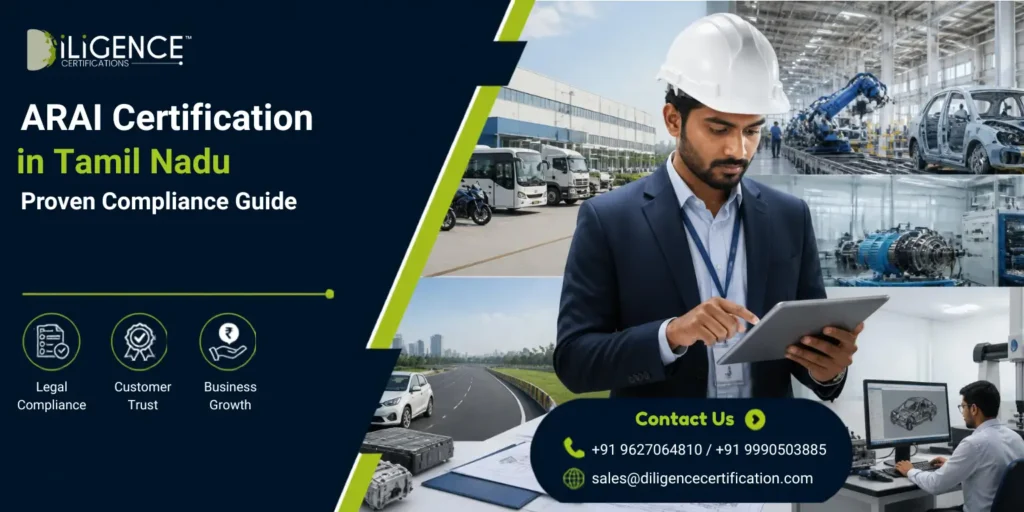
By - “ARAI Certification” for Tamil Nadu is basically an approval and homologation process pertaining to the vehicles, engines, components, or other relevant type approvals in the regulatory framework of the Indian motor vehicle laws.
- The type of approval required shall depend on the category of vehicle or component, its propulsion system, technical specifications, relevant CMVR/AIS rules, and the change/product introduced.
- Diligence Certifications will assist companies to determine the correct path for approval, prepare technical documents, and arrange the tests required.
Introduction
An auto company based in Chennai once consulted a compliance expert when its prototype was near production. The engineering department had finished developing the vehicle, purchased the components and made huge investments on tooling. But the trouble came late - the company didn’t have the full type-approval requirements mapped before finalizing the design.
Getting the certificate isn’t the only thing - a number of technical parameters, component approvals and tests had to be carried out to ensure smooth passage through the certification process.
This is a common oversight in the automotive industry. ARAI Certification in Tamil Nadu shouldn’t be seen as the last paperwork step for manufacturers. This process needs to be considered throughout the development, testing and documentation of the product.
ARAI offers certification and homologation for the wide variety of automotive vehicles, systems and components. Official certification process of ARAI includes vehicles, engines, components, gensets, equipment, retrofitment and conformity-of-production amongst others.
In case of a Tamil Nadu manufacturer, the real question is not “How do I get ARAI certificate?”, but rather:
Which certification, test and compliance pathway is applicable to my vehicle or automotive product?
What Is ARAI Certification?
ARAI is an abbreviation of the name “Automotive Research Association of India”. It is an automotive R&D, testing, and certification body which conducts extensive operations in the fields of vehicle engineering, safety, emissions, homologation, and other automotive technologies.
As per commonly used terminology in business parlance, one can use the phrase ARAI Certification to refer to the process of type approval, certification, and homologation needed for vehicles and automotive products.
However, technically speaking, the type of approval could be either CMVR type approval, component approval, engine approval, retrofitment approval, conformity-of-production, or any other form of certification/homologation services.
The ARAI Homologation Management & Regulation division acts as a coordination centre for type approval processes relating to the CMVR.
What does ARAI approval establish?
At a practical level, the approval process is intended to establish that the relevant vehicle, system, component or product complies with the applicable regulatory and technical requirements.
Depending on the product, this can involve areas such as:
- Vehicle safety
- Emission requirements
- Vehicle construction and specifications
- Electrical and electronic systems
- Performance-related requirements
- Fuel or energy systems
- Safety-critical components
- Applicable Automotive Industry Standards
- Central Motor Vehicles Rules requirements
- Type-specific testing and documentation
The exact tests should never be assumed from the product name alone. The vehicle category, technical configuration and applicable notifications determine what is actually required.
Why Is ARAI Certification Important for Tamil Nadu Manufacturers?
Tamil Nadu has a substantial automotive and auto-component manufacturing ecosystem, particularly around Chennai and other industrial clusters. This creates a strong market for passenger vehicles, commercial vehicles, two-wheelers, electric mobility products, automotive components and specialised vehicle systems.
For these businesses, regulatory planning becomes part of product development.
A company may have excellent engineering and manufacturing capabilities, but an incomplete homologation file can still delay commercialisation.
ARAI compliance can support:
Regulatory market access:
Type approval and related certification are important elements of bringing regulated vehicles and products into the Indian market.
Product safety:
Testing evaluates applicable safety requirements rather than relying only on the manufacturer’s internal assessment.
Emission compliance:
For applicable vehicles and engines, emission-related requirements form an important part of India’s motor-vehicle regulatory system.
Technical credibility:
A properly approved product demonstrates that applicable regulatory requirements have been addressed through the prescribed process.
Production continuity:
After type approval, applicable conformity-of-production requirements may continue to apply. ARAI separately provides COP services for vehicles, engines and components.
Which Products May Need ARAI Certification in Tamil Nadu?
There is no single ARAI certificate for every automotive business. The applicable approval depends on the product, vehicle category, propulsion system, technical specifications and intended use.
Two-Wheeler Vehicles
Motorcycles, scooters, mopeds and qualifying electric two-wheelers may require type approval before commercial introduction. Applicable requirements can vary according to fuel type, vehicle specifications and regulatory classification.
Three-Wheeler Vehicles
Passenger and goods three-wheelers may fall under type-approval requirements. This can include fully built vehicles, drive-away chassis, conventional-fuel models and electric three-wheelers. Testing depends on the vehicle’s classification and technical configuration.
Four-Wheeler Vehicles
Passenger cars and commercial vehicles may require type approval. Categories such as M1, N1, M2, M3, N2 and N3 have different regulatory requirements based on factors such as weight, construction and intended application.
Electric Vehicles
EVs require specific compliance attention because they combine electrical, electronic, battery and mechanical systems. Assessment may cover the electric powertrain, traction battery or REESS, electrical safety, charging systems and other applicable requirements.
Automotive Components
Certain safety-critical automotive components may require approval under applicable CMVR requirements. This is particularly important for manufacturers supplying components to OEMs.
Engines
Engines may require separate testing and approval depending on their application and applicable emission and performance requirements.
CNG and LPG Retrofitment
Businesses converting vehicles to CNG or LPG may need retrofitment approval and related testing for the vehicle, engine and components. Manufacturers should identify the applicable requirements before commercial production or installation begins.
What Is the Difference Between ARAI Certification and Vehicle Homologation?
The two terms are closely related but are not always interchangeable.
Homologation is the broader process of demonstrating that a vehicle, system or component complies with the applicable regulatory requirements.
Type approval is the formal approval of a particular vehicle type, model, variant, engine, component or other applicable product after the required evaluation.
In everyday business discussions, companies often use “ARAI homologation” and “ARAI certification” to describe the same compliance journey.
For a manufacturer, the more important issue is identifying the exact approval category and applicable requirements.
ARAI Certification Process in Tamil Nadu
The ARAI approval process should be planned around the specific vehicle, engine or component rather than using a generic checklist.
Step 1: Product Evaluation
In the first step, the product category, the type of vehicle, fuel/power train, seating capacity, weight and dimension, purpose of use and model variations and safety equipment used must be known. This helps us know the route of approval.
Step 2: Identifying Applicable Standards
This involves mapping all the relevant CMVR, AIS, and other standards. This step ensures that wrong testing and modification of the vehicle is not carried out at the later stages.
Step 3: Preparing Documentations
Preparing the application along with technical specification, layouts, design drawings, component list, required certificates and licences from BIS and also WMI/WMC documentation, if any.
Step 4: Application Submission
Applying for the approval via the ARAI procedure, which includes its CMVR-Type approval software and related e-services.
Step 5: Testing
The vehicle/engine/component undergoes testing as per requirements based on the product.
Step 6: Address any Questions
Any technical comments or questions by ARAI must be addressed consistently with what has been provided in the drawings, specifications, and prototype.
Step 7: Get Approval
Upon satisfactory completion of the tests and documentation, the required type approval/certification is granted.
Step 8: Conformity of Production (COP)
The process could continue post approval. The vehicle/engines involved would need to comply with the Conformity of Production (COP).
Documents Required for ARAI Certification
These may vary from product to product, but the documents that the manufacturer usually requires are:
- Application documents
- Manufacturer information
- Authorizations
- Technical specification
- Vehicle drawings
- Plans
- Information about parts
- Testing results, where required
- Existing certification papers
- BIS certificates relevant to safety critical parts, where required
- WMI/WMC data, where required
- Details about prototype/submission of parts
- Model and variants
- Technical declaration
- Other compliance documents
The ARAI documentation mentions that AIS 007 formats are used for vehicle technical specification and vehicle drawings in the published vehicle type approval documentation.
The safest way is to compile the dossier on the basis of vehicle category and certification process rather than any “ARAI documents list.”
How Long Does ARAI Certification Take?
There is no standard timeline for ARAI Certification in Tamil Nadu since the amount of testing and documentation required varies widely across products.
Currently, ARAI provides indicative timelines for various levels of vehicle type approvals. The timelines provided by ARAI show that full-level vehicle type approval application will take about 45 working days, partial level vehicle type approval will take 30 working days and documentation only will take 10 working days, under specific conditions.
These are indicative service timelines and not a fixed completion date.
The following could affect the actual project timeline:
- Completeness of documentation
- Prototype readiness
- Test availability
- Applicable test scope
- Component approvals
- Technical queries
- Modifications during testing
- Manufacturer response time
- Regulatory changes
A company that waits until the prototype is completely finalized can therefore face a much longer commercial launch schedule than a company that performs compliance mapping during engineering.
What Is the Cost of ARAI Certification in Tamil Nadu?
There is no single fixed ARAI Certification in Tamil Nadu cost The overall expense depends on the approval category and testing scope.
Cost can be influenced by:
- Type of vehicle
- Number of variants
- Applicable tests
- Prototype requirements
- Component testing
- Emission testing
- Safety testing
- Battery or electrical-system testing
- Retesting requirements
- Documentation work
- Regulatory consultancy
- Travel and logistics associated with testing
For this reason, quoting one generic “ARAI certification fee” without knowing the vehicle or component is potentially misleading.
A proper quotation should be prepared only after reviewing the product specifications and intended approval route.
Common Reasons for Delays in ARAI Approval
From a compliance-management perspective, delays often arise before the formal testing stage.
Incomplete Technical Information
If specifications do not clearly describe the vehicle, additional clarification may be required.
Design Changes After Testing Begins
A change to a safety-critical component, powertrain, battery system or vehicle configuration can affect the approval scope.
Component Approval Gaps
A vehicle-level approval can depend on compliance of applicable components.
Poor Document Control
Different versions of drawings, specifications and test documents can create unnecessary technical questions.
Prototype Not Matching the Dossier
The submitted vehicle should correspond to the declared technical configuration.
Late Compliance Planning
This is perhaps the most expensive mistake.
If regulatory requirements are considered only after the product is engineered, the manufacturer may discover that a design change affects an already-completed component, test or supplier arrangement.
A Practical Example for a Tamil Nadu EV Startup
An example of a compliance process for a Tamil Nadu-based start-up developing a small three-wheel EV.
The engineering team starts by focusing on battery capacity, motor performance and range. A prototype is designed, and then the search for compliance begins.
During the compliance exercise, it is found that the vehicle requires a more comprehensive compliance assessment involving the classification of the vehicle, the technical specification, safety components, and electrical and vehicle standards.
Rather than considering this an “ARAI paperwork issue,” it would be prudent to develop a compliance matrix when the prototype design stage.
The matrix maps:
Vehicle feature → Applicable Requirement → Component Reference → Test Requirement → Document → Compliance Status
This simple tool provides the engineering and compliance teams with a common basis for work.
It also addresses a common issue in automotive projects where engineering designs based on one specification while regulatory documentation is based on a different specification.
This example is illustrative and not related to any Diligence client.
ARAI Certification for Automotive Component Manufacturers
Tamil Nadu has good automotive component suppliers and hence component level compliance needs special consideration.
For any component manufacturer producing a safety critical component, the following considerations are necessary:
- If there is a notified requirement for that component.
- The relevant standard.
- If type approval is needed.
- If testing has to be done through notified testing agencies.
- The technical documents that are required.
- If there is an additional requirement due to OEM vehicle level approval.
- If there is an impact on approval due to changes.
ARAI has confirmed that the approval of components refers to the safety critical components notified through the CMVR process and testing is carried out through notified agencies as per Rule 126.
That is why component manufacturers should not take for granted that their ISO certificate or test report and purchase order from OEM is sufficient as a replacement for regulatory approval.
ARAI Certification and Electric Vehicles
The advent of electric vehicles has brought changes to the way of thinking about compliance.
Whereas a traditional vehicle would generally pose questions relating to the engine, emission control, fuel systems, and mechanical safety, an electric vehicle poses additional engineering interfaces with respect to batteries, electric propulsion system, charging system, electronics, and high voltage safety.
ARAI has created specific infrastructure that enables it to test, certify, and develop electric/hybrid vehicles.
Therefore, for an electric vehicle manufacturer, compliance must be addressed alongside product development.
A good internal question to ask would be:
“Will our approval scope change if we modify this battery, motor, controller, or safety critical component tomorrow?”
Why Choose Diligence Certifications for ARAI Certification in Tamil Nadu?
Diligence Certifications approaches ARAI Certification in Tamil Nadu as a compliance project rather than simply an application-filing task.
The team can assist businesses with:
- Initial regulatory assessment
- Product-category mapping
- Applicable approval identification
- Documentation preparation
- Technical dossier coordination
- Testing coordination
- Query management
- Compliance tracking
- Approval support
- Post-approval compliance guidance
Diligence Certifications states that its ARAI service covers support for vehicles, engines and components and provides end-to-end assistance with documentation and the application process.
The broader Diligence Certifications services portfolio also covers automotive and other regulatory compliance requirements.
For businesses entering the automotive market, this wider compliance view can be useful because ARAI approval may sit alongside other requirements depending on the product and business model.
Conclusion
ARAI Certification in Tamil Nadu must be approached as an integral part of the product development and market entry process and not as just an additional document once the manufacturing of the product is completed.
For a two-wheeler manufacturer, electric vehicle (EV) startup, commercial vehicle manufacturer, automotive component manufacturers or retrofitment kit manufacturer, the very first thing that needs to be done is to define the regulatory path for the product.
ARAI’s own framework shows that the ARAI Certification landscape includes several categories like vehicles, engines, components, retrofitment and production conformity activities.
In case you are developing or importing any automotive product in Tamil Nadu, do not begin with an all-inclusive checklist. Begin with your product specifications.
Provide details about your vehicle, engine or component and Diligence Certifications will assist you in defining the regulatory pathway for the same.
Frequently Asked Questions
What is ARAI Certification in Tamil Nadu?
ARAI Certification in Tamil Nadu refers to vehicle, engine and component approval services under ARAI for automotive compliance and homologation requirements.
Is ARAI Certification mandatory for all vehicles?
No, it depends on the vehicle category, specifications, intended use and applicable CMVR regulations.
Which vehicles require ARAI approval?
Two-wheelers, three-wheelers, four-wheelers, EVs, engines and certain automotive components may require ARAI approval.
How can I apply for ARAI Certification in Tamil Nadu?
Manufacturers need to prepare documents, submit applications, complete required testing and fulfil applicable regulatory requirements.
How long does ARAI Certification take?
The timeline depends on product category, testing requirements, documentation accuracy and approval complexity.
What documents are required for ARAI Certification?
Technical specifications, drawings, manufacturer details, application documents, component details and applicable certificates are generally required.
Does ARAI Certification apply to electric vehicles?
Yes, qualifying EVs may require approval covering battery systems, electric powertrain, safety and performance requirements.
Can automotive component manufacturers obtain ARAI approval?
Yes, certain safety-critical components may require approval under applicable CMVR requirements.
What is the difference between ARAI Certification and homologation?
Homologation is the overall compliance process, while ARAI Certification involves specific testing and approval activities.
Can Diligence Certifications help with ARAI Certification in Tamil Nadu?
Yes, Diligence Certifications provides support for documentation, testing coordination, compliance assessment and approval assistance.