

 BIS Certification
 CDSCO
CDSCO
 CPCB
CPCB
 LMPC
LMPC
 WPC Approval
 Global Approvals
 TEC
TEC
 ARAI
ARAI
 BEE
BEE
 ISO Certification
 DGCA Certification
 NOC For Steel
 APEDA Registration











 Business Registration
 FSSAI Mark Certification




 Legal Services
 Trademark Registration
 Copyright Registration
 Patent Registration
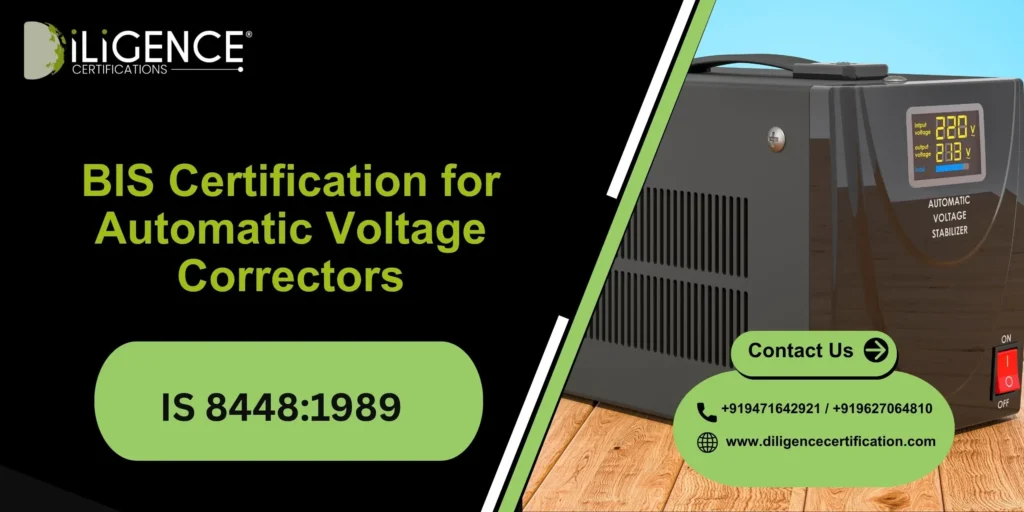
- Mandatory Quality Compliance:BIS certification guarantees that Automatic Voltage Correctors (AVCs) conform to the quality and safety requirements stipulated in IS 8448:1989.
- Covers Domestic Voltage Correctors:This standard is primarily applicable to step-type automatic line voltage correctors for household electrical appliances.
- Ensures Voltage Stability:Certified products are subjected to tests that ensure stable voltage levels in the output, irrespective of input voltage fluctuations.
- Safety Assurance:BIS certification guarantees safety from electrical hazards like overloads, short circuits, and overheating.
- Market Trust & Legal Compliance:Products that carry BIS certification enjoy greater market trust and comply with regulatory norms for sale and distribution in India.
Introduction
Automatic Voltage Correctors (AVCs) are significant electrical devices that serve the purpose of maintaining voltage stability in household electric supply systems. In India, Automatic Voltage Correctors have to comply with the standards set by the Bureau of Indian Standards in IS 8448:1989.BIS standards for Automatic Voltage Correctors ensure that they meet certain requirements in terms of quality, safety, and performance. This standard is specifically applicable to step-type automatic line voltage correctors for household appliances, which safeguards them from damage due to voltage fluctuation.
What is IS 8448:1989?
IS 8448:1989 is a standard set by the Bureau of Indian Standards that specifies the technical characteristics of step type automatic line voltage correctors used in domestic applications. The standard offers in-depth guidelines regarding the design, construction, and performance of these devices in order to ensure their smooth operation in the regulation of voltages.It states the ways in which the voltage correctors should be able to function in different input voltages and still be able to deliver output voltages that are safe and suitable for domestic use.
Key Points:
- Scope of the Standard:It applies to step type automatic voltage correctors used for voltage regulation for household electrical appliances.
- Performance Requirements:It specifies requirements for maintaining a stable output voltage level in spite of changes in the input supply voltage.
- Safety Guidelines:It includes requirements for safety from electrical hazards such as short circuits, overload, and overheating.
- Design & Construction:It includes requirements for the quality of materials, components, and construction of the product.
- Testing & Compliance:It includes requirements for various tests to be performed on the product for BIS certification, such as voltage regulation, insulation resistance, and durability tests.
Products Covered Under IS 8448 : 1989
The standard IS 8448:1989 was developed by the Bureau of Indian Standards and applies to step-type automatic line voltage correctors for domestic purposes. The devices are intended for regulating the varying input voltage and delivering a constant output to guarantee the safe functioning of domestic electrical devices.The standard encompasses various voltage stabilizers and correctors that utilize a single-phase power supply system. The standard is focused on step-type devices that employ step correction mechanisms, usually in the form of relay-based systems.
Key Reasons:
- Step-Type Automatic Voltage Correctors:These are voltage regulators that regulate the voltage in steps to provide stability to the voltage supplied to the appliances.
- Domestic Voltage Stabilizers:Voltage correctors are used to provide voltage stability to home appliances such as TVs, fridges, and air conditioners.
- Single-Phase Voltage Correctors:AVCs are designed to provide voltage stability using a single-phase voltage supply system.
- Relay-Based Voltage Stabilizers:Voltage stabilizers are designed using the relay-based system.
- Appliance-Specific Voltage Correctors:Voltage stabilizers are designed to provide voltage stability to individual appliances such as fridges, air conditioners, and TVs.
Importance and Benefits of BIS Certification
| Importance | Benefits |
| Ensures Product Safety:The Bureau of Indian Standards certification ensures safety from electrical hazards like short circuits and overheating. | Enhanced Market Trust:BIS certified products enjoy greater consumer trust due to quality and safety guarantees. |
| Maintains Voltage Stability:The Bureau ensures that voltage correctors function efficiently in varying power conditions. | Better Product Reliability:Reliable performance and durability of certified voltage correctors |
| Regulatory Compliance:The Bureau facilitates compliance with mandatory regulations and standards set by the government to allow sales. | Competitive Advantage:Helps manufacturers differentiate themselves in a competitive market by displaying certification. |
| Quality Assurance:The Bureau ensures that the product meets set standards in design, construction, and performance. | Reduced Risk of Failures:Reduces risk of product failure and associated costs. |
| Consumer Protection:The Bureau safeguards household appliances from damage by ensuring proper voltage regulation. | Wider Market Access:Enables easier entry into the Indian market by abiding by BIS standards. |
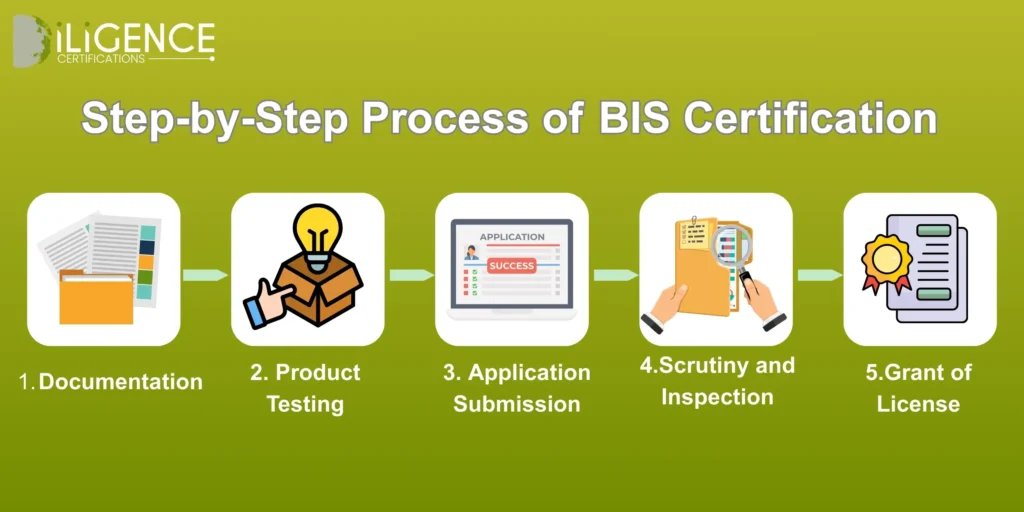
Step-by-Step Process of BIS Certification
Step1:Documentation
- Collect required technical documents
- Prepare product specifications
- Gather company registration details
- Ensure documents follow BIS format
Step2:Product Testing
- Send samples to a BIS-approved lab
- Conduct safety and quality tests
- Receive test reports
- Confirm compliance with BIS standards
Step3:Application Submission
- Fill out the BIS application form
- Upload all required documents
- Attach valid test reports
- Pay the necessary BIS fees
Step4:Scrutiny and Inspection
- BIS reviews submitted documents
- Authority verifies test results
- Factory/product inspection may occur
- Clarifications requested if needed
Step5:Grant of License
- BIS approves the application
- License number is issued
- Product can carry BIS mark
- Renewal required before expiry
Documents Required for BIS Certification
| Category | Documents Required |
| Business Documents | Business license/registration, ISO certificate, organizational details |
| Manufacturer Details | Factory layout, process flow chart, machinery list, production details |
| Product Documents | Product specifications, component list, user manual, model details |
| Testing Documents | Test report from BIS-recognized lab, sample details, test request form |
| Legal & Compliance | Authorization letter, brand ownership proof, trademark certificate (if any) |
| Import/Foreign Manufacturer (If applicable) | AIR (Authorized Indian Representative) details, contract agreement, overseas manufacturer documents |
Timelines, Costs, Validity & Renewal
- Timelines: Usually from 20 to 30 days, with only 7-15 days for the testing.
- Costs: The cost of the government and the test varies depending on the product. There can be some additional charges though.
- Validity: The validity period is 2 years in most situations.
- Renewal: The renewal is done before the expiration; there should be updated documents/tests; the renewal
Why Choose Diligence Certifications
Diligence Certifications is an established consultancy firm that helps companies acquire BIS certification for various products, including the product “Automatic Voltage Correctors” as per the standard “IS 8448: 1989.” The company is well aware of the regulatory requirements for the product, ensuring the process is smooth and hassle-free.The company helps the manufacturer acquire the certification quickly, saving time and avoiding potential delays in the process.
Conclusion
The BIS Certification of Automatic Voltage Correctors under IS 8448:1989 is vital in ensuring the safety, quality, and proper functioning of voltage correctors. By adhering to the guidelines laid down by the Bureau of Indian Standards, businesses can provide voltage correctors that are capable of providing protection to domestic appliances from voltage fluctuations.This not only helps in winning consumer confidence but also helps businesses in meeting regulatory norms while staying ahead in the competitive arena. On a broader note, BIS certification is vital in promoting safe, efficient, and quality electrical appliances in the domestic sector.
Frequently Asked Questions (FAQs)
What is IS 8448:1989?
It is an Indian standard published by the Bureau of Indian Standards for automatic voltage correctors for use in domestic applications.
Is BIS certification for AVCs mandatory?
Yes, it is mandatory for safety, quality, and compliance purposes.
What products are included in the Indian Standard IS 8448:1989?
Step type automatic voltage correctors and domestic voltage stabilizers.
What is the main function of voltage correctors?
The function of voltage correctors is to stabilize voltage to protect electrical appliances from voltage fluctuations.
Who can apply for BIS certification?
Manufacturers, both Indian and foreign.
What tests are conducted for certification?
The tests conducted are performance tests, safety tests, insulation tests, and durability tests.
How long does the certification process take?
The process takes a few weeks.
What is the validity of BIS certification?
The validity of BIS certification is 1-2 years.
What happens if a product is not BIS certified?
The product cannot be sold in India.
How does BIS certification benefit consumers?
It provides safe, reliable, and high-quality products for consumption.