 BIS Certification
 CDSCO
CDSCO
 PESO
PESO
 CPCB
CPCB
 LMPC
LMPC
 WPC Approval
 Global Approvals
 TEC
TEC
 ARAI
ARAI
 BEE
BEE
 ISO Certification
 DGCA Certification
 NOC For Steel
 APEDA Registration























 Business Registration
 FSSAI Mark Certification












 (32).jpg)
 Legal Services
 Trademark Registration
 Copyright Registration
 Patent Registration
 By
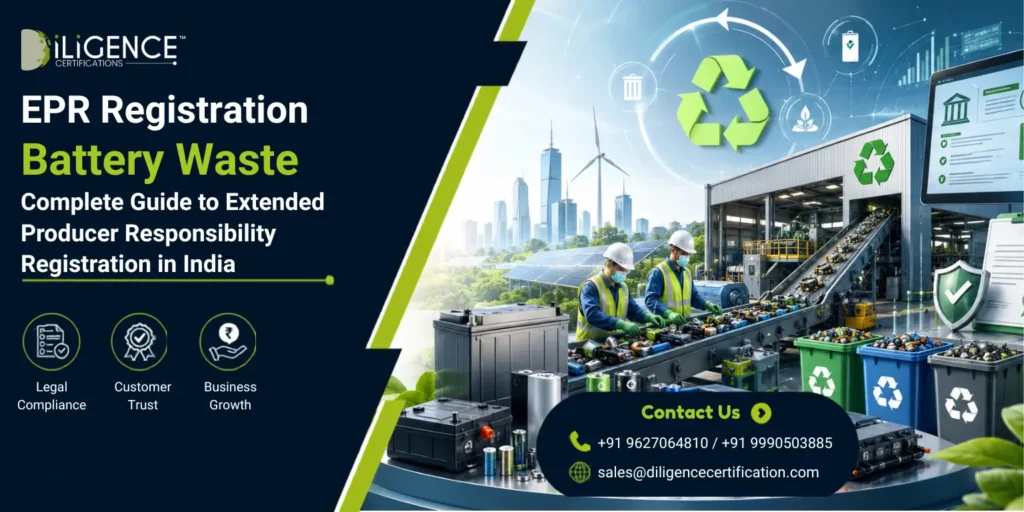
By - Battery Waste Extended Producer Responsibility shows registration of battery waste Extended Producer Responsibility with various types of batteries, recycling of batteries, collection process, and environmental compliance.
- Battery Waste EPR features battery waste Extended Producer Responsibility compliance, battery waste EPR registration, compliance requirements, recycling targets, and sustainable battery waste management.
- Develops professional business graphics for battery waste Extended Producer Responsibility guide blog banner featuring battery recycling, circular economy, and environmental compliance.
Introduction
With the increase in usage of batteries in portable electronic devices, electric vehicles, industrial machines, and storage of energy, battery waste has become an increasingly significant issue. If such batteries are not discarded properly, they can release dangerous chemicals into the environment and affect soil, water, and the public at large. In order to deal with this challenge, the Government of India has made it necessary that Battery Waste Management Rules are followed by all the producers, importers, manufacturers, and obligated organizations.
As per the rules, it is mandatory for the eligible enterprises to get Battery WasteExtended Producer Responsibility Registration from the official CPCB website in order to perform their duty with respect to the recycling, refurbishment, and proper management of battery waste.
Be it the manufacturer of the batteries, importer, producer, brand owner, electric vehicle company, electronics manufacturing industry, MSMEs, startups, and ecommerce organizations working with batteries, Battery Waste EPR Registration becomes an essential part of their journey.
What is Battery Waste EPR?
Battery Waste Extended Producer Responsibilitystands for Battery Waste Extended Producer Responsibility Scheme which is one of the environmental compliance tools developed through the Batteries Waste Management Rules. This system makes sure that battery waste is recycled or processed through recyclers.
The purpose of Battery Waste EPR is to prevent pollution of the environment, resource recovery, recycling, and establishment of a circular economy by ensuring efficient battery waste management.
These services come under Battery Waste Extended Producer Responsibility:
- Registration of EPR
- Battery Waste Management
- Recycling of EPR
- Waste Collection Plan
- Support of Authorized Recycler
- Documentation of EPR
- Compliance Management
- Regulatory Guidance
Battery Waste EPR Registration helps industries comply with environmental regulations in a safe and responsible way by managing battery waste efficiently across India.
Applications of Battery Waste EPR
Battery Waste EPR is meant for enterprises engaging in the manufacture, importation, sale, assembly, and use of batteries and battery-operated devices in India. The registration enables enterprises to follow environmental laws and fulfill their obligations under the Battery Waste Management Rules.
Companies that normally need Battery Waste EPR Registration are as follows:
- Battery Manufacturers
- Importers
- Brand Holders
- Battery Assemblers
- Electric Vehicle Manufacturers
- Electronics Manufacturers
- Consumer Electronic Enterprises
- Renewable Energy Enterprises
- Industrial Equipment Manufacturers
- E-commerce Enterprises
- MSMEs
- Startups
Battery Waste EPR Registration enables enterprises to manage batteries in an environmentally friendly manner.
Who Needs Battery Waste EPR Registration?
Battery Waste EPR Registration is required for the companies that introduce the batteries or the products with batteries to the market in India. This is useful for companies to be compliant with the CPCB guidelines while managing their battery waste responsibly.
The companies which usually need Battery Waste EPR Registration are:
- Manufacturers
- Importers
- Brand Owners
- Battery Manufacturers
- Battery Importers
- Electric Vehicles companies
- Electronics Companies
- Renewable Energy Equipment manufacturers
- Industrial Batteries suppliers
- E-commerce companies
- MSMEs
- Startups
The Battery Waste EPR Registration helps companies to comply with their environmental responsibilities while operating legally.
Types of Compliance Under Battery Waste EPR
Compliance requirements vary depending on the type of business, category of batteries handled, and applicable EPR obligations. Meeting these compliance requirements helps businesses remain legally compliant while contributing to sustainable battery waste management.
Battery Waste EPR Registration Compliance
Eligible businesses must obtain Battery Waste EPR Registration through the CPCB portal.
The registration generally includes:
- Business Registration
- PAN Details
- GST Registration
- IEC (if applicable)
- Authorized Signatory Details
- Battery Category Details
- Business Category
Useful for:
- Producers
- Importers
- Brand Owners
- Battery Manufacturers
- MSMEs
- Startups
Maintaining accurate registration details helps businesses comply with the Battery Waste Management Rules and applicable CPCB guidelines.
Battery Waste Collection & Recycling Compliance
Registered entities are responsible for ensuring that waste batteries are collected, recycled, refurbished, or processed through authorized recyclers or refurbishers.
This generally includes:
- Waste Battery Collection
- Recycling
- Refurbishment
- Authorized Recycler Engagement
- EPR Target Fulfilment
- Environmentally Sound Disposal
Useful for:
- Producers
- Importers
- Brand Owners
- Battery Manufacturers
- Electronics Companies
Proper battery waste management supports environmental sustainability while helping businesses fulfill their EPR obligations.
Documentation & Reporting Compliance
Businesses must maintain accurate records and submit required compliance information under the applicable Battery Waste EPR framework.
Documentation generally includes:
- Registration Records
- Battery Category Details
- Annual Returns
- Recycler Certificates
- Compliance Reports
- Waste Processing Records
Maintaining proper documentation helps businesses demonstrate compliance during inspections and regulatory verification.
Documents Required for Battery Waste EPR Registration
The documents required for Battery Waste EPR Registration may vary depending on the business category, battery type, and operational activities. Proper documentation helps ensure a smooth and hassle-free registration process.
Generally, the required documents include:
- PAN Card
- GST Registration Certificate
- Business Registration Certificate
- IEC (if applicable)
- Authorized Signatory Details
- Address Proof
- Battery Category Details
- Digital Signature Certificate (if applicable)
- Email ID & Mobile Number
- Authorization Letter (if applicable)
- Other documents required by CPCB
Keeping documents updated helps businesses complete Battery Waste EPR Registration efficiently while ensuring compliance with CPCB requirements.
Step-by-Step Registration Process for Battery Waste EPR Registration
Having all the necessary business documents and regulatory documents in place facilitates easy and hassle-free processing of the Battery Waste EPR Registration process. Proper registration process will help reduce the chances of any application rejections or delays.
Step 1: Eligibility Check
Before the application process begins, it is necessary for the applicant to verify the type of business which could be either Producer, Importer, Brand Owner, Manufacturer, etc., according to the Battery Waste Management Rules.
Eligibility check usually involves:
- Business Category
- Battery Type
- EPR Responsibilities
- Regulatory Requirements
Step 2: Gathering All Required Documents
After determining that the applicant qualifies, he/she should gather all the necessary documents prior to filling the online form.
The list of documents will consist of:
- Business Registration Certificate
- PAN Card
- GST Registration Certificate
- Battery Category Details
- Authorized Signatory Details
- Proof of Address
All documents should be available for convenience and time saving.
Step 3: Filling Out the Online Application Form
The applicant is expected to fill out the application form provided on the CPCB Battery Waste EPR portal by supplying relevant details.
The application form usually contains:
- Business Details
- Applicant Details
- Battery Category Details
- Contact Information
- Compliance Details
The supply of correct information facilitates quicker application processing.
Step 4: Verification of the Application
After submission, the CPCB will review the application and verify the documents submitted by the applicant.
Usually, the verification process involves the following:
- Business Information
- Registration Documents
- Battery Category Details
- Compliance Information
- Supporting Documents
In case further information or documents are required, the concerned authority may ask for them prior to approving the application.
Step 5: Battery Waste EPR Registration
After the completion of the successful verification process, the Battery Waste EPR Registration will be obtained by the applicant through the CPCB portal.
With the help of this registration, businesses can:
- Meet their EPR Requirements
- Submit Compliance Reports
- Dispose of Batteries Waste Properly
- Collaborate with Authorized Recyclers
- Obey Relevant Regulations
Battery Waste EPR Registration acts as proof of the compliance of the business with the relevant Battery Waste Management Rules.
Step 6: Compliance
After obtaining the Battery Waste EPR Registration, businesses are required to keep up with all the guidelines and rules of the CPCB and Battery Waste Management Rules.
Usually, this involves:
- Meeting EPR Targets
- Keeping Records of Compliance
- Filing Returns
- Updating Business Information
Compliance with Battery Waste Management Rules
Timeline, Cost & Validity of Battery Waste EPR Registration
The timeline, cost, and validity of Battery Waste EPR Registration depend on factors such as document readiness, application verification, and applicable compliance requirements.
| Timeline | Cost | Validity |
| The registration timeline depends on document verification and application processing. | The cost depends on the applicable government fee and professional service charges, if any. | Battery Waste EPR Registration remains valid as per the prevailing CPCB guidelines. |
| Proper documentation helps reduce processing delays. | Additional charges may vary depending on business requirements. | Businesses should comply with applicable renewal or update requirements whenever necessary. |
| Processing time may vary based on the completeness of the application. | Proper planning helps manage the registration cost efficiently. | Maintaining updated business information helps ensure continued compliance. |
Importance & Benefits of Battery Waste EPR Registration
| Importance | Benefits |
| Helps businesses comply with Battery Waste Management Rules and EPR regulations. | Enhances business credibility and demonstrates environmental responsibility. |
| Supports proper collection, recycling, refurbishment, and environmentally sound disposal of waste batteries. | Improves brand reputation among customers and business partners. |
| Encourages responsible battery waste management and regulatory compliance. | Enables smooth compliance with CPCB requirements and environmental standards. |
| Promotes sustainable business practices and circular economy initiatives. | Reduces compliance risks and improves operational efficiency. |
| Helps businesses fulfil their legal environmental obligations. | Strengthens long-term business sustainability and regulatory confidence. |
Why is Battery Waste EPR Registration Important?
Battery Waste Extended Producer Responsibility (EPR) Registration is an important step in compliance for the industries involved in the manufacture, importation, assembly, or sale of batteries and battery-powered products in India. The process will ensure the industry remains compliant with the Battery Waste Management Rules in India while supporting responsible collection, recycling, refurbishment, and environmentally sound waste disposal.
Being properly compliant with Battery Waste EPR will not only help businesses remain compliant with the law but will also promote resource conservation through material recovery of critical metals like lithium, cobalt, nickel, and lead. It also promotes the reduction of environmental pollution and the development of a sustainable circular economy.
The importance of Battery Waste EPR Registration is explained through the following points:
- Regulatory Compliance
- Environmental Protection
- Responsible Battery Waste Management
- Sustainable Business Practices
- Promotion of Circular Economy
Battery Waste EPR Registration provides the business community with a well-structured system for responsible battery waste management.
Consequences of Non-Compliance with Battery Waste EPR Requirements
The organizations that fall under the purview of Battery Waste Management Regulations and do not follow Battery Waste EPR obligations could have certain regulatory and operational concerns. This non-compliance would affect both the continuity of the business and the environmental compliance of the organization.
Some of the possible effects could be:
- Non-compliance with CPCB guidelines
- Regulatory actions by the competent authorities
- Environmental compensation (EC), where applicable
- Delay in business operations
- Loss of business credibility
- Compliance risks
- Fewer business opportunities
- Complications during regulatory inspections
- Brand damage
Adherence to Battery Waste EPR regulations would help organizations comply with environmental obligations.
Renewal of Battery Waste EPR Registration
In order to enjoy the benefits of Battery Waste EPR Registration, companies need to make sure that their registration information stays updated according to the latest CPCB guidelines. Any changes in terms of business information, signatory information, contact details, battery categories, or compliance records must be made whenever needed.
Staying up-to-date with regard to the registration information would enable businesses to comply continuously with the Battery Waste Management Rules and fulfill their EPR obligations without facing any problems with the regulatory authorities.
The following are the usual activities undertaken to update registration information:
- Update Business Information
- Verify Registration Information
- Update Battery Category Information
- Submission of Required Documents
- Adherence to CPCB Guidelines
Battery Waste EPR Registration enables businesses to carry out their operations without any difficulty in compliance with the relevant environment regulations and EPR compliance requirements.
How Professional Assistance Helps in Battery Waste EPR Registration?
Documentation for Battery Waste EPR Registration needs to be done in accordance with the rules and guidelines set by the CPCB and also the Battery Waste Management Rules. Even a minor mistake in the process of documentation will create problems and doubts for the company during the time of registration.
With the help of professionals, the whole process of registration becomes easy as the business organizations get to know their EPR obligations and documentations through which they can register.
Professional services typically assist businesses in:
- Understanding Battery Waste EPR requirements
- Document preparation and verification
- Filing the online application
- Compliance obligation guidance
- Resolving documentation issues
- Tracking application status
- Responding to regulatory queries
The professional services generally include:
- Eligibility assessment
- Documentation assistance
- Online registration support
- Compliance advisory
- Application status tracking
- Query resolution
Professional assistance enables businesses to complete Battery Waste EPR Registration efficiently while reducing compliance risks and ensuring smooth regulatory approval.
Why Choose Diligence Certifications for Battery Waste EPR Registration?
The Battery Waste EPR Registration requires documentation, appropriate filing, and continuous compliance with the Battery Waste Management Rules. Professional assistance can help businesses register with ease while complying with the CPCB guidelines.
Diligence Certifications provides complete assistance in Battery Waste EPR Registration and thus enables businesses to concentrate on their business activities while professionals handle the whole process of registration and compliance.
Some of the key benefits of choosing Diligence Certifications include:
- Complete documentation assistance
- Support in online application filing
- Guidance on CPCB compliance requirements
- Quick resolution of registration-related queries
- End-to-end registration support
- Post-registration compliance assistance
Obtaining Battery Waste EPR Registration with Diligence Certifications makes the registration process simple, efficient, and fully compliant with applicable regulations.
Conclusion
Battery Waste Extended Producer Responsibility (EPR) Registration is a mandatory compliance requirement for businesses who manufacture, import, sell, assemble, or offer their batteries and battery-operated goods in the Indian marketplace. Through this requirement, businesses can ensure compliance with the Battery Waste Management Rules, which in turn helps them to achieve proper collection, recycling, refurbishing, and environmentally responsible battery waste management.
No matter if you are a producer, importer, brand owner, battery manufacturer, electronics company, electric vehicle manufacturer, MSME, startup, or e-commerce company; Battery Waste EPR Registration can help you fulfill your legal requirements and make a contribution towards the sustainable development of the circular economy.
Frequently Asked Questions
Battery Waste EPR Registration - What is It?
Battery Waste EPR Registration is a license provided to eligible Producers, Importers, Brand Owners, and other entities as per Battery Waste Management Rules for proper battery waste management.
Who is Eligible for Battery Waste EPR Registration?
Producers, importers, brand owners, battery manufacturers, battery importers, electric vehicle firms, electronics manufacturers, MSMEs, startups, renewable energy firms, and other companies involved in batteries are eligible for Battery Waste EPR Registration.
Is Battery Waste EPR Registration Mandatory?
Yes. Battery Waste EPR Registration is mandatory for eligible firms as per the Battery Waste Management Rules and relevant CPCB guidelines.
Is Battery Waste EPR Registration Valid for MSMEs and Startups?
Yes. MSMEs, startups, producers, importers, brand owners, battery manufacturers, and other eligible entities involved in batteries must obtain Battery Waste EPR Registration.
Why is Battery Waste EPR Registration Important?
The Battery Waste EPR Registration is important for businesses to meet environmental regulations, handle battery waste, fulfill Extended Producer Responsibility requirements, enhance credibility, and manage waste sustainably.
Is Battery Waste EPR Registration an Environmental Sustainable Initiative?
Yes. Battery Waste EPR Registration ensures the responsible collection, recycling, refurbishing, resource recovery, and environmentally safe disposal of waste batteries.
How Can Professional Consultants Help with Battery Waste EPR Registration?
Professional consultants can help companies through the following processes related to Battery Waste EPR Registration: eligibility assessment, documentation preparation, submission of applications online, compliance management, tracking applications, and even beyond registration.
Who needs Battery Waste EPR Registration in India?
Battery Waste EPR Registration is required for producers, importers, manufacturers, and brand owners who place batteries or battery-operated products in the Indian market. They must comply with the Battery Waste Management Rules and CPCB guidelines.
Which documents are required for Battery Waste EPR Registration?
Common documents include the company's PAN, GST certificate, CIN or business registration, IEC (if applicable), authorized signatory details, product information, and other documents required by the CPCB portal.
What are the benefits of Battery Waste EPR Registration?
Battery Waste EPR Registration ensures legal compliance, promotes environmentally responsible battery recycling, helps avoid penalties, improves brand credibility, and supports sustainable waste management practices.