BIS Certification
 CDSCO
CDSCO
 PESO
PESO
 CPCB
CPCB
 LMPC
LMPC
 WPC Approval
 Global Approvals
 TEC
TEC
 ARAI
ARAI
 BEE
BEE
 ISO Certification
 DGCA Certification
 NOC For Steel
 APEDA Registration























 Business Registration
 FSSAI Mark Certification












 (32).jpg)
 Legal Services
 Trademark Registration
 Copyright Registration
 Patent Registration
 By
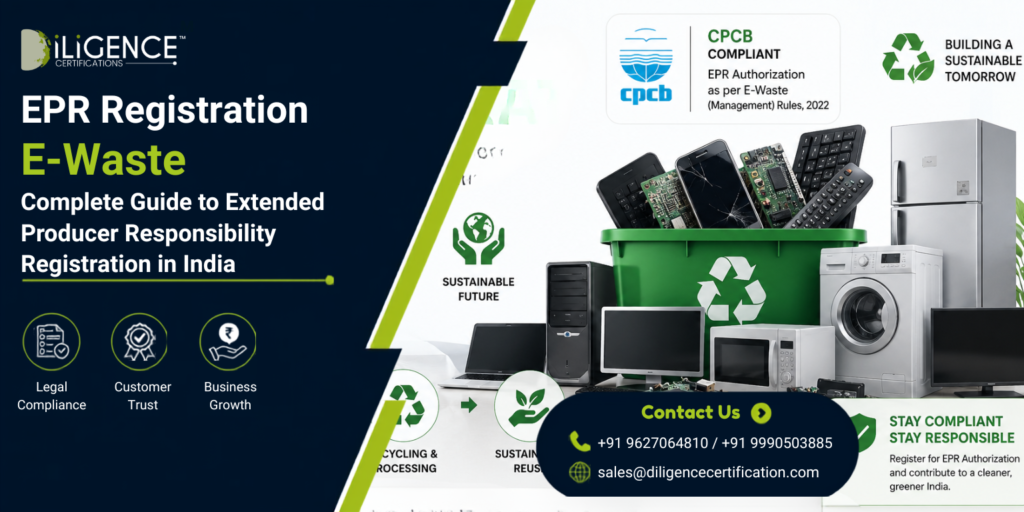
By - Full coverage of E-Waste EPR Registration Process including eligibility criteria, documents required, and CPCB compliance requirements.
- Elucidates about who requires E-Waste EPR Registration and how companies can meet their recycling and EPR requirements.
- Supports producers, importers, brand holders, MSMEs, and startups in meeting their requirements under E-Waste Management Rules.
Introduction
Due to the rise in the use of electronics like mobile phones, laptops, television, computers, and domestic appliances, the generation of e-waste has increased rapidly in India. Disposal of e-waste through incorrect ways may adversely affect the environment and even human health due to the presence of hazardous material. To resolve this problem, E-Waste EPR Registration has been made mandatory for qualified businesses by the Government of India under E-Waste (Management) Rules.
Businesses producing, importing, and selling electrical or electronic products must get E-Waste EPR Registration via the CPCB portal to ensure correct collection, recycling, and disposal of electronic waste through authorized recyclers.
What is E-Waste EPR Registration?
E-Waste EPR Registration is one of the methods used for complying with the rules regarding E-Waste (Management) Rules and is designed in such a way as to ensure that producers take care of electronic waste that is created due to their production processes.
The services typically include:
- E-Waste EPR Registration
- E-Waste Management
- Waste Collection
- Recycling Management
- Authorized Recycler Services
- Documentation & Compliance
- Regulatory Guidance
E-Waste EPR Registration ensures that companies comply with CPCB regulations and contribute towards making the environment clean and sustainable.
Applications of E-Waste EPR Registration
E-Waste EPR Registration applies to businesses involved in manufacturing, importing, branding, assembling, or selling electrical and electronic equipment in India.
Businesses that generally require registration include:
- Producers
- Importers
- Brand Owners
- Electronics Manufacturers
- Consumer Electronics Companies
- Home Appliance Manufacturers
- IT Equipment Manufacturers
- E-commerce Businesses
- MSMEs
- Startups
The registration enables businesses to comply with environmental regulations while fulfilling their EPR responsibilities.
Who Needs E-Waste EPR Registration?
E-Waste EPR Registration is required for businesses introducing electrical or electronic equipment into the Indian market. It ensures compliance with CPCB guidelines and promotes responsible e-waste management.
It is generally required for:
- Producers
- Importers
- Brand Owners
- Electronics Manufacturers
- Electrical Equipment Manufacturers
- Consumer Electronics Companies
- E-commerce Companies
- MSMEs
- Startups
Obtaining E-Waste EPR Registration helps businesses operate legally while meeting their environmental obligations.
Types of Compliance Under E-Waste EPR Registration
E-Waste EPR Registration Compliance
Eligible businesses must obtain E-Waste EPR Registration through the CPCB portal.
The registration generally includes:
- Business Registration
- PAN Details
- GST Registration
- IEC (if applicable)
- Authorized Signatory Details
- Product Category Details
- Business Category
Useful for:
- Producers
- Importers
- Brand Owners
- Manufacturers
- MSMEs
- Startups
Maintaining accurate registration details helps businesses comply with CPCB requirements.
E-Waste Collection & Recycling Compliance
Registered entities must ensure that electronic waste is collected, recycled, refurbished, or disposed of through authorized recyclers.
This generally includes:
- E-Waste Collection
- Recycling
- Refurbishment
- Authorized Recycler Engagement
- EPR Target Fulfilment
- Environmentally Sound Disposal
Useful for:
- Producers
- Importers
- Brand Owners
- Electronics Manufacturers
- Consumer Electronics Companies
Documentation & Reporting Compliance
Businesses are required to maintain proper records and submit compliance reports under the applicable E-Waste Management framework.
Documentation generally includes:
- Registration Records
- Product Category Details
- Annual Returns
- Recycler Certificates
- Compliance Reports
- Waste Processing Records
Documents Required for E-Waste EPR Registration
Generally, the required documents include:
- PAN Card
- GST Registration Certificate
- Business Registration Certificate
- IEC (if applicable)
- Authorized Signatory Details
- Address Proof
- Product Category Details
- Digital Signature Certificate (if applicable)
- Email ID & Mobile Number
- Authorization Letter (if applicable)
- Other documents required by CPCB
Keeping documents updated helps ensure a smooth and hassle-free registration process.
Step-by-Step Process for E-Waste EPR Registration
Step 1: Eligibility Check
First, it is important to check if the applicant belongs to the business category and EPR requirement according to the rules.
These usually consist of:
- Business Category
- Product Category
- EPR Obligations
- Regulatory Requirements
Step 2: Collecting All Necessary Documents
It is essential to collect all the necessary documents after making sure about the eligibility criteria before submitting the online application form.
The documents needed generally consist of:
- Business Registration Certificate
- PAN Card
- GST Registration Certificate
- Product Category Details
- Authorized Signatory Details
- Proof of Address
Step 2: Completion of the Online Application Form
Having collected all the necessary documents, the applicant needs to fill out the online application form through the official CPCB E-Waste EPR portal by giving accurate information about the business and the product.
Generally, an application form contains:
- Details of Business
- Details of Applicant
- Details of Product Category
- Contact Details
- Details of EPR Compliance
Accuracy of information will make sure that the application process goes without any unnecessary delay.
Step 3: Verification of the Application
The application form having been filled out, the CPCB verifies the information and the documents provided by the applicant.
Generally, verification involves:
- Details of Business
- Documents for Registration
- Details of Product Category
- Details of Compliance
- Supporting Documents
If more information is needed, the concerned authority may ask for more documents before approving the application.
Step 4: E-Waste EPR Registration
Upon successful verification, the applicant receives E-Waste EPR Registration from the CPCB Portal.
The E-Waste EPR Registration allows businesses to:
- Meet EPR Requirements
- Submit Compliance Reports
- Handle E-Waste Efficiently
- Collaborate with Authorized Recyclers
- Observe Relevant Regulatory Requirements
The E-Waste EPR Registration acts as evidence that a business complies with the relevant E-Waste (Management) Rules and CPCB Regulations.
Step 5: Compliance
Upon receipt of the registration, the business is expected to continue adhering to the relevant CPCB guidelines and E-Waste Management Rules.
In most cases, this means the business will be required to:
- Achieve EPR Targets
- Maintain Compliance Records
- File Returns
- Update Business Information
- Comply with Relevant E-Waste Regulations
Timeline, Cost & Validity of E-Waste EPR Registration
The timeline, cost, and validity of E-Waste EPR Registration depend on document readiness, application verification, and applicable compliance requirements.
| Timeline | Cost | Validity |
| The registration timeline depends on document verification and application processing. | The cost depends on the applicable government fee and professional service charges, if any. | E-Waste EPR Registration remains valid as per the prevailing CPCB guidelines. |
| Proper documentation helps reduce processing delays. | Additional charges may vary depending on business requirements. | Businesses should comply with applicable renewal or update requirements whenever necessary. |
| Processing time may vary based on the completeness of the application. | Proper planning helps manage the registration cost efficiently. | Maintaining updated business information helps ensure continued compliance. |
Importance & Benefits of E-Waste EPR Registration
| Importance | Benefits |
| Helps businesses comply with the E-Waste (Management) Rules and EPR regulations. | Enhances business credibility and demonstrates environmental responsibility. |
| Supports proper collection, recycling, refurbishment, and environmentally sound disposal of electronic waste. | Improves brand reputation among customers and business partners. |
| Encourages responsible e-waste management and regulatory compliance. | Enables smooth compliance with CPCB requirements and environmental standards. |
| Promotes sustainable business practices and circular economy initiatives. | Reduces compliance risks and improves operational efficiency. |
| Helps businesses fulfil their legal environmental obligations. | Strengthens long-term business sustainability and regulatory confidence. |
Why is E-Waste EPR Registration Important?
E-Waste EPR Registration is an important environmental compliance requirement for those businesses engaged in manufacturing, importing, branding, or marketing of electrical and electronic equipment in India. This process ensures that business enterprises comply with the E-Waste (Management) Rules by being accountable for the collection, recycling, refurbishing, and environmentally safe disposal of electronic waste.
Effective EPR process not only ensures compliance with legal obligations but also ensures resource recovery, prevents environmental pollution, and fosters the growth of sustainable circular economy. Businesses, with the help of authorized recyclers, are able to recover resources in a most efficient manner and reduce the environmental effect of disposed electronic goods.
Importance of E-Waste EPR Registration can be explained as follows:
- Regulatory Compliance
- Environmental Protection
- E-Waste Management
- Sustainable Business Practices
- Circular Economy
E-Waste EPR Registration enables organizations to manage electronic waste responsibly and remain compliant with the regulations.
Consequences of Non-Compliance with E-Waste EPR Requirements
There are many possible implications for companies that are bound by the E-Waste (Management) Rules and do not comply with their respective EPR requirements. There are many potential implications that non-compliance will bring about.
These include:
- Violation of CPCB norms
- Regulation from the competent authority
- Environment Compensation (EC) where appropriate
- Delay in conducting business operations
- Reputation of the business
- Risks of compliance
- Loss of business opportunities
Implications for inspection by the regulatory authorities
It is important to comply with E-waste EPR requirements in order to ensure compliance and proper environmental management.
Renewal of E-Waste EPR Registration
In order to continue availing all the advantages offered by E-Waste EPR Registration, it is necessary that businesses keep their registration information up-to-date according to the latest CPCB guidelines. The updating of any kind of information related to the business information, authorized signatory information, product category information, contact information, and compliance information needs to be done whenever necessary.
Updating the registration information will ensure continued compliance with the E-Waste (Management) Rules and continuous fulfillment of EPR obligations.
The process of registration updating consists of the following steps:
- Update Business Information
- Verify Registration Information
- Update Product Category Information
- Submit Necessary Documents
- Adhere to CPCB Guidelines
How Professional Assistance Helps in E-Waste EPR Registration?
The documentation required for E-Waste EPR registration must be done in line with the relevant CPCB guidelines and E-Waste Management Rules. Even small mistakes in documentation, product classification, and filling of the application can result in unnecessary delays.
Professional service providers will help businesses to understand the EPR compliance requirements and register for the same efficiently.
Professional services providers usually help businesses with the following things:
- Understanding of E-Waste EPR requirements
- Documentation preparation and validation
- Online filing of the application
- Compliance obligation guidance
- Documentation issue resolution
- Application status tracking
The professional services generally include:
- Eligibility Assessment
- Documentation Assistance
- Online Registration Support
- Compliance Advisory
- Application Status Tracking
- Query Resolution
Professional assistance enables businesses to complete E-Waste EPR Registration efficiently while reducing compliance risks and ensuring a hassle-free approval process.
Why Choose Diligence Certifications for E-Waste EPR Registration?
Getting E-Waste EPR Registration is an important task, and involves proper documentation, proper filling of application and proper compliance of the relevant CPCB guidelines. Guidance from professionals will help companies get E-Waste EPR Registration without facing any delay or trouble regarding compliance issues.
Diligence Certifications assists companies in getting E-Waste EPR Registration, so that companies can concentrate on their business activities.
Some of the key benefits of choosing Diligence Certifications include:
- Complete Documentation Assistance
- Support in Online Application Filing
- Guidance on CPCB Compliance Requirements
- Quick Resolution of Registration-related Queries
- End-to-End Registration Support
- Post-registration Compliance Assistance
Obtaining E-Waste EPR Registration with Diligence Certifications makes the registration process simple, efficient, and fully compliant with applicable regulations.
Conclusion
E-Waste EPR Registration is a vital step for companies that are engaged in manufacturing, importing, branding or marketing of electrical and electronic equipment in India. It not only makes companies compliant with the E-Waste (Management) Rules, but also assists in proper collection, recycling, refurbishment and environmentally sustainable disposal of electronic waste through authorized recyclers.
Be it a producer, importer, brand owner, electronics manufacturer, consumer electronics manufacturer, e-commerce company, MSME, or even a startup; getting E-Waste EPR Registration makes it easier to meet your compliance requirements and proves your commitment towards sustainability. A well-implemented EPR system not only meets regulatory requirements, but also assists in sustainable resource recovery and helps in creating a circular economy.
Frequently Asked Questions
What is E-Waste EPR Registration?
The E-Waste EPR Registration is a compulsion registration process which takes place through the CPCB scheme for the registered producers, importers and brand owners for responsible handling of electronic waste as per E-Waste (Management) Rules.
Who can apply for E-Waste EPR Registration?
Producers, importers, brand owners, electronic goods manufacturers, electrical goods manufacturers, consumer electronics, e-commerce, MSMEs, startups and other eligible organizations that are placing the electrical and electronic equipment in the Indian market are generally supposed to get E-Waste EPR Registration.
Is E-Waste EPR Registration Compulsory?
Yes. E-Waste EPR Registration is compulsory for the eligible entities as per the relevant E-Waste (Management) Rules and guidelines of the CPCB.
Is E-Waste EPR Registration Compulsory for MSMEs and Start-ups?
Yes. MSMEs and start-ups which manufacture, import, and/or sell the eligible electrical and electronic products need to abide by the relevant EPR requirements.
Why is E-Waste EPR Registration Significant?
E-Waste EPR Registration enables businesses to adhere to the relevant regulations on environment, manage the e-waste in a responsible manner, meet the EPR compliance, enhance business reputation, etc.
Is E-Waste EPR Registration Sustainable for Environment?
Yes. It promotes proper collection, recycling, refurbishing, material recovery, and sustainable disposal of electronic waste along with the implementation of circular economy.
How Can Professional Consultants Help in E-Waste EPR Registration?
Professional consultants help companies in conducting an eligibility test, preparing documents, applying online, ensuring compliance, tracking the application process, and so on.
How long does it take to obtain E-Waste EPR Registration?
The timeline for E-Waste EPR Registration depends on document readiness, application accuracy, and CPCB verification. Complete and accurate documentation helps ensure faster processing.
What documents are required for E-Waste EPR Registration?
Businesses generally need a PAN Card, GST Registration Certificate, Business Registration Certificate, IEC (if applicable), Authorized Signatory Details, Address Proof, Product Category Details, and other documents required by the CPCB.
Can producers and importers apply for E-Waste EPR Registration online?
Yes. Eligible producers, importers, and brand owners can apply for E-Waste EPR Registration through the official CPCB online portal by submitting the required documents and compliance information.