BIS Certification
 CDSCO
CDSCO
 PESO
PESO
 CPCB
CPCB
 LMPC
LMPC
 WPC Approval
 Global Approvals
 TEC
TEC
 ARAI
ARAI
 BEE
BEE
 ISO Certification
 DGCA Certification
 NOC For Steel
 APEDA Registration























 Business Registration
 FSSAI Mark Certification












 (32).jpg)
 Legal Services
 Trademark Registration
 Copyright Registration
 Patent Registration
 By
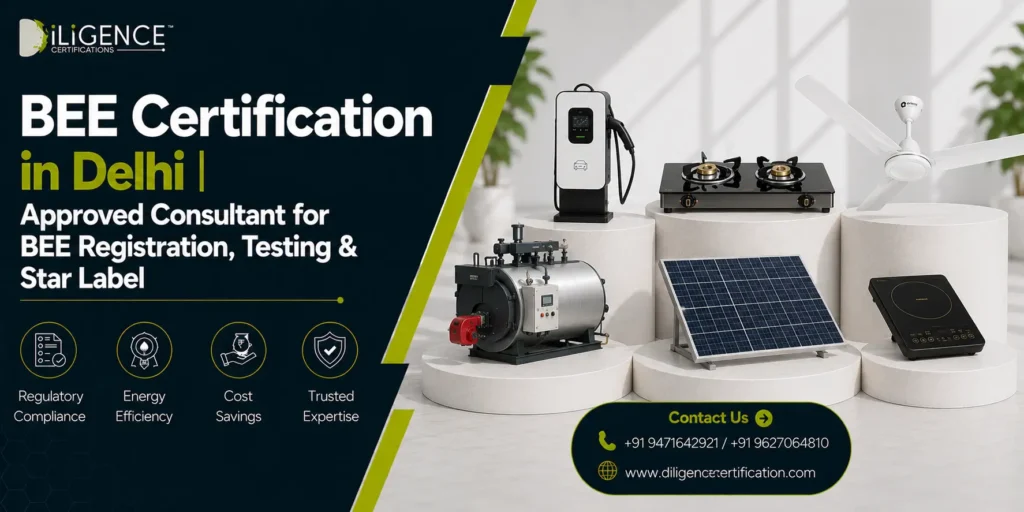
By - BEE Certification in Delhi is required for regulated electrical appliances before sale, import, or distribution in India.
- It includes product testing, brand registration, model registration, star label approval, and renewal compliance.
- Diligence Certifications helps manufacturers and importers complete BEE approval with proper documentation and expert support.
Introduction
One such instance was when an importer from Delhi approached our company once he received his consignment and it was time to sell it, however the product could not be put up for sale as per the e-commerce policy since the product needed a BEE certificate in Delhi. The product was packed, delivered to the warehouse and the process of communicating with the dealers had also begun.
The reason being is that the product required BEE certification to be able to be sold within India. This happens quite often among appliance makers, importers and brand owners who complete the formalities of GST, IEC, custom, BIS, packaging and other logistic requirements, but only realize the need for a BEE certificate later.
BEE Certification is not simply a sticker on the appliance. For customers, the star rating helps compare electricity consumption. For businesses, it becomes a legal and commercial requirement.
What is BEE Certification in Delhi?
BEE Certification in Delhi is the approval process through which regulated electrical appliances are registered under the Bureau of Energy Efficiency’s Standards and Labelling programme. After approval, the product can display the BEE star label according to its energy efficiency performance.
The Bureau of Energy Efficiency has been set up under the Energy Conservation Act to facilitate efficient energy utilization in India. The star rating program by the Bureau assists consumers in recognizing energy-efficient products and aids manufacturers in upgrading the performance of their products.
Delhi happens to be one of the most prominent centers for importing electrical goods, electronic trading, institutional supplies, e-commerce, and manufacturing in India. That is why obtaining BEE Certification in Delhi is crucial for business organizations working with regulated appliances.
Why BEE Certification is Needed?
It is needed because it ensures that the appliance being sold is energy-efficient. It reduces energy use and enables the consumer to compare products easily.
For businesses, BEE Certification helps in:
- Legal sale of notified products
- Retail and marketplace approval
- Better consumer trust
- Stronger brand credibility
- Smooth product launch
- Reduced compliance risk
- Better positioning in energy-efficient categories
If a product falls under a mandatory BEE category, it should not be sold without valid approval and star labelling. Non-compliance can create sales delays, dealer objections, and regulatory issues.
Products Covered Under BEE Certification
The exact requirement depends on the product category and current BEE notification. Some products are covered under mandatory labelling, while others may be covered under voluntary labelling.
Common products that may require BEE registration include:
- Room air conditioners
- Frost-free refrigerators
- Direct cool refrigerators
- Ceiling fans
- LED lamps
- Colour televisions
- Washing machines
- Water heaters
- Distribution transformers
- Deep freezers
- Commercial refrigeration products
- Other notified electrical appliances
Before applying, the product category must be checked properly. Wrong category selection can lead to wrong testing, wrong documentation, and approval delay.
BEE Certification Process in Delhi
The process for BEE Certification in Delhi includes product applicability checking, document preparation, testing, brand registration, model registration, and label approval.
1. Product Category Check
The initial process is verification whether the particular item comes under the compulsory or voluntary scheme of BEE. It is essential to know that each product has its own technical criteria, testing methodology, and labeling requirements.
As for instance, an air conditioner and a ceiling fan may be required to get BEE registration; however, the test and labeling criteria would be different for both items.
2. Document Preparation
After category confirmation, the required business and product documents are collected. This includes company documents, product specifications, brand authorization, model details, and other declarations.
Incomplete or mismatched documents are one of the most common reasons for BEE application delay.
3. Product Testing
The product must be tested according to the applicable standard. Testing confirms the energy performance of the product and helps determine the star rating.
The test report should match the model details, product rating, and technical specifications submitted in the application.
4. Brand Registration
The manufacturer, importer, or brand owner must complete brand registration on the BEE portal. Business details, trademark details, authorization documents, and contact information are reviewed during this stage.
5. Model Registration
After brand registration, the specific model is submitted for BEE approval. The application includes model number, technical specifications, test report details, energy consumption data, and label information.
Each model must be registered carefully. Even a small mismatch in model number, capacity, or rating plate detail can create an objection.
6. Star Label Approval
After review and approval, the BEE star label can be generated for the approved model. The label must be used exactly as per the approved format.
The star label is generally displayed on the product, packaging, catalogue, or product listing, depending on the category requirement.
7. Renewal and Compliance
BEE approval has a validity period. Businesses must track renewal timelines, revised standards, label period changes, and any product modification.
If the product design, energy rating, model number, or technical specifications change, fresh review may be required.
Documents Required for BEE Certification in Delhi
The document list depends on the applicant type, product category, and whether the product is manufactured in India or imported.
Business Documents
- Certificate of Incorporation or firm registration
- GST registration certificate
- Company or firm PAN card
- Import Export Code, if applicable
- Trademark certificate or brand authorization
- Authorized signatory details
- Power of attorney, if applicable
- Undertaking and declarations
Product Documents
- Product technical specifications
- Product catalogue or brochure
- Model number details
- Rating plate details
- Test report
- Product label artwork
- User manual, if required
- Energy consumption details
- Product photographs, if required
Importer Documents
- IEC certificate
- Brand authorization from foreign manufacturer
- Importer business documents
- Product test report
- Model-wise product details
- Authorization letter
- Declaration and undertaking
A proper document review before submission can save several weeks. Many businesses face objections because the test report, rating plate, and model registration details do not match.
BEE Certification for Importers in Delhi
Delhi has a large number of importers dealing in appliances, electronics, lighting products, and consumer goods. For importers, BEE Certification in Delhi is important before selling regulated products in India.
Importers need to ensure that the product is tested according to Indian requirements and that the brand authorization is properly prepared. If the foreign manufacturer owns the brand, the Indian importer may need authorization to apply for BEE registration.
Important points for importers:
- Check whether the product is covered under mandatory BEE labelling
- Confirm model details before shipment
- Arrange proper brand authorization
- Keep IEC and business documents ready
- Ensure the test report matches Indian BEE requirements
- Do not print labels before approval
Importers should start the BEE process before the product enters the market. Waiting until the stock reaches the warehouse can delay sales.
BEE Certification for Manufacturers in Delhi
Manufacturers need BEE approval when their product falls under a notified category. For manufacturers, BEE Certification is linked with product design, energy efficiency, testing, and labelling.
A manufacturer should plan BEE compliance during the product development stage. If the product fails to meet the required energy performance level, changes may be needed before approval.
BEE approval also helps manufacturers position their products better in competitive markets. A higher star-rated product can attract customers who compare electricity savings and long-term operating cost.
Cost of BEE Certification in Delhi
The cost of BEE Certification in Delhi depends on the product category, number of models, testing requirements, government fees, and professional support required.
| Particulars | Details |
| Government Fees | Depends on product category and BEE requirements |
| Testing Charges | Vary based on product type and laboratory requirements |
| Number of Models | More models generally increase overall registration cost |
| Documentation Cost | Depends on technical file preparation |
| Consultancy Fees | Depends on scope of support and compliance complexity |
| Renewal Cost | Applicable as per BEE guidelines and product category |
| Total Cost | Contact Diligence Certifications for a customized estimate |
Businesses should not calculate BEE cost only for one product if they are planning to launch multiple models. A model-wise compliance plan gives better clarity on total cost and timeline.
Timeline for BEE Certification in Delhi
The timeline depends on product testing, document readiness, application accuracy, and BEE review.
| Stage | Expected Timeline |
| Product applicability check | 1-2 working days |
| Document preparation | 3-7 working days |
| Product testing | Depends on product category and lab schedule |
| Brand registration | Depends on document accuracy and review |
| Model registration | Depends on technical review and clarification |
| Final label approval | Subject to BEE processing |
Testing usually takes the most time. If the product category has high testing demand or limited lab availability, the timeline may increase.
Common Mistakes in BEE Registration
Many companies treat BEE registration as a simple online filing process. In reality, it is a technical compliance process.
Common mistakes include:
- Wrong product category selection
- Incomplete test report
- Mismatch in model number
- Wrong rating plate details
- Missing brand authorization
- Incorrect label format
- Applying very close to product launch
- Ignoring renewal dates
- Using old test data
- Not checking updated BEE norms
A small error in model number or capacity can hold the application. That is why professional review is important before submission.
Benefits of BEE Certification in Delhi
BEE Certification gives both legal and commercial benefits.
Major benefits include:
- Legal compliance for notified appliances
- Better consumer confidence
- Easier product listing on marketplaces
- Stronger dealer and distributor acceptance
- Improved brand reputation
- Competitive advantage through star rating
- Support in institutional sales and tenders
- Alignment with energy efficiency goals
In Delhi NCR, customers are highly price-conscious, but they also compare electricity bills. A star-rated appliance can be easier to sell because it shows long-term savings.
Why Choose Diligence Certifications for BEE Certification in Delhi?
Diligence Certifications helps manufacturers, importers, and brand owners complete BEE registration with proper documentation and compliance support.
Our services include:
- Product category applicability check
- Document preparation
- Test report review
- Testing coordination support
- Brand registration assistance
- Model registration filing
- Star label approval guidance
- Renewal support
- Importer and manufacturer advisory
We work as a compliance partner, not just a filing agency. Our focus is to reduce avoidable objections, maintain document accuracy, and help clients move through the approval process smoothly.
Conclusion
Certification for BEE appliances in Delhi is crucial for manufacturers, importers, and brand owners involved in selling electrical equipment regulated under law. This will assist companies in selling their goods legally and meeting Indian energy conservation standards.
Prior to marketing any appliances in the market, a company must examine various factors including applicability of certification, testing process, model specifications, label validity, and required documents.For expert support with BEE Certification in Delhi, contact Diligence Certifications and talk to our consultants for a customized approval plan.
For expert support with BEE Certification in Delhi, contact Diligence Certifications and talk to our consultants for a customized approval plan.
Frequently Asked Questions
What is BEE Certification in Delhi?
BEE Certification in Delhi is the approval required for regulated electrical appliances under the Bureau of Energy Efficiency’s Standards and Labelling programme. It allows approved products to display the BEE star label.
Is BEE Certification mandatory in Delhi?
Yes, BEE Certification is mandatory for products listed under BEE’s mandatory labelling scheme. Such products should not be sold, imported, or distributed without valid approval.
Who needs BEE Certification in Delhi?
Manufacturers, importers, brand owners, and sellers dealing in notified electrical appliances need BEE Certification in Delhi before placing products in the Indian market.
Which products require BEE Certification?
Products such as air conditioners, refrigerators, ceiling fans, LED lamps, televisions, washing machines, water heaters, and distribution transformers may require BEE approval.
What documents are required for BEE Certification in Delhi?
Generally, business documents, GST, PAN, IEC, trademark or brand authorization, product specifications, model details, rating plate, test report, and declarations are required.
How long does BEE Certification take?
The timeline depends on product category, testing duration, document readiness, application review, and clarification handling. Product testing usually takes the most time.
What is the cost of BEE Certification in Delhi?
The cost depends on government fees, testing charges, number of models, product category, documentation work, and consultancy support. Contact Diligence Certifications for a customized estimate.
Can importers apply for BEE Certification in Delhi?
Yes, importers can apply for BEE Certification if they have proper IEC, business documents, product details, test reports, and brand authorization from the manufacturer or brand owner.
What is BEE star labelling?
BEE star labelling is an energy efficiency rating system that shows how efficiently an appliance uses electricity. A higher star rating generally means better energy efficiency.
Why choose Diligence Certifications for BEE Certification in Delhi?
Diligence Certifications provides end-to-end support for product applicability checks, documentation, testing coordination, brand registration, model registration, star label approval, and renewal compliance.