BIS Certification
 CDSCO
CDSCO
 PESO
PESO
 CPCB
CPCB
 LMPC
LMPC
 WPC Approval
 Global Approvals
 TEC
TEC
 ARAI
ARAI
 BEE
BEE
 ISO Certification
 DGCA Certification
 NOC For Steel
 APEDA Registration























 Business Registration
 FSSAI Mark Certification












 (32).jpg)
 Legal Services
 Trademark Registration
 Copyright Registration
 Patent Registration
 By
By - The BEE Certification process in Kerala is necessary for various products that use energy under the Bureau of Energy Efficiency Standards & Labeling Scheme.
- It is compulsory for manufacturers, importers, brand owners, and traders to perform testing and document preparation, register their brands and models, and apply for a BEE star label certification.
- Diligence Certifications can assist companies in securing BEE Certification in Kerala with product eligibility assessment, testing, and filing applications.
Introduction
An importer from Kochi once sought out a consultant because the consignment of appliances had already arrived at the port. All preparations were made including the setup of dealerships, printing of packages, and planning of the launches in the cities of Ernakulam, Thrissur, Kozhikode, and Thiruvananthapuram. However, there was just one problem, and that was the fact that the product line needed a BEE Certification before selling in Kerala.
The business had handled GST, import documents, logistics, warehouse planning, and distributor agreements. Still, one compliance gap was enough to stop commercial movement. If an appliance falls under BEE’s mandatory Standards and Labelling programme, it cannot be marketed casually without proper approval.
This case applies to companies that are engaged in selling ceiling fans, air conditioners, refrigerators, LED lights, geysers, washing machines, commercial coolers, motors, chillers, LPG stoves, and other energy-efficient devices.
There is a significant presence of consumer appliance sales, electricity awareness, and distribution channels in cities like Kochi, Thiruvananthapuram, Kozhikode, Kollam, Thrissur, Kannur, Palakkad, Alappuzha, and Malappuram. In the case of marketing regulated appliances in the state of Kerala, the BEE certification is no mere government requirement. It is also an essential market criterion.
What is BEE Certification in Kerala?
BEE Certification in Kerala involves the process whereby eligible energy-consuming devices are tested, evaluated, recorded, and certified as per the requirements of the BEE star rating process.
BEE means Bureau of Energy Efficiency, an organization operating under the Ministry of Power of the Government of India. The Standards and Labelling programme of the BEE provides guidance on the relative energy performance, power consumption, and cost savings of different products.
BEE star ratings are provided in the range of 1 star to 5 stars, implying that the higher the number of stars, the greater the level of energy efficiency for that particular product. This assists the consumer in identifying highly efficient products while providing a marketing tool for producers and importers.
Simply put, BEE Certification in Kerala shows that the device has met the requirements of the BEE star rating programme.
Importance and Business Benefits of BEE Certification in Kerala
| Importance of BEE Certification | Business Benefits |
| Required for regulated energy-consuming products | Allows legal sale of applicable products in India |
| Supports compliance with BEE rules | Reduces risk of product rejection or market restriction |
| Helps consumers compare energy performance | Builds buyer confidence |
| Allows use of BEE star label | Improves product visibility in retail and online markets |
| Supports interstate product distribution | Helps dealers and distributors trust the product |
| Strengthens brand reputation | Makes products more acceptable in competitive markets |
| Encourages energy-saving appliances | Supports sustainable business positioning |
For businesses in Kerala, BEE approval becomes important before product launch, import clearance planning, distributor onboarding, retail sale, and e-commerce listing. Dealers may ask for valid BEE approval before stocking regulated appliances.
A product may look good, work well, and have strong pricing. But if it falls under mandatory BEE registration and the approval is missing, the business may face avoidable delays.
Products Covered Under BEE Certification in Kerala
BEE Certification in Kerala applies to different product categories depending on whether the product is covered under mandatory or voluntary BEE Standards and Labelling requirements.
Common product categories include:
- Ceiling fans
- Room air conditioners
- Refrigerators
- LED lamps
- Electric water heaters
- Washing machines
- Colour televisions
- Distribution transformers
- Deep freezers
- Commercial beverage coolers
- Chillers
- Motors
- Pumps
- Domestic LPG stoves
- Induction hobs
- Agricultural pump sets
- Table fans and wall fans
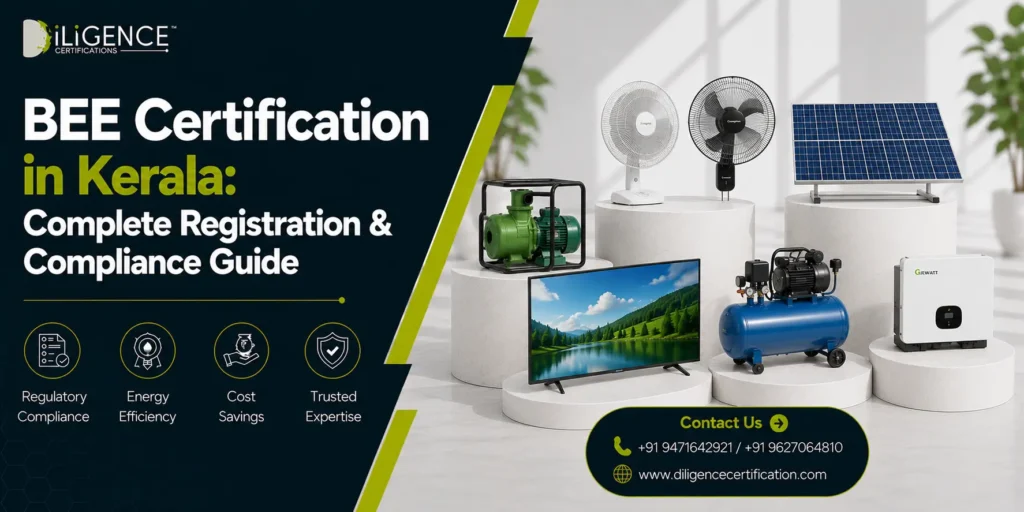
- Solar photovoltaic products
- Air compressors
- Ultra-high-definition televisions
- Grid-connected solar inverters
Businesses should not assume that BEE registration is only for household appliances. Several commercial and industrial products may also fall under energy-efficiency labelling requirements.
Before importing, manufacturing, packaging, or selling a product in Kerala, the product category should be checked properly. This prevents wrong filing, testing mistakes, document mismatch, and compliance queries.
Mandatory and Voluntary BEE Registration
BEE product registration is generally divided into two categories: mandatory registration and voluntary registration.
Mandatory BEE Registration
Mandatory BEE registration applies to products covered under the compulsory Standards and Labelling programme.
For these products, BEE approval must be obtained before manufacturing, importing, distributing, or selling in India. The process generally includes product testing, brand registration, model registration, document submission, and label approval.
Registration becomes compulsory to ensure compliance with the minimum requirements for performance and efficiency. It will also make sure that products not meeting the energy requirements do not come into the market.
For companies in the state of Kerala, BEE certification becomes a necessity since the retailer/distributor/online portal/institutional buyer might require such certification before accepting the product.
Selling a mandatory product without BEE approval can create compliance risk, stock movement issues, commercial loss, and reputational damage.
Voluntary BEE Registration
Voluntary BEE registration applies to product categories where star labelling is not compulsory but is allowed under the BEE programme.
Many companies choose voluntary registration to show that their products are energy efficient. This helps when buyers compare products based on electricity savings, performance, and long-term value.
In the case of the market of Kerala, where buyers tend to compare their costs of operation, the labeling of an appliance based on BEE stars might help shape consumers’ purchasing decisions because it serves as a measure of credibility.
Voluntary BEE registration may also support government supply, corporate procurement, and institutional sales where energy performance is considered during purchase decisions.
Step-by-Step BEE Certification Process in Kerala
The BEE Certification process in Kerala consists of technical review, testing, documentation, online submission, and certification. The process must not be taken to be just a matter of filling forms.
Even a minor discrepancy in model number, brand name, rating plate information, test report, and other label details can put a stop to the process.
Step 1: Product Category Check
The first step involves verifying the product category of mandatory or voluntary BEE registration.
Product category, testing standards, labeling duration, star rating chart, and technical criteria need to be verified here, which determine the entire compliance process. For instance, the requirements of the LED lamp would differ from those of the air conditioner, refrigerator, commercial cooler, motors, or domestic LPG stove.
The correct product categorization will help the organization to understand the necessity of testing and required documents along with the application format.
Step 2: Brand Registration
Brand registration is a prerequisite to model registration. Documents such as company information, trademark documentation, authorization letters, etc., have to be submitted by the applicant.
In case the brand and manufacturer are different from each other, it becomes imperative to ensure proper authorization. Foreign manufacturers might need documentation from importers as well.
Trademark details not matching, lack of proper authorization letter, and discrepancy in ownership of the brand are some causes of delays in BEE certification process in Kerala.
Step 3: Product Testing
The product model must be tested as per the applicable energy-performance requirements.
The test report should match the BEE application details. Model number, rating, capacity, product specification, and brand name must remain consistent.
A test report with mismatched details can create queries during review. In some cases, the company may need correction, clarification, or fresh testing.
For importers, testing planning should begin before large shipment movement. Waiting until the product reaches the warehouse can create unnecessary commercial pressure.
Step 4: Model Registration
After testing, model registration is filed with BEE. This includes model number, technical details, energy consumption, rated capacity, test values, label period, and product specifications.
BEE approval is generally issued model-wise. If a company has multiple models, each model may require separate registration as per applicable rules.
For manufacturers and importers supplying products across Kochi, Thiruvananthapuram, Kozhikode, Kollam, Thrissur, Kannur, Palakkad, and Alappuzha, this stage becomes important when multiple variants are sold under one brand.
Step 5: Document Review
BEE reviews the application, test report, technical file, brand documents, declarations, and label details.
If BEE raises a query, the applicant must respond with correct supporting documents. A technical query should be answered with technical accuracy, not general explanation.
Many applications are delayed because query replies are prepared without checking the test report, rating plate, product photograph, and application details together.
Step 6: Label Approval
After approval, the company receives permission to use the BEE star label on the approved model.
The label must be used strictly as per BEE requirements. The product label should show correct star rating, model number, energy consumption, validity period, and other required details.
Incorrect use of the label can create compliance issues even after approval. Therefore, label artwork should be checked carefully before printing on packaging or product material.
Documents Required for BEE Certification in Kerala
The document list depends on product category, applicant type, brand ownership, manufacturing location, and import status.
Common documents include:
- Company registration certificate
- GST certificate
- Factory licence or manufacturing proof
- Trademark certificate or trademark application
- Brand authorisation letter
- ISO certificate, if applicable
- Product technical specification sheet
- Product test report
- Sample label design
- Product photographs
- Rating plate details
- Model number details
- Authorisation letter
- Import Export Code, if applicable
- MSME certificate, if available
- Undertakings and declarations
- Foreign manufacturer authorisation, if applicable
- Import documents, if applicable
For importers, documentation needs closer attention. The brand name, manufacturer name, product model, invoice details, and authorisation documents should match properly.
A small difference in product name or model number may look minor to the business team, but it can become a compliance issue during BEE review.
Common Challenges in BEE Certification in Kerala
Many businesses face delays because they assume BEE registration is only an online process. In reality, approval depends on technical accuracy.
Common challenges include:
- Wrong product category selection
- Incorrect model number
- Mismatch between test report and application
- Incomplete trademark documents
- Wrong label period selection
- Delay in laboratory testing
- Poorly prepared technical file
- Missing importer authorisation
- Incorrect star rating calculation
- Incomplete declaration formats
- Query response errors
- Difference between product photo and test report details
A practical example is a company submitting a test report with one model number while the packaging shows a slightly different model code. The sales team may treat it as a harmless variation. The reviewing authority may treat it as a mismatch.
That is why BEE Certification in Kerala should be managed with proper document checking before submission.
BEE Certification Cost, Timeline, and Validity in Kerala
The cost, timeline, and validity of BEE Certification in Kerala depend on product category, testing requirements, number of models, government fees, documentation, and review process.
Diligence Certifications does not recommend guessing the cost without checking product details. A ceiling fan, LED lamp, air conditioner, refrigerator, washing machine, motor, pump, or commercial cooler may have different testing and technical requirements.
| BEE Certification Cost | BEE Certification Timeline | BEE Certification Validity |
| Depends on product category and BEE requirements | Depends on testing, documentation, and application review | Depends on applicable BEE rules and label period |
| Influenced by laboratory testing and government fees | Complete documents can reduce delays | Validity remains as per approved registration |
| May vary according to number of models | BEE queries may extend the process | Renewal may be required after expiry |
| Importer cases may require additional documents | Testing timeline affects filing | Continued compliance is required |
| Documentation support may affect total cost | Incorrect submissions can delay approval | Regulatory updates must be monitored |
For an accurate estimate, businesses should share product category, model details, brand ownership status, manufacturing location, and import status with a consultant.
BEE Certification in Kerala for Manufacturers
Manufacturers in Kerala dealing with regulated energy-consuming products must ensure that their products are tested and registered before supply.
This is relevant for businesses operating in Kochi, Thiruvananthapuram, Kozhikode, Kollam, Thrissur, Kannur, Palakkad, Malappuram, Alappuzha, and nearby industrial areas.
A manufacturer should align product design, rating plate, model code, technical sheet, and test sample from the beginning. Changes after testing may affect the application.
Manufacturers should also maintain records for renewal, surveillance, model updates, and future compliance checks.
BEE Certification in Kerala for Importers
Importers dealing in energy-consuming products must check BEE requirements before importing goods into India.
Where the product is covered under mandatory BEE registration, the importer may need brand authorisation, foreign manufacturer documents, product specifications, test reports, and model details.
For importers supplying Kerala markets through Kochi, Thiruvananthapuram, Kozhikode, Thrissur, Kollam, and other commercial centres, early compliance planning helps avoid stock delays.
Importers should not wait until goods are ready for dispatch or retail sale. BEE applicability should be checked before purchase orders, packaging approval, and shipment planning.
Why Choose Diligence Certifications?
Diligence Certifications supports manufacturers, importers, traders, and brand owners with BEE Certification in Kerala and across India.
Our team assists with:
- Product category identification
- BEE applicability check
- Brand registration support
- Documentation preparation
- Testing coordination
- Model registration filing
- Query response support
- Label approval assistance
- Renewal and compliance guidance
The main benefit of professional support is error control. Most BEE registration delays do not happen because the product is poor. They happen because documents, test reports, label details, or technical specifications are not aligned.
Conclusion
BEE certification in Kerala is essential for businesses engaged in the manufacture, import, trading and branding of regulated energy-consuming items. This will help ensure market compliance, consumer trust, credibility of products, and efficient distribution within the country.
Companies doing business in cities such as Kochi, Thiruvananthapuram, Kozhikode, Thrissur, Kollam, Kannur, Palakkad, Malappuram, Alappuzha, and others in Kerala need to verify the relevance of BEE certification for their product before starting production, importation, packaging and sales.
Even when a product appears robust and appealing in terms of its technical features and market potential, an appropriate certification may be lacking.
Get started on BEE Certification in Kerala by reaching out to Diligence Certifications.