BIS Certification
 CDSCO
CDSCO
 PESO
PESO
 CPCB
CPCB
 LMPC
LMPC
 WPC Approval
 Global Approvals
 TEC
TEC
 ARAI
ARAI
 BEE
BEE
 ISO Certification
 DGCA Certification
 NOC For Steel
 APEDA Registration























 Business Registration
 FSSAI Mark Certification












 (32).jpg)
 Legal Services
 Trademark Registration
 Copyright Registration
 Patent Registration
 By
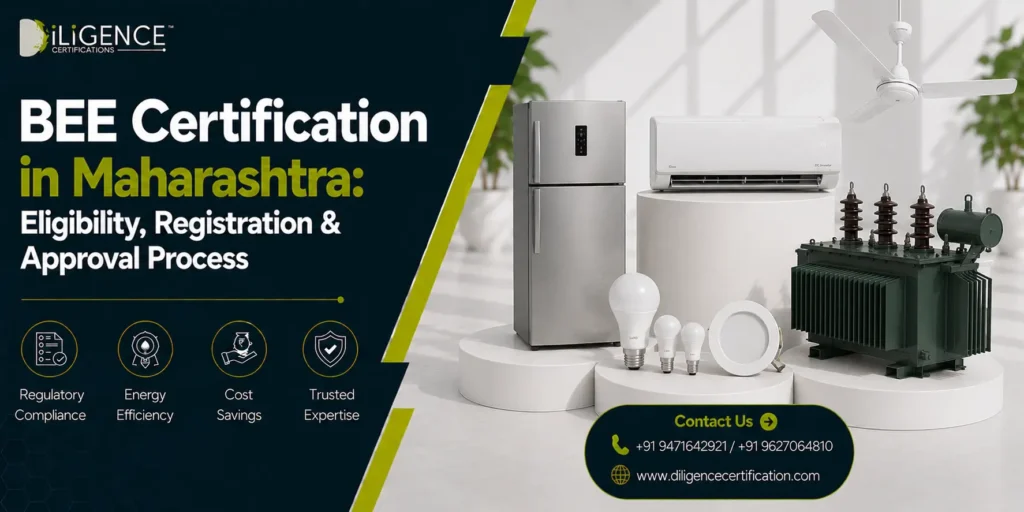
By - It is mandatory for manufacturers/importers/brand owners to get certification in Maharashtra for regulated electrical appliances and energy-consuming products in India.
- Testing, branding, model registration, and star labeling need to be done by the manufacturer/importer/brand owner to be eligible.
- Diligence Certifications provides assistance in handling BEE paperwork, testing coordination, filing, etc.
Introduction : BEE Certification in Maharashtra
One such company based out of Pune intended to introduce their range of energy-efficient ceiling fans in the state of Maharashtra. Everything from designing of the product to printing of the package had been taken care of. However, at the last moment, one big distributor posed a very basic question: “Is the BEE star label approval done?”
That one question stopped the entire dispatch.
While the company had finished testing for its products in the laboratory, it was yet to register its brand and get approval for its model in accordance with the Bureau of Energy Efficiency. However, the merchant would not stock the product on his shelves until it got BEE approval.
Such a case is prevalent in the state of Maharashtra as it is known for its manufacturing and trading industry. Companies working in cities like Mumbai, Pune, Nasik, Nagpur, Aurangabad, Thane, Navi Mumbai, Kolhapur, Satara, Solapur, and their surrounding industrial zones come across problems associated with appliances like electric devices, motors, pumps, lighting, refrigeration, and household items.
For these kinds of enterprises, getting certified by BEE in Maharashtra cannot be considered just a regulatory process. It acts as a gateway to the market since it is necessary for any product that needs BEE certification.
What is BEE Certification in Maharashtra?
BEE Certification in Maharashtra is the certification procedure in which the Bureau of Energy Efficiency certifies the manufacturers, importers, and brand owners, giving them permission to sell their products carrying a BEE star label.
The Bureau of Energy Efficiency operates under the Ministry of Power, Government of India. The Standards and Labelling Program assists customers in recognizing energy-efficient electrical appliances and comparing them in terms of energy performance.
After the product certification, it can be allowed to bear a BEE star rating. The number of stars typically lies between 1 star to 5 stars. Higher numbers of stars imply greater energy efficiency in a particular type of appliance.
For many products, BEE approval is mandatory before sale, import, distribution, or display in the Indian market. For some product categories, BEE labelling may be voluntary, but it still improves product credibility and customer confidence.
Importance and Benefits of BEE Certification in Maharashtra
| Importance of BEE Certification | Business Benefits |
| Required for regulated energy-consuming products | Allows legal sale of applicable products in India |
| Supports compliance with BEE Standards and Labelling rules | Reduces risk of penalties and market restrictions |
| Enables BEE star labelling on eligible products | Builds customer trust and purchase confidence |
| Helps dealers verify product compliance | Improves distributor and retailer acceptance |
| Proves energy-efficiency performance | Strengthens brand credibility |
| Supports product sale across Maharashtra and other states | Helps smooth interstate distribution |
| Useful for manufacturers and importers | Improves launch planning and documentation control |
| Encourages energy-saving product design | Supports long-term sustainable business image |
Dealership network in Maharashtra is very competitive. Irrespective of whether a firm operates via local dealers, big retailers, Internet commerce, or project basis supply chain, the level of scrutiny for compliance documentation has increased drastically.
A valid BEE certificate helps the business move confidently in the market.
Products Covered Under BEE Certification
BEE certification applies to several electrical appliances and energy-consuming products. The exact requirement depends on whether the product falls under a mandatory or voluntary BEE category.
Common product categories include:
- Ceiling fans
- Room air conditioners
- Refrigerators
- LED lamps
- Distribution transformers
- Washing machines
- Electric geysers
- Deep freezers
- Commercial beverage coolers
- Induction hobs
- LPG stoves
- Chillers
- Motors
- Pumps
- Solar photovoltaic products
- Side-by-side refrigerators
- Table fans
- Wall fans
- Colour televisions
- Storage water heaters
Before manufacturing, importing, or selling a product, businesses should confirm whether their product category is covered under the latest BEE Standards and Labelling Programme.
Mandatory and Voluntary BEE Registration
Mandatory BEE Registration
Mandatory BEE registration is required for products notified by BEE under the compulsory Standards and Labelling Programme. If a product comes under the mandatory category, it cannot be sold in India without valid BEE approval.
The manufacturer or importer must complete product testing, brand registration, model registration, fee payment, documentation, and label approval before commercial sale.
Selling a mandatory product without BEE approval may create legal and commercial problems. Dealers may reject the stock, online platforms may ask for certification proof, and authorities may raise compliance objections.
Voluntary BEE Registration
The Voluntary BEE Registration occurs in cases where the BEE label is not mandatory for all types of products but companies opt to register for their products.
Many brands opt to get voluntary registration as it makes the product more credible. In products that have many competitors in the market, buyers consider how much electricity each consumes before making a choice. The stars on the label make them more credible.
For premium brands, voluntary BEE certification helps create positioning especially for energy-saving products.
Step-by-Step BEE Certification Process in Maharashtra
The BEE certification process involves technical review, test data, product details, and document verification. A small mismatch in model number, label design, or test report can delay approval.
Step 1: Product Category Check
Step one involves determining whether the product will require mandatory or voluntary registration for BEE purposes.
Some factors that need to be determined include the product schedule, energy performance standards, star rating tables, period of validity, label design specifications, and testing requirements.
Step 2: Brand Registration
Step two involves brand registration, which is necessary before model registration. In this process, the applicant is expected to provide information such as company details, trademarks, authorization letters, business registration, etc.
For importers, brand ownership and authorization by the foreign manufacturer are required.
Step 3: Product Testing
The product model must be tested from a recognised laboratory as per the applicable BEE testing standard.
The test report should clearly mention product details, model number, rating, energy consumption, and technical specifications. These details must match the application.
Step 4: Model Registration
After testing, the applicant files model registration with BEE. This includes model details, technical data, test values, label period, rated capacity, product photographs, and proposed label information.
Incorrect model data is one of the most common reasons for BEE queries.
Step 5: Document Review
BEE reviews the submitted application and documents. If any clarification is required, the applicant must respond properly.
A weak query response can delay approval. Professional review before submission helps reduce avoidable objections.
Step 6: Label Approval
After approval, the product gets permission to use the BEE star label.
The label must be printed and displayed as per BEE guidelines. Businesses should ensure that packaging, product plates, catalogues, and marketing material do not show incorrect rating claims.
Documents Required for BEE Certification in Maharashtra
The required documents may vary depending on product category and applicant type. However, the common documents include:
- Company registration certificate
- GST certificate
- Factory license or manufacturing proof
- Trademark certificate or brand authorization
- ISO certificate, if applicable
- Product technical specification sheet
- Test report from approved laboratory
- Sample label design
- Authorization letter
- Importer Exporter Code, if applicable
- MSME certificate, if available
- Undertaking and declarations
- Product photographs
- Model details
- Rating plate information
- User manual or product catalogue
- Foreign manufacturer authorization, if applicable
Importers may require additional documents such as import documents, overseas manufacturer details, brand authorization, and product declaration.
Common Challenges in BEE Certification
Many businesses assume that BEE registration is only an online filing process. In practice, the approval depends on accuracy of technical details, testing, documentation, and label compliance.
Common problems include:
- Wrong product category selection
- Mismatch between test report and application
- Incorrect model number
- Missing trademark proof
- Incorrect label period selection
- Delay in laboratory testing
- Poorly prepared technical file
- Missing foreign manufacturer authorization
- Incorrect star rating calculation
- Query response errors
- Confusion between brand registration and model registration
- Product name mismatch in documents
For example, if the product model name on the test report is slightly different from the model name in the application, BEE may raise a query. This looks like a minor issue, but it can delay approval by weeks.
BEE Certification Cost, Timeline, and Validity in Maharashtra
| BEE Certification Cost in Maharashtra | BEE Certification Timeline | BEE Certification Validity |
| Depends on the product category and BEE requirements | Depends on product testing and document readiness | Depends on the product category and applicable BEE regulations |
| Includes testing, documentation, and government-related fees | Complete documents help reduce approval time | Registration remains valid for the approved label period |
| Varies based on number of models | Delays may occur due to incorrect submissions | Renewal or re-registration may be required after expiry |
| Importer cases may need additional documentation | BEE queries can extend the timeline | Businesses must monitor updates in standards |
| Professional support may affect total expense | Early planning helps avoid launch delays | Continued compliance is required |
For exact cost estimation, businesses should contact Diligence Certifications because pricing depends on product type, number of models, testing requirement, and documentation status.
Why Choose Diligence Certifications?
Diligence Certifications supports manufacturers, importers, and brand owners with BEE Certification in Maharashtra and across India.
Our team assists with:
- Product category identification
- BEE registration guidance
- Documentation preparation
- Testing coordination
- Brand registration support
- Model registration filing
- Query handling
- Label approval assistance
- Renewal and compliance support
Our consultants understand the practical issues businesses face during product launch. We help clients avoid basic mistakes such as wrong product classification, incomplete documents, incorrect test report details, and delayed query responses.
For a manufacturer or importer, the benefit is simple: fewer errors, better planning, and a more structured certification process.
Conclusion
The significance of BEE Certification in Maharashtra cannot be overstated for manufacturers, importers, and brand owners of products which fall under energy consumption regulations. It will help organizations to achieve compliance as per legal guidelines, star rating approval, dealer assurance, and prevent any sort of market delay.
If you are doing business in cities like Mumbai, Pune, Nashik, Nagpur, Aurangabad, Thane, Navi Mumbai, Kolhapur, Solapur, Satara, and other industrial zones in Maharashtra, then BEE certification should be planned well before the time.
If your product falls under the category requiring BEE Certification in Maharashtra, then get in touch with Diligence Certifications for professional assistance.
Frequently Asked Questions
BEE Certification means?
It means the certification of energy consuming products done by Bureau of Energy Efficiency if the products qualify for receiving BEE certification.
Is BEE Certification Mandatory in Maharashtra?
Yes, it is mandatory in Maharashtra as long as the products are part of compulsory BEE standards & labeling program.
Who is supposed to obtain BEE certification in Maharashtra?
It must be obtained by manufacturers, importers and brands dealing in those electrical appliances in Maharashtra.
BEE Certification is required for which products?
It includes ceiling fans, air conditioners, refrigerators, led lamps, geysers, motors, pumps, chillers, deep freezers among other electrical items.
How does one go about obtaining BEE Certification?
It involves product category verification, brand registration, testing, model registration, documentation & label approval procedures.
How much time does it take to acquire BEE Certification?
It depends on the testing and submission process of the product and documentation. Complete documentation can prevent any unforeseen delay.
What all documents are required to get BEE Certification?
Some of the important documents include Company Registration Details, GST Certificate, Trademark Certificate, Test Report, Technical Specifications, Authorization Letter, Product Photographs, and Label Design.
Is it possible to obtain BEE Certification for importers?
Yes, the BEE Certification can also be obtained by importers. Importers need to get authorization from the foreign manufacturer, import documents, IEC Documents, Brand Documents, and Test Report of Products.
For how many years is the BEE Certification valid?
The validity period of BEE Certification depends upon product type, BEE Regulation, and Label Approval. Re-newal and re-registration after the expiry of this period may also be necessary.
What are the consequences if you sell products without BEE Certification?
Non-BEE products could face non-conformity issues, be rejected by dealers, denied market access, face penalties, and incur business losses.