 BIS Certification
 CDSCO
CDSCO
 PESO
PESO
 CPCB
CPCB
 LMPC
LMPC
 WPC Approval
 Global Approvals
 TEC
TEC
 ARAI
ARAI
 BEE
BEE
 ISO Certification
 DGCA Certification
 NOC For Steel
 APEDA Registration

















 Business Registration
 FSSAI Mark Certification


 (32).jpg)
 Legal Services
 Trademark Registration
 Copyright Registration
 Patent Registration
 By
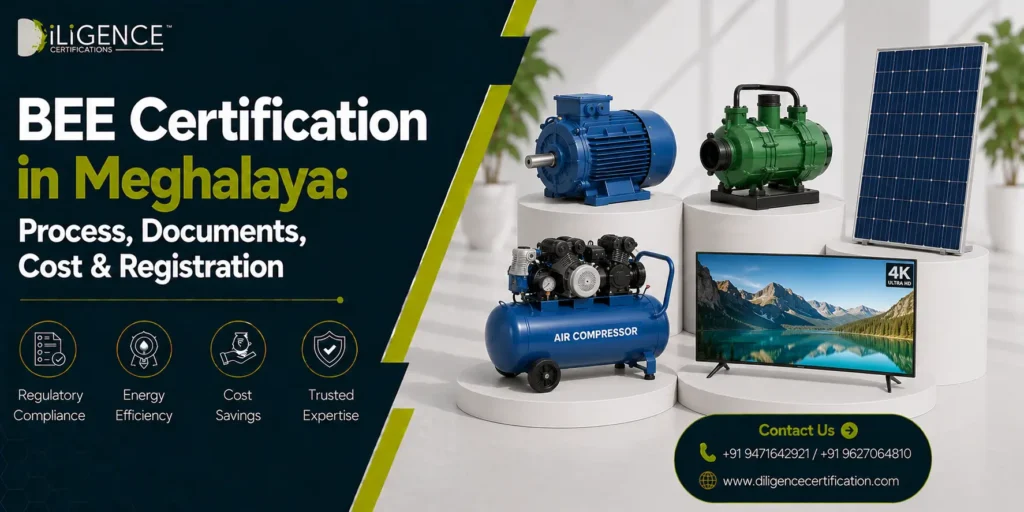
By - BEE Certification in Meghalaya is mandatory for certain eligible electrical devices and energy-consuming products prior to their sale, distribution, and import into India.
- It is mandatory for manufacturers, importers, and brand owners to conduct product testing, brand registration, model registration, and BEE labeling.
- Diligence Certifications provides assistance to companies operating in Meghalaya in the above processes.
Introduction
An appliance distributor from Shillong was on the verge of distributing LED bulbs, ceiling fans, and refrigerators to their dealerships in Meghalaya. The inventory had arrived at the warehouse, the packing had been completed, and some of the dealerships were asking for delivery.
Just before dispatch, one institutional buyer asked a direct question: “Are these models approved under BEE?”
The distributor had GST, invoices, product brochures, and warranty cards. But the BEE registration and star label approval were not completed. The order was paused immediately.
This sort of scenario is frequent for enterprises that offer energy-consuming products. While the majority of such businesses take interest in procurement, costing, packaging, and dealer commissions, the verification takes place only when required by the purchaser, market, or authority.
For regulated products, BEE Certification in Meghalaya cannot be considered just another branding option. It is an important process that contributes to the legality of market entry.
What is BEE Certification in Meghalaya?
BEE Certification in Meghalaya refers to the certification of suitable electrical appliances and energy consuming equipment as per the Bureau of EnergyEfficiency Standards and Labelling scheme.
The certificate verifies that the product has undergone testing as per energy efficiency standards and is eligible for display of the BEE star label. The star rating can also assist consumers in comparing the energy efficiency of products before buying them.
It becomes crucial for commercial purposes in Meghalaya when manufacturing, importing, distributing, or selling such products within India. Generally, BEE certification will be done on a model-by-model basis.
BEE Certification in Meghalaya covers the following groups of persons dealing with the relevant product categories.
Why BEE Certification in Meghalaya Matters for Businesses
BEE approval protects the business before the product reaches the market. A product may look good, perform well, and have competitive pricing, but if it falls under mandatory BEE requirements, it cannot be treated casually.
| Importance of BEE Certification | Business Benefit |
| Required for applicable products | Supports legal sale in India |
| Confirms energy-efficiency compliance | Reduces regulatory risk |
| Allows BEE star label use | Improves product credibility |
| Helps buyers compare energy use | Supports purchase decisions |
| Required by many dealers and platforms | Smoothens market acceptance |
| Supports institutional sales | Helps during vendor onboarding |
| Reduces rejection risk | Protects stock movement |
| Builds consumer trust | Strengthens brand reputation |
As a result, consumers of Meghalaya buying in Shillong, Tura, Jowai, Nongpoh, Baghmara, Williamnagar, among other surrounding places, have become more aware of certified goods. Additionally, vendors favor certified goods, as they minimize their risks through compliance documents.
Products Covered Under BEE Certification in Meghalaya
BEE Certification in Meghalaya applies to products covered under mandatory or voluntary BEE Standards and Labelling requirements.
Common product categories include:
- Room air conditioners
- Refrigerators
- Ceiling fans
- Table fans
- Wall-mounted fans
- LED lamps
- Electric water heaters
- Washing machines
- Colour televisions
- Distribution transformers
- Deep freezers
- Commercial beverage coolers
- Chillers
- Domestic LPG stoves
- Induction hobs
- Electric motors
- Agricultural pumps
- Solar photovoltaic products
- Air compressors
- Ultra-high-definition televisions
A business should not assume that BEE registration is needed only for household appliances. Several commercial and industrial products may also fall under BEE requirements.
Before manufacturing, importing, packaging, or selling any energy-consuming product, the exact product category should be checked.
Mandatory and Voluntary BEE Registration
BEE registration is generally divided into mandatory and voluntary registration. The difference matters because it affects whether approval is compulsory before sale.
Mandatory BEE Registration
Mandatory BEE registration applies to product categories where approval is compulsory before sale, import, distribution, or marketing in India.
For these products, businesses must complete testing, brand registration, model registration, documentation, and label approval before placing products in the market.
Selling a mandatory product without BEE approval can result in stock blockage, dealer rejection, marketplace issues, compliance risk, and loss of buyer trust.
Voluntary BEE Registration
This is the case for Voluntary BEE Registration if the application of star rating to such products is allowed, although not mandatory.
A number of firms prefer voluntary registration since it assists them in positioning their products as energy efficient. When dealing with competition, having an energy-efficiency star will act as a good selling point.
For instance, if two similar products are placed beside each other, the one with an energy-efficiency star will seem more credible.
Step-by-Step BEE Certification Process in Meghalaya
The BEE Certification in Meghalaya process involves technical review, product testing, documentation, online filing, and label approval. It should not be treated as only a form submission task.
Small mismatches in model number, brand name, test report, rating plate, or product photograph can delay approval.
Step 1: Product Category Check
The first step involves checking if the product is registered by way of mandatory or voluntary BEE registration.
This involves checking the product schedule, standard, star rating chart, label duration, testing requirement, and other technical requirements.
For instance, the requirement for registering an LED lamp will differ from that for registering an air conditioner, refrigerators, ceiling fan, commercial cooler, or electric motor.
A correct product category check prevents wrong filing, unnecessary testing, and repeated queries.
Step 2: Brand Registration
Branding must be done before model registration. It will involve company information, trademark, brand ownership, authorization letters, and other applicant information.
Where the brand owner is not the same as the manufacturer, then an appropriate authorization is necessary. The importer might also require documents from the overseas manufacturer.
The failure of the branding to be well-matched with respect to trademark, brand name, applicant name, or authorization can delay the application process in Meghalaya for BEE certification.
Step 3: Product Testing
The product model must be tested as per applicable energy-performance requirements.
The test report should match the application details exactly. Model number, capacity, rated input, brand name, technical specification, and product category must remain consistent.
If the packaging shows one model number and the test report shows another, the application may attract queries. In some cases, fresh testing or correction may be required.
Step 4: Model Registration
After testing, model registration is filed with BEE. This includes product details, test values, model number, star rating information, label period, and technical specifications.
BEE approval is generally issued model-wise. If a business has multiple variants, each model may need separate registration depending on the applicable product rules.
For businesses supplying appliances in Shillong, Tura, Jowai, Nongstoin, Nongpoh, and Cherrapunji, this stage becomes important when several models are sold under one brand.
Step 5: Document Review
BEE reviews the application, test report, brand documents, declarations, technical file, and label details.
If a query is raised, the applicant must submit a clear and technically correct response. A general explanation may not be enough if the query is related to model details, star rating values, or testing data.
Proper checking before submission reduces avoidable objections.
Step 6: Label Approval
After approval, the company receives permission to use the BEE star label on the approved model.
The label must show correct details such as model number, star rating, energy consumption, label period, and other required information.
Incorrect use of the BEE label can create compliance problems even after approval. The approved label should be used carefully on packaging, product bodies, marketing material, and dealer communication.
Documents Required for BEE Certification in Meghalaya
The document list depends on product type, applicant category, brand ownership, manufacturing location, and import status.
Common documents include:
- Company registration certificate
- GST certificate
- Factory licence or manufacturing proof
- Trademark certificate or trademark application
- Brand authorisation letter
- ISO certificate, if applicable
- Product technical specification sheet
- Product test report
- Sample label design
- Product photographs
- Rating plate details
- Model number details
- Authorisation letter
- Import Export Code, if applicable
- MSME certificate, if available
- Undertakings and declarations
- Foreign manufacturer authorisation, if applicable
- Import documents, if applicable
For importers, documentation requires closer attention. The manufacturer name, brand name, model number, invoice details, test report, and authorisation documents must be aligned.
A small mismatch may look harmless to the sales team, but it can become a compliance issue during review.
Common Challenges in BEE Certification in Meghalaya
Many businesses face delays because they assume BEE registration is only an online application. In reality, approval depends on technical accuracy and document consistency.
Common challenges include:
- Wrong product category selection
- Incorrect model number
- Mismatch between test report and application
- Incomplete trademark documents
- Missing brand authorisation
- Wrong label period selection
- Delay in product testing
- Poorly prepared technical file
- Incorrect star rating calculation
- Incomplete declaration formats
- Query response errors
- Difference between product photo and rating plate details
A practical example is a company submitting a test report for model “LED-12W-A” while the packaging shows “LED12WA”. The marketing team may treat both as the same model. The reviewing authority may treat them as different details.
That is why BEE Certification in Meghalaya should be handled with proper document review before filing.
BEE Certification Cost, Timeline and Validity in Meghalaya
The cost, timeline, and validity of BEE Certification in Meghalaya depend on product category, number of models, testing requirements, government fees, documentation status, and review process.
Diligence Certifications does not recommend giving a fixed cost without checking product details. A ceiling fan, LED lamp, refrigerator, air conditioner, washing machine, and commercial cooler may have different requirements.
| BEE Certification Cost | BEE Certification Timeline | BEE Certification Validity |
| Depends on product category | Depends on testing and review | As per applicable BEE rules |
| Influenced by government fees | Complete documents reduce delay | Validity depends on label period |
| Varies by number of models | Testing timeline affects filing | Renewal may be required |
| Importer cases may need extra documents | Queries can extend timeline | Continued compliance is required |
| Documentation support affects total cost | Incorrect filing causes delay | Updates must be monitored |
For an accurate estimate, businesses should share product category, model details, brand ownership status, manufacturing location, and import status.
BEE Certification in Meghalaya for Manufacturers
Manufacturers dealing with regulated energy-consuming products must complete BEE registration before supplying products to the market.
This is relevant for businesses manufacturing in Meghalaya or supplying products to dealers in Shillong, Tura, Jowai, Nongpoh, Nongstoin, Williamnagar, and nearby areas.
Manufacturers should align product design, model number, rating plate, packaging, technical sheet, and test sample from the beginning. Any change after testing can affect the application.
They should also maintain proper records for renewal, surveillance, production details, and future compliance checks.
BEE Certification in Meghalaya for Importers
Importers must check BEE applicability before importing electrical appliances or energy-consuming products into India.
If the product falls under mandatory BEE registration, the importer needs proper authorisation, product specifications, test reports, model details, import documents, and manufacturer information.
For importers supplying products in Meghalaya, planning should be done before stock movement. Otherwise, the business may face delayed dispatch, blocked inventory, or dealer rejection.
A good compliance approach is simple: check BEE applicability before placing the import order, not after the goods arrive.
Why Choose Diligence Certifications?
Diligence Certifications supports manufacturers, importers, traders, and brand owners with BEE Certification in Meghalaya and across India.
Our team assists with:
- Product category identification
- BEE applicability check
- Brand registration support
- Documentation preparation
- Testing coordination
- Model registration filing
- Query response support
- Label approval assistance
- Renewal and compliance guidance
The main benefit of professional support is error control. Most BEE registration delays do not happen because the product is poor. They happen because documents, test reports, label details, or technical specifications are not aligned.
For a business, this delay can affect dispatch, dealer onboarding, import planning, and sales commitments. A properly reviewed application reduces such risk.
Conclusion
BEE certification in Meghalaya is essential for organizations that deal in appliances, electricals, and energy-consuming machines.
Businesses, manufacturers, importers, brand owners, dealers, and distributors located in Shillong, Tura, Jowai, Nongpoh, Nongstoin, Cherrapunji, Williamnagar, and surrounding areas must determine BEE compliance before introducing, importing, labeling, or marketing their products.
An effective product might not succeed in the market because of its lack of BEE certification even if it is technologically advanced. BEE Certification in Meghalaya assists enterprises in meeting energy consumption standards, applying for the BEE rating label, and gaining confidence of their distributors and customers.
Diligence Certifications can assist with applicability checks, document preparation, testing coordination, model registration, query handling, and label approval support for BEE Certification in Meghalaya.
Frequently Asked Questions
What is BEE Certification in Meghalaya?
BEE Certification in Meghalaya is the certification procedure for eligible energy-consuming products as per Bureau of Energy Efficiency Standards and Labelling Programme.
Is BEE Certification mandatory in Meghalaya?
Yes, BEE Certification is mandatory for those products which come under the mandatory BEE Standards and Labelling Programme.
Who requires BEE Certification in Meghalaya?
Manufacturers, importers, brand owners, traders, distributors, and sellers handling eligible appliance or energy-consuming products in Meghalaya might require BEE Certification.
What products require BEE Certification?
Some examples of those products which require BEE Certification include air conditioning, refrigeration, ceiling fan, LED lamp, washing machine, television set, electric motor, pump, chiller, and commercial cooler.
How to apply for BEE Certification in Meghalaya?
There are several steps involved in applying for BEE Certification in Meghalaya which include product category verification, brand registration, product testing, model registration, document verification, and label approval.
Which documents will be needed to apply for BEE Certification?
Some common documents include Company Registration, GST Certificate, Trademark Documents, Test Report, Product Photographs, Technical Specifications, Rating Plate, and Authorization Letter.
Is it possible for importers to apply for BEE Certification in Meghalaya?
Yes, importers can apply for BEE Certification in Meghalaya, but only when they possess the necessary authorization from manufacturers, along with other documents.
How much time does it take to obtain BEE Certification in Meghalaya?
It largely depends upon the testing process, documents and responses to queries. In case of incorrect documents, the certification process takes more time.
What is the price of BEE Certification in Meghalaya?
It differs depending upon product category, number of models, testing charges, government fee, documentation process, and professional help.
Why should businesses in Meghalaya obtain BEE Certification?
For selling regulated products, using BEE Star Label, and building buyer confidence.